
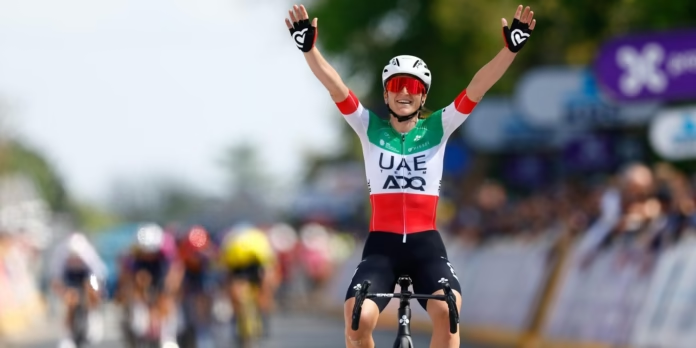
Brabantse Pijl Women 2026 takes place on the 17th April, starting in Lennik and finishing in Overijse. It remains a 1.Pro race rather than part of the Women’s WorldTour, but it still sits in one of the most important places on the spring calendar, bridging the cobbled Classics and the Ardennes-style races that follow.
That position is what makes the race so interesting. Brabantse Pijl Women is not really a pure cobbled Classic and it is not yet a full Ardennes Monument either. Instead, it works as a transition race, one that rewards riders who can climb punchy hills repeatedly, handle an aggressive one-day race, and still finish strongly from a small group or after a late attack.
If you are new to the race, the easiest way to think about it is this: Brabantse Pijl Women is often where the spring starts to tilt away from raw cobbled power and towards punchier climbing legs. The riders who thrive here are usually the ones who can accelerate hard on short climbs, recover quickly, and repeat the effort over and over again.
For the wider spring context, ProCyclingUK’s A complete history of Paris-Roubaix Femmes helps explain the shift away from the cobbled Monuments, while the Beginner’s guide to Amstel Gold Race Women 2026 shows where the calendar heads next.
What is Brabantse Pijl Women?
Brabantse Pijl Women is the women’s edition of Brabantse Pijl, a Belgian one-day race held on the same day as the men’s event. The women’s race is part of the UCI Women’s ProSeries and has grown into one of the key one-day races of April, especially because of where it sits between Paris-Roubaix Femmes and Amstel Gold Race.
That timing matters. Riders coming out of the cobbled block often use this race to see how well their legs translate onto steeper, repeated climbs, while more Ardennes-oriented riders see it as an ideal opening test before the bigger climbing Classics. As a result, the startlist often brings together a broader range of rider types than many other spring races.
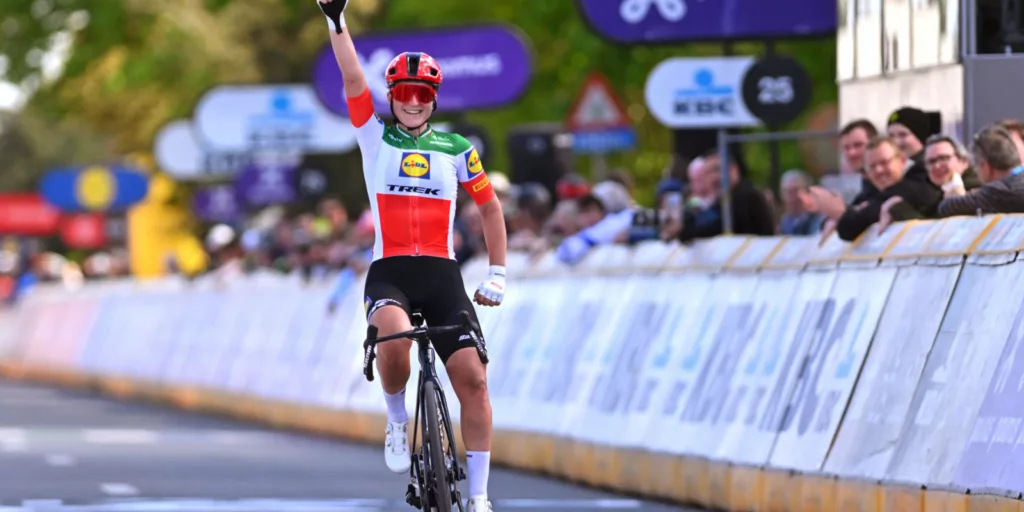 Photo Credit: Getty
Where does Brabantse Pijl Women 2026 take place?
The 2026 race starts in Lennik and finishes in Overijse, continuing the recent format that uses the Brabant hills rather than the cobbled roads more closely associated with Flanders.
Overijse is especially important because it gives the race its identity. The finishing area is closely tied to the repeated local circuit and to the short, sharp climbs that make the finale so selective. That means the race tends to build in intensity rather than simply waiting for one giant climb at the end.
What kind of route does it have?
Brabantse Pijl Women is usually around the mid-120km range, and the 2026 event should again follow the familiar pattern of an opening section followed by laps of a finishing circuit around Overijse.
That route style is a big part of why the race is so watchable. Instead of one long, flat lead-in to a single decisive climb, riders are repeatedly sent over short, punchy ascents that gradually wear the field down. It is a race of accumulation. One attack may not decide it, but five or six hard efforts in the space of 30km often do.
In recent editions, climbs such as Moskesstraat, Holstheide and the finishing S-Bocht have been central to how the race unfolds. Those are not Alpine-style climbs. They are steep enough to hurt, short enough to encourage aggressive racing, and frequent enough that riders never get much chance to settle.
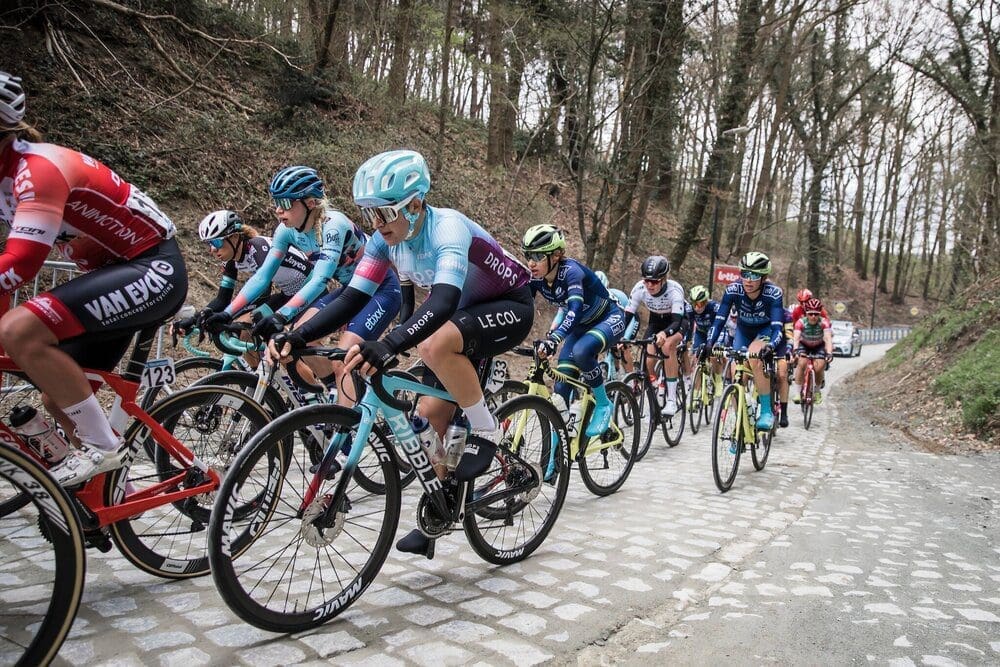 Photo Credit: Rhodephoto
Why is Brabantse Pijl Women different from the Tour of Flanders or Amstel Gold Race?
This is probably the easiest question for new fans to ask, because the race can look, at first glance, like it belongs to both worlds.
Compared with the Tour of Flanders, Brabantse Pijl Women is less about cobbles and less about one huge prestige test spread over a longer race. It is shorter, sharper and more repetitive. Compared with Amstel Gold Race, it is a little more direct and often more explosive, because the climbs come in a tighter, more intense pattern.
That is why it often suits riders who are punchy rather than purely climby, and why it can reward both attackers and fast finishers from a reduced group. It is not unusual to see a race here where the strongest rider attacks, gets caught, and the winner still comes from a group of five or six after another acceleration.
What usually decides the race?
Repeated climbing and timing.
That sounds simple, but it is the heart of Brabantse Pijl Women. The race is rarely won through one overwhelming show of force from a long way out. More often, it is shaped by who can keep responding to moves on the climbs and who still has enough left to make the right acceleration late on.
The circuit format helps create that kind of finale. Because the same roads and climbs come around again, teams know where they need to be, which means positioning becomes intense and mistakes get punished quickly. A rider who is slightly too far back before a climb can lose five or ten places immediately, and in a race this selective that can be enough to end their chances.
The finish itself also matters. Recent editions have often been decided by one sharp, well-timed move on the final climb or in the final kilometres after a day of repeated selection. That is classic Brabantse Pijl Women. Not a huge solo from 40km out, but one decisive acceleration after the race has already stripped away most of the field.
 Photo Credit: Cor Vos
What kind of riders tend to do well here?
This is usually a race for puncheurs, Classics specialists, and versatile riders who can handle repeated sharp climbs.
That includes riders who are strong enough for the cobbled races but not limited to them, and riders who are building towards the Ardennes races but want something a touch less mountainous. The ideal Brabantse Pijl Women rider is explosive, tactically sharp and comfortable in an aggressive one-day race where the winning move may come quite late.
The recent results underline that. Riders such as Elisa Longo Borghini and Marianne Vos have shown exactly the sort of qualities this race rewards – punch, timing, resilience and the ability to make the right move late rather than simply attack earliest.
Why should new fans pay attention to this race?
Because it is one of the best races on the calendar for learning how different rider types interact in spring.
Brabantse Pijl Women often puts cobbled Classics riders, puncheurs and early Ardennes contenders into the same race at the same time. That creates a more open tactical picture than some of the bigger races, where the likely script can feel clearer in advance. Here, the result can come from a solo attack, a two-rider move, or a sprint from a small elite group.
It is also an excellent race for understanding just how important repeated short climbs are in women’s cycling. A newcomer might assume that only long climbs create selection, but Brabantse Pijl Women shows how brutal a race can become when riders are constantly forced into short, high-intensity efforts.
Where does Brabantse Pijl Women sit in the season?
The 2026 race falls on the 17th April, two days before the Amstel Gold Race. That makes it one of the last major stepping stones before the Ardennes block properly begins.
That timing gives the race a dual purpose. It is a target in its own right, but it is also a form signal. Riders who go well here often carry that momentum into Amstel, Flèche Wallonne and Liège-Bastogne-Liège, because the physical demands begin to overlap more and more from this point in the spring.
You can see that wider shift in the calendar by pairing this race with the Amstel Gold Race Women 2026 route guide and the Beginner’s guide to Flèche Wallonne Féminine 2026.
Final verdict
Brabantse Pijl Women 2026 is one of the most useful and enjoyable races of the spring for new fans to understand. It is short enough to stay intense, hard enough to create real selection, and open enough tactically that several different rider types can still imagine winning.
More than anything, it is the race where spring starts to change shape. The cobbles are no longer the whole story, but the high mountains have not fully taken over either. What you get instead is a smart, aggressive, punchy one-day race that often tells you a great deal about who is really ready for the next phase of the season.

