The men’s Milano-Sanremo 2026 is one of the easiest races in cycling to explain and one of the hardest to predict.
That is the secret of the race, and also the reason it can be so addictive. The route looks almost too simple for a Monument. A very long day from Pavia to Sanremo, a manageable middle section, then the familiar run toward the Capi, the Cipressa and the Poggio before the finish on Via Roma. But that simplicity is deceptive. Milano-Sanremo is built on patience, suspense and the idea that nearly 300 kilometres of waiting can still be decided in the final few minutes.
For new fans, that makes it one of the best races in the sport to learn from. You do not need to understand a maze of climbs or a week of tactics. You only need to understand one central question: can anyone break the race before the fastest survivors get to Sanremo?
If you want the women’s version too, ProCyclingUK’s Milan-Sanremo Women 2026 route guide shows why the same closing sequence works so well in a shorter format.
What is Milano-Sanremo?
Milano-Sanremo is the longest one-day race in the men’s WorldTour and one of cycling’s five Monuments.
That status matters because it shapes the whole way the race is ridden. Riders are not just chasing another spring win. They are racing for one of the sport’s most prestigious one-day titles, and one with a very particular identity. Milano-Sanremo is not usually won by the rider who can simply overpower the route from distance. It is won by the rider who knows exactly when to stop waiting.
That makes it different from almost every other major Classic. The route is iconic, but the prestige comes just as much from the uncertainty. This is one of the few races where a durable sprinter, an explosive attacker and a perfectly timed opportunist can all still believe deep into the finale.
When is Milano-Sanremo 2026?
The 2026 edition takes place on Saturday 21 March.
That places it at a fascinating point in the season. Riders already have racing in their legs, but the spring is still young enough that not every hierarchy feels fully settled. Milano-Sanremo has a habit of exposing that quickly. If a team hesitates on the Cipressa or Poggio, the race can slip away. If they force too much too early, they can end up setting it up for somebody else.
It is one of the first weekends of the year when the very biggest names feel as though they are finally racing toward something that really defines a season.
 Photo Credit: LaPresse
What does the 2026 route look like?
Milano-Sanremo 2026 starts in Pavia and finishes in Sanremo after 298 km.
The finale remains exactly what it should be. The three Capi come first, then the Cipressa, then the Poggio, then the descent and run to Via Roma. That closing sequence is the soul of the race and the reason Milano-Sanremo keeps producing such different winners.
The main route change from older editions comes at the start, with the race again beginning in Pavia rather than Milan itself. In practical terms, that does not really change how the race should be understood. Sanremo still works in the same basic way. The early distance is there to stretch the riders, soften them gradually and ensure the Cipressa and Poggio arrive with nearly 300 km already in the legs.
That is the key point. The race is not difficult because the climbs are monstrous. It is difficult because those final climbs arrive after a day long enough to empty everyone a little.
Why is the race so hard if the climbs are not that steep?
Because Milano-Sanremo is selective through timing rather than brute force alone.
The Cipressa and Poggio are not Alpine climbs. On paper, neither looks severe enough to destroy a field on its own. But they come after a huge day in the saddle, and that changes everything. Riders do not hit those climbs fresh. They hit them after hours of protecting position, following the race and trying not to spend too much before the real argument begins.
That is why Sanremo can feel deceptive. It asks the riders to conserve for so long that, when the decisive phase finally arrives, it does so at maximum tension. The race does not need savage gradients to create drama. It only needs a field that has been stretched to the point where one sharp acceleration can suddenly matter.
What are the key climbs?
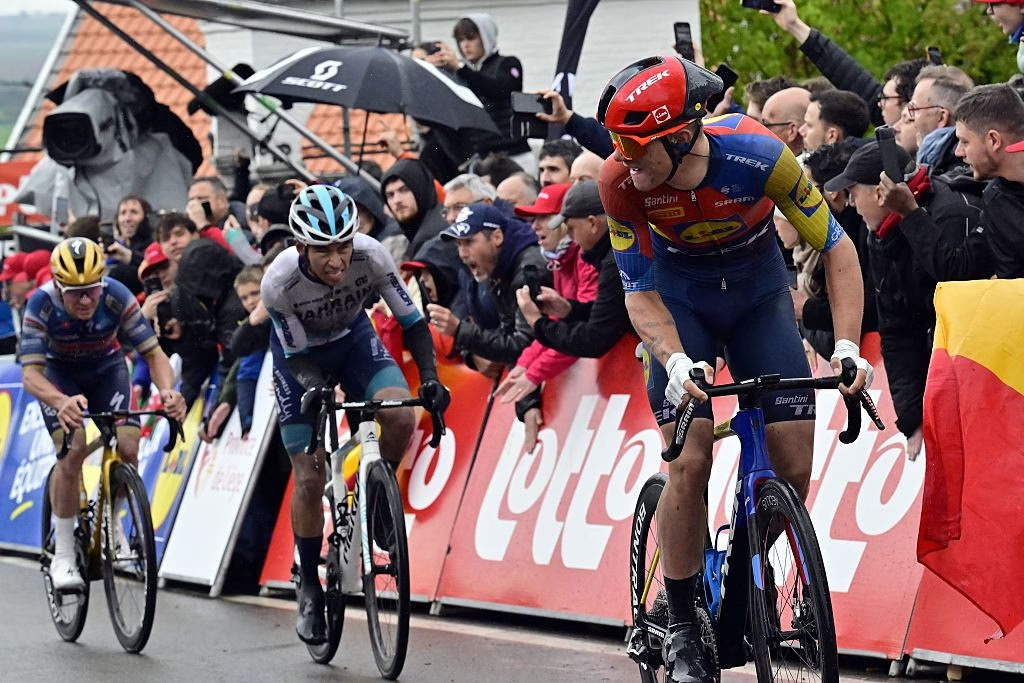
The three Capi – Capo Mele, Capo Cervo and Capo Berta – begin the tightening of the race, but the two great landmarks are the Cipressa and the Poggio.
The Capi matter because they shift the mood of the day. The race stops feeling like a long approach and starts feeling like a finale in formation. The bunch stretches, positioning becomes more urgent and the road begins to reward teams that still have numbers.
Then comes the Cipressa, which is often the first real chance to break the race open. It is long enough and late enough for strong teams to make the race genuinely selective if they choose to commit. In modern Sanremo, the Cipressa matters more than it once did because it is now seen less as a prelude and more as a launch point.
The Poggio is where the race turns from tension into decision. It is not long enough to guarantee a clean selection and not steep enough to hand the race automatically to pure climbers. That is exactly what makes it so good. The strongest attacker sees it as the final launch point. The fastest finisher sees it as the final obstacle. The clever rider sees it as the moment when hesitation can be worth as much as power.
What kind of rider usually wins Milano-Sanremo?
That is the beauty of the race. There is no single perfect answer.
A pure climber usually finds the finale too shallow and the run-in too fast. A pure sprinter may find the pace on the Poggio too violent if the race has been shaped aggressively enough before it. So the ideal winner is often a fast all-rounder, someone with enough climbing punch to survive the final climbs and enough speed, handling or tactical instinct to finish the job afterwards.
That is why Sanremo often feels more open than the other Monuments. It can suit a superstar who attacks on the Poggio, a durable sprinter who survives everything, or a rider who simply judges the final five minutes better than anyone else.
 Photo Credit: LaPresse
Why doesn’t the race usually explode earlier?
Because almost everybody knows where the race is most likely to be won.
That is one of the most distinctive things about Milano-Sanremo. The early break can go clear and build a gap, but the peloton almost always keeps enough faith in the script that the biggest teams wait until the final sequence to fully impose themselves. The result is a race that can look calm for a very long time even while the real tension is already building underneath.
For newer fans, that can feel unusual at first. Sanremo is not meant to be watched in the same way as Roubaix or Flanders. It is not a race of constant visible damage. It is a race of delayed consequence. The trick is to understand that the key drama often arrives in a very compressed burst after hours of control.
What should new fans watch for?
The easiest way to watch Milano-Sanremo is in layers.
Treat the long opening section as a waiting game with consequences. Teams are trying to spend as little as possible while still keeping their leaders safe and well placed.
Then start watching more closely once the race reaches the Capi. That is where the shape of the bunch changes. The calm begins to narrow, and positioning starts to matter much more clearly.
The Cipressa is where you should really start following the favourites. If a team wants to make the race selective, this is often the first place it can do so properly.
The Poggio is where the race asks its final question. If the favourites wait too long, the chance can be gone. If they go too early, they may drag exactly the wrong riders with them.
And then remember one more thing: the race is not always won at the top of the Poggio. The descent and run to Via Roma are still part of the answer.
 Photo Credit: LaPresse
How is Milano-Sanremo different from the other Monuments?
It is the Monument of suspense.
Paris-Roubaix tends to destroy the field through repeated physical punishment. The Tour of Flanders keeps asking the same steep, cobbled question until only the best can still answer. Liège-Bastogne-Liège is more about attrition and endurance. Milano-Sanremo works differently. It invites almost everyone to believe for most of the day, then forces the decisive move into a very narrow window.
That is why it can feel both frustrating and brilliant depending on the kind of racing you prefer. If you want action from distance, Sanremo can test your patience. If you like timing, tension and the possibility of several different endings, it is one of the best races in cycling.
Why is Milano-Sanremo 2026 a good race for beginners?
Because the route is easy to understand, even if the outcome is not.
You do not need to memorise a complicated profile. You only need to understand the Cipressa, the Poggio and why nearly 300 km of waiting changes how those two climbs feel. Once you understand that, the whole race becomes easier to read.
It also helps that the finish is so iconic. Via Roma gives the race a sense of arrival that even first-time viewers can feel immediately. Whether it ends in a solo move, a tiny group or a sprint, it almost always feels important.
So what should you expect from Milano-Sanremo 2026?
Expect a race that feels calm until it suddenly is not.
Expect the first half to matter less in obvious sporting terms than in energy management and team control.
Expect the Cipressa to begin the real argument and the Poggio to force the final answer.
And expect a race where several different kinds of riders can still imagine winning much deeper into the day than in almost any other Monument. That is what makes Milano-Sanremo 2026 so compelling. It is not just a long race. It is a long race built around one of cycling’s most beautifully unresolved finales.