The Cateye AMPP900 and AMPP2200 are both serious rechargeable front lights, but they solve different winter-riding problems. The AMPP900 gives commuters and road riders a compact 900-lumen beam without a premium price. The AMPP2200 is a larger, more powerful light intended for riders who regularly leave street lighting behind. On 30 October 2026, Tredz listed the AMPP900 at £48.99 and the AMPP2200 at £139.99, both in stock. That £91 difference is substantial enough to make the decision about the roads you actually ride, rather than the largest number on the packaging.
For mixed urban and suburban riding, the AMPP900 is the better-value choice. It has enough output for short stretches of darker road and a useful range of lower modes. The AMPP2200 earns its place when you want a broader reserve of light for fast descents, poorly surfaced lanes or gravel after dark. Neither has been tested side by side by ProCyclingUK. This comparison uses Cateye’s specifications, live UK retail listings and independent riding reviews, with manufacturer battery claims kept separate from real-world findings.
Cateye AMPP900 vs AMPP2200 specifications
| Specification | Cateye AMPP900 | Cateye AMPP2200 |
|---|---|---|
| UK price checked 30 October | £48.99 at Tredz | £139.99 at Tredz |
| Maximum stated output | 900 lumens | 2,200 lumens in Ultra Boost |
| High-output runtime | 900 lumens for 2 hours | 2,200 lumens for 1 hour; 1,500 lumens for 1.5 hours |
| Middle setting | 400 lumens for 3 hours | 800 lumens for 2.5 hours |
| Lower steady settings | 200 lumens for 5 hours | 400 lumens for 5 hours; 200 lumens for 12 hours |
| Battery capacity | 3,000mAh | 5,000mAh |
| Manufacturer-listed weight | 142g | 213.5g |
| Charging | USB-C; roughly 4 to 8 hours depending on supply | USB-C; roughly 4 hours with a 2A supply |
| Water-resistance rating | IPX4 | IPX4 |
| Mount | Cateye FlexTight | Cateye FlexTight |
| Extra controls | Mode memory; double-click for High | Mode memory; double-click for Ultra Boost; lock mode |
The table uses manufacturer figures, which are measured under specified conditions. It would be misleading to compare the AMPP900’s two hours at 900 lumens with the AMPP2200’s one hour at 2,200 lumens and declare a simple winner. Those settings deliver very different amounts of light. The more useful comparison is what each can sustain at a level appropriate to the road, and whether the beam puts that light where a cyclist needs it.
What 900 and 2,200 lumens mean on the road
A lumen figure measures total light output, not the distance at which a pothole becomes visible. Lens design, beam shape, angle and mounting height all influence the result. A tightly focused 900-lumen beam can sometimes reveal distant details more clearly than a higher-output light that spreads its output widely. Both Cateye models use OptiCube lens technology, but the AMPP2200’s larger body and higher settings give it more scope to illuminate the road ahead and the edges of a lane.
Cyclingnews tested the AMPP900 over commuting and road rides and found it a strong all-rounder, particularly for the money. The reviewer considered it capable on darker roads but not a light intended to run at full power through an entire night. Road.cc’s independent AMPP2200 review praised its broad usable beam, secure mount and simple controls, while also noting that its top setting is short-lived. Those are different tests in different conditions, not a controlled beam comparison, but they help explain the practical strengths of each model.
On a streetlit commute, a light should make you conspicuous without unnecessarily dazzling other road users. Maximum power is rarely needed for that job. On an unlit lane at speed, particularly with bends, potholes and debris, additional usable light becomes more valuable. The AMPP2200 is easier to justify for that second scenario, but the fact that it can briefly reach 2,200 lumens does not mean you should leave it there throughout every ride.
Battery life matters more than peak output
The AMPP900 is rated for two hours at 900 lumens, three hours at 400 lumens and five hours at 200 lumens. Those figures make it practical for a winter club ride that starts in daylight and finishes in the dark, provided the rider manages the settings. The AMPP2200 can sustain 800 lumens for a claimed two and a half hours, 400 lumens for five hours and 200 lumens for twelve hours. Its much larger battery is therefore useful even when its Ultra Boost mode is ignored.
At maximum power the comparison looks less favourable for the bigger light: one hour at 2,200 lumens against two hours at 900. That is the cost of drawing much more power. The AMPP2200’s 1,500-lumen High mode is rated for one and a half hours, so riders who need a consistently very bright beam should plan around that rather than assuming the full output lasts all evening. For long rides, changing modes as conditions change is more sensible than treating any maximum setting as a default.
Real-world runtime can fall below a published figure in cold weather or as the battery ages. Cyclingnews found the AMPP900’s claimed high-power duration broadly plausible in its test, but criticised how late the low-battery warning appeared. That matters on an unlit road, where a sudden reduction in light is more than an inconvenience. The AMPP2200 has a larger reserve and a three-colour battery indicator, but it still needs charging discipline and a backup light for longer winter journeys.
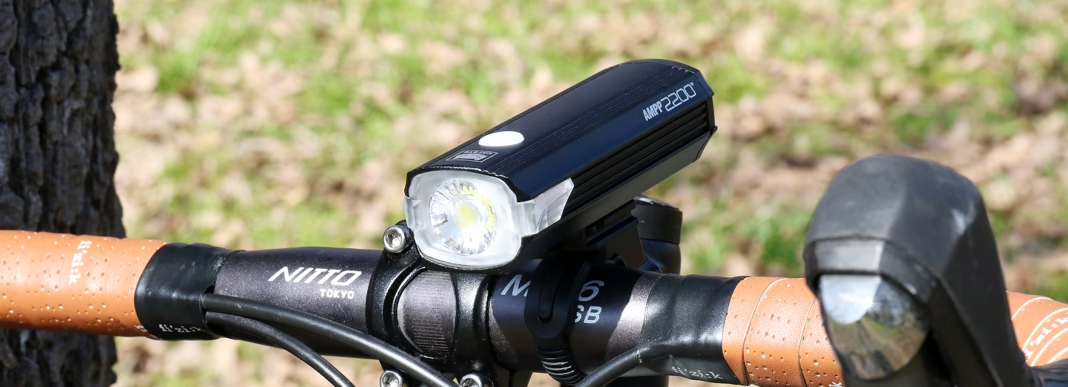 Photo Credit: Cateye
Mounting, controls and riding with gloves
Both lights use Cateye’s familiar FlexTight bracket. It is a practical advantage because the mount is tool-free, adjustable and well suited to moving a light between bicycles. The AMPP900 is smaller and lighter, which can make it less intrusive on crowded handlebars. The AMPP2200 is roughly 72g heavier according to Cateye’s own figures, and its longer body needs more clearance around a computer mount, bell or handlebar bag.
The control philosophy is deliberately straightforward. Both have a mode-memory function and a double-click shortcut to their brightest setting. The AMPP900 has five modes, including a daytime visibility pattern; the AMPP2200 has seven, adding the very high Ultra Boost setting and a long-running Enduro mode. The larger model also has a lock function to help prevent accidental activation in a bag, which is useful when travelling with the light between rides.
The AMPP900’s raised button was easy to locate while wearing thick gloves in Cyclingnews testing, although its battery warning drew criticism. Road.cc found the AMPP2200’s single-button interface easy to understand and its bracket secure. The bigger light’s simplicity is particularly welcome on dark roads, where a rider should not have to look down repeatedly to find a setting. There is no app, custom beam programming or complicated pairing sequence to manage on either model.
Weather resistance and charging
Both are rated IPX4, meaning they are designed to resist splashing water rather than immersion. That is appropriate for normal rain and road spray, but it is not a licence to leave either light submerged, pressure-wash its charging port or ignore damaged seals. A winter rider should dry the charging area before plugging in a cable and check the rubber cover after every recharge. Neither product is being presented here as fully waterproof.
USB-C is standard on both lights, and Cateye does not include a charging cable in the specification. The AMPP900 has a 3,000mAh battery and takes roughly four hours to charge from a 1A supply, or longer with a weaker source. The AMPP2200 has 5,000mAh capacity and a stated four-hour recharge with a 2A supply. These figures are not directly comparable unless the charging equipment is equivalent. Road.cc also noted that the AMPP2200 cannot be used while charging, so do not plan to extend a night ride by connecting a power bank mid-ride.
The UK price difference changes the decision
At the checked Tredz prices, the AMPP2200 costs £91 more than the AMPP900. That is nearly three times the initial outlay, but it is not simply a case of paying for two and a half times the lumens. You are buying a larger battery, more sustained output options, a bigger light body and a lock mode. For a rider regularly descending fast, unlit roads in winter, those are tangible benefits. For someone whose commute is mostly under street lighting, they may never be used.
The AMPP900 listing at £48.99 was in stock when checked, as was the AMPP2200 at £139.99. Both are conventional retailer links, not affiliate-tracked destinations. Prices can change without notice, particularly as winter promotions and Christmas buying begin. Compare the actual model and its included bracket rather than assuming every bundle with a similar Cateye name contains the same light.
 Photo Credit: Cateye
Which Cateye front light should you buy?
Choose the Cateye AMPP900 if your riding is mostly commuting, winter club runs and occasional unlit stretches. At under £50 it offers a credible combination of brightness, weight, controls and charging convenience. Its limitations are the short full-power runtime and the late low-battery warning identified in independent testing. Carry a backup for extended night riding, and use the 400-lumen setting where the road allows rather than draining the battery at 900 lumens unnecessarily.
Buy the Cateye AMPP2200 if you regularly ride dark country lanes or gravel routes and want a larger reserve of light with flexible lower-output modes. Its 800-lumen setting and five-hour 400-lumen option are arguably more useful than the one-hour Ultra Boost headline. For a broader look at front and rear options, the UK commuting and dark-lanes lights guide covers the different demands of seeing the road and being seen by traffic.
-
 Photo Credit: Alpecin-Premier Tech (official team announcement)
-
Photo Credit: RCS