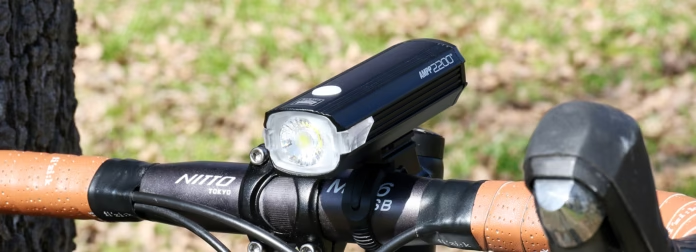
The Cateye AMPP2200 sits at the powerful end of the Japanese brand’s rechargeable front-light range. Its headline figure is 2,200 lumens, but that number only tells part of the story. The more useful qualities are the broad spread of outputs, a straightforward one-button interface, a dependable FlexTight bracket and a 200-lumen Enduro mode that stretches claimed runtime to 12 hours.
That makes the AMPP2200 an interesting option for riders who regularly move between lit roads and genuinely dark lanes. It has enough reserve output for fast riding where seeing the road matters, without forcing you to run the battery at maximum power throughout the ride. The trade-off is that Ultra Boost lasts only an hour, while its IPX4 weather rating and inability to operate while charging leave room for rivals to offer more flexibility.
This article contains affiliate links. We may earn a commission from qualifying purchases at no extra cost to you.
At the time of writing, Tredz has the Cateye AMPP2200 available in the UK. The reduced price makes considerably more sense than the original £179.99 RRP and puts the light into a much more competitive part of the market.
Cateye AMPP2200 specifications
| Maximum output | 2,200 lumens |
| Battery | 3.6V 5,000mAh rechargeable lithium-ion |
| Ultra Boost | 2,200 lumens, 1 hour |
| High | 800 lumens, 2.5 hours |
| Low | 400 lumens, 5 hours |
| Enduro | 200 lumens, 12 hours |
| Daytime HyperConstant | 1,500/400 lumens, 4 hours |
| Flashing | 200 lumens, 60 hours |
| Charging | USB-C, approximately 4 hours |
| Water resistance | IPX4 |
| Dimensions | 43 x 39 x 117mm |
| Weight | 213.5g including battery |
| Mount | Cateye FlexTight bracket |
A powerful light without unnecessary complexity
The AMPP2200 is deliberately conventional in operation. There is no app to configure, no wireless remote supplied and no complicated menu structure. A raised illuminated button handles the controls, while a double press gives direct access to the 2,200-lumen Ultra Boost setting. Mode memory also means the light can return to the setting you were previously using.
That simplicity is one of the recurring positives in independent testing. It matters on a winter ride because a light should not demand much attention when you are wearing gloves, watching traffic and trying to read the road surface. Cateye also retains its familiar FlexTight bracket, a design with a long track record and considerably more adjustability than many fixed rubber-strap mounts.
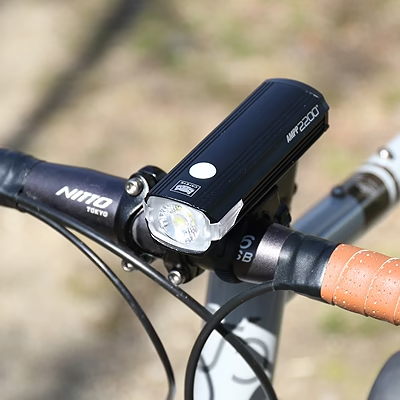
The aluminium housing also gives the AMPP2200 a more substantial construction than lightweight commuter lights. At 213.5g it is not especially light, but this is a high-output unit with a 5,000mAh battery rather than a small lamp intended primarily to make the rider visible.
How useful are 2,200 lumens?
Maximum lumen figures can distort bike-light comparisons. For most road riding, 2,200 lumens is not something you need continuously. Cateye effectively acknowledges that by treating maximum output as an Ultra Boost mode rather than the normal high setting. The standard High mode is 800 lumens and lasts a claimed 2.5 hours, while 400 lumens extends that to five hours.
Ultra Boost is better viewed as temporary extra reach for very dark descents, poorly lit lanes or short off-road sections. Independent testing found the beam broad enough to illuminate more than a narrow central patch, which is important because usable beam shape matters at least as much as the headline output. Side windows also provide some lateral visibility at junctions.
If you are deciding how much output you actually need, our guide to how bright bike lights should be for UK roads is a useful companion. Riders who spend almost all their time under street lighting can buy something smaller and cheaper. The AMPP2200 makes more sense when unlit roads form a regular part of the route.
Battery life is more nuanced than the headline suggests
The one-hour runtime at 2,200 lumens looks limiting until the rest of the modes are considered. An hour of maximum power is unlikely to suit a long winter ride if you insist on leaving Ultra Boost engaged, but doing so would also waste much of what the light offers. The 800-lumen mode is far more practical for sustained dark-road use, and 400 lumens can cover a substantial evening ride.
Enduro mode is arguably the most useful addition. Its 200-lumen output is modest, but the claimed 12-hour runtime gives the AMPP2200 a genuine low-power option for long rides, commuting sections and occasions when preserving battery capacity matters more than illuminating a completely dark road at speed.
USB-C charging is welcome, although the light cannot be used while it is charging. That reduces its appeal for riders who rely on an external power bank during very long events. A replaceable battery or pass-through charging system would give an endurance-focused light more flexibility.
Where the AMPP2200 falls short
The clearest specification weakness is the IPX4 rating. It means the light is designed to tolerate splashing water, but competing high-output lights can offer stronger water-resistance ratings. For normal wet-road use that does not automatically make the Cateye unsuitable, although riders deliberately buying for repeated severe-weather exposure may reasonably expect more at this price.
There is also no remote control and no smart connectivity. Whether that matters depends on what you want from a front light. The AMPP2200’s strength is that it avoids turning a simple accessory into another device to configure, but riders who value remote mode changes or programmable outputs can find those features elsewhere.
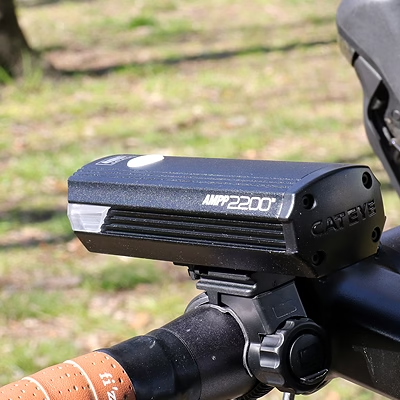
Finally, 213.5g is noticeable if your priority is a minimal cockpit. That weight is understandable given the battery capacity and aluminium construction, but a rider needing a daytime visibility light or a backup for occasional darkness should look at a much smaller unit instead.
AMPP2200 alternatives
The high-output light market is crowded. Ravemen and Magicshine both offer models with different beam patterns, remote controls and stronger weather protection, while Exposure occupies a more expensive part of the market with UK-made lights aimed at riders prepared to pay substantially more for their lighting system.
Within Cateye’s own range, the AMPP1700 is the obvious step down, although the AMPP2200’s Enduro mode gives the more powerful model an extra dimension beyond the additional maximum output. At the other end of the scale, riders primarily wanting a commuting light should compare the options in our guide to the best bike lights for UK commuting and dark lanes.
There is also a different design philosophy in products such as the Bookman bike-light range, where compactness and urban visibility matter more than producing enough light for fast riding on completely unlit roads.
Who should buy the Cateye AMPP2200?
The strongest case is for road and gravel riders who frequently train after dark and want one light that can cover urban roads, country lanes and occasional darker off-road sections. Its range of outputs is broad enough to manage battery use sensibly, and the direct Ultra Boost access means maximum output is available when it is genuinely useful.
It is less compelling for pure commuters who rarely leave street-lit roads, where much of the output and battery capacity is unnecessary. Audax and ultra-distance riders should also consider whether the lack of pass-through charging is a deal-breaker, while riders expecting prolonged exposure to very poor weather may prefer a light with a higher ingress-protection rating.
For riders who fit the first group, the current discount materially changes the value equation. You can check the current Cateye AMPP2200 price and availability at Tredz. At £139.99 rather than £179.99, it competes much more convincingly with similarly powerful alternatives.
Verdict
The Cateye AMPP2200 is strongest when judged as a versatile high-output road light rather than as a device intended to deliver 2,200 lumens all evening. Its useful 400- and 800-lumen settings, 12-hour Enduro mode, simple controls and secure FlexTight mounting system give it a practical range that the headline figure alone does not convey.
There are compromises. IPX4 protection is unexceptional, maximum output drains the battery quickly and the inability to run from an external power source limits its endurance credentials. Riders who want remote controls or configurable electronics will also find more sophisticated alternatives.
For regular night riding on British lanes, though, simplicity has value. The AMPP2200 offers substantial reserve output without making everyday operation complicated, and its lower 2026 selling price makes the overall package easier to justify. Tredz currently lists the AMPP2200 here for riders comparing UK availability.
-
 Photo Credit: Canyon SRAM (supplied media release)
 -
 Photo Credit: Park Tool