
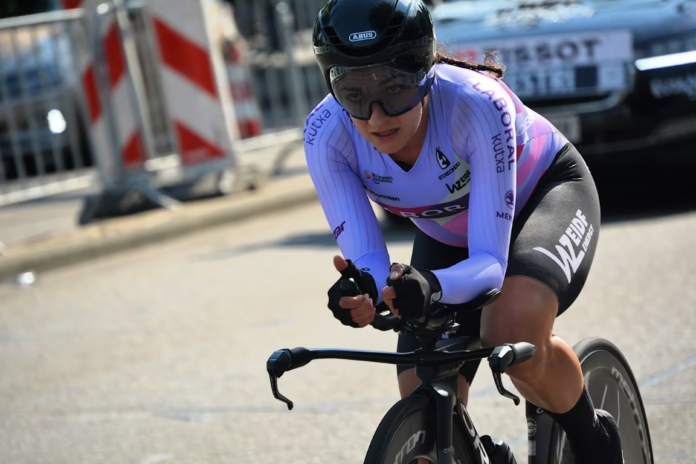
Debora Silvestri has confirmed she suffered five broken ribs and a micro-fracture to her shoulder blade after her heavy crash at Milan-Sanremo Donne, in what looks set to be a significant setback at a crucial point in her spring.
Posting on Instagram on the evening of the 21st March, the Laboral Kutxa rider thanked fans for their messages of support and said she feels “quite good” despite the extent of the injuries. She also suggested the outcome could have been worse, thanked her team for its backing, and made clear that her focus is already on recovering and returning.
That is encouraging in one sense, but the injury list still points to a difficult period ahead. Rib injuries are especially awkward for cyclists because recovery is rarely just about waiting for the bone to heal. Breathing, sleeping, riding position and basic comfort all become part of the problem, and even when the sharpest pain begins to ease, rebuilding rhythm can take time.
Why this is such a blow for Silvestri
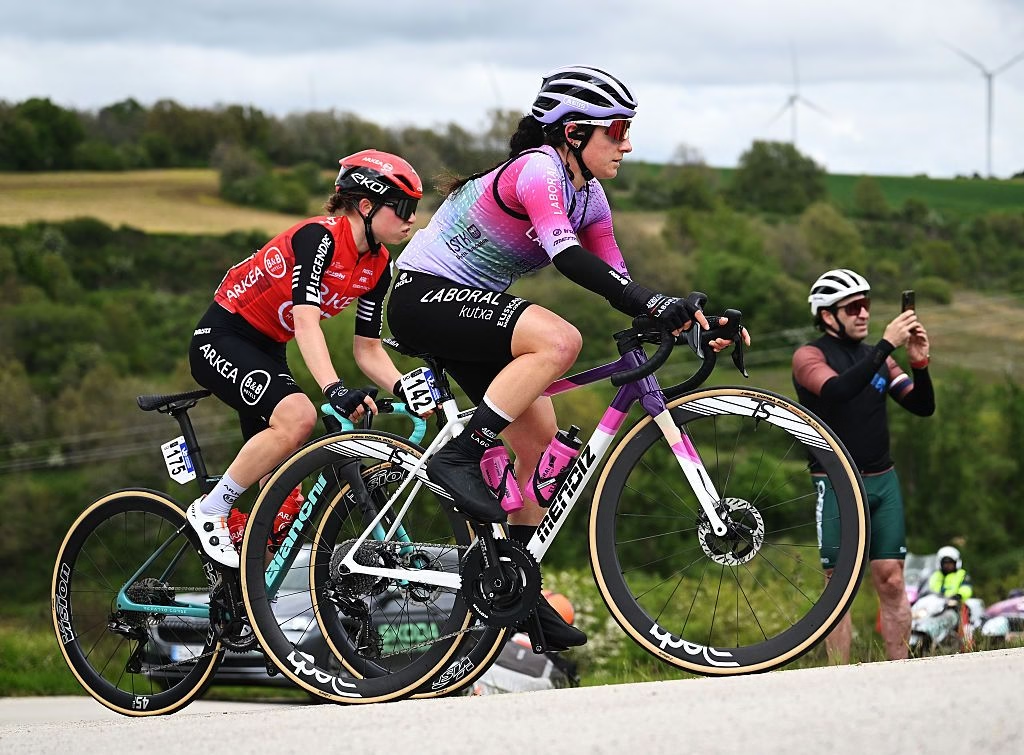
Silvestri has developed into the kind of rider teams value highly, even if she is not always the loudest name on a startlist. She can get through hard days, she can hold her level across a stage race, and she has shown over the last few seasons that she is capable of turning consistency into results.
Her palmarès tells that story clearly. She won the mountains classification at the Festival Elsy Jacobs in 2022, the sort of result that highlights repeat climbing strength over several days. Earlier still, she was 3rd overall at the Giro della Toscana Femminile in 2021 and 4th overall at Setmana Ciclista Valenciana in the same season, both results that underlined her ability to stay competitive across a full race rather than just on one standout day.
More recent results have shown that she has kept moving forward. She was 5th overall at Andalucía Ruta Del Sol in 2023 and 7th overall at GP Ciudad de Eibar, while her victories at Pionera Race-SCV in 2024 and GP Ciudad de Eibar in 2025 confirmed she was no longer simply riding well without reward. She had started to convert that form into wins.
That is why this crash matters beyond the immediate medical bulletin. It interrupts a rider who had carved out a clear place for herself as a dependable and increasingly successful performer in hilly races and selective one-day events. Injuries like this do not just cost race days. They cost continuity, training blocks and momentum.
What happened on the Cipressa descent
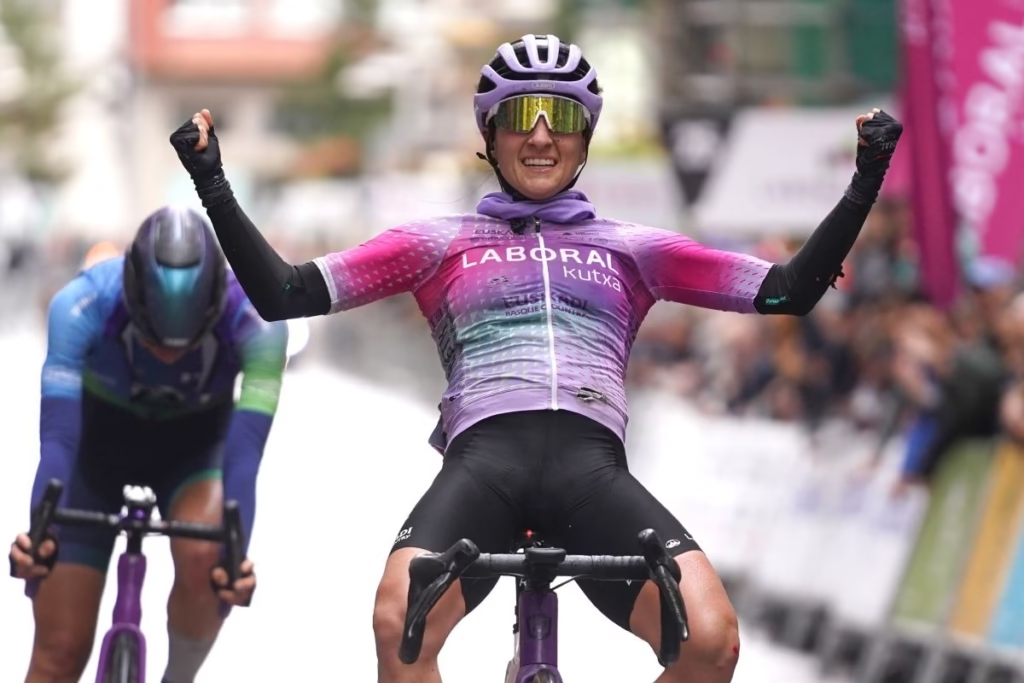
The crash came on the descent of the Cipressa during a tense and fast phase of Milan-Sanremo Donne, with the pace already rising sharply ahead of the decisive run towards Sanremo.
Silvestri went headfirst over a roadside barrier and fell several metres onto a lower section of road in a crash that immediately looked serious. The sequence developed quickly. Kasia Niewiadoma was the first rider to go down after hitting the armco barrier, with Kim Le Court staying with her until medical teams arrived. Margaux Vigie also fell into the same lower section as Silvestri, though she was able to get back up and continue to the finish.
It was the sort of crash that reminds you how quickly a race can shift from tactical tension to something much more serious. Descents in races like Milan-Sanremo Donne are always about fine margins, but when the speed is high and positioning is frantic, those margins narrow even further.
The crash came at a decisive point in the race
That is part of what made the incident feel especially stark. The race was already entering the phase where everything starts to tighten, with teams fighting for position and riders trying to stay close enough to react to the finale.
Instead, the race had to absorb a major crash just as the pressure was peaking. Once things settled and the finale resumed, Lotte Kopecky sprinted to victory after the race regrouped, narrowly beating Noemi Rüegg on the line. Afterwards, Kopecky referenced the earlier incident and said she hoped everyone involved was okay.
That felt entirely appropriate. Even in a race as big as Milan-Sanremo Donne, there are moments when the result inevitably becomes secondary for a while.
-
 Photo Credit: A.S.O./Gaëtan Flamme

Mixed emotions for Laboral Kutxa
For Laboral Kutxa, the last 24 hours have brought a sharp contrast.
On one side is the immediate concern around Silvestri, her injuries, and the unavoidable disruption that follows a serious crash. On the other is a major positive result, with Catalina Soto Campos winning the Pan-American continental title, a timely reminder that the team still has real depth and momentum even while dealing with a difficult setback.
That contrast is part of the reality of a long cycling season. One rider’s breakthrough can arrive on the same day as another rider’s misfortune. Teams are often forced to hold both truths at once.
For Silvestri, the key thing now is that the injuries, while serious, were not even worse given the nature of the fall. For Laboral Kutxa, the challenge will be managing her absence while trying to hold onto the upward trajectory they have built across the opening part of the season.
What comes next
The immediate priority is recovery, and there is no sensible way to rush this type of injury. Broken ribs and a shoulder blade problem are not the sort of issues a rider can simply ride through without consequence. Even once Silvestri is back on the bike, the process of returning to full race sharpness is likely to take longer than the first optimistic update might suggest.
Still, the tone of her own message was understandably positive, and that matters too. Riders often know very quickly whether an incident has truly altered the season or simply interrupted it. Silvestri’s reaction suggested she is already focused on the second of those possibilities.
For now, this stands as one of the more sobering stories from Milan-Sanremo Donne. It was a reminder of how hard the race becomes when the pace lifts, the road narrows and the margins disappear, and of how quickly a rider’s spring can be changed by one moment on a descent.

