

Finding women’s cycling legally is much easier than it was a few years ago, but it is still not simple. The biggest races are now widely televised, yet the answer changes by country, by organiser and sometimes even by race within the same series. A Women’s WorldTour event may be free in Spain, Italy, Belgium, the Netherlands, France or Australia, but paid-only in the UK, United States or Canada.
The key distinction is straightforward. A stream is legal when it comes from the broadcaster or platform holding the rights for your country, whether that is a public broadcaster, a free streaming app tied to that broadcaster, or a paid platform with the official rights. This guide sticks to those official options. Rights can and do change during the season, so the safest habit is still to check the race organiser, the broadcaster schedule or the UCI event page in the days before the race.
 Photo Credit: Getty
What “free and legal” usually means in women’s cycling
In practice, free and legal usually falls into three categories.
The first is a public broadcaster showing the race on television and online at the same time. That model is still used in several European countries. France Télévisions, RTVE, Rai, VRT and NOS all provide cycling coverage through their own platforms for viewers in their home markets, although not every women’s race is shown in full every time.
The second is a free ad-supported broadcaster platform. Australia is the clearest example here, with SBS On Demand carrying a large amount of men’s and women’s cycling for free. That gives Australian viewers one of the strongest free viewing setups anywhere.
The third is that some countries simply do not have a free legal option for most top-level women’s road racing. In those markets, the official route is usually a paid subscription service. The UK and Ireland now sit in that category for much of the major international calendar, while in the United States and Canada, paid platforms remain the main route into live top-level coverage.
Where you can watch for free by country
United Kingdom and Ireland
For most of the biggest women’s races, there is no dependable free legal option in the UK or Ireland at the moment. The main live rights for major cycling coverage now sit behind paid services, which means the official route for races such as the biggest Classics and Grand Tours is usually subscription-based rather than free.
There can still be exceptions around highlights, clips or occasional free-to-air arrangements, but as a general rule viewers in the UK and Ireland should assume that live women’s WorldTour racing is paid access unless a broadcaster clearly says otherwise.
France
France remains one of the better places to watch major women’s races for free, particularly for events tied to ASO and the spring calendar. France Télévisions and france.tv are often the first places to check for races such as Paris-Roubaix Femmes and the Tour of Flanders.
The main caveat is that coverage depth can vary. Free access does not always mean a full start-to-finish broadcast, and that remains one of the recurring frustrations even in better-served markets.
Spain
Spain is one of the strongest markets for free legal access. RTVE’s cycling coverage regularly includes women’s racing through Teledeporte and RTVE Play. For Spanish viewers, RTVE is one of the clearest and easiest first checks for the major races.
That simplicity matters. If RTVE has the rights, the legal stream is usually easy to find and does not sit behind a paywall.
 Photo Credit: Getty
Italy
Italy also remains strong for free access, especially for Italian races and major cycling properties like Trofeo Alfredo Binda. Rai Sport streams live through RaiPlay, and Rai remains one of the central legal homes for women’s cycling in Italy.
As with France and Spain, not every race on the calendar will necessarily be shown with the same depth, but Italy is still among the easiest countries in Europe for finding major women’s races on a free official platform.
Belgium
Belgium is one of the best countries for free women’s cycling coverage. VRT MAX and Sporza carry major races live, and women’s events are treated as part of the country’s broader cycling culture rather than an afterthought. A good chunk of lower races are also available free on Pickx.
For Belgian viewers, this is close to the ideal model: free, official, easy to find and backed by a broadcaster that takes cycling seriously.
Netherlands
The Netherlands also offers genuine free legal access to key races through NOS. Its live pages and livestreams regularly include women’s cycling, and for Dutch viewers it is often the correct first place to check for the biggest one-day races.
That does not guarantee every single women’s race in the world, but for the main spring and summer events the Dutch market remains one of the friendlier ones for free official access.
 Photo Credit: Getty
Australia
Australia is arguably the standout free market outside Europe. SBS and SBS On Demand carry a wide range of major cycling events, including women’s races, and they do so in a way that is easy to access and easy to understand.
That makes Australia unusually strong compared with many English-speaking markets. Where UK viewers usually have to pay, Australian viewers often get the same major races free and legally through a broadcaster-backed platform.
United States
The United States is much less generous for free access. Major women’s races are more commonly tied to paid services, which means legal access is usually available, but not free.
There may occasionally be race-specific exceptions, but nobody in the US should assume women’s road racing will be free to watch live. Paid access remains the norm.
Canada
Canada is similar to the US in that legal access exists, but usually through subscription. For most fans, that means official coverage is available, but not free.
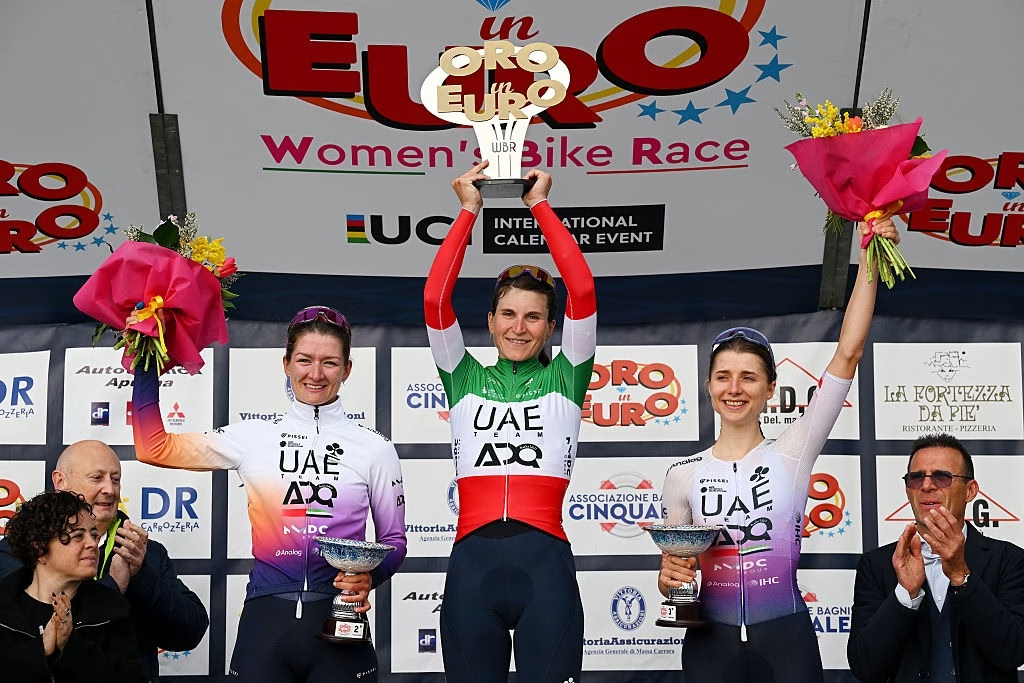 Photo Credit: Getty
So which countries currently have the best free access?
If the question is simply where women’s cycling is easiest to watch legally without paying, the strongest answers right now are Belgium, the Netherlands, Spain, Italy, France and Australia. Those countries all have clear free routes through official broadcaster platforms.
If the question is where women’s cycling is easiest to watch in English without paying, Australia is the standout. The UK no longer fits that description for most top-tier races because the main live rights are now tied so closely to paid services.
The catch: race rights still vary more than fans expect
This is the part that catches people out. Women’s cycling is not sold as one simple package worldwide. Rights can vary by organiser, by country and by event type. A Monument may be free in one country, a stage race may be on a different channel, and a smaller Women’s WorldTour event may have a shorter broadcast window or different domestic treatment.
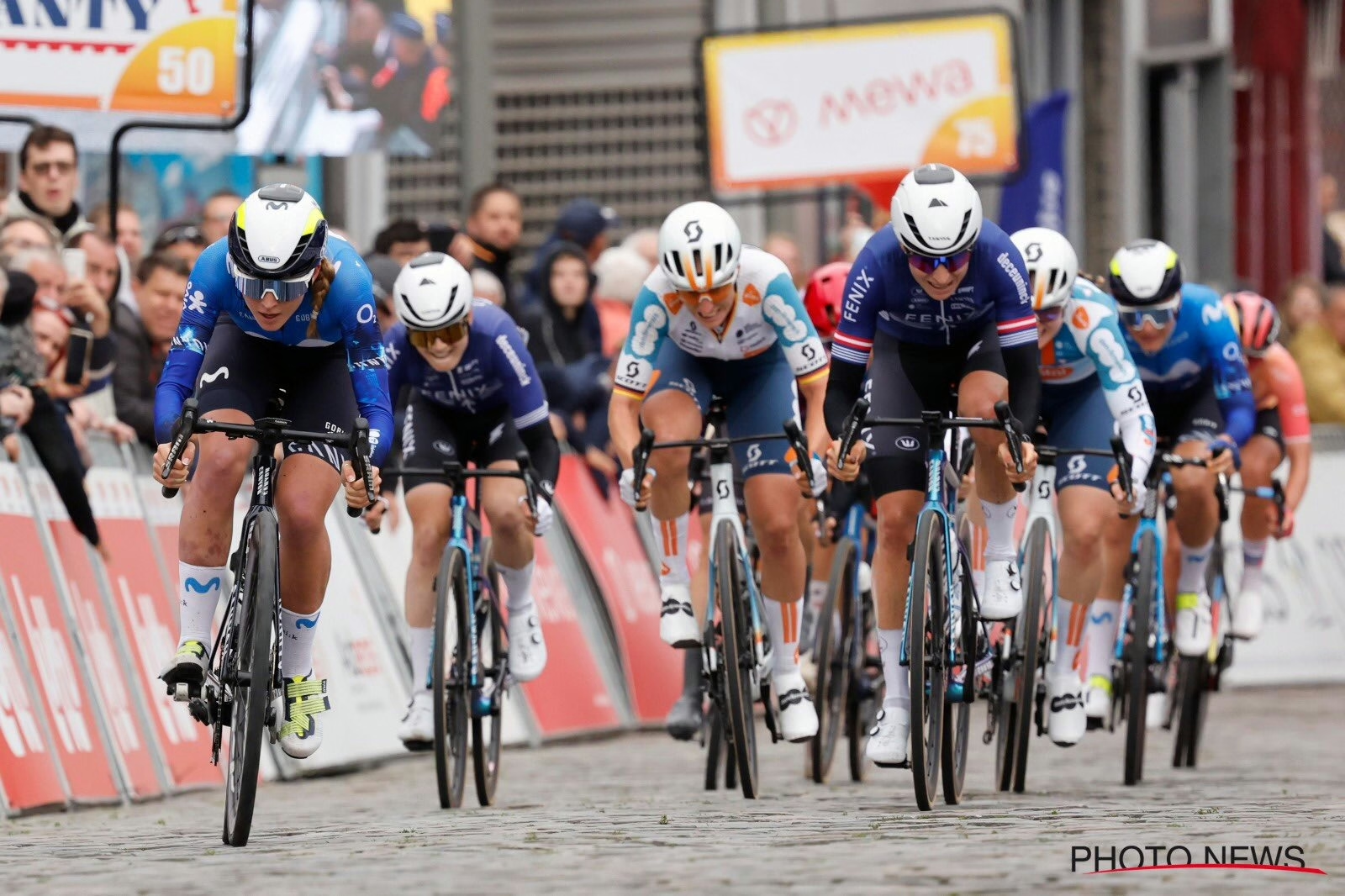
That is why the best habit is still a practical one. Check the organiser’s site, the local public broadcaster, and the UCI watch page a few days before the race. In countries with strong free coverage, that is usually enough to find the legal stream. In paid markets, it will at least confirm whether there has been an exception or a late rights change.
-
 Photo Credit: PhotoNews

The simple version
Belgium, the Netherlands, Spain, Italy, France and Australia currently offer some of the best free legal routes into women’s cycling through official broadcaster platforms such as VRT MAX, NOS, RTVE Play, RaiPlay, france.tv and SBS On Demand. The UK, Ireland, United States and Canada are much more likely to require a subscription.
The good news is that legal options are far better than they used to be. The less encouraging truth is that they are still uneven, and fans still need to think country first, not race first, when figuring out what is actually available.
What about using a VPN to watch women’s cycling streams in another country?
A VPN can sometimes make it possible to access a stream from another country, but that is not the same thing as the stream being officially available to you. Most women’s cycling coverage is geo-blocked because rights are sold market by market.
In practical terms, a VPN is more straightforward when you are travelling and trying to access a service you already use at home. It is less clear when you are using it to reach a broadcaster in a country where you do not live, simply because that country has a free stream. Broadcasters make their rights position clear through territorial restrictions and geo-blocking.
The safest guidance is simple. Check whether your own country already has an official rights holder first. If it does, use that. If you are abroad, look for an official international version or travel access option from your home broadcaster rather than assuming a free stream in another country is automatically available to you.

