
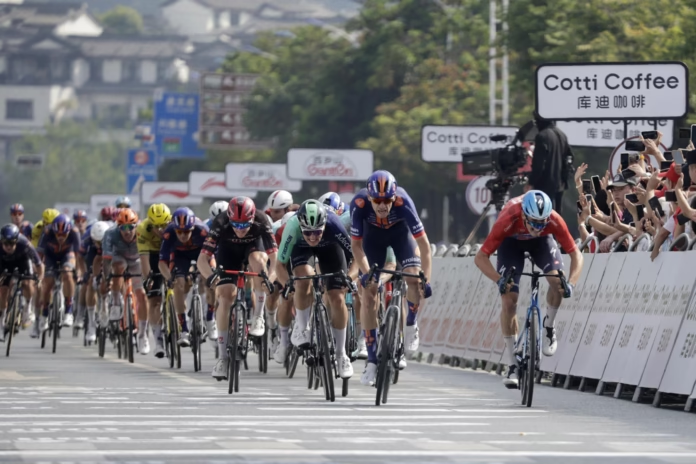
Frits Biesterbos won stage 2 of the 2026 Tour of Guangxi in 3:45:19, taking a tightly compressed finish ahead of Paul Magnier and Olav Kooij. Magnier was second and Kooij third, with all three credited on the same time.
The stage was defined by movement rather than a single breakaway that controlled the day. The early escape repeatedly changed size, the National Road climb reduced both the break and the rear of the peloton, and several late attacks failed to create a separate winning gap. Biesterbos ultimately took the decisive finishing place from a group that remained together on the clock.
That made the race less about a long-distance advantage than about surviving the successive selections and arriving at the finish in the right order. Max Kanter, Robin Froidevaux and Jordi Meeus followed the podium, also on the same time, confirming how little separation remained after the attacks had run their course.
How it unfolded
Three riders established a small gap with 178 kilometres remaining, but the first move did not settle the shape of the stage. By 170 kilometres to go, only two riders were reported clear, and a counter-attack followed at 169 kilometres. The gap was already decreasing at 167 kilometres, so the opening escape was creating activity without establishing lasting control.
The front changed again at 157 kilometres, when four riders held a small advantage. Timo De Jong was caught by the peloton with 151 kilometres remaining, then Dries De Bondt, Baptiste Veistroffer and Arthur Kluckers counter-attacked three kilometres later. The sequence showed a race repeatedly moving riders across the road while the peloton kept the developing groups within reach.
Multiple attacks followed at 140 kilometres, and the gap between the first group and the peloton continued to come down. Another two-rider counter went clear at 129 kilometres. Rather than one break building an advantage and forcing a settled chase, the first half of the stage became a series of partial regroupings, with the composition of the front changing before the decisive terrain had arrived.
The opening moves kept the race unsettled
The early three-rider move was reduced to two, then followed by a counter and a four-rider combination. Those changes mattered because each one prevented the race from moving into a stable pattern. The riders at the front were not simply extending one advantage; they were being replaced, joined or drawn back as the peloton narrowed the distance.
De Jong’s capture at 151 kilometres was the first named indication that a rider who had been away had been absorbed by the bunch. De Bondt, Veistroffer and Kluckers then supplied a new reference point at the head of the race, but their counter was part of the same unsettled process. Further attacks at 140 kilometres and another counter at 129 kept the possibility of a successful break open without allowing one combination to define the stage.
The event sequence does not identify every rider in the early groups, so the important development was the changing structure rather than a claim about one rider controlling the escape. The stage had movement in abundance, but no secure separation. That distinction became important later, when the climb and the final accelerations had to decide which riders could contest the finish.
The chase remained active into the approach to National Road
By 56 kilometres to go, Jonas Rickaert had been caught by the peloton. His capture was another sign that riders who had moved clear were being returned to the main group as the stage approached its key section. The race was still absorbing individual efforts rather than allowing every late escape to survive into the final hour.
At 37 kilometres remaining, the breakaway reached National Road, an 8.5-kilometre climb reported at an average gradient of 3.4 per cent. Liu Chenglu was dropped from the break shortly afterwards. The climb therefore began its work at the front immediately, turning the earlier succession of attacks into a more consequential reduction of the leading group.
Jhonatan Narváez and Javier Romo counter-attacked with 34 kilometres to go. Their move came as the front was already being reshaped, and the gap between the leading group and the first chase was decreasing at 33 kilometres. The consequence was not a decisive escape but another change in the chase structure, with the race continuing to compress around the climb and its aftermath.
National Road reduced both sides of the race
De Bondt was dropped from the break at 31 kilometres to go and was caught by the peloton one kilometre later. At roughly the same point, riders were also dropping from the back of the peloton. The climb was therefore separating riders in both directions: the original escape was losing members while the main group was becoming smaller behind it.
An attack from Bahrain Victorious followed at 29 kilometres, and six riders were reported to have a small gap. Afonso Eulálio, Rudy Porter and Rémy Rochas were named among that move. One kilometre later, Fredrik Dversnes Lavik was listed in a three-rider group, showing that even after the first break had been reduced, the front was still being rebuilt through fresh combinations.
Eulálio featured at the second categorised-climb sprint with 22 kilometres to go. That event marked a transition from the long climb-related reshaping of the race to the more direct closing battle. The break had not disappeared into one confirmed decisive move, but its repeated reductions had narrowed the number of riders capable of influencing the final kilometres.
The effect on the peloton was equally important. Riders were dropping from the back while the front groups were being caught or reduced, leaving a smaller field to respond to the next attacks. The stage was not producing a large time gap, but it was steadily removing riders from the contest that would eventually be decided by the final order.
The peloton accelerated with 14 kilometres remaining, bringing the pressure into the closing section. At 8.6 kilometres, Kévin Vauquelin attacked. Veistroffer followed with an attack at 6.5 kilometres, continuing the day’s pattern of one move being answered by another rather than allowing a lone rider to establish a clear route to the finish.
The two attacks were meaningful because they tested the reduced group after the climb, but neither created a final separation large enough to determine the result. Narváez won the last intermediate sprint at 2.9 kilometres to go, adding another named change to a finale in which the order remained unsettled almost to the line.
With 900 metres remaining, Laurenz Rex was pulling. That was the final identified race action before the finish and placed the emphasis on the last approach rather than on a late solo break. The leading riders reached the line close enough for the result to be decided by their finishing order, not by a recorded time difference.
Biesterbos was then recorded as the winner. Magnier finished second and Kooij third, both on the same time as the stage winner. The final order preserved the central feature of the day: repeated attacks and selective pressure had changed the groups, but they had not separated the leading finishers on the clock.
Biesterbos converted a compressed finale
Biesterbos’s victory came after a stage in which the decisive advantage was survival through the changing front rather than a sustained breakaway margin. The initial escape was reduced, new counters appeared, and the National Road climb dropped riders from the break and the peloton. By the final kilometres, the race had become a contest among those who remained in contention.
Magnier came closest in the final ranking, taking second, while Kooij completed the podium in third. Neither was separated from Biesterbos by time. The same result applied to Kanter, Froidevaux and Meeus, placing six riders together at the head of the stage result after the attacks by Vauquelin and Veistroffer had failed to create a decisive gap.
The result therefore reflects two different kinds of separation. The climb and the preceding pressure separated riders from the groups in front and behind, while the final kilometres failed to separate the leading riders by time. Biesterbos gained the stage win within that compressed contest, with the order at the finish providing the distinction that the road had not produced as a gap.
The sequence also explains why the stage cannot be reduced to a simple sprint description. The finish was close, but the route to that finish included a succession of breaks, counters, catches and drops. The riders contesting the final order had first passed through a race in which the front repeatedly changed and the field was gradually narrowed.
The winning shape of the stage
Three phases shaped the result. Early attacks prevented the break from becoming permanent; National Road reduced the escape and the peloton; and the closing accelerations tested the remaining group without producing a separate winner. Biesterbos emerged from that progression at the front when the final order was settled.
The main rivals followed different paths through the same compressed race. Magnier and Kooij reached the podium on the same time as Biesterbos, while Kanter, Froidevaux and Meeus remained immediately behind in the same credited time. The narrow spread was the final consequence of a day where selection occurred, but not through a lasting time gap between the leading finishers.
Behind the first six, Matteo Moschetti finished seventh, Erlend Jordbrekk Blikra eighth, Lionel Taminiaux ninth and Oded Kogut 10th. Their positions extended the compressed result through the top 10, but the key distinction remained Biesterbos’s first place ahead of Magnier and Kooij after the late attacks had failed to split the leading finishers.
Tour of Guangxi Stage 2 2026 Result
| Pos. | Rider | Team / nation | Time / gap |
|---|---|---|---|
| 1 | Frits Biesterbos | Team Picnic PostNL (WT) | 3:45:19 |
| 2 | Paul Magnier | Soudal Quick-Step (WT) | Same time |
| 3 | Olav Kooij | Decathlon CMA CGM Team (WT) | Same time |
| 4 | Max Kanter | XDS Astana Team (WT) | Same time |
| 5 | Robin Froidevaux | Tudor Pro Cycling Team (PRT) | Same time |
| 6 | Jordi Meeus | Red Bull – BORA – hansgrohe (WT) | Same time |
| 7 | Matteo Moschetti | Pinarello Q36.5 Pro Cycling Team (PRT) | Same time |
| 8 | Erlend Jordbrekk Blikra | Uno-X Mobility | Same time |
| 9 | Lionel Taminiaux | Lotto Intermarché (WT) | Same time |
| 10 | Oded Kogut | NSN Cycling Team (WT) | Same time |

