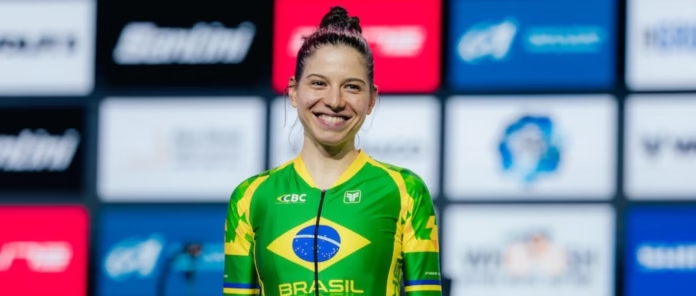
Gabriela Guerra will make the jump from elite virtual racing to the professional road peloton in 2027 after agreeing a two-year contract with Cofidis. The Brazilian, twice a silver medallist at the UCI Cycling Esports World Championships, has earned her opportunity following an unusually rapid introduction to road competition.
At 32, Guerra is not following the familiar route through junior racing and development squads. Her signing is a calculated bet on whether the physical qualities that made her one of the strongest riders in e-cycling can translate into the positioning, endurance and tactical demands of international road racing.
From virtual racing to the road
Guerra’s sporting background is anything but conventional. She first made her name as a skateboarder, building an online following while living between Brazil and Germany. Mountain biking later became an important part of her life, and she began racing off-road in the United States. Indoor cycling followed during a winter spent in Germany, eventually becoming the discipline in which she established herself internationally.
Her virtual racing record includes two runner-up finishes at the UCI Cycling Esports World Championships. She was also second in the overall classification of the inaugural Zwift Games in 2024, behind Kathrin Fuhrer. Those performances demonstrated the sustained power and repeated high-intensity efforts required in short, competitive indoor events, although road racing asks different questions.
Guerra only began testing herself in road competition in September 2026, riding for Germany’s Wheel Divas Cycling Team. She quickly won at Riderman in Germany and then at the Mirabelle Classic in France. The latter success was particularly striking: she attacked from distance and stayed clear to secure a solo victory, a result already covered in ProCyclingUK’s report on Guerra’s Mirabelle Classic win.

Why Cofidis have taken the chance
Two wins cannot establish how a rider will cope with a full professional calendar, but they gave Cofidis tangible evidence beyond power numbers from a smart trainer. The French team have offered Guerra a deal covering the 2027 and 2028 seasons, allowing time for adaptation rather than judging the experiment on a handful of early races.
In the team’s official announcement, Cofidis sporting manager Raphaël Jeune said they were excited to see how Guerra would respond to the challenge, pointing to her determination and road performances late in the season. The immediate priority will be learning how to race within a professional bunch, handle repeated race days and contribute to team objectives while developing her own opportunities.
For Guerra, the appeal is precisely that uncertainty. She said she wanted to discover whether her abilities in e-cycling could carry over to the road, adding that her first races had given her confidence and attracted Cofidis’ attention. She also stressed her eagerness to help teammates and experience racing at the highest level.
A different pathway into professional cycling
Indoor competition has become a serious arena in its own right, but moving from esports success to a professional road contract remains unusual. Virtual racing rewards precise pacing and repeatable efforts in controlled conditions. Road racing adds weather, terrain, group dynamics, bike handling and the ability to make decisions under pressure, often after several hours in the saddle.
Guerra’s 2026 results suggest that the transition is possible, at least in selected races. The next test is whether she can reproduce those performances against deeper fields and across a much longer season. Cofidis are investing in that possibility, while Guerra gets a rare opportunity to turn a career built largely indoors into one on the international road circuit.
-
 Photo Credit: Park Tool
-
 Photo Credit: Cor Vos (via Radsport-News)