Jeannie Longo is one of the most extraordinary figures the sport has produced. Few riders in any discipline, men’s or women’s, stayed relevant for so long, won so often and stretched their career across so many different eras. She was a world champion on the road, a world champion on the track, an Olympic champion, a record-setter and, for years, the dominant figure in French women’s cycling. Even that only starts to explain her. Longo was not simply successful. She was relentless, durable and often difficult to place neatly in the history of the sport because her achievements were so vast and her legacy so complicated.
That is why she still matters. When you look through the broader women’s cycling history hub, Longo sits in the background of almost every era, not as a footnote but as a force. Riders such as Marianne Vos, Anna van der Breggen and Demi Vollering belong to more visible and more professionalised eras, but Longo helped set the competitive standard long before the modern structures were in place. She is one of those riders whose story becomes bigger the more closely you look at it.
Before cycling, Jeannie Longo was already an elite athlete
Longo was born in Annecy on the 31st October 1958 and did not come into cycling through the usual junior racing pathway. Before that, she was a strong skier and an accomplished athlete more broadly, winning school and university skiing titles before turning her focus towards the bike. That background helps explain a lot about the rider she became. She was not moulded only by the habits of the peloton. She brought an outsider’s physical range and an unusual level of self-belief into cycling, then accelerated through the sport with striking speed.
Her rise was quick enough that she became French road champion at a young age and soon developed into the central figure in French women’s cycling. The scale of that national dominance is hard to overstate. Across road, time trial and track disciplines, she amassed French titles at a rate few riders of any era could match. For years, French women’s racing repeatedly returned to the same conclusion: Jeannie Longo was still the rider to beat.
A rider who could win almost everything
The easiest way to misunderstand Longo is to think of her as just a climber or just a time trial specialist. She was far broader than that. Her career reached across road and track, and across one-day races, stage races, pursuit efforts and time trials. She won world pursuit titles on the track in 1986 and 1988, then built an equally formidable record on the road. That versatility is one reason her career still feels so unusual. Many all-time greats dominate one shape of racing. Longo dominated several.
She won the elite women’s road world title five times and the elite women’s time trial world title four times. She also won the women’s Tour de France equivalent, the Grande Boucle, three times from 1987 to 1989. In the broader story of women’s stage racing, that places her firmly among the most important early names, alongside riders who helped define the fragmented pre-Tour de France Femmes landscape explored in The Tour de France Femmes: Most Asked Questions. Longo’s three overall wins in that lineage remain one of the headline achievements of her road career.
She also belongs to a generation whose achievements are sometimes harder to measure cleanly in modern databases. That does not make them any less important. If anything, it makes riders like Longo more significant, because so much of women’s cycling history still has to be reconstructed through the scale of what they won rather than through the cleaner statistical frameworks of the present. ProCyclingUK’s piece on who are the women cyclists with 100 UCI road wins touches on exactly that problem. Longo’s official UCI-era tally is already enormous, but the true reach of her career was larger still.
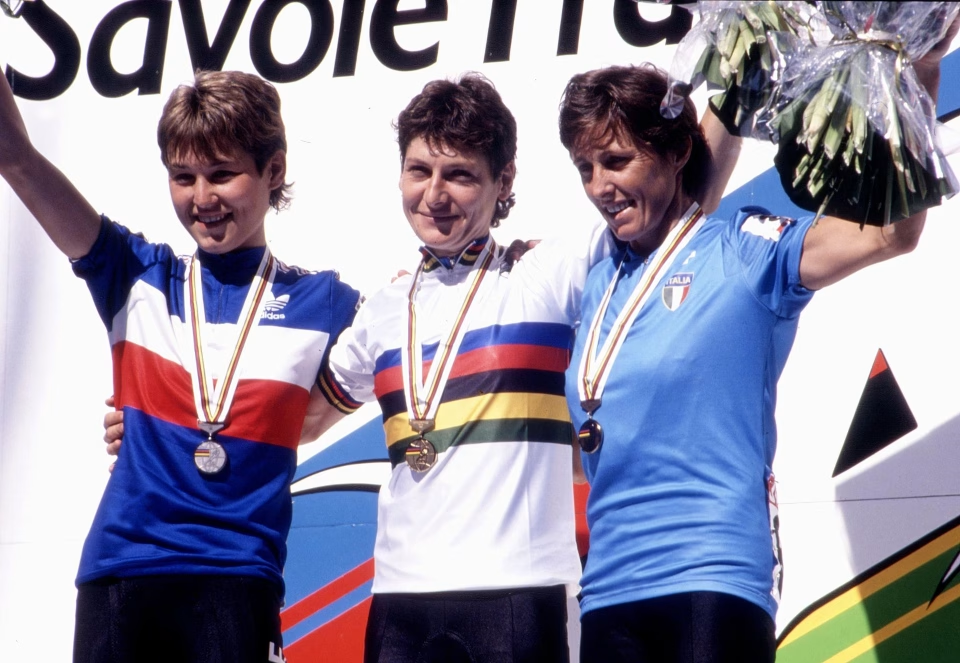
Jeannie Longo at the World Championships
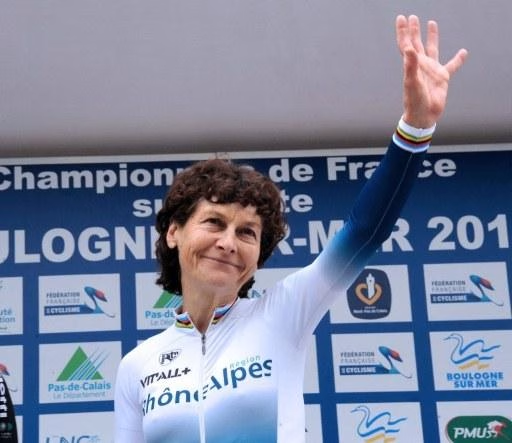
If one strand best captures Longo’s quality, it is the World Championships. She won five road race titles, in 1985, 1986, 1987, 1989 and 1995, and four world time trial titles, in 1995, 1996, 1997 and 2001. That spread alone tells you how long she remained at the top. She was not just brilliant for a brief peak. She was winning rainbow jerseys across two very different phases of her career.
Her 1989 road world title remains one of the clearest examples of her authority. ProCyclingUK’s brief history of the road cycling world championships notes that she won that year by more than four minutes, which is the kind of margin that instantly separates a champion’s ride from a merely strong one. It was also her fourth road world title, underlining how thoroughly she had already shaped that era of the sport.
The Olympic career that made her a global figure
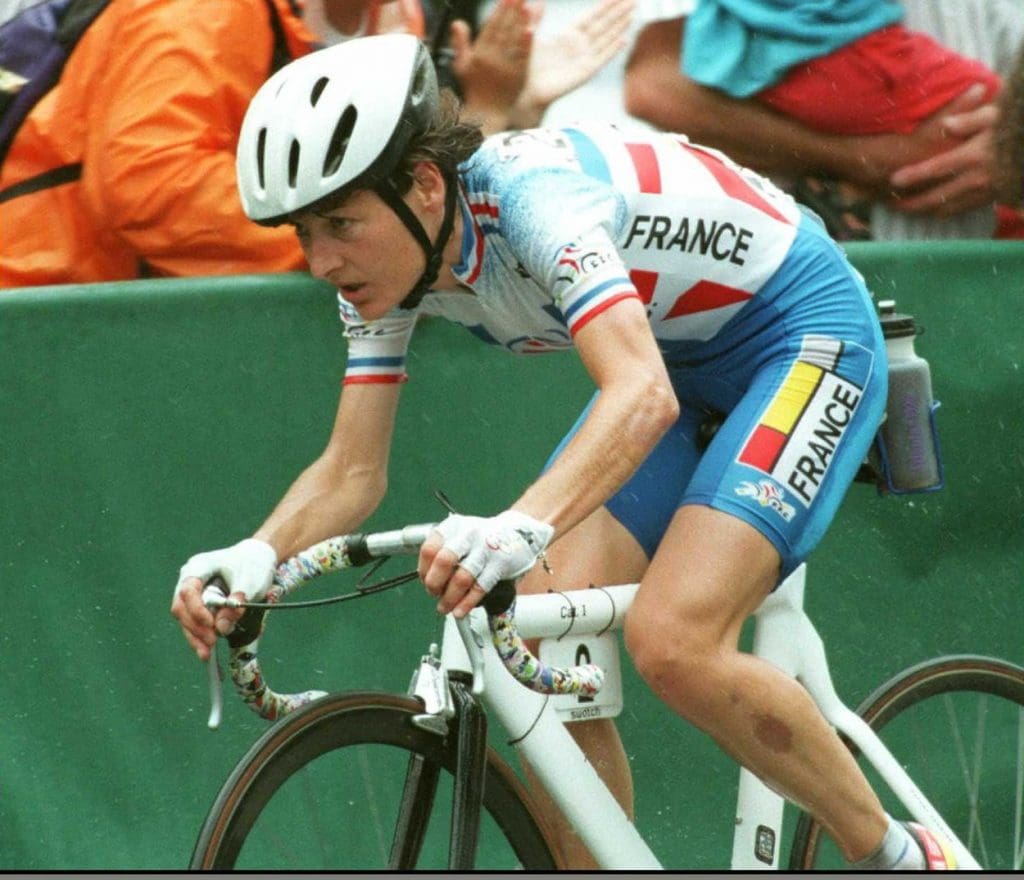
Longo’s Olympic career is one of the most remarkable in cycling history. She competed at seven Olympic Games, from Los Angeles 1984 through to Beijing 2008. That sort of longevity is difficult to grasp in any sport, but especially in one as physically demanding and tactically evolving as cycling. By the time she reached Beijing, some of her rivals had not even been born when she first became an Olympian.
The defining moment came in Atlanta in 1996, when she won Olympic road race gold. For all her world titles and national dominance, Olympic gold gave Longo the sort of simple, lasting sporting image that every great athlete needs. ProCyclingUK’s women’s Olympic road race winners places her clearly in that lineage, and her Atlanta win remains one of the central pillars of her legacy.
What made the Olympic story even more impressive was that it did not end there. In Beijing in 2008, aged 49, she finished fourth in the time trial and missed a medal by only two seconds. Even near the end of her elite career, she was still close enough to the podium to make the old question unavoidable: how was she still this good?
The hour record and the Jeannie Longo engine
Time trialling and pursuit had always suited Longo, but the women’s hour record gives another useful window into her abilities. ProCyclingUK’s history of the women’s hour record notes that in late 2000 she pushed the record first to 44.767km and then to 45.094km in Mexico City, becoming the first woman to break the 45km barrier. It was also the last women’s hour record set on a steel bike, which gives the achievement an almost old-world feel now.
That record matters because it cuts through reputation and tactics. The hour record is brutally simple. It asks what one rider can produce alone against the clock. Longo’s answer was emphatic, and it reinforced what much of her career had already shown: she possessed one of the sport’s great individual engines.
Jeannie Longo’s greatest years
There was no single neat peak to Longo’s career because she remained successful for so long, but several phases stand out.
The first was the mid to late 1980s, when she became world champion repeatedly and established herself as the outstanding rider of her generation. The second was the mid 1990s, when she returned to the summit of the sport with world titles and Olympic gold. The third was the remarkable late-career phase in which she was still capable of competing with riders much younger than her, culminating in that near miss for an Olympic medal in Beijing.
That long arc is what makes Longo different from many other champions. A lot of great riders dominate one era. Longo seemed to stretch across several. She was there when women’s racing was less visible, less professional and often less stable. She was still there when the sport had changed around her.
Why Jeannie Longo’s legacy is so complicated
A full history of Longo cannot pretend the story is clean. It is not. Part of the complexity comes from confirmed anti-doping history, part from later suspicion and part from the role of her husband and coach Patrice Ciprelli. Longo herself served a one-month ban in 1987 after testing positive for ephedrine. That case is part of the historical record and cannot be separated from any serious account of her career.
Later, in 2011, she faced disciplinary proceedings linked to missed anti-doping whereabouts tests, though that case was ultimately dismissed after a ruling that she had not been properly informed of her status in the testing pool. The separate case involving Ciprelli’s EPO purchases only deepened the discomfort around her later years. None of that erases Longo’s achievements, but it does change how they are discussed. She is not remembered only as a pioneer or only as a champion. She is remembered as a champion whose story remains contested.
That tension is part of why Longo can feel oddly distant in broader storytelling about women’s cycling. She is too important to ignore, but she is not always embraced in the same uncomplicated way as some other legends. Her results are immense. Her after-image in the sport is much harder to settle.
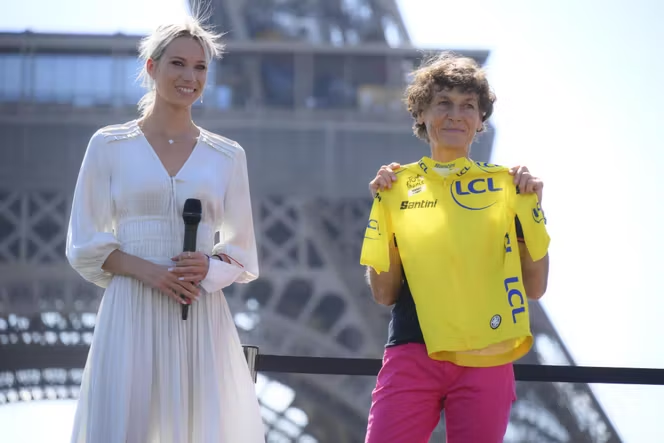 Photo Credit: Presse Sports
Jeannie Longo’s post-cycling career was still built around racing
Even the phrase post-cycling career is a little misleading with Longo, because she never really stopped competing. What ended was her elite road career. What followed was a long and still highly successful second life in masters and Gran Fondo racing. She remained active in age-group competition and continued winning world titles well into her 60s.
That continuation matters because it tells you something basic about her relationship with the bike. Longo did not race only because she happened to be good at it. She raced because competition was clearly central to who she was. Even after the elite spotlight moved elsewhere, she kept returning to the same sporting logic: prepare, compete, win if possible, and keep going.
She has also remained a reference point in the French and wider women’s cycling story. Whenever the history of major women’s road races, Olympic success or time trial excellence is revisited, Longo’s name keeps appearing. You see it in the history of the women’s Tour line, in Olympic road racing, in the World Championships and in the hour record. She is not always the easiest legend to celebrate, but she is impossible to remove from the structure of the sport’s past.
Why Jeannie Longo still matters in women’s cycling history
Longo matters because she compressed several careers into one life. She was an early pioneer in a sport that still lacked visibility, then a dominant world champion, then an Olympic champion, then a long-distance survivor who kept winning into middle age, then an age-group world champion long after her elite peers had disappeared from competition. There are riders with cleaner stories and riders with warmer public reputations. There are not many with careers as large.
For anyone trying to understand women’s cycling history properly, Longo is unavoidable. She belongs in the same wider conversation as the great race histories, the growth of the women’s Tour structure and the sport’s biggest Olympic and world titles. Her story is not simple, but that is part of why it is worth telling in full. Jeannie Longo was not just one of the best of her time. She was one of the riders who made several different times in women’s cycling feel connected.
Jeannie Longo career highlights
- Olympic road race champion, Atlanta 1996
- Seven Olympic appearances, from 1984 to 2008
- Five elite road world titles and four elite world time trial titles
- World pursuit titles on the track in 1986 and 1988
- Three overall wins in the women’s Tour de France lineage
- Women’s hour record holder at 45.094km in 2000
- Continued to win masters and Gran Fondo world titles in her 60s