

The 2026 Giro d’Italia has lost two of its most credible general classification contenders before the race has even started, with João Almeida ruled out after illness, and Mikel Landa also confirmed absent as he continues recovering from a pelvis fracture. It is a significant shift in the shape of the race. Almeida was one of the clearest podium threats on paper, while Landa remained a dangerous outsider with the experience and climbing pedigree to make the mountains more complicated for everyone else.
Almeida confirmed on Monday that he will not start the 2026 Giro d’Italia after illness disrupted his preparation too heavily. In his statement, he said sickness in recent months had affected his build-up to the point where he would not be ready in time for a race he clearly cares about deeply. UAE Team Emirates-XRG and the rider have instead opted for a rest period, with later goals in the season still to be decided.
That is a major loss for the race as much as for UAE. Almeida had been one of the strongest names in the expected GC picture after a 2025 season that included three WorldTour stage-race wins and 2nd overall at the Vuelta a España behind Jonas Vingegaard. His 2026 had begun more steadily, with podium finishes at the Volta Comunitat Valenciana and Volta ao Algarve, but his subdued ride at Volta a Catalunya had already hinted that something was not right.
Almeida’s value in a Grand Tour goes beyond simple star power. He is the kind of rider who makes a three-week race tighter and less forgiving. He climbs with consistency, he limits losses well, and he rarely disappears from the overall picture unless something physical has clearly gone wrong. Remove that sort of rider from a start list and the race does not become easy, but it does become less balanced.
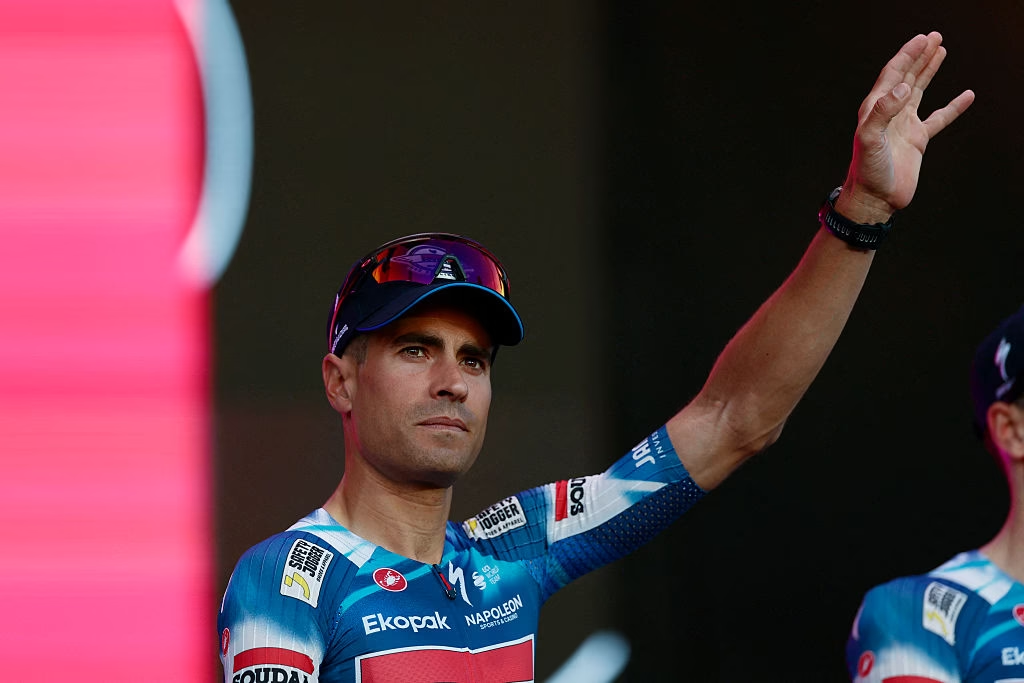
Landa’s absence adds a second meaningful blow to the Giro’s depth. Soudal Quick-Step confirmed that further analysis after his crash on stage 2 of Itzulia Basque Country revealed a small fractured pelvis. The injury had not been fully identified at first, but it now requires more recovery time, which rules him out of the race.
For Landa, the timing is especially cruel. He had spoken about coming back from a difficult winter and had started to feel good again in Itzulia before the crash. Missing the Giro also carries extra weight because he was aiming to return strongly after last year’s edition ended in another heavy crash and abandonment. There is a familiar sense of frustration around his relationship with this race, because even when he arrives with form and ambition, something seems to get in the way.
His absence does not alter the very top of the market in the same way Almeida’s does, but it still matters. Landa remains one of the most experienced mountain specialists in Grand Tour racing, and even at this stage of his career he is the sort of rider who can force the favourites to stay honest. He may not have gone to the Giro as the man everyone expected to win, but he was certainly one of the riders capable of making the overall battle harder to control.
Taken together, the two withdrawals change the tone of the race before the opening stage. Vingegaard now looks even more firmly established as the pre-race favourite, simply because two of the riders who could most plausibly have tested the race from different angles are gone. Almeida would have brought a steady, complete GC threat. Landa would have brought climbing experience and the ability to animate the mountains if given any freedom. Losing both narrows the range of ways the race can become genuinely unstable.
-
 Photo Credit: A.S.O./Gaëtan Flamme
UAE do still have options, of course. Jay Vine and Adam Yates now look the most obvious names to inherit greater responsibility, though that changes the team’s shape. With Almeida, the Giro could have been approached around one clear GC card. Without him, UAE may need to be more flexible and more reactive, especially in the first half of the race. That does not make them weak, but it does make them less settled.
Soudal Quick-Step face a different problem. Landa was not merely a name on the list. He was their best route into the high mountains and their clearest chance of staying visible in the overall fight. Without him, their Giro becomes much harder to frame around general classification ambition.
The broader effect is straightforward enough. The 2026 Giro d’Italia has not lost all of its intrigue, but it has lost two riders who would have made the race deeper, tighter and more difficult for the favourite to manage. Almeida’s illness removes one of the clearest podium-level threats. Landa’s injury removes an experienced climber who could still shape the race on the hardest terrain. Together, those absences leave the Giro looking noticeably thinner at the sharp end than it did only a few days ago.

