
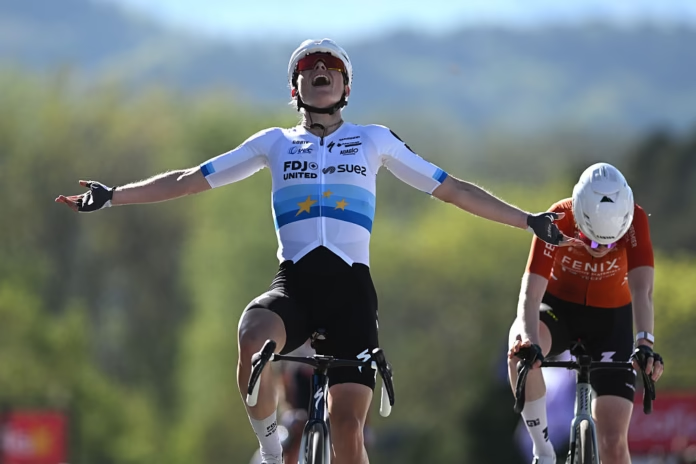
La Flèche Wallonne Femmes 2026 did not produce a historic shock, but it did produce a result that fits neatly into the race’s longer story. Demi Vollering won for the second time, beating Puck Pieterse and Paula Blasi on the Mur de Huy, in what was the 29th edition of the race and the longest edition yet at 148.2km.
That matters because La Flèche Wallonne Femmes is one of the clearest continuity races in women’s cycling. The route changes, the peloton gets deeper, the pace rises, but the essential question stays the same: who can best judge the Mur de Huy after a hard, increasingly selective day? In 2026, Vollering gave the latest answer, and in doing so moved herself into a smaller, more exclusive group in the race’s history.
A race that quickly became one of the anchors of women’s cycling
La Flèche Wallonne Femmes began in 1998 and has been part of the highest level of women’s racing for most of its existence, first through the UCI Women’s Road World Cup and then the UCI Women’s WorldTour. That gives it a special place in the calendar. It is not one of the sport’s newest prestige races trying to build meaning quickly. It is already one of the historic one-day references.
It is also one of the races most tightly defined by its finish. Many Classics can shift identity over time through route changes, weather or tactical fashion. La Flèche Wallonne Femmes remains recognisable because the Mur de Huy keeps imposing the same kind of selection, even as the race around it becomes harder and more sophisticated.
The Mur de Huy has always decided more than the result
The Mur de Huy is only 1.3km long, but its gradient and timing make it one of the most distinctive finishes in women’s cycling. The climb averages around 9 per cent and includes far steeper ramps, which means the race is rarely won by the rider who is merely strongest in general terms. It is won by the rider who can arrive well-positioned, manage the steepest section and still launch at the right moment.
That is what makes the race so useful historically. It repeatedly tells you which riders can handle a very specific kind of pressure. A winner here is usually not just in form. She is precise. That has been true across the eras of Fabiana Luperini, Nicole Cooke, Marianne Vos, Anna van der Breggen and now Demi Vollering.
Dutch dominance remains one of the defining themes
If there is one long-running historical pattern in La Flèche Wallonne Femmes, it is Dutch success. Riders from the Netherlands have won 15 of the 29 editions held through 2026, and the modern era in particular has been shaped by a succession of Dutch winners on the Mur de Huy. Vollering’s 2026 win fits directly into that tradition rather than standing outside it.
That sequence matters because it has not been built by one rider alone. Vos won the race five times between 2007 and 2013. Van der Breggen then redefined the event with seven consecutive victories from 2015 to 2021, the most dominant stretch by any rider in the history of the race. Vollering’s wins in 2023 and 2026 do not approach that level of command yet, but they place her clearly in the race’s Dutch line of succession.
Where Vollering’s 2026 win sits historically
Vollering had already won La Flèche Wallonne Femmes in 2023. Her 2026 victory therefore moved her to two wins in the race, putting her alongside the smaller group of multiple winners and still well behind the towering records of Van der Breggen, Vos, Cooke and Luperini. In historical terms, that makes 2026 less about breaking the race open and more about deepening her place within it.
That is still significant. La Flèche Wallonne Femmes is not a race where repeat wins come easily unless a rider is exceptionally well-suited to the Mur de Huy and the tactical demands around it. Vollering now has proof that her 2023 win was not just a good year aligning with the right finish. She is now part of the race’s established pattern of repeat winners.
Pieterse and Blasi show how the race is evolving
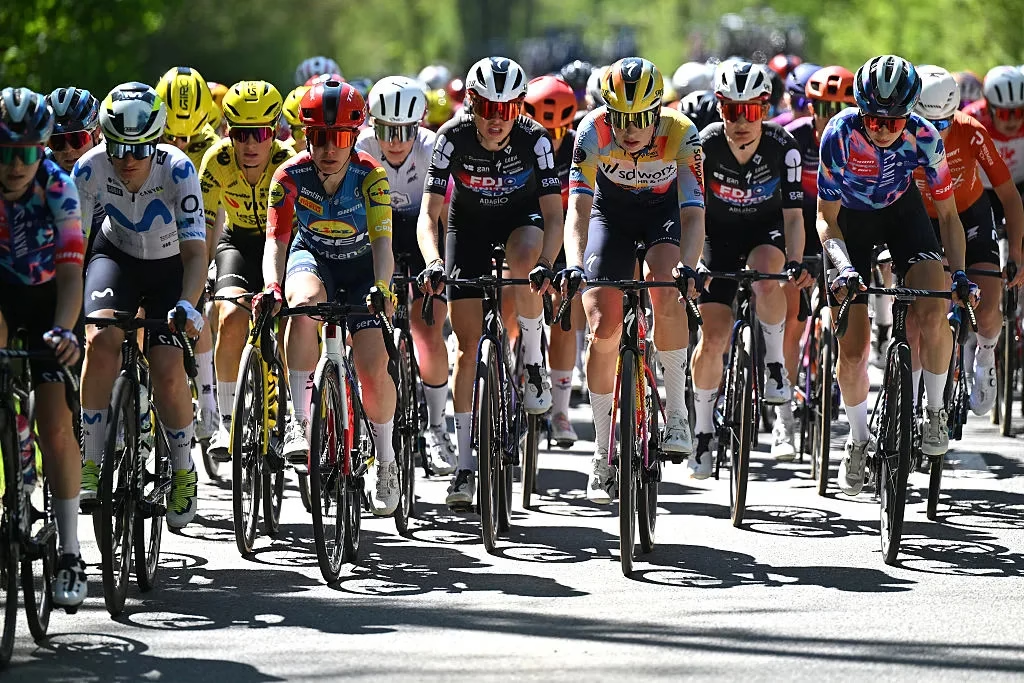
The podium behind Vollering is important too. Puck Pieterse, the 2025 winner, finished 2nd in 2026, while Paula Blasi took 3rd only days after her Amstel Gold Race Women victory. That gives the 2026 edition a distinctly modern feel: a proven uphill specialist winning, last year’s winner still right there, and a fast-rising younger rider confirming her place at the top level.
Historically, that is useful because it shows the race is not frozen in one era’s terms. The Mur still decides things, but the riders arriving there are changing. Van der Breggen’s era was about repeated supremacy. Vollering’s era, at least so far, looks more contested. Pieterse is close enough to make every victory a fight, and Blasi’s emergence suggests the next layer is rising quickly.
The race is getting longer, but the essential question is unchanged
The 2026 edition was the longest in the race’s history at 148.2km, which reflects a broader trend in women’s cycling toward longer, more demanding one-day races. Earlier editions were often considerably shorter, especially in the first decade of the event. That makes the modern race harder before the Mur de Huy even begins.
Yet the interesting thing is that extra distance has not changed the race’s essential identity. It has made the field more fatigued and the run-in more selective, but it has not removed the Mur’s authority. If anything, the longer route only sharpens the historical continuity: even as the sport modernises and the race grows, the same final climb still exposes the same core qualities.
-
 Photo Credit: A.S.O./Billy Ceusters

What 2026 tells us about the current era
In the historical context, 2026 looks like a bridge edition. It did not belong to a single-rider monopoly in the way many of the Van der Breggen years did, but it did confirm Vollering as the clearest current specialist for this finish. It also kept Pieterse central to the race’s ongoing story and added Blasi to the shortlist of riders who may shape its next phase.
That makes La Flèche Wallonne Femmes 2026 historically useful. It sits at the point where the race still has a reigning reference rider, but no longer feels closed by one dominant pattern. The hierarchy is visible, but not fixed. That is often when a race becomes most interesting, because history is still recognisable while the next version of it is already pushing through.
How the 2026 edition should be remembered
La Flèche Wallonne Femmes 2026 should be remembered as the year Demi Vollering became more than a one-time winner at Huy. She is now part of the race’s repeat-winner tradition, and that matters in a Classic whose history is so heavily shaped by riders who mastered one very particular finish more than once.
It should also be remembered as an edition that kept the race’s long themes intact. The Mur de Huy still ruled. Dutch riders still shaped the outcome. The route got longer, but the essential question remained the same. At the same time, Pieterse and Blasi made clear that the current era is not settled enough to become repetitive.
That is a strong historical place for any edition to occupy. La Flèche Wallonne Femmes 2026 did not rewrite the race. It confirmed where the race has come from, and hinted at where it goes next.

