
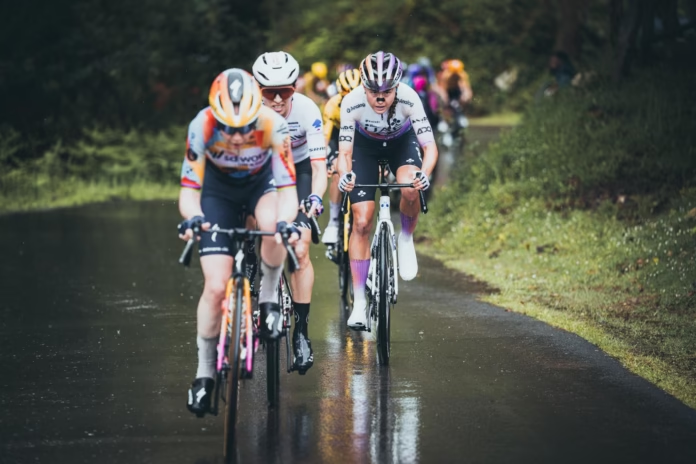
La Vuelta Femenina 2026 ends on Saturday, 9th May with the stage the whole race has been pointing towards: La Pola Llaviana/Pola de Laviana to L’Angliru. After six days of crashes, bonus seconds, sprint finishes, late attacks and one brutal summit finish at Les Praeres, the final stage brings the most feared climb of the race.
The route covers 132.9km and is the longest stage of this year’s race. It is also the queen stage, with three categorised climbs before the final ascent of L’Angliru. That makes it a very different test from Stage 6. Les Praeres was short, savage and explosive. The Angliru is longer, more attritional and far more likely to punish anyone who starts the final climb already close to the limit.
Anna van der Breggen starts the final stage in the red jersey after winning Stage 6 on Les Praeres. She leads Paula Blasi by 18 seconds, with Marion Bunel 3rd at 41 seconds, Monica Trinca Colonel 4th at 52 seconds and Évita Muzic 5th at 59 seconds. The gaps are now real, but not secure. On the Angliru, even a minute can disappear quickly.
For the wider route picture, our La Vuelta Femenina 2026 full route guide breaks down all seven stages and how the race has built towards this final mountain showdown.

La Vuelta Femenina 2026 stage 7 route
Stage 7 starts in La Pola Llaviana/Pola de Laviana and finishes on L’Angliru after 132.9km. The race stays in Asturias for its final day, using terrain that should make the stage hard long before the final climb begins.
The opening part of the stage includes the category 3 Alto de Santo Emiliano after around 15km. It comes too early to decide the race, but it should help shape the breakaway and begin wearing down teams before the more serious climbing arrives later.
The second categorised climb is the Alto de la Tejera, another category 3 ascent, which comes after roughly 75km. That should bring the race back into a more selective phase, especially if teams with GC ambitions want to make the final approach harder.
The category 2 Alto del Tenebredo arrives around 98km into the stage and is the most important climb before the Angliru. It gives teams a chance to weaken rivals, isolate leaders and set up support riders before the final ascent. A rider who is already struggling here will have a very difficult time surviving the Angliru.
Then comes the climb everyone has been waiting for. L’Angliru is around 13km long at close to 10 per cent average, but the average does not fully explain the difficulty. The second half is the real problem, with extreme ramps, irregular gradients and sections that can push riders into survival mode. It is one of the most brutal climbs in professional cycling and a fitting final test for the red jersey.
What time does stage 7 start?
Stage 7 is expected to start at 10:36 local time in Spain, which is 09:36 in the UK. The finish is expected around 14:30 local time, or 13:30 UK time, depending on the speed of the race.
Key stage details:
- Date: Saturday, 9th May
- Route: La Pola Llaviana/Pola de Laviana to L’Angliru
- Distance: 132.9km
- Stage type: Mountain
- Key climbs: Alto de Santo Emiliano, Alto de la Tejera, Alto del Tenebredo and L’Angliru
- Final climb: L’Angliru
- Final climb length: around 13km
- Final climb average gradient: around 9.7 per cent
- Stage start: around 09:36 UK time
- Expected finish: around 13:30 UK time
- Race leader: Anna van der Breggen
UK viewers can follow the race through TNT Sports and HBO Max, with the wider broadcast picture covered in our guide to watching La Vuelta Femenina 2026 in the UK.
Why stage 7 matters
Stage 7 matters because it decides La Vuelta Femenina 2026. Stage 6 finally created a proper climbing hierarchy, but the Angliru is a harder and more complete test. It is not only about one explosive acceleration. It is about managing effort through the whole stage, staying calm before the final climb, then surviving one of the steepest finishes in the sport.
Van der Breggen has the jersey, but she does not have enough time to ride passively. Blasi is only 18 seconds behind, and Bunel is still within 41 seconds. Trinca Colonel and Muzic are also inside one minute. If any of those riders can put Van der Breggen under pressure before the final climb, the race could still open up.
The stage also matters for the secondary classifications. Kopecky still leads the points competition, Van der Breggen leads the mountains classification but will wear red, Alice Coutinho is set to wear the polka-dot jersey on the road, Bunel leads the white jersey, and SD Worx-Protime have taken over the team classification. All of those competitions could still be shaped by the final climb.
For the latest standings, our GC and jerseys after La Vuelta Femenina 2026 stage 6 tracks the red, green, mountains, white and team classifications before the final stage.
 Photo Credit: Naike Erenozaga
How stage 6 changed the race
Stage 6 to Les Praeres changed everything. Until then, the race had been dominated by Kopecky’s consistency, sprint strength and SD Worx-Protime’s repeated success in the flatter and rolling stages. Once the road hit the steepest gradients, the race became something else.
Van der Breggen attacked on the final climb and won the stage by eight seconds from Blasi, with Bunel taking 3rd. Kopecky lost more than 10 minutes, ending her GC challenge and leaving Van der Breggen as SD Worx-Protime’s clear race leader.
Blasi’s ride was one of the most important results of the day. She did not match Van der Breggen completely, but she stayed close enough to keep the race alive. Bunel’s 3rd place also moved her onto the podium and into the white jersey, confirming her as one of the strongest climbers in the race.
The Angliru now comes with a clearer hierarchy, but also with enough uncertainty to keep the final stage open. Van der Breggen is the strongest rider so far. Blasi is close. Bunel is climbing well. Trinca Colonel and Muzic remain close enough to pressure the podium. Niewiadoma, Ostolaza and Aalerud are further back, but the final stage is hard enough for riders outside the top five to move sharply.
Contenders to watch on stage 7
Anna van der Breggen is the obvious favourite after Stage 6. She was the strongest rider on Les Praeres, now has the red jersey, and has the experience to manage a final-stage mountain defence. The Angliru is longer than Les Praeres, but Van der Breggen’s pacing and tactical control should suit the demands of the climb.
Paula Blasi is the biggest threat to red. She is only 18 seconds behind and showed on Les Praeres that she can stay close to Van der Breggen when the road gets steep. UAE Team ADQ have had a strong race across the classifications, and Blasi now has a realistic route to overall victory if she can distance Van der Breggen on the hardest ramps.
Marion Bunel starts the day 3rd overall and in the white jersey. Her Stage 6 ride was a major statement, and the Angliru gives her another chance to show that she can climb with the best in a WorldTour stage race. She does not need to win the stage to finish on the podium, but if the race becomes chaotic, she is close enough to aim even higher.
Monica Trinca Colonel is 4th overall after a strong climb on Les Praeres and should not be dismissed. The Angliru is a different test, but she is close enough to attack the podium if either Blasi or Bunel has a weaker day. Liv AlUla Jayco have a clear reason to keep her well positioned before the final climb.
Évita Muzic is 5th overall and remains FDJ-Suez’s best GC card. She did not gain as much as she might have hoped on Les Praeres, but she stayed within a minute of red and should be suited to another hard mountain finish. If the pace is high before the Angliru, Muzic can still move forward.
Kasia Niewiadoma begins the day at 1:25 and will need a more aggressive race if she wants to move onto the podium. Canyon SRAM zondacrypto may have to take risks rather than simply waiting for the final few kilometres. The Angliru is steep enough for major gaps, but Niewiadoma probably needs the race to be hard before the climb fully bites.
Usoa Ostolaza is another rider who should appreciate a race decided by attrition. Laboral Kutxa-Fundación Euskadi have less responsibility than the biggest teams, which may give her room to race more aggressively. She is tied with Niewiadoma and Katrine Aalerud at 1:25, so a top-five finish is still within reach if she climbs well.
Katrine Aalerud also sits at 1:25 and has the experience to handle a demanding final stage. Uno-X Mobility will know that the Angliru gives her a chance to move up if riders ahead begin to crack.
Lore De Schepper and Lotte Claes complete the top 10 before the final stage and have already exceeded the expectations of many riders in the field. The Angliru will be the biggest test yet, but both have a position worth defending.
Ashleigh Moolman Pasio, Mavi Garcia and Valentina Cavallar are all outside the immediate GC podium picture but remain relevant for the stage. Each has the climbing profile to be visible on the Angliru if they have recovered well from Les Praeres.
-
 Photo Credit: Getty

Tactical outlook
Stage 7 should be more complicated than a simple final-climb shootout. The Angliru is the decisive point, but the three earlier categorised climbs give teams a chance to make the race harder before the final ascent.
SD Worx-Protime have the strongest position. Van der Breggen is in red, the team leads the team classification, and they have enough depth to manage the race if everything stays controlled. Their main aim should be to keep Van der Breggen safe, prevent dangerous moves from riders close on GC, and make sure she starts the Angliru with support and good position.
UAE Team ADQ have the most obvious reason to attack. Blasi is only 18 seconds from red, and waiting until the final kilometre may not be enough. They may try to make the race harder on Alto del Tenebredo or use teammates earlier to put SD Worx-Protime under pressure before the final climb.
Team Visma | Lease a Bike have Bunel on the podium and the white jersey to defend. Their race is already a success, but they also have a chance to do more if the final stage becomes unstable. Bunel is close enough to profit if Van der Breggen and Blasi focus too much on each other.
FDJ-Suez and Liv AlUla Jayco also have podium ambitions through Muzic and Trinca Colonel. Canyon SRAM zondacrypto, Laboral Kutxa-Fundación Euskadi and Uno-X Mobility may need a more open race if Niewiadoma, Ostolaza or Aalerud are to move significantly up the standings.
The breakaway will still be tempting, especially for riders out of GC contention who want one final chance. But if the GC teams race the stage properly, the break may struggle to survive the Angliru. The final climb is so hard that the stage winner is likely to come from the group of overall contenders unless the break has a very large advantage.
Prediction
Stage 7 should confirm the strongest climber of La Vuelta Femenina 2026. The Angliru is too hard for luck, too long for a simple punch, and too steep for riders who are already on the limit before the final climb begins.
Van der Breggen is the pick to win the stage and the overall. She looked the strongest rider on Les Praeres, has the tactical experience to defend red, and should be well supported by SD Worx-Protime before the final climb. Blasi is the clearest danger and only needs a small gap to make the overall race tense, while Bunel has a strong chance of defending the white jersey and holding the podium.
Behind them, Muzic, Trinca Colonel, Niewiadoma, Ostolaza and Aalerud can all move if the Angliru breaks the race apart. The final climb should produce more time gaps, and the podium may still change, but Van der Breggen now has the strongest combination of form, experience and race position.
The most likely outcome is another GC battle on the final climb, with the Angliru confirming Van der Breggen as the strongest rider of the week and deciding the remaining podium places behind her.

