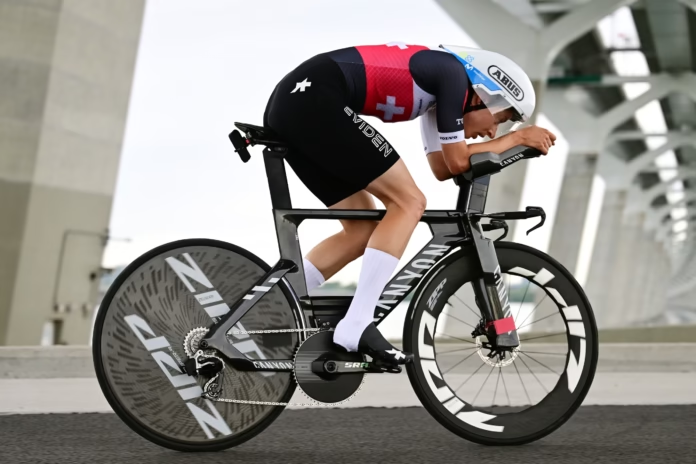
Marlen Reusser retained the elite women’s individual time trial world title in Montréal, recovering from a slower opening section to beat Zoe Bäckstedt by 40 seconds over the 39.2km course.
Bäckstedt set the early standard among the final starters and remained ahead of Reusser through the opening two checkpoints, but the Swiss rider transformed the race through the second half. Reusser moved into the lead before the final intermediate and continued to extend the gap all the way to the finish.
Franziska Koch completed the podium for Germany after a superb ride that had kept her in the hot seat deep into the race, with Elisa Longo Borghini fourth and Cédrine Kerbaol fifth.
How it unfolded
The 39.2km Montréal course was a very different test from the climbing-heavy time trial that decided the world title in Kigali a year earlier. With only 220 metres of elevation gain, long stretches beside the St Lawrence River and the fast roads of Circuit Gilles-Villeneuve, it rewarded sustained speed and careful pacing.
The early benchmarks changed repeatedly as the stronger riders began to reach the finish. Taylor Knibb moved into the lead with 52:43 before Lotte Claes lowered the best time to 52:34. Dominika Włodarczyk then went faster again in 52:24.
Koch changed the level of the competition.
The German was already fastest at the second checkpoint and continued to build through the final section, reaching the finish in 51:09.98. That put her more than a minute ahead of Włodarczyk and established the first time capable of surviving against the final group of favourites.
Kerbaol finished 24 seconds slower than Koch, while Longo Borghini came considerably closer after a strong final section. The Italian stopped the clock at 51:14.74, just under five seconds outside Koch’s provisional lead.
Koch remained in front, but Bäckstedt and Reusser were still on the course.
Bäckstedt puts Reusser under pressure
Bäckstedt had opted to race the elite time trial rather than defend her under-23 world title, and the British rider immediately justified that decision.
She flew through the opening checkpoint in 13:36, ten seconds faster than Reusser. For a rider who had started as one of the principal challengers in the women’s World Championships time trial preview, it was the strongest possible opening.
The advantage did not disappear immediately either. Bäckstedt remained fastest at the second checkpoint, six seconds ahead of Koch, although Reusser had already reduced her deficit to around three seconds.
That was the point at which the race began to change.
Bäckstedt continued to ride strongly and reached the final intermediate nine seconds ahead of Koch. Reusser, however, had moved onto a completely different pace. The defending champion passed the same checkpoint 14 seconds faster than Bäckstedt.
For the first time, Reusser was in control.
Reusser dominates the final section
The gap continued to grow through the closing kilometres.
Reusser had started 90 seconds behind Demi Vollering and eventually caught and passed the Dutch rider on the road. Vollering had already lost substantial time through the opening half and would eventually finish eighth, almost 1:50 behind the winner.
Conditions also became more difficult towards the end. Rain began to fall over parts of the course, leaving several of the final corners increasingly slippery just as the last riders approached the finish.
Bäckstedt nevertheless completed an excellent ride, stopping the clock at 51:04.55 and moving five seconds ahead of Koch.
It was enough to guarantee Great Britain a medal, but Reusser was still taking time.
The Swiss rider reached the finish in 50:24.44, beating Bäckstedt by 40.11 seconds and Koch by 45.54 seconds. What had begun with Reusser ten seconds behind at the first checkpoint ended with another comfortable world title.
 Photo Credit: Getty
Bäckstedt takes silver on elite debut
Silver was another important step in Bäckstedt’s progression from age-group dominance into the elite ranks.
The 21-year-old had already shown during 2026 that she could compete with the strongest time triallists, but Montréal presented a different challenge. At 39.2km, it was considerably longer than most of the time trials she had raced during the season.
Her response was to lead the world championship through the first half and remain the only rider capable of keeping Reusser within sight once the defending champion increased her speed.
Koch’s bronze was one of the other major performances of the day. The German spent a long period as provisional leader and ultimately finished only 5.43 seconds behind Bäckstedt.
Longo Borghini missed the podium by less than five seconds, while Kerbaol rounded out the top five.
Lotte Kopecky finished sixth, with Antonia Niedermaier seventh and Vollering eighth. Włodarczyk and Vittoria Guazzini completed the top 10.
For Reusser, the victory completed a successful title defence on a course that required a very different ride from Kigali. She did not need to dominate from the opening kilometres. Instead, she absorbed Bäckstedt’s fast start, closed the gap steadily and produced the strongest part of her ride when the race reached its decisive final third.
Women’s World Championships time trial 2026 result
| Pos. | Rider | Nation | Time/gap |
|---|---|---|---|
| 1 | Marlen Reusser | Switzerland | 50:24.44 |
| 2 | Zoe Bäckstedt | Great Britain | +40.11 |
| 3 | Franziska Koch | Germany | +45.54 |
| 4 | Elisa Longo Borghini | Italy | +50.30 |
| 5 | Cédrine Kerbaol | France | +1:10.14 |
| 6 | Lotte Kopecky | Belgium | +1:47.63 |
| 7 | Antonia Niedermaier | Germany | +1:49.54 |
| 8 | Demi Vollering | Netherlands | +1:49.94 |
| 9 | Dominika Włodarczyk | Poland | +1:59.08 |
| 10 | Vittoria Guazzini | Italy | +2:05.37 |
Main photo credit: Getty