

The Men’s Tour de Suisse 2026 continues on Friday, 19th June, with stage 3 starting and finishing in Bad Ragaz after Romain Grégoire’s breakaway victory in Locarno. Tadej Pogačar remains in control of the overall race, but the third stage gives a different group of riders a chance, especially if the fast finishers can survive the climbing and reorganise before the finish.
Stage 3 covers 157.9km with 2,690m of climbing. It is officially listed as a hilly stage with a 3/5 difficulty rating, but it is also the closest thing the men’s race has to a sprint opportunity before the Aarburg time-trial and the final mountain stage in Villars-sur-Ollon. The main obstacle is Schwägalp, which comes far enough from the finish to give dropped riders a chance to return, but only if their teams still have the numbers to chase.
UK viewers should treat this as an afternoon stage. The race starts at 12:45 BST, live coverage is expected from 14:00 BST, and the finish is scheduled for around 16:45 BST. The Swiss broadcast window runs until 17:15 BST, giving coverage time for post-stage reaction and classification updates.
For wider race context, see our Men’s Tour de Suisse 2026 full route guide, the full start list for Men’s Tour de Suisse 2026, our Men’s Tour de Suisse 2026 team-by-team guide and our Men’s Tour de Suisse 2026 stage 3 preview.
What time does Men’s Tour de Suisse 2026 stage 3 start?
Men’s Tour de Suisse 2026 stage 3 starts at 12:45 BST on Friday, 19th June.
The stage begins and ends in Bad Ragaz, with the riders taking on 157.9km around eastern Switzerland. The expected finish is around 16:45 BST, although that can shift slightly depending on the early breakaway, the pace on Schwägalp and how quickly the chase organises on the flat run back to the finish.
Live coverage is expected from 14:00 BST. That means UK viewers should join the stage with the breakaway already formed and the race heading towards the more important middle and later sections.
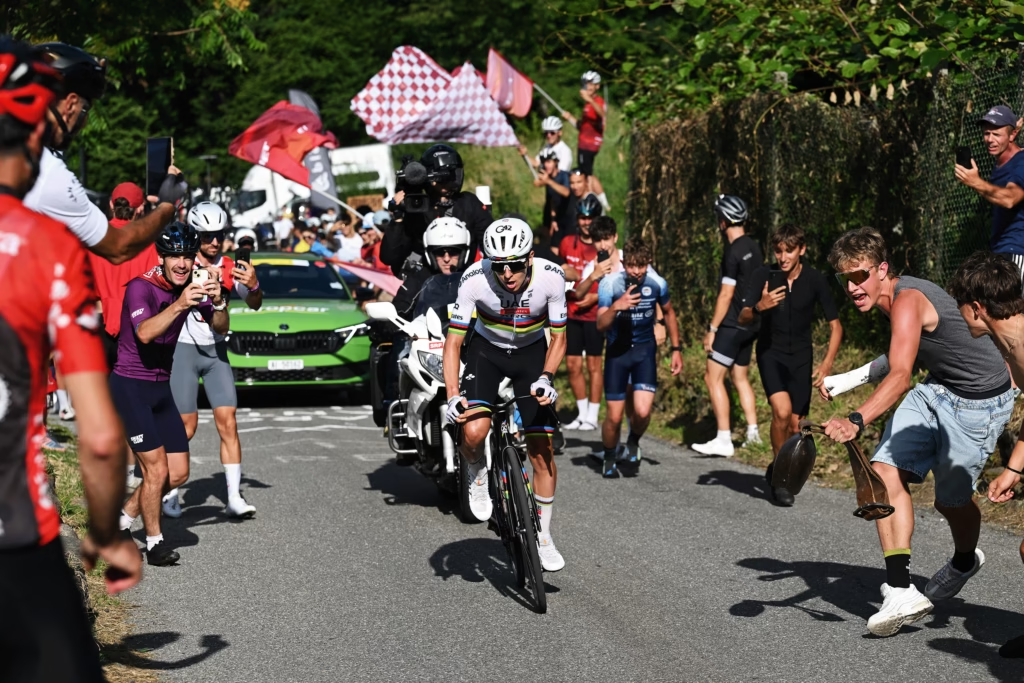
Men’s Tour de Suisse 2026 stage 3 timings in the UK
Stage 3 date: Friday, 19th June
Route: Bad Ragaz to Bad Ragaz
Distance: 157.9km
Elevation: 2,690m
Stage type: Hilly
Race start: 12:45 BST
Live coverage starts: around 14:00 BST
Expected finish: around 16:45 BST
Broadcast scheduled until: around 17:15 BST
The key viewing window should be from around 15:00 BST onwards. That should take the race towards Schwägalp, the descent, the long flat return to Bad Ragaz and the likely fight between the breakaway and the chasing teams.
How to watch Men’s Tour de Suisse 2026 stage 3 in the UK
UK viewers should be able to watch Men’s Tour de Suisse 2026 stage 3 through Warner Bros. Discovery’s cycling coverage, with HBO Max expected to be the main streaming route and TNT Sports the main television option where schedules allow.
The official Tour de Suisse broadcast information lists Eurosport for the United Kingdom, which now sits within the wider WBD/TNT Sports/HBO Max setup. Viewers should check HBO Max’s live cycling section, TNT Sports listings and Eurosport-branded schedules before the stage begins, as channel allocation can vary when the race overlaps with other live sport.
The stage is not expected to be free-to-air in the UK. Highlights, short clips and post-stage videos may appear later, but live coverage should be treated as a paid broadcast option.
For more on the broader broadcast picture, see our how to watch Men’s Tour de Suisse 2026 in the UK guide.
Is Men’s Tour de Suisse 2026 stage 3 free to watch in the UK?
Men’s Tour de Suisse 2026 stage 3 is not expected to be free-to-air in the UK.
The UK broadcast route is through Eurosport/WBD coverage, so live viewing should come through HBO Max and TNT Sports rather than a free public stream. Viewers outside the UK may have different local options, particularly in Switzerland, where the host broadcaster coverage forms part of the race schedule.
What happened on stage 2?
Romain Grégoire won stage 2 in Locarno after the breakaway survived a late chase from the reduced peloton. The Groupama-FDJ United rider was the fastest from the remains of the front move, beating Marcel Camprubí and Bart Lemmen in the sprint.
Pogačar still finished close behind and remained firmly in control of the general classification. His stage 1 solo ride in Sondrio had already given him a commanding advantage, and the late push towards the stage 2 finish showed that he is still willing to race aggressively even when UAE Team Emirates-XRG do not need to chase every move.
That context matters for stage 3. UAE can afford to manage rather than dominate, while other teams may look at Bad Ragaz as one of their best remaining chances for a stage win. The route is too hard to be a guaranteed sprint, but not hard enough to force a GC showdown.

What is the Men’s Tour de Suisse 2026 stage 3 route?
Stage 3 starts and finishes in Bad Ragaz, covering 157.9km with 2,690m of climbing. It is a hilly stage, but the tactical shape is more important than the raw numbers.
The riders tackle St. Luzisteig shortly after the start, which should help shape the early breakaway. The race then passes through the Principality of Liechtenstein and heads towards the Appenzell region before the key climb of the day, Schwägalp.
Schwägalp is where the stage should become clearest. If the pace is controlled, some of the sprinters and classics-style fast men can survive or chase back. If the climb is ridden hard, the race may split and leave only the more durable riders in contention.
After the descent towards Altstätten, the route flattens out all the way back to Bad Ragaz. That gives the sprint teams a route back into the stage, but only if they still have enough riders to chase. It also makes life harder for attackers, who will need commitment and cooperation to hold off a larger group on the flat run-in.
Why stage 3 matters
Stage 3 matters because it is the most realistic sprint-related opportunity in the Men’s Tour de Suisse 2026. Stage 1 was too hard, stage 2 suited the breakaway and puncheurs, stage 4 is the individual time-trial, and stage 5 is the mountain stage in Villars-sur-Ollon.
That makes Bad Ragaz a key day for riders such as Mathieu van der Poel, Thibau Nys, Marc Hirschi, Romain Grégoire and the faster finishers who can survive a hard climb. It also gives sprinters such as Jasper Philipsen, Arnaud De Lie and Matthew Brennan a possible route into the race if they can make it over Schwägalp or chase back afterwards.
For the GC contenders, the stage is about staying safe. Pogačar has the race lead, Richard Carapaz is still one of the main challengers, and riders such as Primož Roglič, Antonio Tiberi, Enric Mas, Ilan Van Wilder and Max Poole need to avoid unnecessary trouble before the time-trial and final mountain stage.
The balance between those two groups should shape the race. The sprinters need control. The GC teams need calm. The breakaway riders need hesitation. That combination can make a stage with no obvious summit finish much more interesting than the profile first suggests.
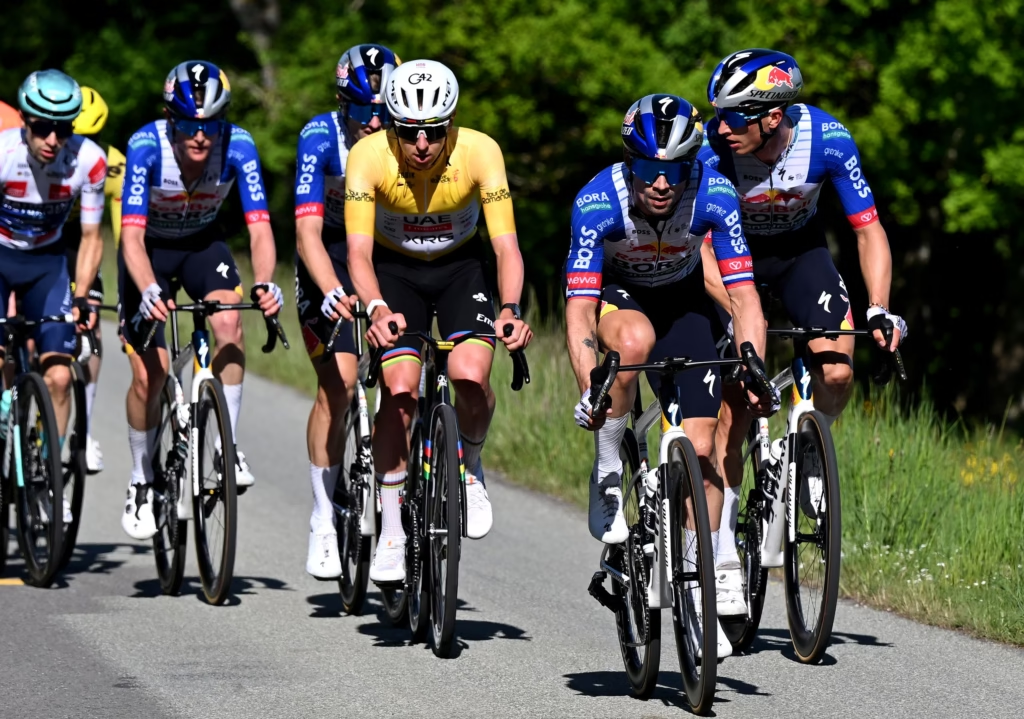
Which riders should viewers watch?
Tadej Pogačar starts stage 3 as the race leader and the rider around whom the whole race is organised. He does not need to attack in Bad Ragaz, but his presence still changes the stage. If UAE Team Emirates-XRG control the race, the sprint teams may get help. If UAE leave the chase to others, the breakaway could have more freedom.
Romain Grégoire should be watched again after his stage 2 win. He has already shown that he can use this race’s hilly terrain to excellent effect, and stage 3 also suits his punchy, fast-finishing style if the pure sprinters are put under pressure.
Mathieu van der Poel looks like one of the most obvious favourites if the race comes back together. Schwägalp should not be easy, but if he survives or returns on the flat run-in, his finishing speed and power make him a major threat.
Marc Hirschi is another clean fit for the stage. Tudor Pro Cycling Team have a rider who can climb, descend, attack and sprint from a reduced group. A hard race over Schwägalp would make the stage more selective, and that should suit him.
Thibau Nys gives Lidl-Trek a strong option if the finish comes from a reduced group. He has the punch to handle selective terrain and the speed to win if the pure sprinters are missing.
Richard Carapaz is unlikely to target the stage in the same way, but he remains dangerous if the race becomes aggressive. EF Education-EasyPost may want to keep pressure on UAE, and Carapaz can turn a tactical split into a GC problem.
Primož Roglič, Antonio Tiberi, Ilan Van Wilder, Enric Mas and Max Poole should mostly be thinking about positioning and safety. None of them can afford to be caught behind if the race breaks up over Schwägalp.
Jasper Philipsen, Arnaud De Lie and Matthew Brennan are the sprint-related names to watch if they start and survive the climbing. The route is not ideal for them, but the long flat return to Bad Ragaz gives them a chance to come back if their teams are organised.
When is the best time to watch stage 3?
Live coverage is expected from around 14:00 BST, but the most important part of the stage should come later.
The opening phase should be about breakaway formation. St. Luzisteig comes early and may help produce a strong move, especially from teams that do not want to wait for the time-trial or final mountain stage.
The best viewing window should be from around 15:00 BST to the finish. That should cover the approach to Schwägalp, the key climb itself, the descent, the flat chase back to Bad Ragaz and the final sprint or breakaway finish.
If the breakaway still has a strong advantage after Schwägalp, the stage could become very tense. If the sprint teams keep the gap close, the final 30km may become a chase between a reduced peloton and the riders who survived up front.
-
 Photo Credit: A.S.O./Gaëtan Flamme

What could happen tactically?
The most likely scenario is a strong breakaway, followed by a complicated chase. That has already been the pattern of the race, and stage 2 showed that the peloton can still misjudge the timing when the front group has enough strength.
The sprint teams will want control, but they may be reluctant to chase too hard before knowing whether their fast riders can survive Schwägalp. If a sprinter is dropped and left without teammates, the stage can quickly slip away. If a team uses too much energy chasing before the climb, they may not have enough left for the flat run back.
UAE Team Emirates-XRG are unlikely to take full responsibility unless a dangerous GC move goes. With Pogačar in yellow, they can manage the race rather than chase for every stage contender. That could leave the burden on teams such as Alpecin-Premier Tech, Lidl-Trek, Tudor Pro Cycling Team and others with stage ambitions.
If the bunch comes back together, Van der Poel, Nys, Hirschi and Grégoire should be among the strongest reduced-group options. If the breakaway survives, it will probably be because the sprint teams waited too long to commit after Schwägalp.
Men’s Tour de Suisse 2026 stage 3 summary
Men’s Tour de Suisse 2026 stage 3 takes place on Friday, 19th June, with a 157.9km hilly route starting and finishing in Bad Ragaz. The race starts at 12:45 BST, live coverage is expected from 14:00 BST, and the finish should come at around 16:45 BST.
UK viewers should look to HBO Max, TNT Sports and Eurosport-branded listings for live coverage. The race is not expected to be free-to-air in the UK.
Pogačar starts the day still in control overall, while Grégoire arrives with momentum after winning stage 2. Bad Ragaz should be the best chance of the week for the fast finishers, but Schwägalp makes it far from a simple sprint day. A reduced sprint, a breakaway win or a late attack are all possible, with the decisive question being whether the sprint teams can survive the climb and still organise the chase on the flat road back to Bad Ragaz.

