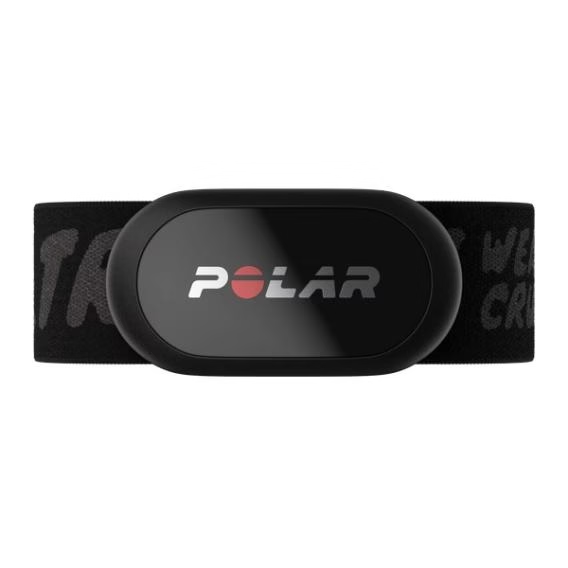
Both the Polar H10 and Wahoo TRACKR HEART RATE are intended to solve the same cycling problem: measuring heart rate reliably when a watch-based optical sensor can become less dependable during repeated changes in effort. Each uses electrical signals detected at the chest rather than relying on reflected light at the wrist. For a road cyclist tracking intervals, riding on an indoor trainer or monitoring aerobic training, either is a plausible upgrade.
The difference is not simply that one records heart rate better. Polar’s established H10 has a replaceable coin-cell battery, support for storing an exercise session and greater water resistance. Wahoo’s TRACKR has a rechargeable battery, a light strap and extra simultaneous Bluetooth connections. The Polar is marginally more expensive at typical UK prices, but its additional features can change the value calculation.
This comparison is based on manufacturer specifications, current UK retailer listings and independent testing from BikeRadar, Cycling Weekly, Cyclingnews and other specialist reviewers. ProCyclingUK has not performed a direct hands-on accuracy or laboratory test, so we distinguish reported test findings from specifications and avoid inventing performance differences.
Polar H10 vs Wahoo TRACKR specifications
| Feature | Polar H10 | Wahoo TRACKR HEART RATE |
|---|---|---|
| UK reference price, November 2026 | £86.50 | £79.99 |
| Sensor type | Electrical chest-strap heart-rate monitor | Electrical chest-strap heart-rate monitor |
| Battery | Replaceable CR2025 coin cell | Rechargeable lithium-ion battery |
| Claimed active battery life | Up to 400 hours | Over 100 hours |
| Water resistance | WR30, rated to 30 metres | IPX7, one metre for up to 30 minutes |
| Total weight, manufacturer | Approximately 60g with strap | Approximately 39g with strap |
| Bluetooth connections | Two simultaneous connections | Up to three simultaneous connections |
| ANT+ | Yes | Yes |
| Session memory | One session, via Polar Beat workflow | No comparable onboard workout storage |
| Charging requirement | Replacement coin cell | Dedicated magnetic charger with USB-C cable end |
Those are product-specific reference prices, not guaranteed Black Friday offers. Fitshop showed both Polar H10 strap sizes in stock at £86.50, while 99 Bikes listed the exact Wahoo TRACKR, product code WFBTHR05W, in stock online for £79.99. Manufacturer and retailer prices can move rapidly in November, so the live destination should be checked before buying.
Is there a real accuracy difference?
Both straps use a chest-based electrical signal, which is generally better suited to rapid changes in effort than a wrist optical sensor. The H10 has an extensive reputation as a benchmark monitor, and it is frequently used as the reference device when other sports watches and sensors are tested. That reputation is useful, but it does not prove that every H10 will produce more accurate data than every TRACKR during an ordinary club ride.
BikeRadar tested both models within its heart-rate monitor comparison. It praised the Polar for accurate, consistent readings and a particularly secure, comfortable strap. The same group test found Wahoo’s TRACKR light and consistent, with no unusual readings during normal use, although its reviewer questioned the overall feature set against the price. These findings do not establish a meaningful accuracy gap for routine cycling.
Cycling Weekly tested the TRACKR during indoor races, wet rides and demanding efforts, comparing it principally with an older Wahoo TICKR. Most readings matched closely, but the tester experienced occasional unexplained heart-rate spikes. That is worth knowing, though isolated readings in one individual’s test should not be translated into a failure rate for the entire model. Other reviewers have found the Wahoo reliable against a Polar H10 reference.
For practical training decisions, fitting the strap correctly matters more than choosing the model with the most aggressive accuracy claim. Moisten the electrodes, ensure the sensor sits snugly against the chest, check the battery and clean the textile strap regularly. If a monitor repeatedly shows impossible values at the beginning of a cold ride, poor electrode contact can be the cause. A completely dry strap may take longer to establish a clean signal.
The real battery choice is replaceable or rechargeable
Polar specifies up to 400 hours from a CR2025 battery. This is an unusual cell compared with the CR2032 used by many other sensors; substituting a larger CR2032 is not recommended because it may damage the battery compartment. The advantage of a coin cell is that it can be replaced immediately if the sensor dies before a ride, provided a suitable spare is available.
Wahoo claims more than 100 active hours from its rechargeable battery. That is still many weeks of riding for somebody training three or four times a week, but substantially fewer active hours than Polar’s stated maximum. It also means keeping track of another device that needs charging. A warning light on the sensor helps, and the charging connection uses a magnetic head with USB-C at the other end. The magnetic head is specific to this product, however, so losing the cable is less convenient than misplacing a standard USB-C lead.
Rechargeability avoids repeated disposable coin cells, and that may be a legitimate reason to favour the TRACKR. Equally, a replaceable battery can help an H10 remain useful for years without uncertainty about the eventual lifespan of a built-in rechargeable cell. Neither technology is maintenance-free. The sensible choice depends on whether you prefer occasional battery replacement or remembering to charge.
 Photo Credit: Polar
Water resistance and recording without a bike computer
Polar has a clear functional advantage for swimmers and people recording mixed-sport training. It quotes WR30 water resistance and provides a single-session memory function when started through the Polar Beat app. That lets a workout be recorded without continuously transmitting to a phone or bike computer, then transferred afterwards. It is particularly useful in settings where wireless data transmission through water cannot be relied upon.
Wahoo’s TRACKR is IPX7-rated, which is sufficient protection for heavy rain, sweat and short accidental immersion in normal cycling use. It should not be treated as a dedicated swimming sensor or a device with equivalent built-in workout memory. BikeRadar specifically highlighted those limitations in its comparison. If your only concern is road and indoor cycling, Polar’s extra water resistance may have little value; if you swim regularly, it matters.
For cyclists who own a compatible watch and an indoor training setup, either device can supply heart rate over ANT+ and Bluetooth. The Polar H10 also supports older 5kHz connections that can be useful with some gym equipment. Before buying for a particular treadmill or exercise bike, check the actual connection protocol rather than assuming that every machine recognises every modern Bluetooth strap.
Connectivity and multiple devices
Polar allows two simultaneous Bluetooth connections and ANT+ transmission, a combination that covers most common cycling arrangements. A rider could connect a bike computer and phone app while still using ANT+ with compatible indoor equipment. Wahoo quotes up to three simultaneous Bluetooth connections as well as ANT+, which offers a little more flexibility when several devices are listening at once.
This distinction sounds minor, and for most riders it is. Connecting a single bike computer or a Zwift setup needs no elaborate connection strategy. However, cyclists collecting data on a sports watch, indoor trainer application and another recording system may appreciate the extra pairing channel. The precise behaviour depends on the apps involved, and not every application handles reconnecting in the same way.
Both products can supply heart-rate variability information to compatible applications. HRV functionality should not be mistaken for a built-in coaching platform or a medical diagnosis. The strap supplies timing data; the application makes whatever interpretation it supports. Neither model alone tells you whether a hard interval session is appropriate tomorrow.
Fit and comfort are worth checking before ordering
Polar uses its Pro Strap with a fabric closure and silicone grip points. BikeRadar praised the H10’s comfort and stability, and Polar offers different strap-length options. Fitshop lists XS-S and M-XXL versions. That choice is useful when a standard chest strap feels excessively long or tight, but the exact size should be selected against the manufacturer’s measurement guidance.
Wahoo’s standard strap is light and soft, but some riders may find its adjustment range less accommodating. Wahoo lists an adjustable length of roughly 66.7 to 87.6cm and claims that stretch makes it suitable for chests up to 127cm. Cycling Weekly’s tester found the standard strap relatively short despite being happy with the overall comfort. It would be sensible to confirm the fit before buying if you sit near the top of the range. Wahoo also sells an XL replacement strap for larger chests.
The quoted weight difference is unlikely to alter a cycling performance outcome, but it can affect how noticeable the monitor feels during a long ride. The H10 weighs about 60g including its strap, while Wahoo quotes around 39g. Neither needs to be removed for a café stop, although cleaning and drying the strap after an indoor session will be important for hygiene and long-term reliability.
 Photo Credit: Wahoo
Which is better value in the UK?
At the checked reference prices the Polar is just £6.51 more expensive. That difference is small enough that the choice should not be dictated by the initial purchase price alone. Polar’s replaceable battery and workout memory are valuable functions, while Wahoo’s rechargeable operation and lighter strap may appeal to somebody already comfortable with regular charging.
There can be genuine seasonal discounts, particularly around Black Friday, but a price in a review is not a permanent offer. Compare the exact product and strap size at checkout. For Polar, see the Fitshop H10 listing and Polar UK specification page. For Wahoo, see 99 Bikes’ exact TRACKR listing. These are direct, non-affiliate links; no tracked offer or commission claim is made.
A cheaper strap can still be perfectly adequate for regular cycling, but models differ in replaceable straps, battery design and compatibility. If you only require one heart-rate number on a bike computer, the extra functionality here may be unnecessary. For somebody wanting dependable indoor intervals and a device that can also support other training, both make sense at their reference prices.
Which chest strap should cyclists buy?
The Polar H10 is the stronger all-round choice when precise training data, long battery life, flexible strap sizes and recording a session without a paired device matter. It has compelling independent reviews, broad compatibility and enough water resistance to suit more than cycling. The small extra purchase cost is defensible against those functions.
The Wahoo TRACKR HEART RATE makes sense for riders who dislike disposable coin cells, value a lighter and less intrusive strap, or already use several Bluetooth-connected applications. It performs the core cycling task well in independent tests, although the proprietary charging connection and absent workout memory are compromises to recognise rather than hide.
For context, our Polar H10 review discusses the benchmark strap in more detail, while our optical versus chest-strap guide explains why a chest sensor can be worthwhile for cycling training. The choice between these two isn’t about inventing a winner in measured accuracy. It is about battery maintenance, fit, extra recording functions and how you intend to use heart-rate data.
-
 Photo Credit: Netcompany INEOS (official contract announcement)
-
 Photo Credit: Sander van Ginkel / Wikimedia Commons