Jonathan Milan won stage 1 of the 2026 Renewi Tour in Diest, edging Olav Kooij in a photo finish after the day’s breakaway was caught inside the final kilometre.
The Lidl-Trek sprinter took victory after a tense and rain-soaked finale in Belgium, where Lionel Taminiaux, Dries De Bondt, Timo Kielich, Carl-Frederik Bévort and Quinten Hermans came agonisingly close to holding off the peloton. The five leaders still had 18 seconds with 2 kilometres remaining, but hesitation in the final kilometre proved fatal.
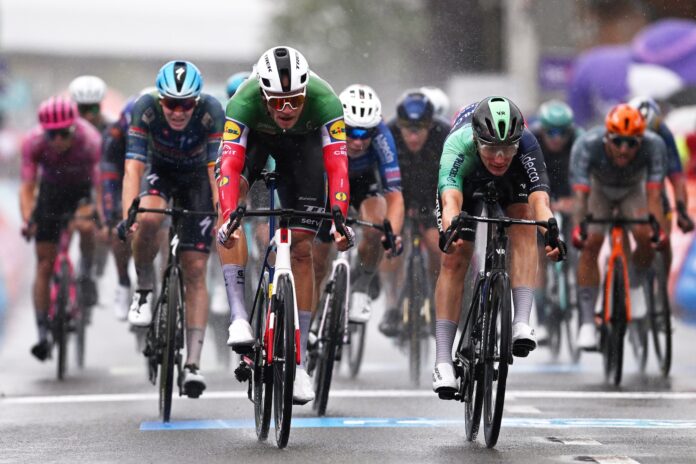
The catch came just before the sprint opened, leaving Milan and Kooij to fight for the first leader’s jersey. The finish was so close that the result needed confirmation from the photo, but Milan was given the win ahead of the Decathlon CMA CGM rider.
A fast opening stage around Diest
The 21st edition of the Renewi Tour began with a fast Belgian circuit stage around Diest, where the terrain was never hard enough to rule out a sprint but awkward enough to keep the race nervous.
The route mixed repeated passages of the finish line with short climbs including the Heuvelstraat, Kerkstraat and Grasbos. None of them were long enough to create a sustained climbing selection, but they gave the attackers places to apply pressure and made the chase more complicated than a flat run-in.
The weather added another layer. The stage began in mild conditions, with a 21°C temperature and a westerly breeze, but rain arrived in the second half of the race. By the final circuits, visibility was poor, the roads were wet and the peloton was dealing with traffic islands, pedestrian crossings, narrow roads and high speeds.
It was a stage that looked like one for the sprinters, but it took them almost the entire distance to get it under control.
Five riders form the day’s breakaway
The early kilometres were aggressive, with repeated attacks before the race finally allowed a group to form.
Taminiaux, De Bondt, Kielich, Bévort and Hermans became the day’s main breakaway, while Ferre Geeraerts tried to bridge across behind them. Geeraerts briefly chased alone but was brought back, leaving the five leaders to carry the attack.
The gap remained manageable but persistent. With 160 kilometres remaining, the peloton trailed by just over a minute. Soon after, the advantage stretched towards 2 minutes, and by 122 kilometres to go the five leaders held 1:55.
The race was still travelling quickly, with 69.1 kilometres covered in 1:32 at an average speed of 45.1km/h. The peloton was never relaxed, but it was also not in a hurry to bring the move back too early.
The break holds steady through the circuits
The stage settled into a familiar pattern as the riders completed the longer laps and then headed towards the shorter finishing circuit.
With 115 kilometres remaining, the five leaders still had around 2 minutes. At 100 kilometres to go, the gap was the same as the race crossed the finish line again before the final lap of the longer circuit.
The short climbs briefly reduced the advantage. At the foot of the two-climb sequence, the peloton had cut the gap to 45 seconds, but the break restored it to 1:15 by the end of the descent from the second climb.
That was an important sign. The five leaders were not simply waiting to be caught. They were organised enough to push the gap back out whenever the peloton eased, and that kept the sprinters’ teams working deep into the stage.
Rain changes the feel of the race
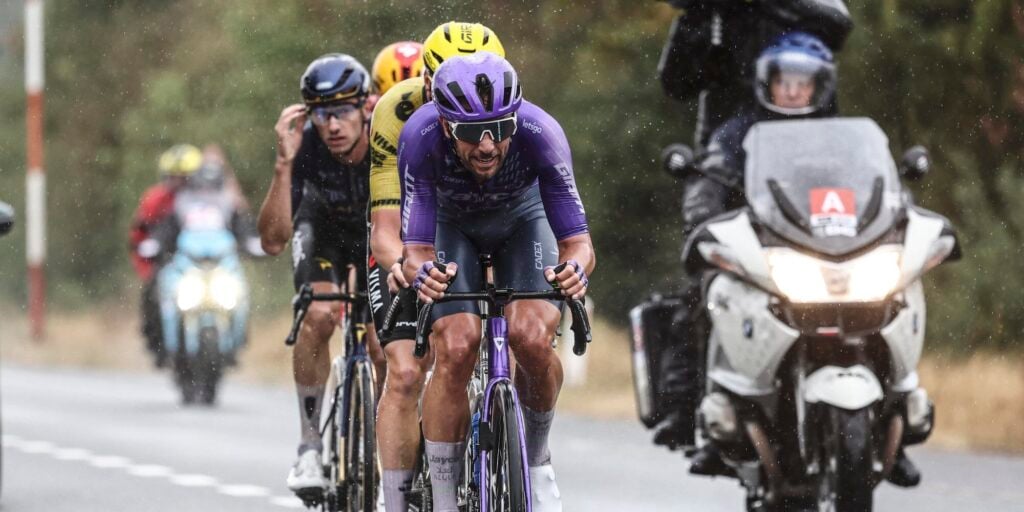
Rain arrived with around 67 kilometres remaining and changed the tone of the finale. The break still held just over a minute, but the conditions were worsening, and the peloton had to chase on roads that were increasingly dangerous.
With 60 kilometres to go, the leaders were still 1 minute ahead. The stage now had a different kind of tension. The chase was still expected to make the catch, but the wet roads made every corner more stressful and every acceleration riskier.
Jonas Abrahamsen crashed in the peloton with around 44 kilometres remaining, another reminder of how quickly the conditions could change a rider’s race. Later, Oliver Naesen and Pier-André Côté also crashed near the front of the bunch inside the final 20 kilometres.
The break, meanwhile, kept riding. With 33 kilometres remaining, they still had 1:31. What had looked like a standard early move was beginning to look more dangerous.
De Bondt and Hermans take the Green KM bonuses
The Green KM in Engsbergen gave the breakaway something extra to race for, with three bonus sprints packed into one kilometre.
De Bondt won the first sprint at 169.7 kilometres, taking 3 seconds ahead of Hermans and Kielich. Hermans then won the second sprint, ahead of Kielich and Bévort. De Bondt took the third sprint, ahead of Taminiaux and Bévort.
That meant De Bondt collected 6 bonus seconds, Hermans took 5, Bévort gained 2, while Taminiaux and Kielich each took smaller rewards. It was a useful haul for the attackers, but the bigger question was whether they could still hold off the bunch.
With 23 kilometres remaining, the five leaders had 1:06. With 15 kilometres to go, they still had 51 seconds. In heavy rain and on technical roads, that was enough to create real doubt.
The break still has a chance
At the foot of the final ascent of the Grasbos, the peloton trailed by 32 seconds. The speed and tension were extremely high, but the breakaway was still intact.
Taminiaux, De Bondt, Kielich, Bévort and Hermans had ridden the whole day together and still had the strength to resist. With 4 kilometres remaining, they held 24 seconds. With 3 kilometres to go, the gap was still 20 seconds. At 2 kilometres, they still had 18 seconds.
That was the moment the stage nearly slipped away from the sprinters. The peloton was closing, but not quickly enough to make the catch inevitable. The leaders were still committed, still not looking back, and still riding like the stage was possible.
Then the cooperation cracked.
Inside the final kilometre, the breakaway riders began looking at one another. After a day of working together, the stage win was suddenly close enough for each rider to think about the sprint. That hesitation cost them.
Late attacks add to the chaos
Before the catch, there was one more layer of late aggression. Florian Vermeersch attacked with five other riders, creating a small gap as the peloton chased the break and dealt with crashes in the final kilometres.
The move did not last, but it added to the disorganisation behind the leading five. With the roads wet and the peloton stretched, every attack and every crash complicated the chase.
Still, the sprint teams had just enough road. The five leaders were swept up inside the final kilometre, ending a breakaway effort that had almost delivered the opening stage against expectations.
It was a cruel finish for the attackers, but a classic Renewi Tour finale: wet roads, late moves, tactical hesitation and a sprint only after the race had nearly escaped the peloton.
Milan edges Kooij in a photo finish
Once the break was caught, the stage became a drag race between the fastest men who had survived the chaos.
Kooij and Milan hit the line almost together. The finish was so tight that it needed the photo to decide it, but Milan was confirmed as the winner, giving Lidl-Trek the first stage and the first leader’s jersey of the race.
For Milan, it was a significant sprint win because it came after a day that was far from straightforward. The chase had been complicated by the rain, crashes and the stubborn breakaway. He still had to stay safe, stay positioned and then beat one of the fastest finishers in the race in a head-to-head dash.
Kooij was close, but not close enough. After a finale where the peloton had almost left it too late, Milan found the final millimetres that mattered.
Breakaway heartbreak in Diest
The five-rider break deserves more than a passing mention. Taminiaux, De Bondt, Kielich, Bévort and Hermans rode a smart, resilient stage and were still ahead with 2 kilometres remaining.
Their advantage was never huge, but it was always awkward. They used the circuits well, recovered time after the short climbs and gained bonus seconds in the Green KM. In the rain, they became even more dangerous because the peloton could not chase with the same confidence it would have had on dry roads.
The final kilometre will hurt. The hesitation was understandable, because the stage win was suddenly within reach, but it was also the moment the peloton needed. Once the leaders stopped riding smoothly, the sprint trains had their chance.
They had nearly stolen the stage. Instead, they set up a dramatic finish for Milan.
A nervous start to the Renewi Tour
Stage 1 gave the Renewi Tour exactly the kind of opening it often produces: a sprint on paper, but only after a far more complicated race than the profile suggested.
The rain turned the final hour into a technical test. The breakaway came within sight of a shock win. The Green KM created movement before the finale. Crashes removed or delayed several riders, including Naesen, Côté and Abrahamsen, while Jelte Krijnsen became the first rider to abandon earlier in the day.
For the GC riders, the key objective was to stay safe. For the sprinters, it was about surviving the chaos and still being in position when the catch came.
Milan did that best. He begins the 2026 Renewi Tour in the leader’s jersey after beating Kooij by the narrowest of margins, but the opening stage belonged almost as much to the breakaway that refused to give in.
Renewi Tour 2026 stage 1 result
| Position | Rider | Team | Time/gap |
|---|---|---|---|
| 1 | Jonathan Milan | Lidl-Trek | 4:04:18 |
| 2 | Olav Kooij | Decathlon CMA CGM | same time |
| 3 | Tim Merlier | Soudal Quick-Step | same time |
| 4 | Jasper Philipsen | Alpecin-Premier Tech | same time |
| 5 | Sam Bennett | Pinarello-Q36.5 Pro Cycling Team | same time |
| 6 | Sam Welsford | Netcompany INEOS | same time |
| 7 | Pavel Bittner | Team Picnic PostNL | same time |
| 8 | Dylan Groenewegen | Unibet Rose Rockets | same time |
| 9 | Arnaud De Lie | XDS Astana Team | same time |
| 10 | Mike Teunissen | Lotto-Intermarché | same time |
Main photo credit: Getty