
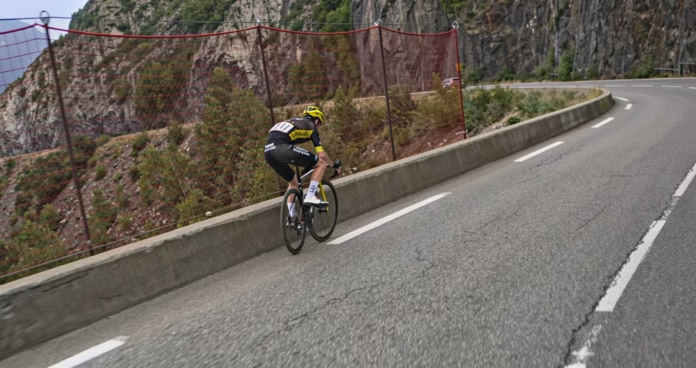
Sepp Kuss came frighteningly close to a serious crash on Stage 20 of the 2026 Tour de France, falling twice while leading the race on the descent from the Col de Sarenne before Richard Carapaz came past to take the stage victory.
The American had already ridden away from Carapaz and appeared to have a genuine chance of winning one of the hardest mountain stages of the Tour. Instead, two crashes in quick succession changed the race. The second, with around 5.8km remaining, sent Kuss towards the outside of the mountain road before the roadside protection stopped him from going any further.
Kuss was able to remount, continue and still finish third, 31 seconds behind Carapaz. There was no immediate indication of a serious injury after the stage, although he was later handed a one-minute GC penalty for two littering infringements earlier in the day.
The full incident sequence was dramatic enough that it became one of the defining images of the Tour’s final mountain stage.
 Photo Credit: Getty
Kuss had dropped Carapaz before the crashes
What makes the incident particularly frustrating for Kuss is that he had already created the position he wanted.
He spent much of Stage 20 in the decisive breakaway with Carapaz on a route containing the Croix de Fer, Télégraphe, Galibier and Col de Sarenne before the descent towards Alpe d’Huez.
Carapaz had spent the opening part of the day collecting the mountain points that would ultimately secure the polka-dot jersey, but Kuss was increasingly focused on the stage victory.
The American eventually rode away from Carapaz and reached the descent alone at the front.
As covered in our initial report on Kuss’s remarkable Stage 20 escape, he had already done much of the hardest work before the crashes began.
He had separated himself from one of the strongest breakaway riders of the entire Tour and was descending towards a possible victory.
The first crash disrupted Kuss’s lead
Kuss crashed for the first time during the final descent with less than eight kilometres remaining.
He was able to get back onto the bike and continue, but the incident immediately changed the rhythm of the chase.
Carapaz was still close enough behind that Kuss could not simply descend conservatively after remounting. Every second mattered, particularly because the road still contained enough climbing towards the finish for Carapaz to close the gap if he returned within striking distance.
Kuss therefore resumed racing almost immediately.
That pressure contributed to the second, much more frightening incident shortly afterwards.

The second crash nearly became something much worse
With around 5.8km remaining, Kuss ran wide on another bend.
He reached the outside of the road and was caught by the protective roadside barrier and netting rather than continuing down the steep slope beyond it.
The images looked alarming because there was very little road between Kuss and the drop.
He managed to recover quickly, climb back onto the bike and continue racing, but by then the stage had effectively changed hands.
Kuss later summed up the incident simply by noting that he was fortunate the safety protection was there.
The result sheet records a lost stage victory.
The more important point is that the protection did its job.
Why did Kuss crash twice?
There was no indication of a mechanical failure causing either incident.
The obvious explanation is the combination of fatigue, speed and pressure.
Stage 20 was one of the most demanding days of the entire Tour. Kuss had spent hours in the breakaway, climbed with Carapaz across some of the highest mountains in the race and then attacked to create his advantage before the descent.
Once he was alone, there was little reason to ease off.
Carapaz was chasing.
Kuss needed enough time in hand to survive both the descent and the remaining run towards Alpe d’Huez.
A rider does not need to make a huge error under those circumstances. Arriving into a corner marginally too quickly or choosing a slightly imperfect line can be enough.
After crashing once, Kuss then had to restart while knowing his advantage was disappearing.
The second mistake followed soon afterwards.
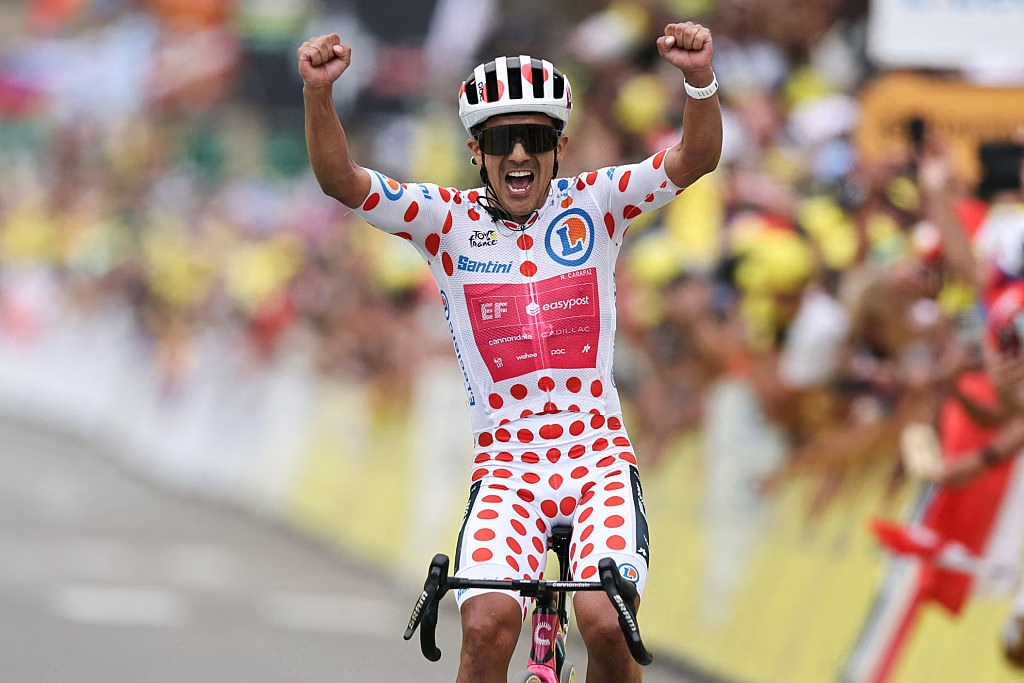
Carapaz passed Kuss and went on to win Stage 20
Carapaz had continued his pursuit throughout the descent and was able to move back ahead once Kuss lost more time in the second crash.
From there, the Ecuadorian completed an exceptional final week by winning Stage 20.
It was his second victory in three stages after his success at Orcières-Merlette on Stage 18 and capped a remarkable comeback in the mountains classification.
Carapaz had already mathematically secured the polka-dot jersey earlier on Stage 20 by taking maximum points across the major climbs. Our analysis of how Richard Carapaz secured the 2026 polka-dot jersey covers the 50-point raid that put the competition beyond his rivals.
Kuss, meanwhile, went from leading the stage to chasing Carapaz.
He still finished remarkably close.
Kuss finished third despite crashing twice
Carapaz won the stage, with Remco Evenepoel second at 26 seconds.
Kuss crossed the line in third place, 31 seconds behind.
That means the two crashes ultimately cost him only half a minute on the stage winner.
Given that Kuss had to stop, remount twice and recover from the second incident beside the edge of the road, that is an extraordinary result in itself.
He also finished ahead of Tadej Pogačar, Isaac Del Toro and several of the other leading climbers.
The Stage 20 GC and jersey standings reflect just how strong the ride had been before things went wrong. Kuss was among the very best riders on the Tour’s final mountain day.
Was Sepp Kuss injured?
There was no immediate report of a serious injury after the two crashes.
Kuss finished the stage and spoke afterwards about what had happened, with nothing at that stage suggesting a fracture, concussion or other injury that would prevent him starting Stage 21.
That does not mean he escaped completely unscathed.
Two crashes in rapid succession can easily leave a rider with bruising, road rash and stiffness the following morning, even when there is no major medical diagnosis.
But the fact Kuss remounted twice, continued racing at a high level and completed the stage strongly was reassuring.
As things stood after Stage 20, there was no indication that the crashes would stop him reaching Paris.

Kuss was later penalised for littering
The day became even more complicated after the finish.
Race commissaires penalised Kuss for two separate littering infringements during Stage 20.
The first brought a 500 CHF fine and deduction of 25 UCI points.
The second resulted in a further 1,000 CHF fine, another 50 UCI points being removed and a one-minute penalty in the general classification.
The penalty had little bearing on the story of the stage because Kuss was no longer racing for a major GC position.
It nevertheless added an unusual postscript to a day where he had already gone through a breakaway, an attack, two crashes and a podium finish.
Did the crashes cost Kuss the stage victory?
Probably, although it is impossible to say he would definitely have won.
Kuss had dropped Carapaz before beginning the final descent and was alone at the front.
That gave him a genuine winning position.
Carapaz was still chasing strongly, however, and there was enough road remaining after the descent that the Ecuadorian could potentially have returned even without the crashes.
What can be said with confidence is that the incidents removed Kuss’s advantage.
The first reduced his momentum.
The second allowed Carapaz to overtake.
Without those mistakes, Kuss would at least have entered the final kilometres in control of his own race.
That is why our original Stage 20 Kuss report described the crashes as costing him a genuine stage-winning opportunity rather than claiming the victory had been certain.
It would have transformed Kuss’s Tour
A Stage 20 victory would have been one of the biggest Tour de France results of Kuss’s career.
He came into the race primarily as a mountain lieutenant for Jonas Vingegaard rather than as a rider targeting his own general classification.
Once Vingegaard crashed out of the Tour, Visma | Lease a Bike had to change its priorities.
Kuss gained considerably more freedom to attack.
He had already tried to win on the first Alpe d’Huez stage, finishing fourth on Stage 19 after being unable to resist Pogačar’s record-breaking ascent.
One day later, he got even closer.
Stage 20 was therefore not an isolated attack. Kuss had clearly made winning a stage one of his main objectives once the team’s yellow jersey campaign disappeared.
For much of Saturday afternoon, it looked as if that persistence would finally be rewarded.
-
 Photo Credit: A.S.O./Gaëtan Flamme

The incident underlined the value of descent protection
The second crash was also a reminder of why organisers place barriers, padding and netting at exposed parts of mountain descents.
Cycling can never completely remove the risks associated with racing downhill at high speed.
Mountain roads contain steep drops, walls, trees and exposed corners that were designed for normal traffic rather than a professional peloton racing for a Tour stage.
The objective is therefore to identify the most dangerous locations and reduce the consequences when mistakes happen.
The protection beside the road where Kuss crashed was an example of that working.
His error still cost him the lead.
It did not turn into a fall down the mountainside.
That distinction mattered considerably more than the stage result.
What does Stage 20 mean for Kuss’s Tour?
Kuss will not leave the 2026 Tour with the Alpe d’Huez victory he came so close to taking, but his final Alpine weekend showed that he remained one of the strongest climbers in the race.
He finished fourth on Stage 19 and then third on Stage 20 after spending much of the latter on the attack.
Those performances came after his original role in the Tour had disappeared with Vingegaard’s withdrawal.
Rather than simply completing the race, Kuss turned towards stage hunting and repeatedly put himself in positions to win.
The final opportunity is very different.
Stage 21 has been shortened to 89km and takes place entirely in Paris, with the three Montmartre passages retained.
That is not terrain designed for Kuss.
His Tour was effectively decided in the Alps.
Stage 20 will be remembered as the day he came closest to winning and, more importantly, the day two crashes could have produced a far worse outcome.
Kuss attacked, dropped Carapaz, led the final mountain stage, crashed twice and still finished third.
The fact he reached the finish at all mattered more than the 31 seconds separating him from the victory.

