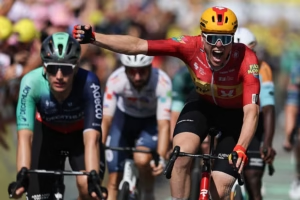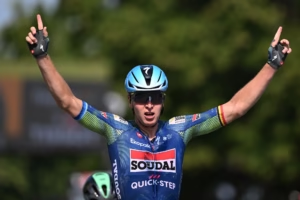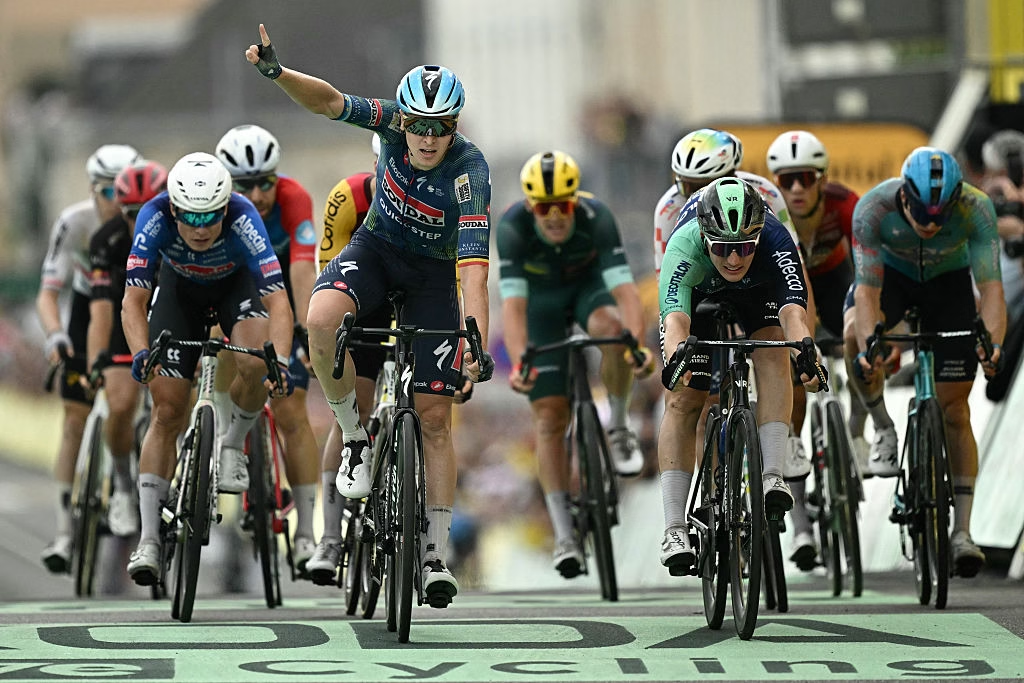
Tim Merlier won stage 12 of the 2026 Tour de France in Chalon-sur-Saône, taking his third victory of the race after another fast, chaotic sprint finish. The Soudal Quick-Step rider came through ahead of Olav Kooij of Decathlon CMA CGM and Jasper Philipsen of Alpecin-Premier Tech, with Biniam Girmay fourth for NSN Cycling Team and Milan Fretin fifth for Cofidis.
The sprint was marred by a crash in the final few hundred metres, with Fernando Gaviria and Søren Wærenskjold among those going down near the front of the bunch. Merlier avoided the trouble and again proved too quick, adding Chalon-sur-Saône to his earlier wins in Bordeaux and Bergerac.
It was his sixth career Tour de France stage win and his third of the 2026 edition. After missing out in Nevers the previous day, Merlier reasserted himself as the fastest pure sprinter in the race, even on a stage that Lidl-Trek had repeatedly tried to make awkward for his rivals.
A final sprint chance from Magny-Cours
Stage 12 took the riders over 179.1 kilometres from the Circuit de Nevers Magny-Cours to Chalon-sur-Saône, a new Tour start venue with motor racing history and a route that always looked likely to invite tension. It was flatter than the previous days in the Massif Central, but not completely straightforward.
The stage included three category 4 climbs and around 1,800 metres of elevation gain. That was not enough to make it a true breakaway stage on paper, but it was enough to give teams like Lidl-Trek a reason to test the pure sprinters before the finish.
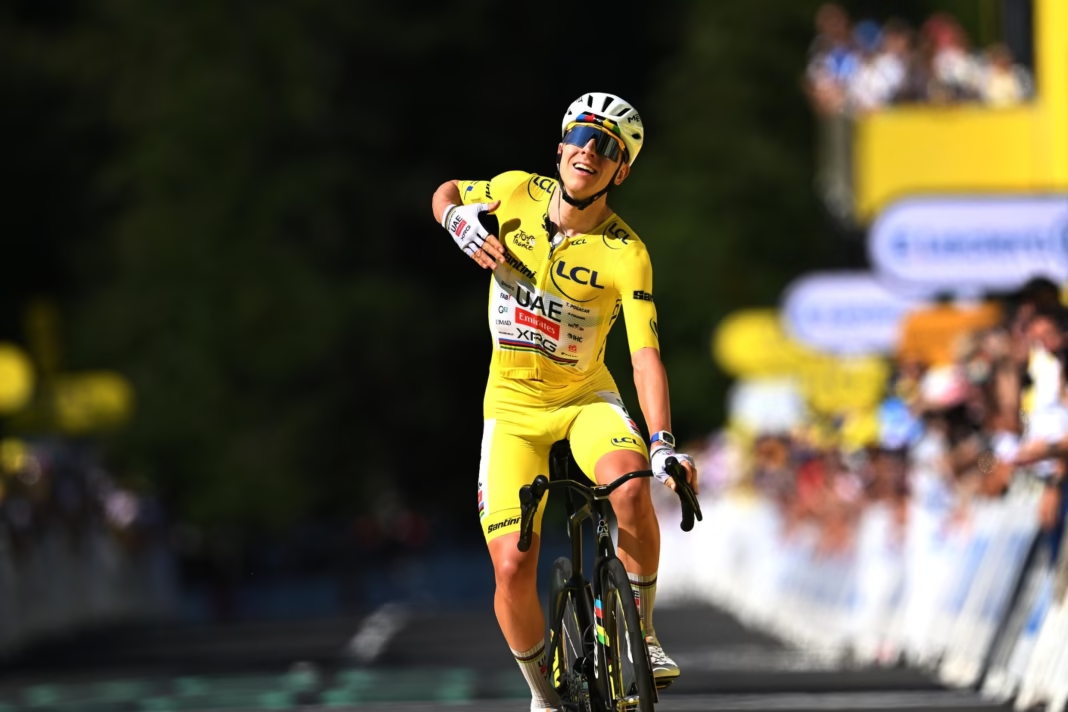
Tadej Pogačar began the day still in yellow, with Jonas Vingegaard at 3:36 and Remco Evenepoel at 4:06. The GC riders were expected to stay out of the way if possible, but with showers, changing wind and a technical finale all mentioned during the day, the risk level was never zero.
The green jersey battle also gave the stage added weight. Mads Pedersen started with 317 points, ahead of Girmay on 272, Philipsen on 255 and Merlier on 223. The stage offered 25 points at the intermediate sprint and 70 at the finish, making it a significant day in the points classification.
Veistroffer goes again after hard start
The opening was much more aggressive than a standard sprint stage. Mauro Schmid attacked as soon as the flag dropped, followed by Marco Haller, Baptiste Veistroffer, Jonas Abrahamsen and others. Josh Tarling, Matej Mohorič and Anders Skaarseth were also among those trying to get away early.
Several moves formed and were closed. Thibault Guernalec, Michel Hessmann, Xabier Mikel Azparren and Mike Teunissen briefly got clear, while another group containing Kasper Asgreen, Valentin Paret-Peintre, Nicolas Prodhomme and Schmid also failed to stick because too many teams were unhappy with the composition.
Eventually Veistroffer forced his way clear alone after 27 kilometres. The Lotto Intermarché rider has become one of the animators of this Tour, and this was another day where he was willing to put himself out front even when the odds were poor.
The peloton eased briefly, with several riders taking comfort breaks, and Veistroffer’s gap pushed out towards 2 minutes as the race approached the intermediate sprint in Decize.
Pedersen adds points behind Veistroffer
Veistroffer took the full 25 points at the intermediate sprint after crossing alone in Decize. Behind, the green jersey contenders fought properly for the remaining points, with Pedersen winning the sprint from the peloton ahead of Philipsen, Merlier, Kanter and Girmay.
That gave Pedersen another 20 points, keeping him in control of the green jersey fight. There was brief confusion over whether he had been relegated in the sprint after a tussle with Philipsen, but the results stood, and the pair shook hands afterwards.
The updated points standings confirmed Pedersen’s advantage: 337 points to Girmay’s 282, Philipsen’s 271, Merlier’s 237 and Kanter’s 215. Merlier had scored, but the green jersey still looked more like Pedersen’s to lose than Merlier’s to chase.
Once the sprint was over, the race opened again. Slock countered briefly, then TotalEnergies tried to move through Alexandre Delettre and Guernalec, with Ewen Costiou joining. Eventually Damiano Caruso, Costiou and Matteo Vercher bridged to Veistroffer, forming the day’s four-rider break.
Four leaders kept close
Veistroffer waited for Caruso, Costiou and Vercher, and the quartet settled into the stage with the peloton holding them at a manageable distance. Soudal Quick-Step, NSN Cycling Team, Alpecin-Premier Tech and Lidl-Trek all had reasons to control, and the gap hovered between 1:20 and 1:50 for much of the middle phase.
The first categorised climb, the Côte de Lanty, came after 80 kilometres. Veistroffer led over the top to take the single KOM point, then repeated the same on the Côte de Cuzy, taking his second point of the day. Neither climb was hard enough to drop the sprinters, but they added to the stop-start rhythm of the stage.
There was also weather to manage. The race began under clouds, then rain briefly hit the riders during the middle of the stage, with teams warning of changing conditions and possible wind. It did not create echelons, but it added another layer of caution before the finale.
Merlier briefly stopped with a small mechanical and chased back. Vingegaard later swapped bikes after what appeared to be a rear wheel puncture, with Victor Campenaerts waiting for him. Neither incident changed the race.
Veistroffer goes solo again
With around 62 kilometres remaining, Veistroffer accelerated from the break and only Costiou could follow. Caruso and Vercher looked at each other and were soon brought back by the peloton.
Costiou later sat up with around 50 kilometres remaining, leaving Veistroffer alone at the front again. His gap was only around 35 to 40 seconds, but he continued to push on over rolling terrain.
It was another improbable solo effort from a rider who has made breakaways his signature during this Tour. He had already been recognised for aggression on stages 5 and 7, and by the end of the day he would collect another combativity award.
The peloton had him under control, but the catch was not immediate. The sprinter teams did not want to bring him back too early, especially with the final category 4 climb still to come and the possibility of counter-attacks from stronger rouleurs.
Lidl-Trek blow up the finale
That is exactly what happened. With around 34 kilometres remaining, Simmons attacked from the peloton and immediately drew a response. Sprinters’ teammates such as Louis Vervaeke, Krists Neilands and Davide Ballerini followed, and Vacek was also there for Lidl-Trek.
The front of the race suddenly became much more complicated. A dozen riders caught Veistroffer, then the move swelled to 14 riders with serious power: Per Strand Hagenes, Vacek, Georg Steinhauser, Daan Hoole, Ballerini, Robert Stannard, Filippo Ganna, Tim Marsman, Schmid, Lewis Askey, Jenno Berckmoes, Alex Kirsch, Fred Wright and Robbe Dhondt.
For a moment, the sprinter teams were under pressure. The group entered the final 30 kilometres with around 20 seconds, while Soudal Quick-Step had to chase for Merlier. Schmid tried to go clear from the lead group, with Ganna and Wright chasing, but the peloton closed the gap down.
The attackers were caught with 24 kilometres remaining, but the stage had changed. Lidl-Trek had turned a controlled sprint day into a far more nervous final half-hour.
Pedersen keeps attacking
The final climb, the Côte de Montagny-lès-Buxy, came just over 20 kilometres from the line. Lidl-Trek again took charge, with Derek Gee-West setting a hard pace before Simmons and Vacek attacked over the climb.
Vacek led over the summit in a small group, only for Romain Grégoire to help close the gap. Pedersen then attacked himself, and Philipsen briefly collaborated with him as they tried to split the bunch. It was a revealing moment: Pedersen knew a straight sprint against Merlier, Kooij, Philipsen and Girmay was not his best route, so Lidl-Trek tried to make the final kilometres more like a classics race.
The attacks kept coming. Vauquelin and Michel Hessmann opened a small gap. Asgreen went, followed by Ballerini. Max Walker later tried inside the final 10 kilometres after another failed move from Asgreen, Skjelmose and Tobias Halland Johannessen.
But the sprinter teams kept dragging it back. Team Picnic PostNL, Alpecin-Premier Tech, XDS Astana Team, Decathlon CMA CGM and Soudal Quick-Step all had reasons to prevent a late move from stealing the day.
Technical run-in to Chalon-sur-Saône
The finale into Chalon-sur-Saône was not a simple straight drag. After a roundabout more than 4 kilometres from the finish, the riders had to negotiate a traffic island and speed bump around 3 kilometres out, then a sharp right-hand turn and a hairpin left at 2.3 kilometres to go.
That section stretched the peloton and made positioning crucial. Once the riders reached the banks of the Saône, the finish became more direct, with a long curve to the right leading towards the final 500 metres.
XDS Astana Team took control inside the final 5 kilometres for Kanter, with three teammates ahead of the German sprinter. Other trains then moved up around them. Merlier, Philipsen and Pedersen were all near the front with 3 kilometres to go.
Vacek did a long turn for Lidl-Trek into the final kilometre, but Alpecin-Premier Tech then took over with a strong train for Philipsen. Once again, Philipsen looked set up for his first stage win of the race. Once again, Merlier had other ideas.
Merlier wins as crash disrupts sprint
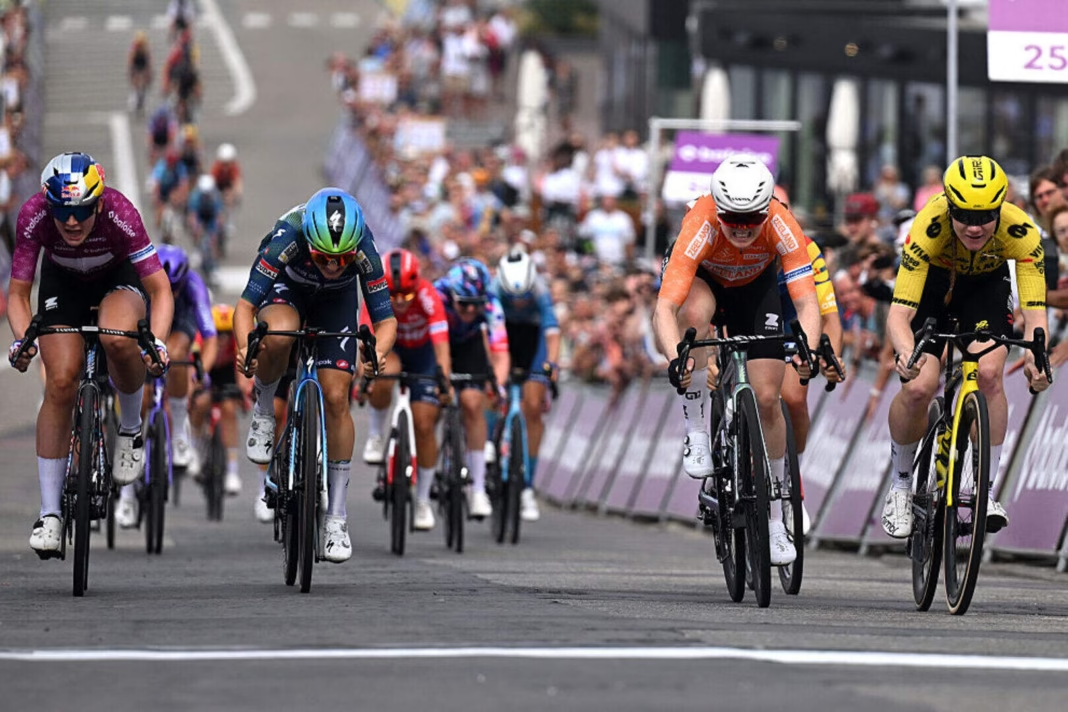
Alpecin-Premier Tech led into the final kilometre with a long line of riders, but Merlier launched with the speed to come past. Philipsen had the lead-out, but not the final acceleration. Kooij also came through strongly, but neither could match the Soudal Quick-Step sprinter.
Merlier crossed the line first, taking his third stage win of the 2026 Tour. Kooij finished second, Philipsen third, Girmay fourth and Fretin fifth. The result confirmed the same sprint pattern seen earlier in the race: Merlier does not always have the cleanest route, but when he gets a launch, his top-end speed is difficult to answer.
Behind, the sprint was disrupted by a crash in the final few hundred metres. Gaviria and Wærenskjold were among those who went down near the front, with several riders held up behind. The fall was dramatic, but initial reports suggested nobody had been seriously hurt.
It was another reminder of how fine the margins are on sprint days. Teams had spent the whole stage trying to reach this exact point, only for the final few seconds to decide both the win and the damage.
Merlier returns to the top
Merlier’s win was an emphatic response after missing out in Nevers. He had been aiming for a hat-trick there, only for Wærenskjold and Uno-X Mobility to judge the finale better. In Chalon-sur-Saône, he got the third win anyway.
That gives him victories in Bordeaux, Bergerac and now Chalon-sur-Saône, plus six career Tour stage wins in total. It also reopens, at least slightly, the question of how much the points classification matters to him. He gained 70 points at the finish and 14 at the intermediate sprint, but Pedersen’s earlier work means the green jersey remains a difficult target.
The more immediate point is that Merlier is the dominant bunch sprinter of this Tour. Kooij has a win and another second place. Wærenskjold has his Nevers victory. Girmay has been consistent. Philipsen continues to be close. But Merlier is the one repeatedly turning sprint chances into wins.
For Soudal Quick-Step, it was also a reward after they had been forced to chase hard through a chaotic final third. They did not have the race fully under control, but they kept Merlier close enough to finish the job.
Philipsen still searching
For Philipsen, third place was another frustrating near miss. Alpecin-Premier Tech had taken control in the final kilometre, and on paper that was exactly the situation they wanted. Yet Merlier still came past.
The Belgian has been involved in almost every sprint of the race, scoring consistently and staying in the green jersey fight, but the stage win is still missing. That matters more because this may have been one of the final clear bunch sprint chances of the Tour.
There was a similar feeling for Girmay. Fourth place kept him scoring points, but he needed more than that to put serious pressure on Pedersen. Kooij’s second was another sign of his consistency, though Merlier’s finishing speed again proved too much.
Pedersen, meanwhile, was not in the top five at the finish, but Lidl-Trek had still shaped the stage. They took intermediate points, attacked repeatedly, and forced the sprinter teams to burn riders before the finale. It did not deliver a stage win, but it reinforced why he remains difficult to beat in green.
Quiet GC day before the next battles
For the general classification riders, the stage passed without meaningful time gaps. Pogačar retained yellow, with Vingegaard still 3:36 down and Evenepoel third at 4:06. Ayuso remained in white, with Seixas still second in the young rider standings and Del Toro third.
The main GC incident was Vingegaard’s bike change, but it came far enough from the finish and under calm enough conditions to cause no real concern. Pogačar was also able to take a comfort break during the early part of the stage while Veistroffer was up the road, a sign that the GC teams were happy to let the sprint teams manage the day.
The race will soon turn back towards more selective terrain, but stage 12 belonged to the sprinters, even if the road to the sprint was far less calm than expected.
Veistroffer earned another combativity award, Lidl-Trek tried everything to avoid a predictable finish, and Alpecin-Premier Tech set up Philipsen once more. But at the end, Merlier was fastest again.
Tour de France 2026 stage 12 result
Results powered by FirstCycling.com
Main photo credit: Getty