
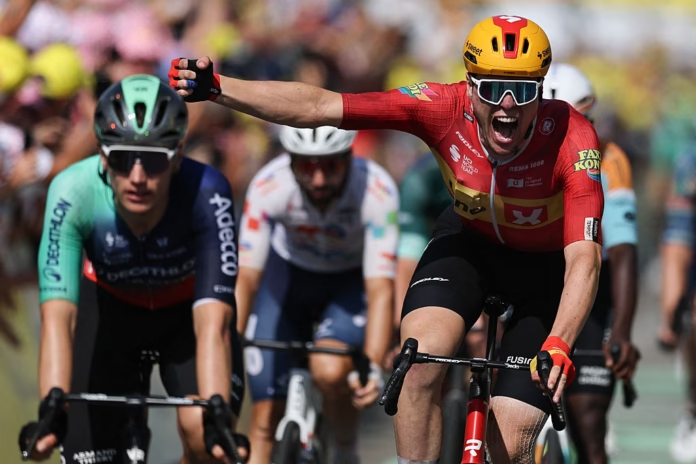
Søren Wærenskjold won stage 11 of the 2026 Tour de France in Nevers, sprinting to his first Tour stage victory after Uno-X Mobility delivered the finale and held off the faster-fancied names. The Norwegian beat Olav Kooij of Decathlon CMA CGM and Jasper Philipsen of Alpecin-Premier Tech after the day’s breakaway was caught with 5 kilometres remaining.
Milan Fretin finished fourth for Cofidis, with Huub Artz fifth for Lotto Intermarché and Biniam Girmay sixth for NSN Cycling Team. Anthony Turgis, Clément Russo, Fernando Gaviria and Pascal Ackermann completed the top 10, all on the same time of 3:10:06.
It was a major win for Wærenskjold after he had finished second behind Tim Merlier in Bordeaux. It also gave Uno-X Mobility a much-needed sprint victory in a race where they had already worn yellow through Torstein Træen but were still waiting for a stage win.
A sprint day after Le Lioran
Stage 11 took the riders over 161.3 kilometres from Vichy to Nevers, a route that looked like one of the clearer sprint chances of the second week. After Tadej Pogačar’s victory at Le Lioran on stage 10 and the renewed GC damage inflicted on Jonas Vingegaard, this was a day for the overall contenders to stay out of trouble.
The stage began with 174 riders after Chris Harper did not start. The Pinarello-Q36.5 rider had crashed on the descent of Puy Mary the previous day, along with Tom Pidcock and Matteo Jorgenson, and his team later confirmed a serious thumb injury that required surgery.
Conditions were different from the heatwave that had dominated the previous stages. There were wet roads and grey skies early on, with teams warning riders to avoid needless risks. The wind was not strong enough to suggest echelons, but the damp roads added another layer of tension.
The route had only two category 4 climbs, Côte de Billonnière and Côte de Billy-Chevannes, and just two mountains points on offer. The real question was whether the sprinter teams would control the race, and whether Tim Merlier could chase a hat-trick after winning in Bordeaux and Bergerac.
Van der Poel starts the attacking
The stage began in an unexpected way. Mathieu van der Poel was the first rider to attack almost as soon as the flag dropped, despite the finish looking suitable for his teammate Philipsen. He tried again soon afterwards, this time followed by Valentin Paret-Peintre, with Aaron Gate, Matis Louvel and Magnus Cort among those briefly chasing.
That move was shut down quickly. The sprinter teams knew that allowing Van der Poel into the day’s break would make the stage much harder to control, especially after his victory from the break into Ussel two days earlier.
There were plenty of other riders interested too. Julian Alaphilippe, Baptiste Veistroffer, Liam Slock, Lewis Askey and Brent Van Moer were among the early names trying to get clear. Unlike some of the previous sprint stages, this was not an instant, uncontested escape.
The move that finally settled went after 13 kilometres: Alaphilippe for Tudor, Nelson Oliveira for Movistar, Anthon Charmig for Uno-X Mobility and Mathis Le Berre for TotalEnergies. Slock tried to bridge for Lotto Intermarché, but never made contact.
Le Berre takes intermediate sprint points
Once the quartet had gone clear, the peloton eased enough for their lead to reach more than a minute. Slock continued between the two groups for a while, but the front four did not wait. Lotto Intermarché later called him back to the bunch, with the team needing him for the sprint.
The intermediate sprint came early, at Saint-Pourçain-sur-Sioule after 27.8 kilometres. Le Berre crossed first from the break to take 25 points, ahead of Oliveira, Alaphilippe and Charmig. Slock, still in between at that point, took fifth before being caught.
Behind, Philipsen won the sprint from the peloton for the remaining points, edging Kanter and Pedersen. Girmay, Quinn Simmons, Mathias Vacek, Mike Teunissen, Tom Van Asbroeck, Merlier and Harold Tejada also scored.
For Pedersen, it was a lower return than his early sprint wins on the harder stages, but enough to keep adding to his green jersey total. For Merlier, taking only 2 points underlined the difference between his stage-win focus and the wider demands of the points classification.
Charmig collects the KOM point
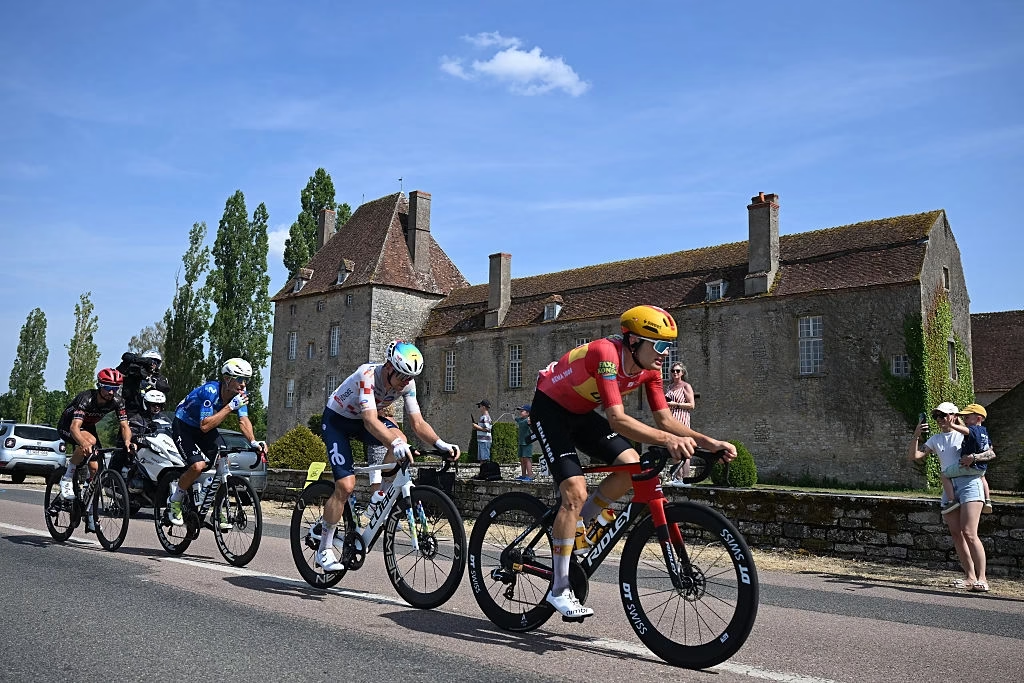
The first climb of the day, the Côte de Billonnière, came almost immediately after the sprint. Charmig led the break over the top to take the single mountain point, with the peloton still controlling the gap at around 1:20.
The four leaders worked well together through the first half of the stage. Their workload was almost evenly split, with Charmig and Le Berre taking marginally longer turns and Oliveira and Alaphilippe close behind. After one hour of racing, the average speed was a striking 53.1km/h.
That pace made the breakaway credible even without a large advantage. The peloton never let the gap stretch far beyond 1:40, but the four attackers were riding fast enough to force a proper chase.
Soudal Quick-Step, NSN Cycling Team and XDS Astana Team were the main teams controlling behind. Soudal Quick-Step had the clearest reason, with Merlier aiming for a third sprint win in five stages. NSN and Astana also had Girmay and Kanter in the points battle, while Alpecin-Premier Tech initially left others to do much of the work.
Holding pattern through Moulins
The race passed through Moulins with the gap hovering around 1:15. The riders had also reached the halfway point of the 2026 Tour by distance after stage 9 had been shortened, a small statistical marker in what was otherwise a controlled sprint day.
Alaphilippe was the most decorated rider in the break, with his six Tour stage wins and long history of attacking racing, but this was never an ideal day for him. The route into Nevers was not punchy enough to favour his old strengths, and the sprinter teams had too much reason to chase.
Oliveira brought time-trial strength and experience, Le Berre brought TotalEnergies visibility, and Charmig gave Uno-X Mobility a rider up front even while the team protected Wærenskjold behind. The quartet had a balanced feel, but they were being held on a short leash.
Behind them, George Bennett, Krists Neilands, Pascal Eenkhoorn and Harold Tejada were among those sharing the chase. Marco Frigo also contributed for NSN. The peloton was not panicking, but it was not drifting either.
Alaphilippe dropped on final climb
The second climb, the Côte de Billy-Chevannes, came with just over 40 kilometres remaining. It measured 1.4 kilometres at 5 per cent, not enough to split the peloton, but enough to test the break after more than 120 kilometres of high-speed riding.
Charmig set the pace on the ascent and led over the top to take the final KOM point of the day. The climb was ridden quickly, and Alaphilippe was distanced from the break. From that moment, only Charmig, Oliveira and Le Berre remained at the front.
That changed the race. Three riders were easier to chase than four, and the sprinter teams began to increase the pressure. The gap was still just over a minute with under 40 kilometres to go, but the peloton had the advantage.
Soon afterwards, there was a crash in the bunch involving Ben O’Connor, Georg Zimmermann and Abel Balderstone. All three got back up, although Zimmermann was checked for a possible concussion before resuming.
Breakaway holds into the final 20 kilometres
The remaining trio refused to fold. Charmig, Oliveira and Le Berre kept their lead around 50 seconds with 25 kilometres to go, then 45 seconds as the race entered the final 20 kilometres.
The chase was becoming more serious. Alpecin-Premier Tech finally joined the work, with Silvan Dillier helping on the front. Team Picnic PostNL also contributed through Frank van den Broek, while Decathlon CMA CGM began moving up for Kooij.
Soudal Quick-Step had already spent a lot of energy earlier in the stage and were less visible in the final chase than might have been expected. That gave other teams a chance to shape the finale, and Uno-X Mobility had the useful position of having had Charmig in the break while still preparing Wærenskjold behind.
The break still had 35 seconds with 15 kilometres remaining and 20 seconds with 10 kilometres to go. It was close enough to make the sprinters work, but not quite enough to force panic.
Gaviria punctures before the catch
There was late drama for Gaviria, who suffered a mechanical inside the final 10 kilometres. For a Caja Rural-Seguros RGA team built around sprint chances, it was a potentially costly moment.
Gaviria called for assistance and was paced back by teammates. At first it looked as though his sprint chance might be over, but the pace briefly dropped after the catch, allowing him to return to the bunch before the finale.
The breakaway was caught with 5 kilometres remaining. Charmig, Oliveira and Le Berre had forced the peloton to chase deep into the stage, with Charmig later named the most combative rider after his turns helped keep the move alive.
Once the catch was made, the peloton briefly bunched up. Nobody wanted to commit too early, and that hesitation allowed teams to reset for the final sprint. It also helped Gaviria make it back into contention.
Uno-X take control late
The final kilometres were less technical than Bergerac but still required positioning. The approach to Nevers came on wide roads before a right-left bend just before the flamme rouge. From there, the finish ran along a long right-hand curve beside the canal, making the right side of the road the fastest line.
NSN launched a big acceleration into the final 2 kilometres for Girmay, stringing the bunch out again. Philipsen, Kanter and Kooij were all positioned near the front, and the sprint looked open.
Then Uno-X Mobility took over. Jonas Abrahamsen hit the front inside the final kilometre and drove the lead-out with real force. After his team had spent the day represented in the break by Charmig, they now had the timing and position for Wærenskjold.
It was a clean, committed lead-out at exactly the right moment. Wærenskjold had finished second in Bordeaux behind Merlier, but in Nevers he had a better launch and a clearer path.
-
 Photo Credit: Cs-wolves / Wikimedia Commons, CC BY-SA 4.0
Wærenskjold beats Kooij and Philipsen
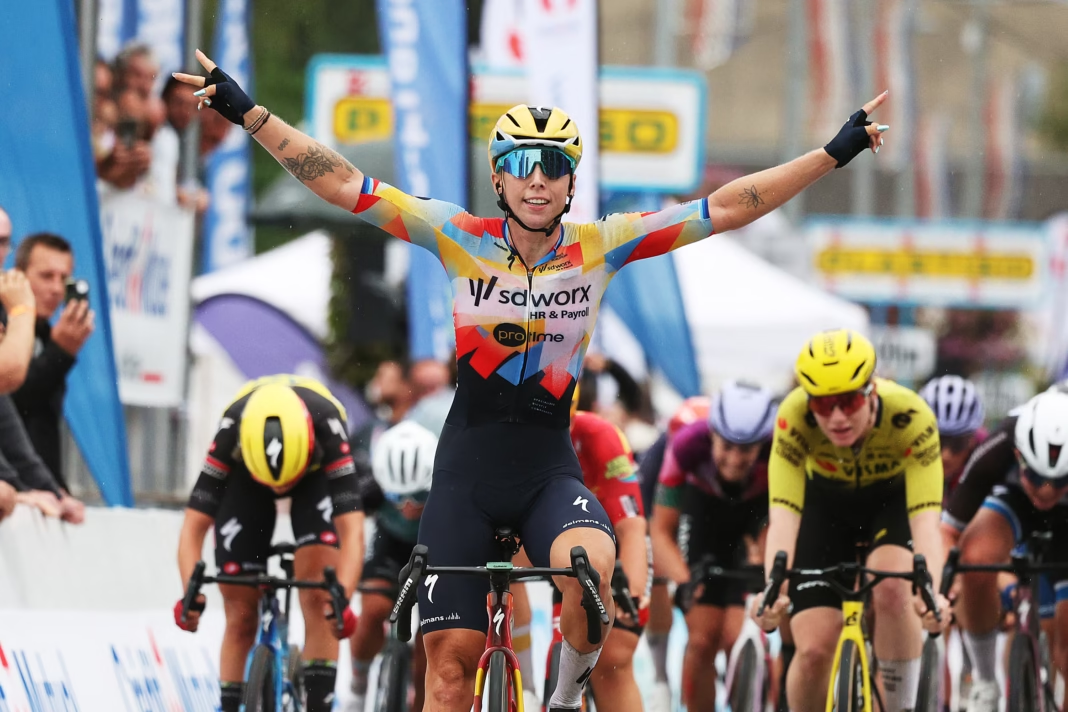
Wærenskjold finished it off, powering to victory ahead of Kooij and Philipsen. The Norwegian’s win was the first Tour de France stage victory of his career and a major statement after several near misses for the sprinters in this race.
Kooij’s second place kept him consistent after his Pau stage win, while Philipsen’s third continued a frustrating pattern. The Alpecin-Premier Tech sprinter again scored well and was in the mix, but the first stage win of his Tour still has not arrived.
Fretin’s fourth was another strong sprint result for Cofidis, with Artz fifth after Lotto Intermarché had called Slock back for the final. Girmay, expected to be one of the main favourites, had to settle for sixth after NSN’s late acceleration had initially looked promising.
Turgis, Russo, Gaviria and Ackermann rounded out the top 10. Gaviria’s ninth place was a recovery of sorts after his late mechanical, but it also left a sense of what might have been had Caja Rural not been forced to chase back in the final kilometres.
Merlier misses the hat-trick
The biggest absence from the top of the result was Merlier. After winning in Bordeaux and Bergerac, the Soudal Quick-Step sprinter had looked like the obvious favourite for Nevers, but his team’s control did not translate into a final lead-out strong enough to place him in the top 10.
Merlier had already said before the stage that the Tour was beginning to bite physically, and after a hard stage to Le Lioran, the fatigue was visible across the sprint trains. His green jersey ambitions have also always looked secondary to stage wins, which explained why he did not chase intermediate sprint points with the same intensity as Pedersen or Girmay.
Wærenskjold’s win spreads the sprint success around again. Kooij won in Pau, Merlier took Bordeaux and Bergerac, and now Uno-X Mobility have their sprint victory. Philipsen, meanwhile, remains the major fast man still searching.
The result also gives the green jersey picture another shift. Pedersen added points at the intermediate sprint, Philipsen and Girmay scored both there and at the finish, and Kooij’s second place keeps him relevant in the broader sprint hierarchy.
Quiet GC day for Pogačar
For Pogačar and the GC contenders, the stage passed without incident. The yellow jersey stayed safe in the bunch after extending his overall lead to 3:36 over Vingegaard at Le Lioran the previous day.
Vingegaard, wearing the polka-dot jersey while Pogačar led both yellow and the mountains classification, had no reason to take risks. Evenepoel and Lipowitz also remained safely placed after Red Bull-Bora-Hansgrohe had spent the start of the second week trying to calm the internal dynamic between their two podium contenders.
Ayuso stayed in white after Del Toro’s losses at Le Lioran, while Seixas continued his strong first Tour from fifth overall. For the GC riders, this was a day to avoid crashes, stay out of the sprint fight and conserve energy.
Nevers delivered the expected bunch finish, but not the expected winner. Wærenskjold and Uno-X Mobility judged it better than everyone else.
Tour de France 2026 stage 11 result
| Position | Rider | Team | Time/gap |
|---|---|---|---|
| 1 | Søren Wærenskjold | Uno-X Mobility | 3:10:06 |
| 2 | Olav Kooij | Decathlon CMA CGM Team | same time |
| 3 | Jasper Philipsen | Alpecin-Premier Tech | same time |
| 4 | Milan Fretin | Cofidis | same time |
| 5 | Huub Artz | Lotto Intermarché | same time |
| 6 | Biniam Girmay | NSN Cycling Team | same time |
| 7 | Anthony Turgis | TotalEnergies | same time |
| 8 | Clément Russo | Groupama-FDJ United | same time |
| 9 | Fernando Gaviria | Caja Rural-Seguros RGA | same time |
| 10 | Pascal Ackermann | Team Jayco AlUla | same time |
Main photo credit: Getty

