
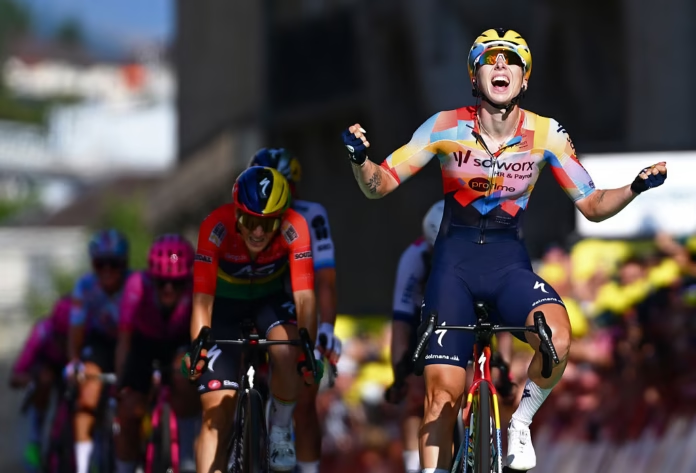
Lorena Wiebes won stage 1 of the 2026 Tour de France Femmes in Lausanne, powering clear on the uphill finish to take the first yellow jersey of the race after a demanding opening day in Switzerland.
The SD Worx-Protime rider beat Kim Le Court of AG Insurance-Soudal and Demi Vollering of FDJ United-Suez after the peloton caught the last remnants of the day’s breakaway in the final kilometres. Puck Pieterse finished fourth for Fenix-Premier Tech, with Noemi Rüegg fifth for EF Education-Oatly on home roads.
Wiebes opened her sprint with around 200 metres to go after surviving Vollering’s acceleration with 600 metres remaining. Only 10 riders finished in her time, with many of the GC contenders already seeing small splits on the Côte Saint-François climb to the line.
A yellow jersey finish from day one
The 2026 Tour de France Femmes began with a 138-kilometre stage starting and finishing in Lausanne, giving the race an opening day that was never going to be a simple bunch sprint.
The finale was built around the Côte Saint-François, a 2.6-kilometre climb averaging 4.6 per cent through the streets of Lausanne. The numbers alone made it look manageable, but the climb was more awkward than the average gradient suggested. There were steeper ramps, repeated right-angle turns and a flatter final section where positioning and timing would matter as much as raw climbing ability.
That created an unusual stage 1 equation. The sprinters could still win if they survived the first part of the climb, but the punchier GC riders had a clear chance to disrupt them. Wiebes was the obvious danger if she could stay close enough, while riders such as Vollering, Le Court, Pieterse, Rüegg, Elisa Longo Borghini, Kasia Niewiadoma-Phinney, Pauline Ferrand-Prévot and Marlen Reusser all had reason to believe the finish could suit them.
It was a stage with a yellow jersey waiting at the top of a climb, not a flat run-in designed for a full peloton.
Four riders go clear early
The first attacks came soon after the official start, with several invited teams trying to put themselves into the race immediately. The move that stuck brought together Maud Rijnbeek of VolkerWessels, Idoia Eraso of Laboral Kutxa-Fundación Euskadi, Nikola Nosková of Cofidis and Océane Mahé of Ma Petite Entreprise.
It was exactly the kind of breakaway the opening stage invited: ambitious riders from teams with every incentive to show themselves early, and enough climbing later in the day to give them secondary targets even if the stage win remained unlikely.
Alison Jackson tried to bridge for St Michel-Preference Home-Auber93, while Kiara Lylyk of Mayenne-Monbana-My Pie also attempted to chase across. Jackson briefly looked capable of reaching the leaders but eventually sat up, leaving the front quartet to build their advantage.
The peloton allowed the gap to stretch, with no major team immediately committing to a full chase. With seven-rider teams and a hard finale still to come, there was a visible stand-off behind.
Mahé takes the first polka-dot jersey
The breakaway’s day quickly became a battle for the first mountains jersey. Mahé was the strongest across the early climbs, taking maximum points on the Côte de Châbles and again on the Côte de Villars-le-Comte.
That put the French rider in control of the QOM classification before the race returned towards Lausanne. The first listed climb, the Côte de Châbles, measured 1.6 kilometres at 7.7 per cent, and Mahé beat Eraso and Rijnbeek there. On the Côte de Villars-le-Comte, a 4-kilometre climb at 5.8 per cent, she again took the points, this time ahead of Eraso and Nosková.
The Tour’s first polka-dot jersey was effectively decided before the final climb. Mahé’s early work ensured Ma Petite Entreprise would leave the opening stage with a distinctive jersey, a valuable result for a debutant team in the race.
For the break itself, though, the situation was becoming more difficult. FDJ United-Suez lifted the pace on the climbs, SD Worx-Protime began to show more control, and the peloton started to split behind.
Crashes and splits unsettle the peloton
The middle section of the stage brought repeated crashes and small splits. Zoe Bäckstedt and Pieterse were among those involved in an earlier crash in the bunch, though both were able to continue. Later, another pile-up caught riders including Henrietta Christie and Debora Silvestri.
Laura Tomasi became the first rider to abandon the 2026 Tour de France Femmes after crashing earlier in the stage. Christina Schweinberger also needed attention after being involved in a pile-up before the Côte de Châbles.
There were also tactical splits as the climbing began to bite. FDJ United-Suez raised the tempo on the Côte de Villars-le-Comte through Amber Kraak and Évita Muzic, and several potential finish candidates were caught out or distanced. Charlotte Kool, Liane Lippert and Amalie Dideriksen were among those reported off the back, while Brodie Chapman, Usoa Ostolaza and Isabella Holmgren also had moments of difficulty.
The opening day was already doing more damage than a conventional stage 1. Even before the final climb, the race had begun to narrow.
Nosková goes solo
On the Côte de Vulliens, the third categorised climb of the day, Nosková turned the breakaway’s points battle into a solo move. She accelerated over the summit, taking the QOM points and pushing on alone rather than easing back into the break.
Eraso and Rijnbeek initially tried to chase, while Amanda Spratt came across from behind to join the pursuit. For a while, the race was scattered across the road: Nosková alone in front, chasers behind, Mahé drifting back after securing the mountains jersey and the peloton still around a minute and a half down.
Nosková’s move became the defining attack of the day. She had been in the early break, then still had the legs and confidence to go alone with more than 35 kilometres remaining.
By the final 25 kilometres, she still had a gap, with Eraso, Rijnbeek and Spratt trying to bring her back. The peloton was closing, but not yet fully organised.
Reusser suffers late scare
Marlen Reusser had one of the day’s biggest scares inside the final 20 kilometres. The Swiss rider crashed in a right-hand turn, then needed help from Movistar teammate Arlenis Sierra before chasing back.
For one of the GC contenders, it was a worrying moment on home roads. Reusser lost contact at a dangerous point in the stage, with the final climb approaching and the peloton already reducing.
Tota Magalhães helped her return, and Reusser eventually made it back to the bunch before the finale. It was a crisis averted rather than a GC blow, but it showed how tense the opening stage had become.
By the finish, Reusser was safely in the front group, taking 10th on the day in the same time as Wiebes. Given the timing of the crash, that was a significant recovery.
The breakaway finally comes back
With 15 kilometres to go, Nosková, Eraso, Rijnbeek and Spratt were together at the front, holding around 45 seconds. Movistar, Liv AlUla Jayco, Canyon SRAM and EF Education-Oatly began fighting for position behind, with the peloton preparing for the uphill finish.
Nosková’s effort earned her the combativity prize, and rightly so. The Cofidis rider had spent the day on the attack, first in the breakaway and then alone after the Côte de Vulliens.
The front group still had 40 seconds with 10 kilometres remaining, but the chase was finally sharp enough. The peloton swept up the breakaway with 6 kilometres to go, just before the final run into Lausanne.
From there, the race became a battle for position. The Côte Saint-François was not long enough for riders to recover from poor placement, and the fight into the base of the climb was as important as the climb itself.
UAE lead into the final climb
UAE Team L’IMAD were prominent as the race entered the decisive final kilometres. Silvia Persico buried herself at the front with Longo Borghini on her wheel, trying to put the Italian into position for the climb.
Canyon SRAM also moved up after Shari Bossuyt led out Le Court, while AG Insurance-Soudal, FDJ United-Suez and SD Worx-Protime all had clear intentions. With the road narrowing, turning and rising, the bunch began to split even before the steepest part of the climb.
A late attack from Cédrine Gery was quickly shut down with around one kilometre to go. Moments earlier, Dominika Włodarczyk crashed with Letizia Paternoster and Elisa Balsamo also caught up in the incident, though all three were back on their bikes.
That removed some fast finishers and added one more layer of chaos to a finale already being raced at full commitment.
Vollering attacks, Wiebes follows
Anna van der Breggen took over in the final kilometre, setting up Wiebes at exactly the moment SD Worx-Protime needed control.
Then Vollering lit up the finish with 600 metres to go. It was the move many had expected from the GC riders: hard enough to stretch the group, early enough to prevent a pure sprint, and timed on the part of the climb where hesitation could cost the stage.
Le Court, Longo Borghini and Wiebes were all on the move, but Wiebes had the key response. She did not panic, held the wheel, and kept herself within striking distance as the gradient eased and the road opened towards the line.
For a rider usually framed as a sprinter, this was a different kind of win. Wiebes had to survive the climb, respond to a GC rider’s acceleration and then produce her sprint from a reduced group.
She did all three.
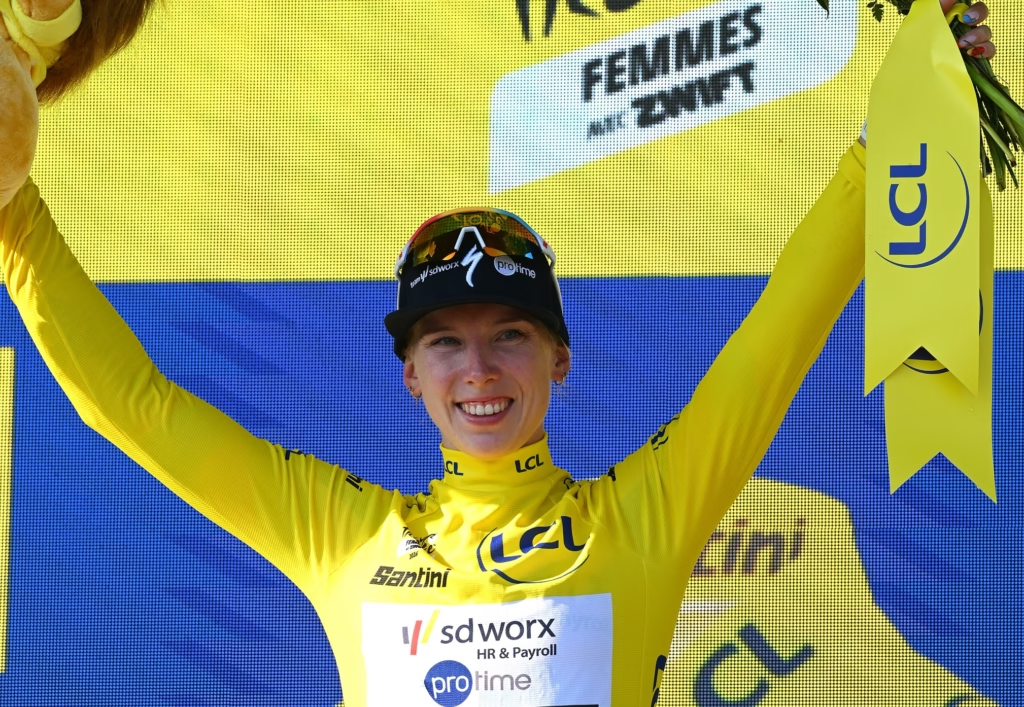 Photo Credit: Getty
Wiebes wins in yellow style
Wiebes opened her sprint with around 200 metres to go and immediately created the decisive separation. Le Court came through for second, with Vollering third after making the race-winning move possible but not having enough to finish it off.
Pieterse took fourth, Rüegg fifth, and only 10 riders finished in Wiebes’ time: Le Court, Vollering, Pieterse, Rüegg, Longo Borghini, Niewiadoma-Phinney, Ferrand-Prévot, Cédrine Kerbaol and Reusser.
Niamh Fisher-Black lost 5 seconds, while Paula Blasi, Van der Breggen, Isabella Holmgren, Marion Bunel and Antonia Niedermaier lost 8 seconds. The gaps were small, but on stage 1 they already mattered. This was not a neutral opening day for the GC contenders.
Wiebes took the stage, the first yellow jersey and a victory that says plenty about her condition. Winning flat sprints is one thing. Winning a climb-sprint against GC riders in Lausanne is another.
A major win for SD Worx-Protime
Wiebes later said she had doubts before the finish, but her team’s belief and work gave her the platform to win.
“The team worked super hard today and then Anna came also still to the front with one kilometre to go,” Wiebes said. “Then Demi attacked and I realised I needed to follow. It was a long sprint but I’m super happy with this.”
She also described how the final moments unfolded once the road opened.
“I expected some attacks and after the first attack I still felt good. Then there was one kilometre to go, I needed to hold on. I told myself: I cannot drop. Then I was a bit blocked, because EF started on the right side. Then I found my way and I started a bit early but I said: I need to go now.”
It was Wiebes’ sixth Tour de France Femmes stage victory and her 131st career win, but it will sit differently from many of the others. This was not simply a sprint finish. It was a statement that she can take yellow on a day where the road tilts up and the GC contenders come out to race.
Vollering takes early bonus seconds
Vollering did not win the stage, but her third place still mattered. She took 4 bonus seconds and showed her form on a finale where FDJ United-Suez had already helped shape the race earlier in the day.
The Dutch rider’s acceleration was the move that split the final group and removed any possibility of a larger bunch sprint. She may have wanted more than third, but the result still gets her Tour moving in the right direction.
Le Court’s second place was also a significant ride. She positioned herself well, responded to the late accelerations and came closest to Wiebes in the final sprint. Rüegg’s fifth place gave the Swiss crowd a home contender inside the top five, while Reusser’s 10th came after her late crash scare.
For the GC riders, the day was about avoiding early mistakes. Most of the main favourites came through safely, but the final climb still created small time gaps and early hierarchy.
Mahé in polka dots, Nosková rewarded
Behind the stage fight, Mahé leaves Lausanne in the polka-dot jersey after her aggressive and calculated ride in the breakaway. She went after the mountain points early and took enough before the finale to secure the first QOM lead of the race.
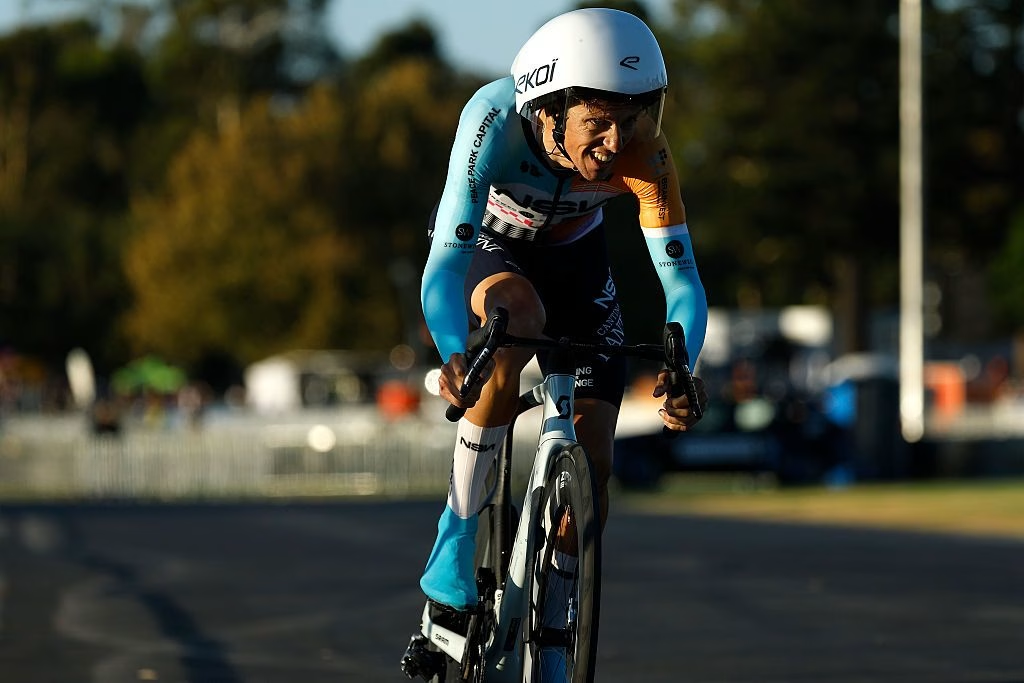
Nosková, meanwhile, earned the combativity prize after a superb day on the attack. The Cofidis rider was part of the early move, attacked again on the Côte de Vulliens, and held the race at arm’s length deep into the final 25 kilometres.
The invited teams had made themselves visible from the opening hour. VolkerWessels, Laboral Kutxa-Fundación Euskadi, Cofidis and Ma Petite Entreprise all shaped the day, which is exactly what they needed from the first stage of the Tour.
They did not stop Wiebes, but they made SD Worx-Protime and the other favourites work.
Stage 1 already changes the tone
The opening stage confirmed that this Tour de France Femmes will not ease into the race. The 138 kilometres around Lausanne produced a breakaway, QOM battle, repeated crashes, GC tension, late chase, reduced uphill sprint and early time gaps.
For Wiebes, it was close to the perfect start. She has yellow, a stage win, and proof that she can survive a finale that many thought might just be too hard. For SD Worx-Protime, the day also showed how useful Van der Breggen remains in controlling the final kilometre and how dangerous Wiebes becomes if she is still there when the road flattens.
For the GC riders, Lausanne was a warning. The gaps were small, but the race was already selective. Positioning, crashes and sharp climbs all mattered from day one.
-
 Photo Credit: Cor Vos
Stage 2 from Aigle to Geneva gives Wiebes another chance in yellow, but after Lausanne, nobody can treat this Tour as a race waiting for the mountains to begin.
Tour de France Femmes 2026 stage 1 result
Results powered by FirstCycling.com
Main photo credit: Getty

