
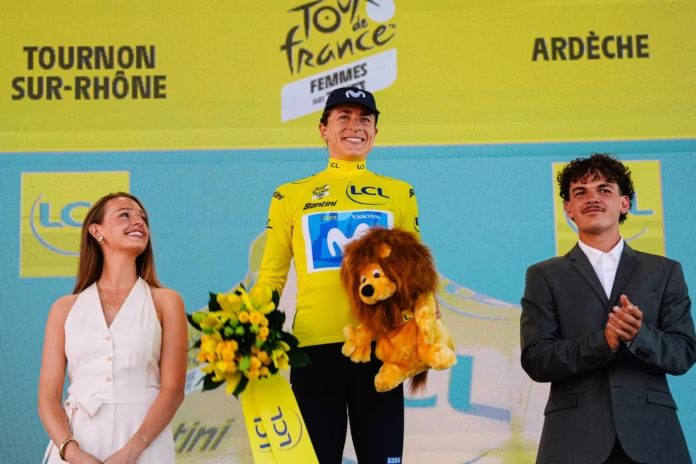
Twelve seconds separate Marlen Reusser from Demi Vollering before the Tour de France Femmes climbs Mont Ventoux today.
On almost any other stage, that would be a useful advantage. On a summit finish of 15.7 kilometres at 8.8%, it is barely an advantage at all.
Reusser takes yellow into Stage 7 after surviving every attack thrown at her across the Beaujolais and holding Vollering to the same time again on Stage 6. Vollering, though, does not need to produce one spectacular attack and disappear up the mountain. She needs only enough separation, combined with the summit bonuses, to remove those 12 seconds.
Kasia Niewiadoma-Phinney is further back at 1:17, but close enough that one exceptional Ventoux ride could put her directly into the battle between them.
The arithmetic is simple. The racing will not be.
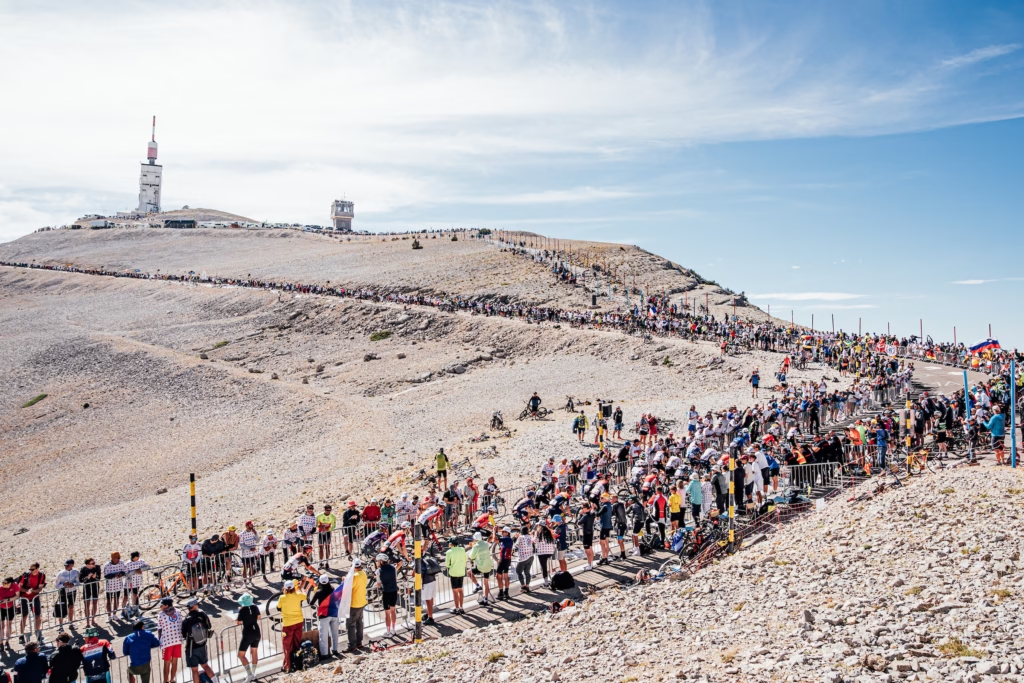
How much is 12 seconds on Mont Ventoux?
Very little.
The officially classified Mont Ventoux ascent measures 15.7 kilometres at 8.8%, although the road is already climbing from Bédoin before the categorised section begins.
The decisive part should take the leading women somewhere around 45 to 50 minutes.
Over an effort of that length, 12 seconds represents only around 0.4% of the total climbing time.
That is the difference between two riders who are almost perfectly matched. One short acceleration, one difficult kilometre, one moment where Reusser chooses not to follow immediately could wipe it out.
It also means Vollering does not need to attack from the bottom and ride away by minutes.
If Reusser begins losing only two or three seconds per kilometre through the steep forest section, the yellow jersey changes shoulders quickly.
That is why the gap looks so different today than it did when Reusser gained her time against the clock.
The finish bonuses make Vollering’s job easier
Stage 7 finishes at the summit, meaning the first three riders receive the usual time bonuses:
- 10 seconds for first
- 6 seconds for second
- 4 seconds for third
Those bonuses fundamentally change the 12-second calculation.
If Vollering wins and Reusser finishes second on the same time, Vollering gains four seconds and the deficit falls to eight.
If Vollering wins with Reusser third on the same time, she gains six seconds and halves the deficit.
If Vollering wins and creates even a small physical gap, yellow becomes much easier to take.
The complete system is explained in our Tour de France Femmes 2026 time bonuses guide.
For example, Vollering winning eight seconds ahead of Reusser in second would produce a 12-second swing once the four-second difference in bonuses is added. A slightly larger physical gap would put Vollering clearly ahead.
Reusser therefore cannot think purely in terms of keeping Vollering within 12 seconds on the road. She needs enough margin to absorb whatever happens at the finish as well.
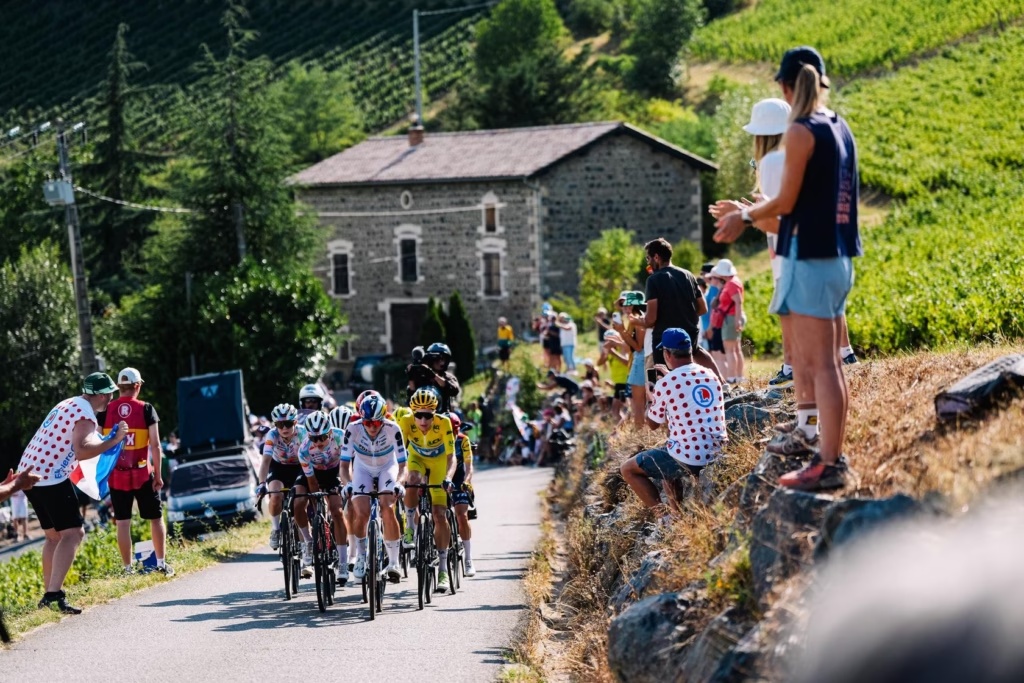
Reusser has already answered the first climbing question
The obvious pre-race argument was that Reusser could dominate the Dijon time trial but might surrender that advantage as soon as the race reached proper climbing terrain.
Stage 5 weakened that assumption considerably.
Vollering attacked repeatedly. Niewiadoma-Phinney followed and attacked herself. Pauline Ferrand-Prévot was dropped, as were most of the other GC contenders.
Reusser remained.
She finished alongside Vollering and Niewiadoma-Phinney and lost only two seconds from her overall advantage because of finish bonuses rather than a physical gap.
That was perhaps the most important result of the Tour so far.
Reusser is not defending yellow simply because she took a huge amount of time against the clock. She has already demonstrated that she can climb with the two women immediately behind her.
The broader plan behind that defence was already taking shape after Dijon in Project Nice: Marlen Reusser’s plan to defend yellow.
Mont Ventoux asks a different question.
Stage 5 was built around repeated shorter climbs and changes of rhythm. Ventoux is sustained. Once the race enters the forest above Saint-Estève, the road sits close to 9% for kilometre after kilometre.
There is no descent to recover on and very little tactical relief.
Reusser now has to prove that the climbing resilience shown on Stage 5 can be sustained for most of an hour.
Reusser should not try to race like Vollering
This may be the most important tactical decision of the stage.
Vollering is better at producing sharp climbing accelerations. If she attacks and Reusser immediately tries to match every change in pace, the yellow jersey risks riding above her sustainable limit.
That could turn a five-second gap into a minute later on the mountain.
Reusser’s better strategy may be to accept temporary separation.
If Vollering attacks and gains five or ten metres, Reusser can maintain her own power and assess whether the move is sustainable. Her time trial ability makes her unusually well suited to that approach.
The climb is long enough that chasing by rhythm rather than acceleration can work.
The problem is psychological. Letting Vollering open even a small gap when the Tour lead is only 12 seconds away is uncomfortable.
Yet the greatest danger for Reusser is not losing five seconds at eight kilometres to go. It is responding too hard, going into the red and losing 45 seconds during the final five kilometres.
Her yellow jersey defence has to be based around restraint.
 Photo Credit: Getty
Vollering needs pressure before the attack
Vollering has the opposite problem.
She does not want Reusser reaching the final three kilometres fresh enough to ride entirely defensively.
FDJ United-Suez therefore need to make the climb hard before Vollering launches.
The ideal scenario is a sustained tempo through the forest, progressively removing Movistar domestiques and forcing Reusser to work close to her limit without giving her one obvious acceleration to respond to.
Then Vollering attacks.
The timing will depend on how Reusser looks.
If the yellow jersey begins showing weakness early, there is no reason to wait. A move with seven or eight kilometres remaining could create the largest possible gap.
If Reusser looks comfortable, Vollering can afford patience. She needs seconds rather than minutes.
That is why Vollering remains the central favourite for the stage and the immediate threat to yellow, just as she did in our Tour de France Femmes GC favourites ranking.
A headwind would favour Reusser
The exposed upper section after Chalet Reynard introduces another tactical variable.
If there is a meaningful headwind, riding alone becomes substantially more expensive.
That favours Reusser.
Vollering would ideally want to create separation before the riders emerge from the forest, but attacking too early could leave her exposed across the final six kilometres while Reusser works with Niewiadoma-Phinney or another contender behind.
It creates a difficult balance.
Attack too late and there may not be enough road to create 12 seconds.
Attack too early and the wind could neutralise the advantage.
This is another reason the steep forest section is likely to determine the race. It provides the gradients Vollering needs without the same aerodynamic disadvantage she may encounter near the summit.
 Photo Credit: Getty
Can Niewiadoma-Phinney bridge 1:17?
Niewiadoma-Phinney’s arithmetic is much harder.
She begins 1:17 behind Reusser and 1:05 behind Vollering.
That cannot be solved through bonuses.
To take yellow, she needs a real climbing gap.
A 77-second turnaround on Ventoux is significant but entirely possible if one rider has an exceptional day and another cracks. On a climb of this severity, GC gaps do not have to remain measured in seconds.
The more realistic immediate objective is moving closer to the top two while protecting her podium.
Niewiadoma-Phinney has one tactical advantage: she does not have to carry the responsibility of the Reusser-Vollering duel.
If Vollering attacks, Reusser has to decide how to respond. Niewiadoma-Phinney can follow if she is capable.
Alternatively, she can attack first and force both of them to react.
That may be her strongest option.
Waiting until Vollering launches risks turning Niewiadoma-Phinney into a passenger in somebody else’s yellow jersey battle. Attacking earlier gives her the chance to make the others race on her terms.
Her ability to win through disruption rather than control has been a defining part of her Tour career, and is one of the reasons she remained among the leading contenders in our Tour de France Femmes riders to watch guide.
Longo Borghini changes the calculation behind them
Elisa Longo Borghini begins fourth overall at 2:28 after taking time through the successful late move on Stage 6.
She is only 1:11 behind Niewiadoma-Phinney.
That means Niewiadoma-Phinney cannot focus entirely on attacking yellow. She also has a podium to defend.
Longo Borghini is exactly the sort of rider who could benefit from Ventoux. She may not have Vollering’s acceleration, but she can produce a sustained climbing effort and continue gaining time when others begin fading.
Antonia Niedermaier is another 12 seconds behind Longo Borghini.
The front of the Tour therefore contains two different battles: Reusser against Vollering for yellow, and a much wider fight involving Niewiadoma-Phinney, Longo Borghini and Niedermaier for the remaining podium positions.
Ventoux could merge the two.
-
 Photo Credit: Getty
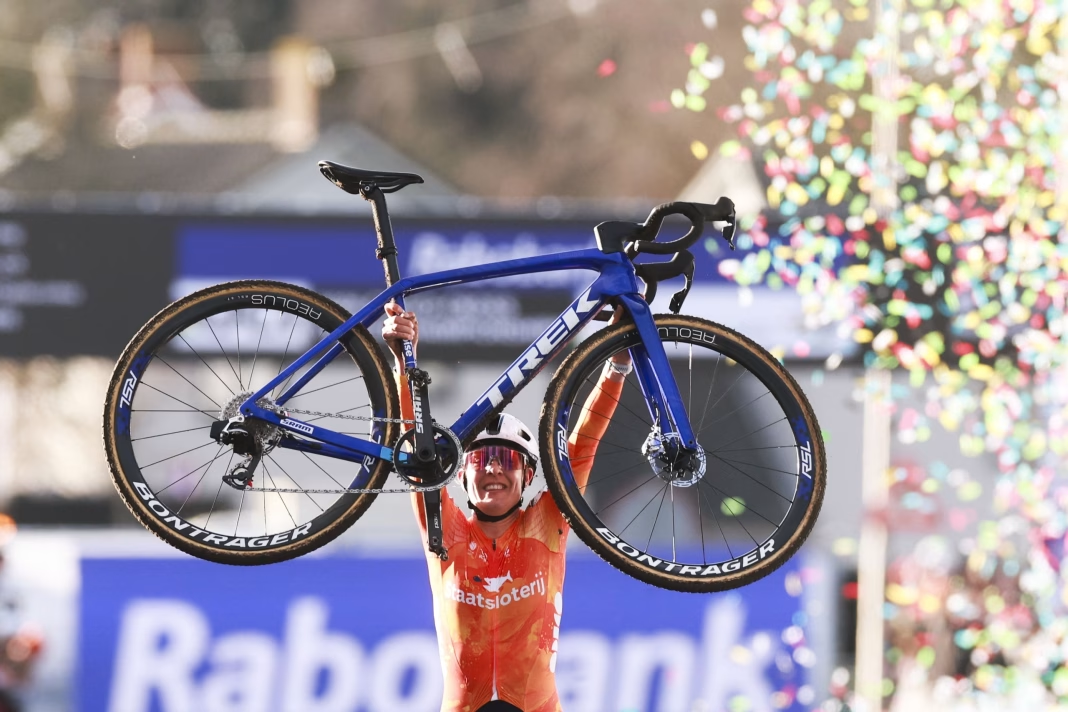

What happens if Reusser and Vollering reach the final kilometre together?
Reusser probably keeps yellow.
If the pair arrive inside the final kilometre together, Vollering would need to create a meaningful late gap or rely heavily on the bonus difference.
Even winning the stage with Reusser second only gains four bonus seconds.
That would leave Reusser eight seconds ahead if no physical gap is recorded.
For Vollering, therefore, arriving at the final kilometre alongside Reusser is not enough. She needs to have already started the process of separating her.
Reusser’s objective is almost the opposite.
If she can remain attached until the exposed upper kilometres, the tactical balance begins moving back towards her. The gradient remains hard, but there is progressively less road available for Vollering to turn superiority into time.
Every kilometre Reusser survives reduces the value of Vollering’s climbing advantage.
What should we expect today?
FDJ United-Suez should make the race hard from the lower slopes rather than wait for a final-kilometre shootout.
Reusser should resist the temptation to follow every acceleration instantly and instead trust the sustained power that has put her in yellow.
Vollering should attack before the final exposed section if she senses weakness.
Niewiadoma-Phinney needs to do more than simply watch them.
The crucial moment is likely to come somewhere between eight and four kilometres from the summit.
That is where the steep forest begins giving way to the exposed upper mountain and where an attack still has enough road to become decisive.
Twelve seconds means Reusser starts Ventoux in yellow.
It does not mean she starts it with control.
Today, for the first time in this Tour, the strongest climber can remove almost every piece of tactical arithmetic from the equation simply by riding away.

