
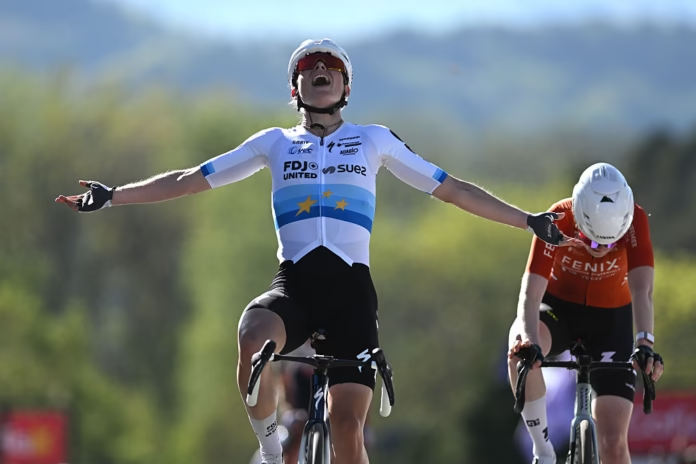
La Flèche Wallonne Femmes 2026 gave the Ardennes week a result that felt both familiar and important. Demi Vollering won on the Mur de Huy, beating defending champion Puck Pieterse, with Paula Blasi taking 3rd. It was Vollering’s second victory in the race, and it came only days after Blasi had disrupted the favourites to win Amstel Gold Race Women.
That matters because La Flèche Wallonne Femmes did not simply restore order after Amstel. It clarified what kind of order exists in the women’s peloton right now. Vollering remains the strongest pure reference for this terrain when the race comes down to a steep uphill finish. Pieterse remains close enough to make that superiority uncomfortable rather than automatic. Blasi’s podium confirmed that her Amstel victory was not a one-day anomaly but the sign of a rider moving quickly into a much higher tier.
La Flèche Wallonne Femmes is often treated as the most predictable race of Ardennes week because everyone knows where it will be decided. That is only partly true. The Mur de Huy narrows the tactical picture, but it does not remove the wider implications. What happened on Wednesday said plenty about form, confidence, team strength and the hierarchy heading into Liège-Bastogne-Liège Femmes and the rest of the season.
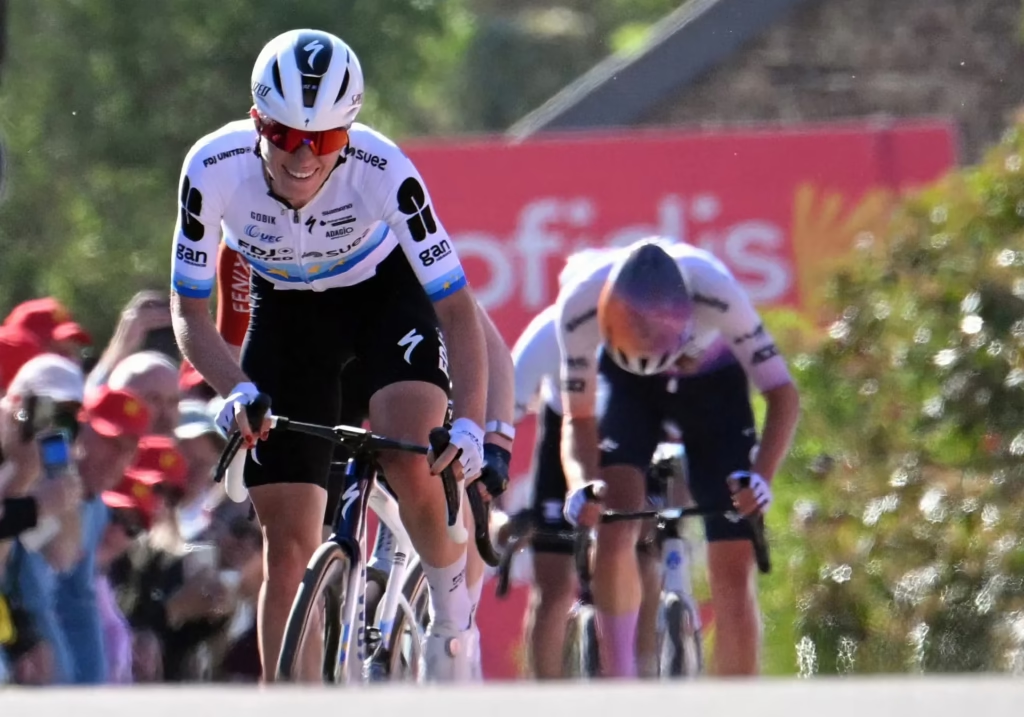
Demi Vollering still owns the clearest answer to the Mur de Huy
The biggest meaning of the race is simple enough: when the finale becomes a pure uphill acceleration test on the Mur de Huy, Vollering still looks like the most complete answer in the peloton. She did not win through chaos, hesitation or luck. She won because she opened the decisive move on the climb and had enough left to hold off Pieterse’s late surge.
That gives her season another layer of authority. Vollering has already been one of the defining riders of the era, but there is still a difference between being among the favourites and being the rider who can make a steep, iconic finish feel almost orderly. La Flèche Wallonne Femmes 2026 reinforced the idea that she remains the rider others have to solve in these specific one-day scenarios.
It also matters that the win came after Amstel, where Vollering was strong without controlling the result. That contrast is useful. Amstel left the sense that the biggest races could still be disrupted by the right late attack. La Flèche Wallonne Femmes showed that when the race becomes more compressed and the finish more specific, Vollering still has the clearest final move.
Puck Pieterse is still the rider who can turn dominance into a fight
Pieterse’s 2nd place may be almost as revealing as Vollering’s win. She was not able to defend her 2025 title, but she got close enough on the Mur de Huy to remind everyone that she remains one of the most dangerous riders in the spring. Vollering won, but it was not a procession. Pieterse finished close enough to keep the race feeling competitive rather than settled.
That matters for the season because Pieterse gives races a different tension. She is not merely a rider who can follow the strongest moves. She is one of the few who can still threaten Vollering when the gradients sharpen and the race becomes selective. Her value lies in making supposedly controlled races feel unstable again.
There is also a broader pattern here. Pieterse had already made clear before the race that she was focused on a standout result in the Ardennes rather than simply collecting podiums. She did not get the win at La Flèche Wallonne Femmes, but the performance kept that ambition credible heading into Liège-Bastogne-Liège Femmes and the next phase of her season.
Paula Blasi’s Amstel was not a one-off
Paula Blasi’s 3rd place may be the most significant long-term detail behind the winner herself. After winning Amstel Gold Race Women with a bold late attack, she could easily have dropped back into the category of interesting outsider, a rider whose best chance had come in one specific race shape. Instead, she backed it up immediately with a podium in a far more controlled uphill finish.
That changes how the season should be read. Blasi is no longer simply a rider who took advantage of one moment of hesitation. She has now performed in two very different Ardennes scenarios: first through aggression and timing at Amstel, then through resilience and climbing strength at La Flèche Wallonne Femmes. That is a much more serious signal.
For UAE Team ADQ, this is exactly the kind of development that shifts a season. A team with an emerging rider can become much more dangerous once rivals have to mark her properly. Blasi now moves from being someone who can surprise the favourites to someone the favourites must actively account for.
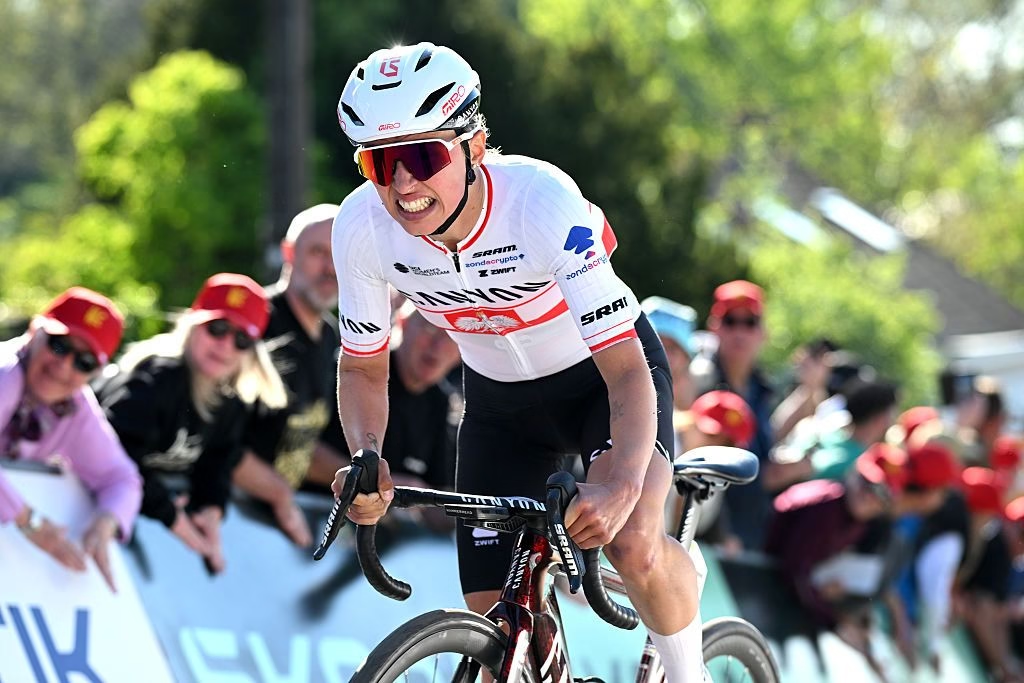 Photo Credit: Getty
The favourites are still the favourites, but the hierarchy has tightened
One of the most useful things La Flèche Wallonne Femmes 2026 did was tighten the hierarchy without simplifying it. Vollering remains the clearest favourite on finishes like this. Pieterse remains the best rider for turning that status into a race rather than a procession. Blasi has moved up decisively. Kasia Niewiadoma-Phinney, meanwhile, leaves with a reminder that good form does not always translate cleanly when details go wrong.
Niewiadoma-Phinney had already shown strong condition with 2nd at Amstel, but on the Mur de Huy she lost momentum through a gearing issue and could not fully contest the finish. That does not erase her form, but it is a useful example of how specific La Flèche Wallonne Femmes can be. On this climb, tiny technical or positional problems become race-shaping ones immediately.
That is why the result should not be read as proof that the rest of Ardennes week is settled. It should be read as evidence that the top of the women’s peloton is becoming more layered. Vollering can still win the defining uphill finish. Pieterse can still push her. Blasi can now podium in two different types of race. Niewiadoma-Phinney is still strong enough to be central even when the result falls short.
FDJ United-SUEZ get more than a win
For FDJ United-SUEZ, Vollering’s victory is about more than one Ardennes result. It is another confirmation that the team can support her in the races where the burden of expectation is heaviest. La Flèche Wallonne Femmes is not a race where team control guarantees victory, but it is a race where positioning, energy conservation and the final launch all matter. Vollering still had to win it herself, but the structure around her helped keep the conditions right.
That matters because the team’s season is not built around isolated days. It is built around major one-day races, stage races and the broader expectation that Vollering should keep converting strength into the biggest results. Every race like this reduces uncertainty. It tells the team that the core model still works when the pressure is highest.
It also matters for the perception of the squad. FDJ United-SUEZ are no longer simply trying to prove they can support a superstar signing. With wins like this, they are steadily reinforcing the idea that the team is one of the genuine power centres of the women’s peloton.
Liège-Bastogne-Liège Femmes now looks even more interesting
The immediate effect of La Flèche Wallonne Femmes 2026 is that Liège-Bastogne-Liège Femmes 2026 in the UK becomes more rather than less intriguing. If Vollering had won by a huge margin and the rest had faded badly, the final Ardennes Monument might feel like a cleaner forecast. Instead, the week has developed in a more useful way.
Vollering has authority. Pieterse has proximity. Blasi has momentum. Niewiadoma-Phinney still has the kind of durability that suits longer one-day racing. Pauline Ferrand-Prévot and Anna van der Breggen remain the sort of riders who can complicate any Ardennes race if they are close enough in the final phase. That gives Liège a richer tactical field than La Flèche Wallonne Femmes, not because the Mur result was unclear, but because the performances behind it were strong enough to keep the next race open.
Liège-Bastogne-Liège Femmes is also a different question. It is longer, broader and less tied to one final climb. That means Wednesday’s result should shape the next race, but not dictate it. Vollering leaves as the clearest reference. She does not leave with the week closed.
-
 Photo Credit: Getty
 -
 Photo Credit: Cs-wolves / Wikimedia Commons, CC BY-SA 4.0

What it means beyond Ardennes week
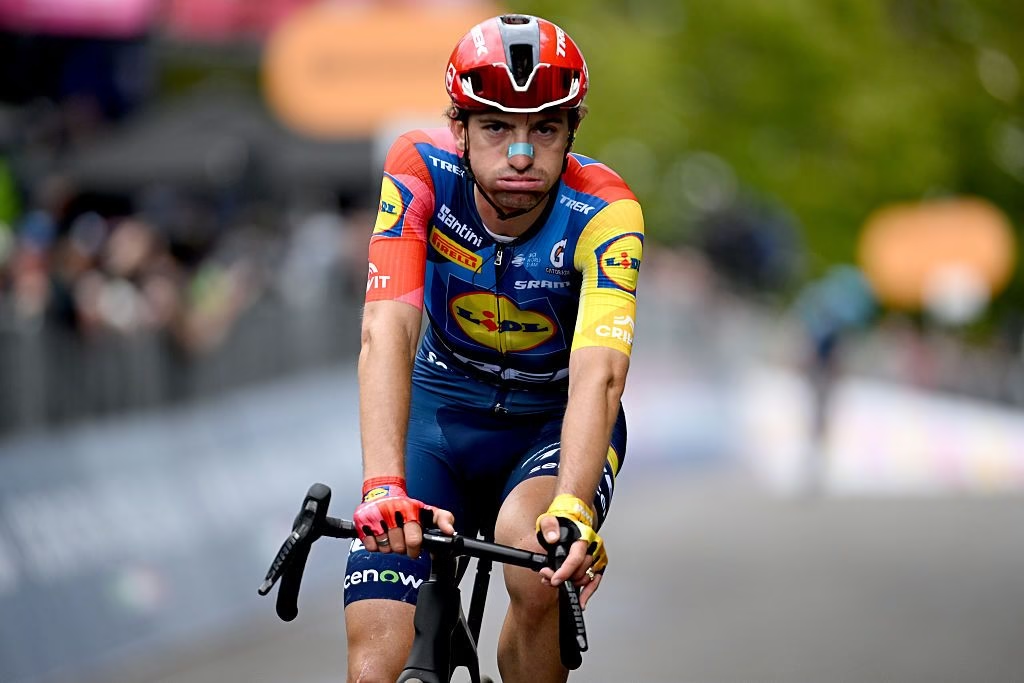
La Flèche Wallonne Femmes 2026 also says something wider about the season. It confirms that women’s cycling still has its dominant riders, but it also shows that dominance now has to survive very different race shapes. Amstel Gold Race Women was won through disruption and belief. La Flèche Wallonne Femmes was won through controlled climbing force. The gap between those results is where the modern peloton has become more interesting.
That is good news for the rest of the year. The strongest riders remain visible, which helps give the season structure. But the layers beneath them are getting deeper. Riders such as Blasi are moving up faster. Pieterse continues to sharpen her position among the very best. Teams can no longer rely on the old assumption that one or two stars will simply absorb every major result.
For the broader calendar, that means the races ahead should remain open in the right ways. The hierarchy is clearer than it was before La Flèche Wallonne Femmes, but it is not rigid. Vollering has the most obvious authority. The rest of the peloton still has enough quality to make that authority work for every victory.
What La Flèche Wallonne Femmes 2026 really changed
The easiest reading of Wednesday is that Demi Vollering won another big uphill finish and reasserted herself as the Ardennes reference. That is true, but it is not the whole story.
What La Flèche Wallonne Femmes 2026 really changed was the precision of the season. It told us that Vollering remains the clearest answer when the race becomes a steep uphill test. It told us that Pieterse is still close enough to keep those races alive. It told us that Blasi’s rise is real. And it told us that the final Ardennes picture is strong enough to stay interesting even after the Mur de Huy has made its selection.
That is a useful outcome for the season. The best rider won, but the race still left enough unfinished business behind her.

