
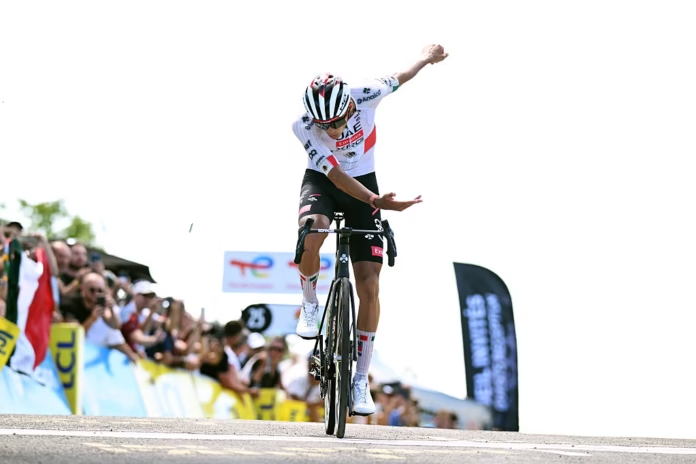
Tour Auvergne – Rhône-Alpes 2026 ended with Isaac del Toro on top, Luke Tuckwell left to absorb how close he had come to one of the season’s biggest shocks, and Juan Ayuso leaving with a podium that felt useful rather than emphatic. In result terms, Del Toro won the race. In season terms, the final weekend said much more than that.
This was not a straightforward Tour de France warm-up with the usual hierarchy lightly rearranged. The race was missing several of the most obvious July names, but it did not lack consequence. Del Toro won back-to-back summit finishes on Grand Colombier and Plateau de Solaison, overturning the race on the final climb. Tuckwell briefly turned the whole race upside down with Red Bull-BORA-hansgrohe after stage 6. Ayuso confirmed that he is moving in the right direction before July. Matteo Jorgenson and Team Visma | Lease a Bike left with a strong team time trial and a high GC finish, but not the final authority they might have wanted.
The Tour Auvergne – Rhône-Alpes 2026 route gave the race enough variety to make those conclusions meaningful. There was an opening breakaway success for Alex Baudin, an individually timed team time trial, chaotic mountain racing to Crest-Voland, and two decisive summit finishes. By the end, the race had tested teams, leaders, recovery, descending, tactical nerve and pure climbing.
That makes the 2026 edition one of the most useful June form lines of the season. It did not give a final answer for the Tour de France, but it did show who is already sharp, who can handle pressure, and who still needs to solve important questions before July.
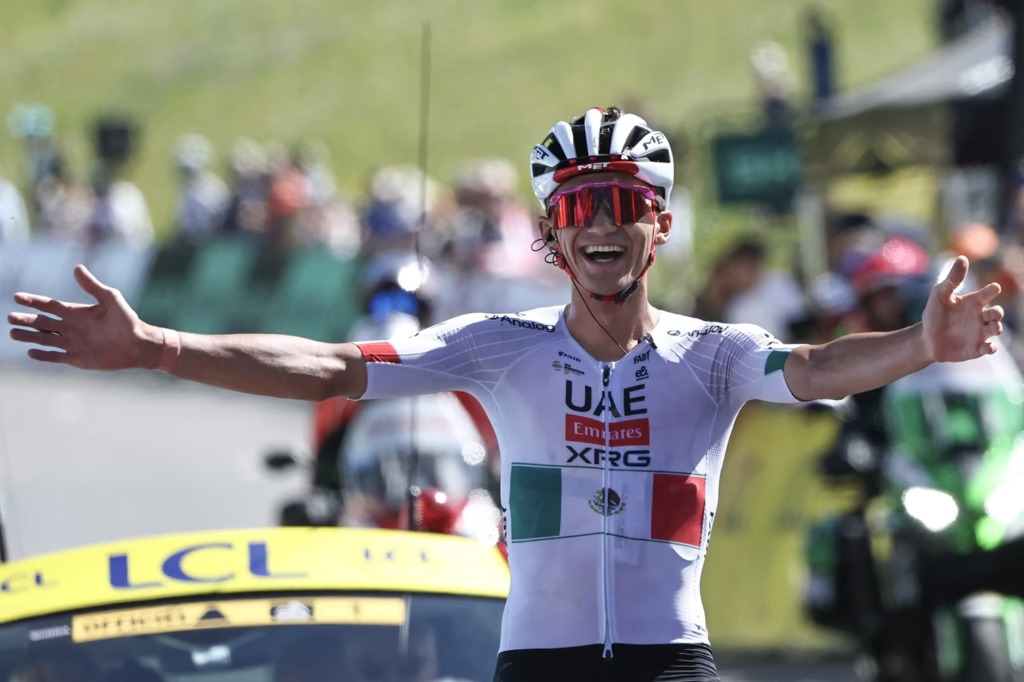
Isaac del Toro is no longer just a future problem
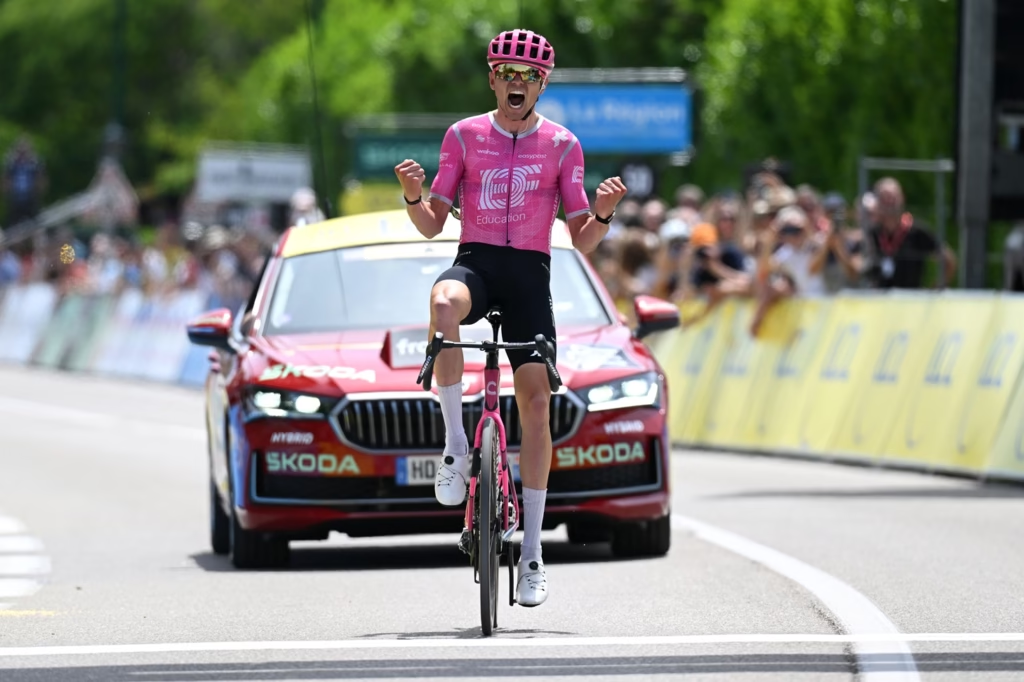
Del Toro’s overall victory changes the tone around his season. He was already one of the outstanding young riders in the peloton, but Tour Auvergne – Rhône-Alpes turned that promise into something more immediate. Winning a WorldTour stage race with back-to-back summit finish victories is not development talk. It is present-tense authority.
His Grand Colombier win on stage 7 brought him back into serious contention. His Plateau de Solaison victory on stage 8 finished the job. The important part was the way he won. He did not wait for others to crack and inherit the race. He attacked, rode clear, and made the final climb look simpler than it was. Starting the final day 49 seconds behind Tuckwell, he needed a proper swing. He created it himself.
That changes how his summer should be viewed. Del Toro is not going to the Tour de France as UAE Team Emirates-XRG’s sole leader, with Tadej Pogačar still the centre of gravity, but his role now looks much more significant. If he is this strong in June, he becomes more than a mountain domestique. He becomes a rider who can change the shape of a stage before Pogačar even needs to move.
UAE have used riders like João Almeida, Adam Yates and Marc Soler in different ways around Pogačar in recent seasons. Del Toro gives them another version of that weapon: young, explosive, confident, and now proven in the exact type of mountain racing that can break a stage apart. If he is asked to support, he can support at a very high level. If he is given freedom, he has already shown what that can look like.
The risk is expectation. A June win does not make him a Tour de France winner in waiting overnight, and UAE may still want to manage his load carefully. But after Tour Auvergne – Rhône-Alpes, nobody can frame him only as an emerging rider. He has become one of the most important climbing pieces in the second half of the season.
Luke Tuckwell’s breakout was real
Luke Tuckwell did not win the race, but his second place overall may still be one of the most striking stories of the week. He moved into yellow after the wild stage 6 to Crest-Voland, carried the jersey through Grand Colombier, then finally lost it on Plateau de Solaison. For a rider still building his profile at this level, that is a huge week.
The temptation is to reduce his race to the final day, where Del Toro overpowered him. That would be unfair. Tuckwell did not collapse out of the race. He finished second overall, 54 seconds down, after three consecutive days of intense mountain pressure. He absorbed the emotional shock of unexpectedly leading a major WorldTour stage race, defended under pressure on stage 7, and still limited the damage well enough to stay ahead of Ayuso, Jorgenson and Tobias Halland Johannessen in the final standings.
For Red Bull-BORA-hansgrohe, the week was more complicated. The team arrived with several options, but Tuckwell became the story almost by force of performance. Maxim Van Gils winning stage 6 and Tuckwell taking yellow made that day one of the most memorable team moments of the race. The final result then gave them something more durable than a stage win: evidence that Tuckwell can be a serious stage-race rider.
The season impact is obvious. He will not be underestimated in the same way again. That makes future races harder, but it also changes how Red Bull-BORA-hansgrohe can use him. He can be a protected rider in one-week races, a second GC card in tougher stage races, or a high-value climbing support rider in Grand Tours. This race gave him options.
The next step is consistency. A single breakout week can disappear quickly if it is not backed up. But the manner of this performance, across multiple mountain days and under the pressure of yellow, makes it feel more substantial than a one-off.
Juan Ayuso gets a useful answer before July
Juan Ayuso’s third place overall did not come with the drama of Del Toro’s win or Tuckwell’s breakthrough, but it may still matter a lot for his season. He finished second on the final stage, completed the overall podium, and looked much closer to the level required for the Tour de France than he had at some earlier points in the year.
The key detail is that Ayuso was not blown away by the race. Del Toro was stronger on the final climb, but Ayuso still put together a serious podium performance. He climbed well, stayed consistent and finished ahead of several high-quality GC riders. For Lidl-Trek, that is a useful sign before the Tour.
The question is what his role becomes in July. If Lidl-Trek take him to the Tour as an outright GC leader, Tour Auvergne – Rhône-Alpes gives them encouragement but not certainty. He was good enough for the podium, but Del Toro was clearly better on the final weekend. If Ayuso is used more flexibly, with stage ambitions and GC possibilities kept open, this race suggests he can be a major factor.
There is also a psychological piece. Riders coming back from setbacks or uneven form often need a race that confirms they are close. Ayuso got that here. He did not dominate, but he looked like a rider moving in the right direction, and June is exactly when that matters.
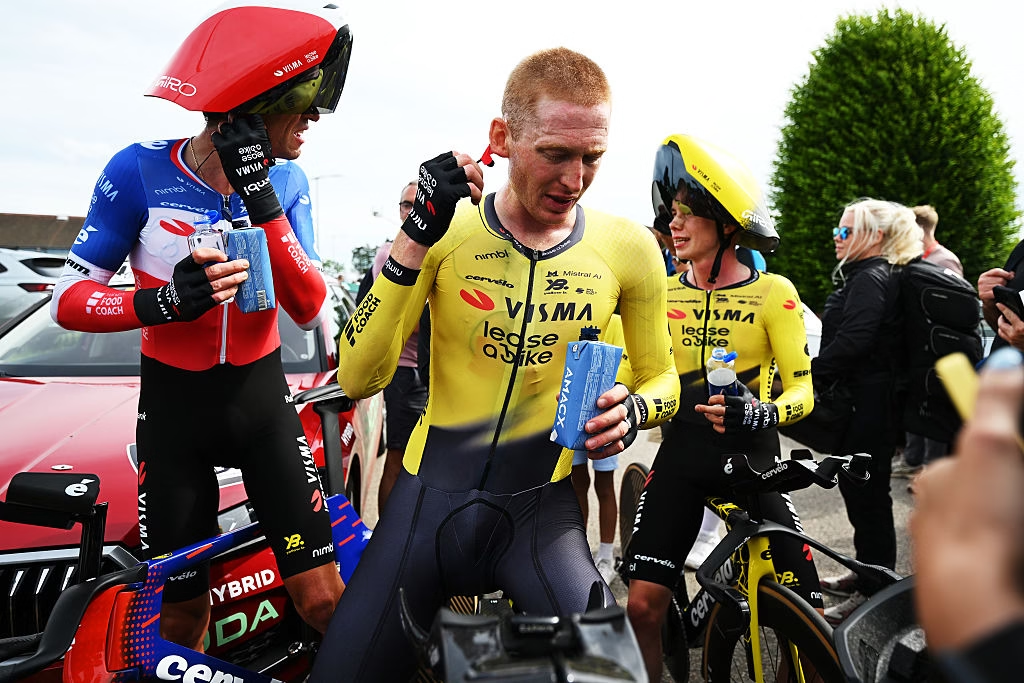 Photo Credit: Getty
Team Visma | Lease a Bike still have strength, but not final control
Team Visma | Lease a Bike won the team time trial and placed Matteo Jorgenson fourth overall, with Cian Uijtdebroeks also inside the top 10. On paper, that is a strong race. In the wider season narrative, it is slightly more mixed.
The team time trial was a clear positive. With the Tour de France bringing back an individually timed team time trial, the stage 3 performance at Tour Auvergne – Rhône-Alpes was not just a race result. It was a live rehearsal. Visma showed that they can organise, pace and execute in that format, even under imperfect conditions. That should carry into July.
The mountain days were more complicated. Jorgenson started the final day close enough to fight for the overall, but he did not leave with the win. Fourth overall is hardly a failure, yet the race did not end with Visma controlling the final climb. Del Toro and UAE carried the authority when the race reached its decisive point.
That distinction is important. Visma remain one of the best teams in the world at structure and collective performance. This race underlined that. But structure alone is not enough when a rider like Del Toro attacks on a final mountain. For the Tour de France, where Pogačar and UAE may have even more firepower, Visma will need more than organisation. They will need the legs to finish the work.
Uijtdebroeks’ seventh place is also useful. He continues to build a profile as a reliable GC rider, even if this race did not put him in the winning conversation. As a team, Visma leave with strong pieces. They just did not leave with the final word.
Paul Seixas showed courage, but the season now needs management
Paul Seixas had been one of the biggest pre-race stories, and for much of the week he looked ready to turn that attention into a serious overall challenge. Then came the stage 7 crash, the long chase, the visible damage, and the eventual abandonment on the final day.
There are two ways to read his race, and both are true. The first is that he showed extraordinary character. His chase after crashing on stage 7 was one of the defining images of the race, and the fact he stayed in contention at all said plenty about his competitiveness and the strength of Decathlon CMA CGM around him.
The second is that the crash changed the season calculation. He is still only 19, and there is no need to force every storyline into immediate GC expectation. The resilience was impressive, but the physical cost cannot be ignored. The next part of his season should be about recovery, patience and careful race selection rather than proving the same point again too quickly.
If managed well, Tour Auvergne – Rhône-Alpes will still be remembered as a confirmation of his level. He was not exposed by the race. He was disrupted by a crash. Before that, he looked like one of the riders capable of shaping the final weekend. That is the piece to carry forward.
French cycling will want him pushed quickly into the centre of every conversation. The smarter route is slower. He has already shown enough.
Maxim Van Gils gives Red Bull-BORA-hansgrohe another route to success
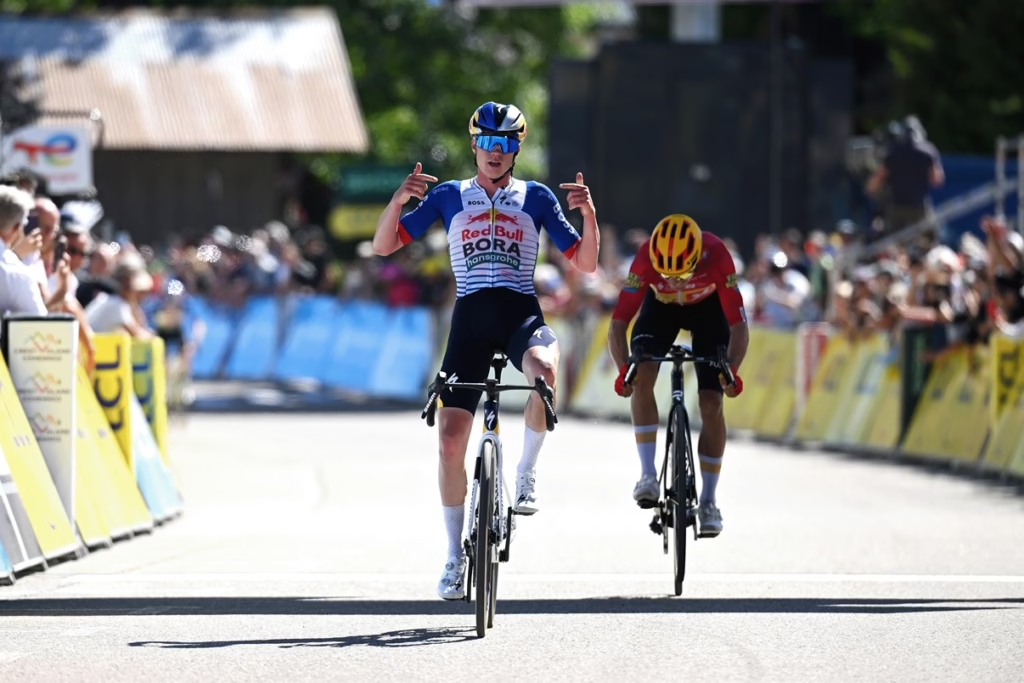
Maxim Van Gils winning stage 6 at Crest-Voland was one of the race’s key turning points. It was not only a stage win. It helped create the conditions for Tuckwell to move into yellow and changed the entire GC picture before Grand Colombier and Plateau de Solaison.
That stage was chaotic, fast and tactically unusual, with a huge breakaway reshaping the race. Van Gils came through it with a win that mattered emotionally and competitively. For Red Bull-BORA-hansgrohe, it showed that their strength in the race was not limited to one GC card. They could win stages, disrupt control and turn complicated racing to their advantage.
Van Gils has always looked at his best when the racing is hard to categorise. Not a pure climber, not a pure sprinter, not simply a classics rider, but dangerous on days where fatigue, positioning and instinct count together. Stage 6 gave him exactly that kind of platform.
For the rest of the season, that makes him valuable in races that do not follow a predictable script. He can win from reduced groups, go deep into hard breakaways and support GC ambitions when the race becomes open. Red Bull-BORA-hansgrohe leave with Tuckwell’s breakout, but Van Gils’ win should not be treated as a side note.
The young GC generation took over the race
One of the clearest messages from the final classification was age. Del Toro won. Tuckwell was second. Ayuso was third. Johannessen, Mattias Skjelmose, Uijtdebroeks and others filled out the upper part of the race. This was not a week dominated by older Grand Tour names tuning up for July. It was a race where the younger GC generation grabbed control.
That does not mean the established hierarchy disappears. Pogačar, Jonas Vingegaard, Remco Evenepoel and Primož Roglič still define much of the sport’s biggest stage-racing conversation. But Tour Auvergne – Rhône-Alpes showed the next group is no longer waiting politely behind them. The gap between development and contention is shrinking.
Del Toro is the strongest example because he won the race. Ayuso is already established, but still young enough that every performance feeds into a long-term arc. Tuckwell’s emergence gives Red Bull-BORA-hansgrohe a new name to build around. Uijtdebroeks and Skjelmose both remain part of the wider conversation, even if they did not win here.
The season effect is that one-week races now look deeper. A rider who might once have been described as a future contender can arrive and win immediately. That changes tactics, team planning and expectations. Nobody gets a free transition year anymore.
UAE Team Emirates-XRG look even deeper before the Tour
UAE Team Emirates-XRG did not need Tour Auvergne – Rhône-Alpes to prove they are strong. They already had the season’s dominant reference point through Pogačar and a deep roster built around winning the biggest races. But Del Toro’s victory still adds a significant layer.
The Tour de France question is not simply whether Pogačar is strong enough. It is how much support, control and tactical danger UAE can put around him. Del Toro’s win answers part of that. If he rides in July, he gives UAE another climber capable of forcing rivals to react before the final leader-on-leader phase.
That is especially relevant on a route where the mountains come early and late, and where team strength can decide whether a contender spends the day attacking or simply surviving. The Tour de France 2026 route analysis points towards a race where the Pyrenees, time trial and final Alpine block will stretch teams across several phases. Del Toro looks like exactly the kind of rider who can influence those phases.
The challenge is internal balance. UAE cannot turn every strong rider into a protected leader at the Tour. Some will have to work. But that is a luxury problem. After Tour Auvergne – Rhône-Alpes, their pool of climbing options looks even more intimidating.
The race became a better Tour de France form guide than expected
Pre-race, the absence of the biggest names could have made Tour Auvergne – Rhône-Alpes feel like a second-tier Tour de France rehearsal. Instead, the race became more useful because it was less scripted. Without Pogačar, Vingegaard and Evenepoel controlling the whole narrative, other riders had room to reveal more.
The individually timed team time trial offered direct July relevance. The chaotic stage 6 showed how quickly a race can shift when a large breakaway gets enough room. The Grand Colombier and Plateau de Solaison summit finishes gave clear climbing evidence. The final classification showed who could put multiple hard days together rather than simply produce one performance.
The Tour de France 2026 full route guide makes that useful. July will not be won in the same way, and the field will be stronger, but many of the same demands apply: controlled team execution, climbing depth, repeated mountain stress and the ability to avoid one bad day becoming fatal.
Tour Auvergne – Rhône-Alpes did not tell us who will win the Tour. It told us which riders and teams are already carrying form into the final approach.
The team time trial rehearsal carries real significance
Stage 3’s individually timed team time trial was one of the most important structural parts of the race. Team Visma | Lease a Bike won the stage, but the broader significance came from the format. With individual times counting for GC, teams had to balance collective speed with the protection of their leaders.
That is directly relevant to the Tour de France. A normal team time trial can reward the fourth rider across the line and allow a team to sacrifice riders more brutally. The individually timed version changes the calculation. Leaders must still finish strongly. Teammates cannot simply drag them to the final kilometre and disappear if the leader then loses time in the closing section.
Tour Auvergne – Rhône-Alpes showed how much tactical detail that creates. Teams need to decide who is protected, how long to keep numbers together, when to let weaker riders drop, and how to use the final climb or rise if the course includes one. Visma handled it best here, but the format will be even more important when yellow is at stake on the opening day of the Tour.
For teams heading to Barcelona, this was not just a stage in a warm-up race. It was data.
What the result means for the Tour de France
The clearest Tour de France takeaway is that UAE Team Emirates-XRG look even more dangerous. Pogačar remains the central figure, but Del Toro’s form gives them another rider who can help control, attack or complicate mountain stages. That strengthens their hand before the race has even begun.
For Lidl-Trek, Ayuso’s podium is encouraging. It does not make him a Tour favourite, but it places him back into the conversation as a rider who can arrive in July with purpose. His final-stage performance against Del Toro showed both progress and the gap still to close.
For Team Visma | Lease a Bike, the signs are mixed but not negative. The team time trial win matters. Jorgenson’s fourth overall matters. Uijtdebroeks inside the top 10 matters. But they did not control the final mountain stages in the way they would have wanted. If they are trying to challenge UAE in July, this race gave them useful evidence and a reminder of the scale of the task.
For Red Bull-BORA-hansgrohe, Tuckwell’s ride changes internal possibilities. The team now has another rider who can be trusted in high-level GC terrain. Whether that affects Tour selection, Vuelta planning or future one-week leadership, the performance has value beyond the podium.
For Decathlon CMA CGM, Seixas’ race was both confirmation and caution. The level is there. The body now needs looking after.

What the result means beyond July
Not every conclusion from Tour Auvergne – Rhône-Alpes has to be squeezed into the Tour de France. Some of the biggest season implications sit beyond July.
Del Toro’s win adds weight to his long-term stage-racing status. Tuckwell has earned new opportunities. Van Gils has re-established himself as a rider who can win hard, messy stages. Johannessen’s fifth overall continues Uno-X Mobility’s steady push towards relevance in tougher WorldTour races. Cian Uijtdebroeks finishing seventh gives Movistar another solid GC marker. Skjelmose, Cristian Rodríguez, José Félix Parra and Guillaume Martin-Guyonnet all leave with useful reference points for the rest of the season.
That is significant because June races often shape programme decisions. A rider who proves they can handle this terrain may get more leadership later in the year. A team that sees unexpected depth may adjust its Grand Tour plans. A rider who underperforms may be redirected towards stage-hunting rather than GC.
Tour Auvergne – Rhône-Alpes was not only a rehearsal. For several riders, it was the event that changed what their teams can ask of them next.
Final verdict
Tour Auvergne – Rhône-Alpes 2026 will be remembered first for Isaac del Toro’s final weekend. Winning on Grand Colombier, then taking the overall with another summit victory on Plateau de Solaison, gave the race a clear and deserving champion. He was the strongest climber when the race reached its most important roads, and he turned a 49-second deficit into overall victory through direct attacking rather than tactical fortune.
But the race’s season meaning goes wider. Luke Tuckwell became a serious name. Juan Ayuso rebuilt confidence. Team Visma | Lease a Bike showed team time trial strength but not final mountain control. Red Bull-BORA-hansgrohe found both a stage win and a breakout GC rider. Paul Seixas showed huge courage before his crash damage ended the race. UAE Team Emirates-XRG added another layer to their already formidable Tour de France armoury.
As a Tour de France warm-up, it gave useful but imperfect evidence. As a standalone WorldTour stage race, it delivered chaos, discovery and a final mountain reversal. By mid-June, that is exactly what a preparation race should do. It sharpened the riders who were ready, exposed those still searching, and sent the season towards July with more questions than it had a week earlier.

