
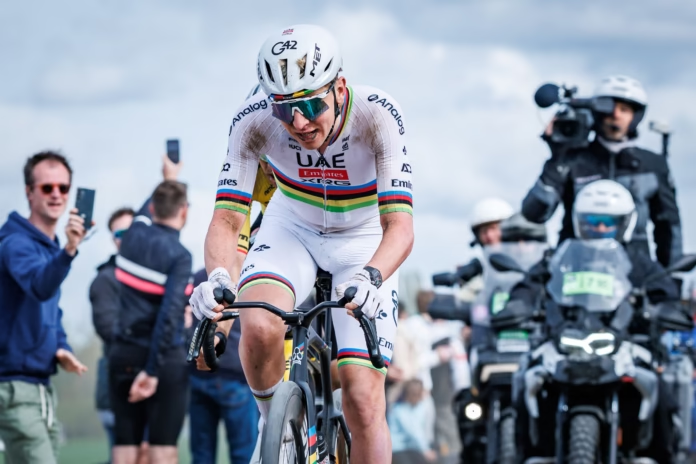
Tadej Pogačar has won the Giro d’Italia. He has now won the Tour de France five times. There is only one Grand Tour missing from a career increasingly short of obvious gaps.
The 2026 Vuelta a España gives him the chance to complete the set.
Pogačar will return to the Vuelta for the first time since his breakthrough Grand Tour debut in 2019, leading UAE Team Emirates-XRG when the race begins in Monaco on 22 August. Victory in Granada three weeks later would make him only the ninth male rider to have won the Giro d’Italia, Tour de France and Vuelta a España during his career.
There is an important distinction around the question being searched ahead of the race. Pogačar cannot win all three Grand Tours in the 2026 season, because Jonas Vingegaard won the Giro d’Italia in May. What Pogačar can do is win all three different Grand Tours across his career, adding the Spanish race to his 2024 Giro victory and five Tour titles.
Given what he has done this season, he starts with a compelling chance.
 Photo Credit: Getty
Which Grand Tours has Tadej Pogačar won?
Pogačar’s Grand Tour record already puts him among the great stage racers.
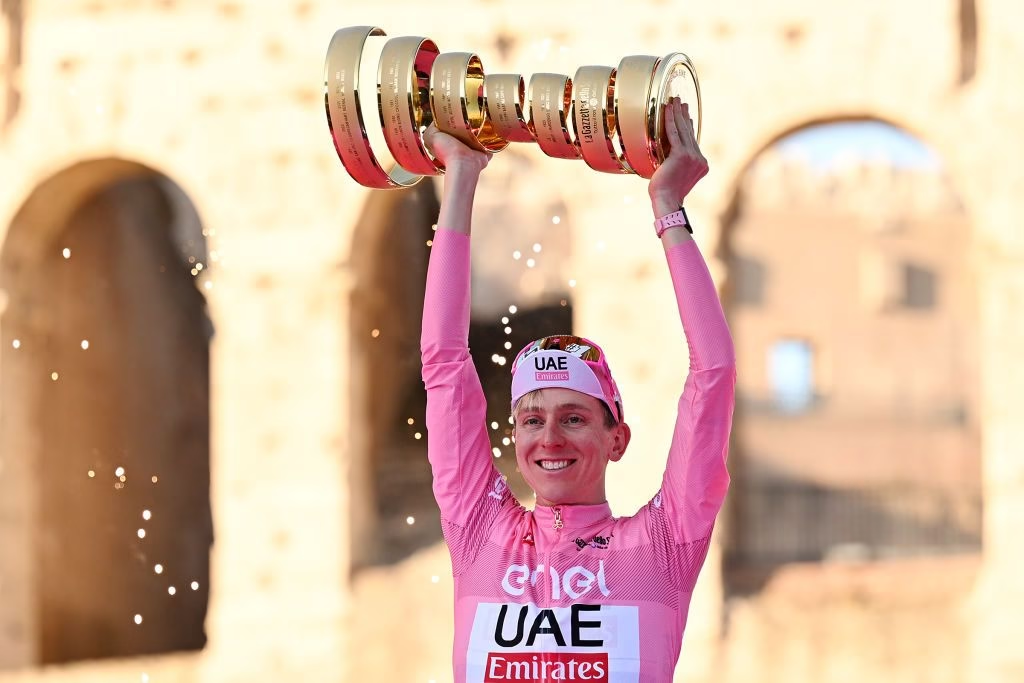
He won the 2024 Giro d’Italia on his debut, taking six stages before going on to complete the first Giro-Tour double since Marco Pantani in 1998. The scale of that achievement is covered in our look at Pogačar’s five Tour de France victories and his place in cycling history.
He has won the Tour de France in 2020, 2021, 2024, 2025 and 2026. His latest victory moved him level with Jacques Anquetil, Eddy Merckx, Bernard Hinault and Miguel Indurain on the record of five Tour wins.
That leaves one empty box.
| Grand Tour | Pogačar’s best result |
|---|---|
| Giro d’Italia | 1st, 2024 |
| Tour de France | 1st, 2020, 2021, 2024, 2025, 2026 |
| Vuelta a España | 3rd, 2019 |
The Vuelta is also the Grand Tour he has raced least.
He has only been there once.
The Vuelta was where Pogačar first announced himself
Pogačar was only 20 when he started the 2019 Vuelta a España, his first Grand Tour.
He finished third overall and won three stages, including the penultimate mountain stage to Plataforma de Gredos. It was one of those performances that seemed extraordinary at the time and looks even more significant with hindsight.
This was before the five yellow jerseys, before the Giro-Tour double and before his Monument collection transformed the scale of his career.
Seven years later, he returns as the overwhelming reference point for the race.
The Vuelta helped introduce Pogačar as a future Grand Tour star in 2019. In 2026, it can complete his collection.
Our Vuelta a España 2026 contenders preview looks more closely at the riders attempting to stop him.
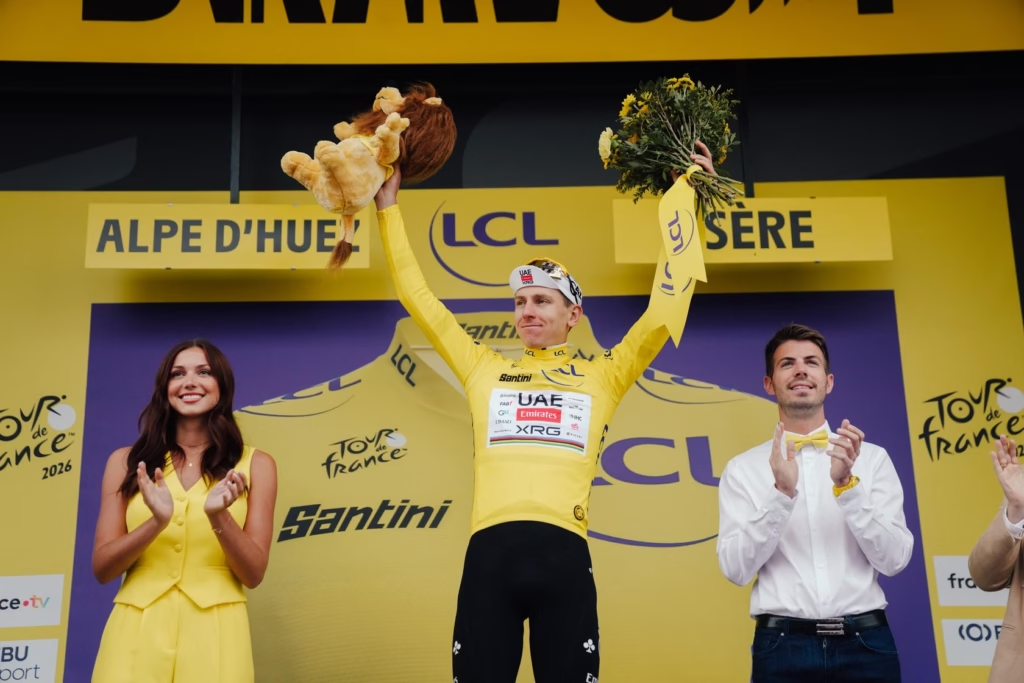 Photo Credit: A.S.O./Thomas Maheux
Why Pogačar starts as the favourite
The straightforward answer is his form.
Pogačar has just completed a fifth Tour de France victory, winning five stages and again demonstrating that there is currently very little terrain on which rivals can reliably expose him.
His climbing remains elite.
His time trialling gives him another route to gaining time.
His sprint makes bonus seconds and uphill finishes useful rather than threatening.
And UAE Team Emirates-XRG have enough depth to prevent most rivals from simply isolating him and turning the race into a sequence of individual battles.
There is no obvious weakness in the 2026 Vuelta route that works specifically against him.
Across 21 stages and around 3,275km, the race contains two individual time trials and a heavy climbing programme, beginning with the Monaco time trial and eventually moving towards major mountain stages in Spain.
If Pogačar reaches the Vuelta close to his Tour level, his rivals face a difficult question: where exactly are they supposed to gain time?
The biggest question is whether the Tour is still in his legs
This is the strongest argument against treating the Vuelta as a foregone conclusion.
The race begins less than four weeks after Pogačar finished the Tour de France.
That is enough time to recover from normal racing.
A three-week Grand Tour is not normal racing.
Pogačar has spent an enormous amount of physical and mental energy building towards and then defending yellow. Now he has to reset quickly enough to handle another 21 stages, another sequence of mountain finishes and another three weeks of GC pressure.
His 2024 season provides the obvious counterargument.
Pogačar won the Giro and Tour in succession and continued deep into the season strongly enough to become world road race champion.
The Giro-Tour double once looked like one of cycling’s disappearing achievements. Pogačar turned it into reality.
The Tour-Vuelta turnaround is shorter.
That makes recovery rather than ability the biggest uncertainty.
UAE have given him a team capable of controlling the race
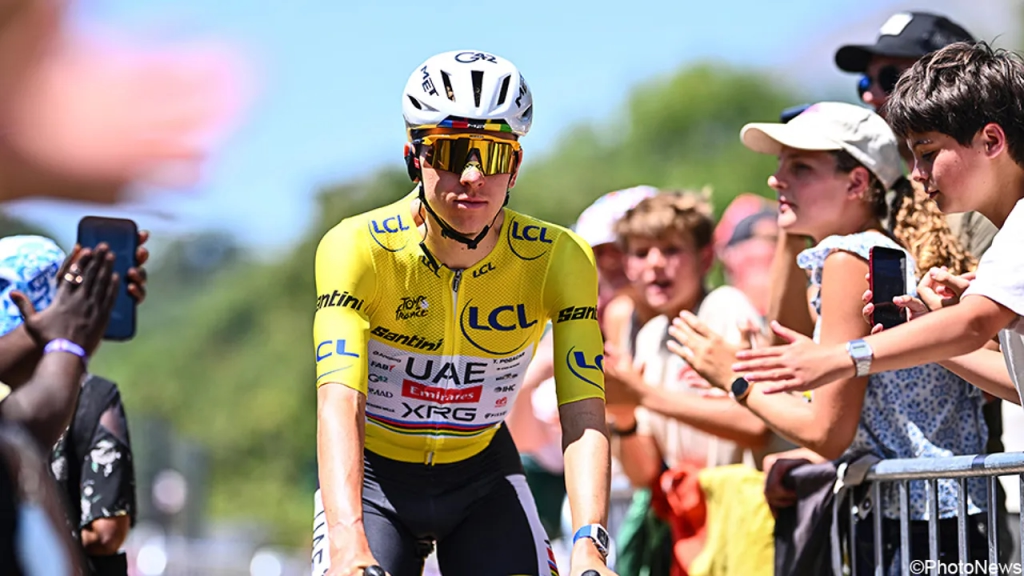
UAE Team Emirates-XRG have selected:
- Tadej Pogačar
- João Almeida
- Jay Vine
- Pavel Sivakov
- Pablo Torres
- Kevin Vermaerke
- Domen Novak
- Ivo Oliveira
It is a squad built with the general classification in mind, with Almeida providing a second high-level GC option and Vine and Sivakov adding substantial mountain support.
That depth matters.
Pogačar should not need to respond personally every time a rival attacks. UAE can control stages, place riders in moves and use Almeida tactically if other teams refuse to help.
It also provides some insurance against fatigue.
The easiest way to beat a dominant Grand Tour leader is often to remove their team and repeatedly force them to make decisions themselves.
Doing that to this UAE line-up will not be easy.
Who could actually beat Pogačar?
That is the question examined in more detail in our full 2026 Vuelta contenders analysis.
The important point is that the opposition does not begin with Pogačar’s complete package.
Some rivals can challenge him on long climbs.
Others may be competitive against the clock.
Several can profit if the Tour has left him below his best.
But beating Pogačar over three weeks requires doing more than staying near him on one mountain.
Someone eventually needs to take time.
The Tour showed again how difficult that can be.
Who has won the Giro, Tour and Vuelta?
Winning all three men’s Grand Tours across a career remains an extremely exclusive achievement.
The riders to have completed the set are:
| Rider | Giro | Tour | Vuelta |
|---|---|---|---|
| Jacques Anquetil | Yes | Yes | Yes |
| Felice Gimondi | Yes | Yes | Yes |
| Eddy Merckx | Yes | Yes | Yes |
| Bernard Hinault | Yes | Yes | Yes |
| Alberto Contador | Yes | Yes | Yes |
| Vincenzo Nibali | Yes | Yes | Yes |
| Chris Froome | Yes | Yes | Yes |
| Jonas Vingegaard | Yes | Yes | Yes |
Vingegaard became the eighth in 2026, when his first Giro d’Italia victory added the maglia rosa to his previous Tour and Vuelta wins.
Pogačar can now become the ninth.
There is an appealing symmetry to it.
Vingegaard completed his set by winning the Giro in May.
Pogačar can complete his by winning the Vuelta in September.
Pogačar is also chasing the rare Tour-Vuelta double
Winning in Spain would achieve more than simply filling the final Grand Tour gap.
Pogačar would also complete the Tour de France-Vuelta a España double in the same season, something achieved by very few riders.
The modern comparison is Chris Froome in 2017, when he followed victory at the Tour by winning the Vuelta several weeks later.
That turnaround is demanding because Tour contenders arrive in Spain with three weeks of racing already in their legs, while some Vuelta rivals have been able to build specifically towards the final Grand Tour of the year.
Pogačar has spent much of his career breaking these assumptions.
The 2024 Giro-Tour double had not been completed for 26 years.
The next historical challenge is waiting in Spain.

Could Pogačar ever win all three Grand Tours in one season?
Not this year.
That question nevertheless becomes more interesting if he wins the Vuelta.
No male rider has ever completed the Giro-Tour-Vuelta treble in a single season. The scheduling alone makes it an extreme challenge, requiring a rider to remain capable of winning three-week races from May until September.
Pogačar has already demonstrated that two Grand Tours in one season are realistic for him.
Winning the 2026 Vuelta would prove something slightly different: that he can win each of the three Grand Tours, and that his dominance is not dependent on repeatedly targeting the same races.
Whether he ever attempts all three in one year can remain a question for another season.
First he has to win the one he does not yet have.
So, can Pogačar win the 2026 Vuelta?
Yes.
He should start as the favourite.
The Beginner’s guide to the Vuelta a España 2026 explains just how climbing-heavy this year’s race is, but there is very little in that parcours that Pogačar has not already shown he can handle.
The uncertainty is not whether his best is good enough.
It is whether his best turns up after another dominant Tour de France.
Crashes, illness, fatigue and three weeks of aggressive Vuelta racing can change any apparently predictable Grand Tour. His rivals also know that simply following him will probably not be enough.
But seven years after finishing third on his Grand Tour debut, Pogačar returns to the race as a very different rider.
The history of the Vuelta a España is full of riders who built their legacies around the red jersey.
For Pogačar, it is now the missing one.
The Giro is done.
Five Tours are done.
Spain is the final piece.

