
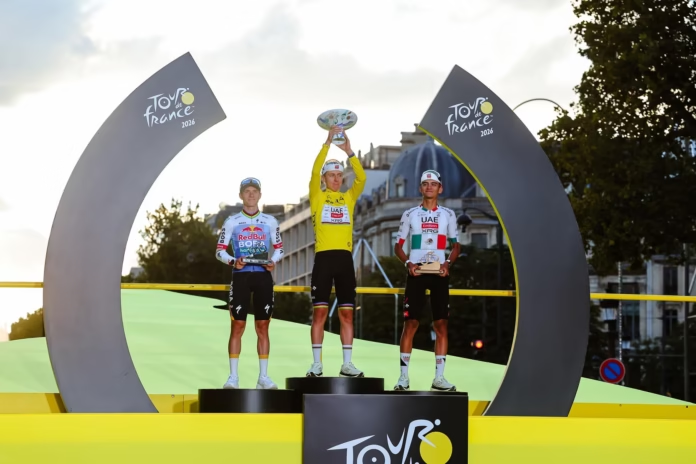
Tadej Pogačar is no longer chasing the five-time Tour de France winners. By reaching Paris in yellow at the end of the 2026 Tour, he joined Jacques Anquetil, Eddy Merckx, Bernard Hinault and Miguel Induráin as only the fifth official five-time winner of cycling’s biggest race.
He has reached that landmark at 27, younger than any of the four riders before him, after a Tour career which has so far produced five victories and two second places from seven starts. Pogačar has won the race in a final-day time trial, dominated it through the mountains, been beaten twice by Jonas Vingegaard and then responded by winning three consecutive editions from 2024 to 2026.
The fifth title also came with five stage victories, taking Pogačar to 26 for his Tour career. He finally added Alpe d’Huez to his palmarès, produced another decisive long-range attack over the Tourmalet and reached Paris 6:26 ahead of Remco Evenepoel. The final Tour de France 2026 results confirm a race which moved him level with the four riders who had defined the historical ceiling of Tour success.
That does not automatically settle the argument over the greatest Tour rider of all time. Merckx still has numbers Pogačar has not reached, while Hinault, Induráin and Anquetil each built their five victories in very different circumstances. What Paris removed was the hypothetical part of the debate. Pogačar has five Tour de France victories. The question now is whether five will be where he stops.
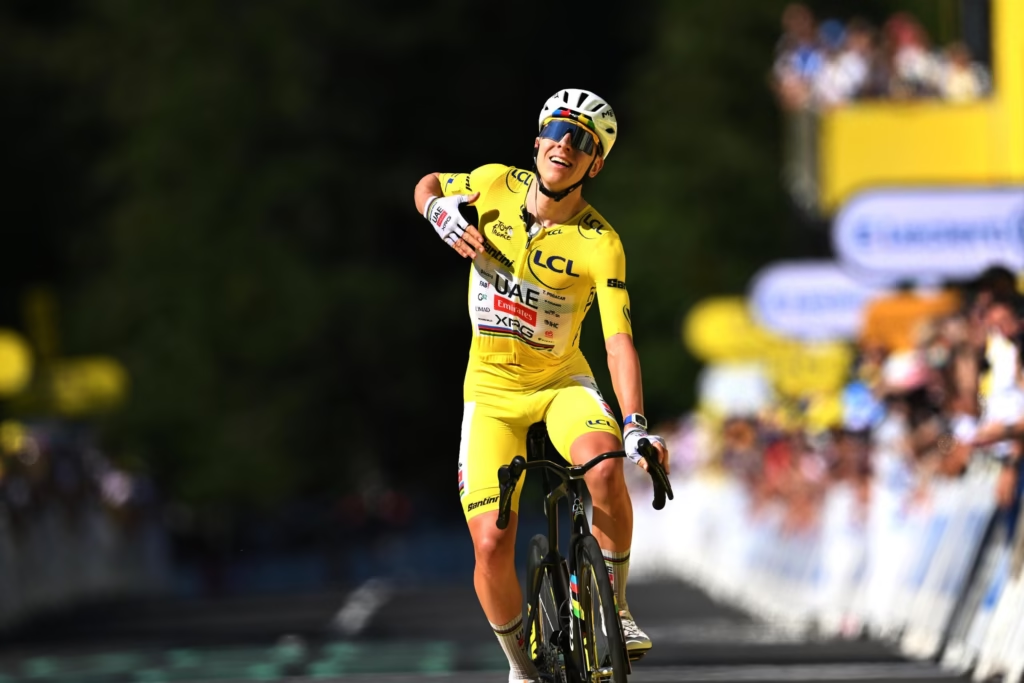
Five wins and two second places from seven Tours
Pogačar’s Tour victories have come in 2020, 2021, 2024, 2025 and 2026. The two missing years were hardly failures either. Vingegaard beat him in 2022 and again in 2023, leaving Pogačar second overall on both occasions.
| Year | Result | Defining feature |
|---|---|---|
| 2020 | 1st | La Planche des Belles Filles overturns Roglič |
| 2021 | 1st | Confirms dominance with a second consecutive Tour |
| 2022 | 2nd | Vingegaard and Jumbo-Visma break him on the Col du Granon |
| 2023 | 2nd | Vingegaard wins again after the decisive Alpine stages |
| 2024 | 1st | Returns to yellow and completes the Giro-Tour double |
| 2025 | 1st | Fourth Tour puts the five-win record within reach |
| 2026 | 1st | Five stage wins and a fifth yellow jersey at 27 |
It means Pogačar has never finished outside the top two at the Tour. Even his two defeats have ended with him on the second step of the podium, a remarkable baseline for a rider who first entered the race at 21.
Those defeats are also important to the story. Five wins from seven starts would look statistically cleaner if Pogačar had simply won every edition, but the Vingegaard years explain why the victories since 2024 carry so much weight. His dominance was interrupted, serious questions were asked about whether another rider had moved beyond him, and Pogačar responded by rebuilding himself into an even more complete cyclist.
The wider historical progression of the race, including the shift from the Team Sky years into the Pogačar-Vingegaard era, is covered in our brief history of the men’s Tour de France.
The 2020 Tour changed everything
The first victory remains the one that transformed Pogačar’s career overnight. He arrived at the 2020 Tour as a 21-year-old Grand Tour talent who had already finished third at the Vuelta a España, but Primož Roglič was the more established Slovenian contender and Jumbo-Visma spent much of the race controlling yellow around him.
Going into the Stage 20 time trial at La Planche des Belles Filles, Roglič led by 57 seconds. Pogačar overturned the deficit with one of the defining individual performances in modern Tour history, taking enough time to win the race on the final competitive day.
The scale of that upset remained central to the discussion when Pogačar returned the following summer. Our 2021 Tour de France guide looked back at the extraordinary way the previous edition had been turned around.
At the time, 2020 felt like the arrival of a rider capable of winning several Grand Tours. Six years later, it is more accurately viewed as the start of a period in Tour history that has increasingly been organised around Pogačar.
The second victory proved he did not need an upset
Pogačar returned in 2021 without the advantage of surprise. He was the defending champion, the rider everyone expected to beat and the obvious reference point for the general classification.
His response was to win again.
The 2021 victory was less dramatic than La Planche des Belles Filles but arguably just as important to the development of his reputation. Pogačar showed that the first Tour had not depended on one spectacular time trial or Roglič suffering one disastrous day. He could arrive as the strongest rider in the race, carry the expectations of being defending champion and still dominate.
By 22, he was a two-time Tour winner. Five victories still belonged to another historical category, associated with names such as Merckx and Hinault rather than a rider barely into his twenties, but the mathematics had already begun to make it possible.
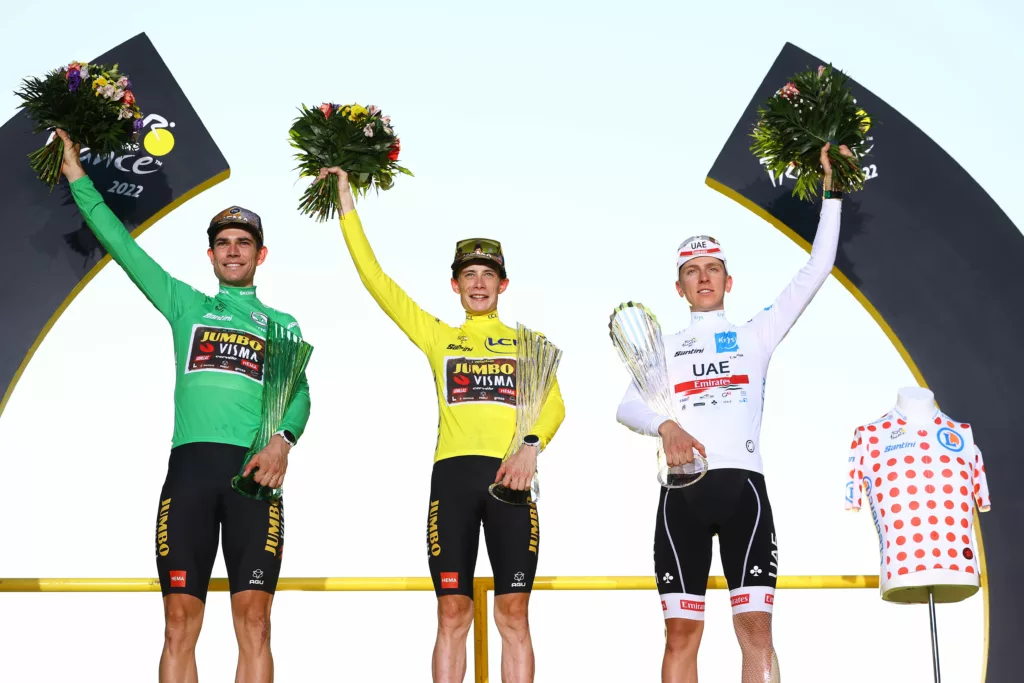
Vingegaard stopped the first period of Pogačar dominance
The next two Tours prevented the Pogačar era from becoming a simple sequence of victories. Vingegaard beat him in 2022 after Jumbo-Visma attacked repeatedly on the road to the Col du Granon, using Roglič and Vingegaard to put Pogačar under pressure until he finally cracked.
Vingegaard then beat him again in 2023. That second defeat changed the conversation more significantly because it removed any suggestion that Granon had simply been a tactical accident. Vingegaard had demonstrated twice that he could beat Pogačar over three weeks, and by the end of the 2023 Tour it was reasonable to ask whether the Dane had become the superior Grand Tour rider.
That period matters when assessing Pogačar historically because his response was not to retreat into ever greater Tour specialisation. Instead, he widened his ambitions, raced more aggressively across the season and returned to July after first attempting something modern GC riders had largely stopped trying.
The Giro-Tour double changed his historical case
Pogačar’s third Tour victory in 2024 came after he had already won the Giro d’Italia. The Giro-Tour double had become rare enough in modern cycling that even the attempt attracted enormous attention, with Chris Froome among those backing Pogačar’s chances before the season. Our piece on Froome backing Pogačar’s Giro-Tour double reflected just how ambitious the programme looked.
Pogačar then demolished the Giro on debut. By the time he won Stage 20 over Monte Grappa, the overall victory had effectively become a formality. He then carried that form into the Tour and reclaimed yellow.
That third Tour did more than put another victory beside his name. It pushed the Merckx comparison into a different territory. Pogačar was no longer simply building a case as the best Tour rider of his generation. He was becoming a rider capable of dominating Grand Tours while also targeting the Monuments and major one-day races that Tour specialists had increasingly left alone.
Four became five faster than expected
Pogačar followed the Giro-Tour season by winning another Tour in 2025. His fourth yellow jersey was confirmed on the Champs-Élysées, where Wout van Aert won the final stage while Pogačar completed another successful three weeks. The 2025 Stage 21 report marked the moment when the five-win group stopped looking like a distant historical target.
The discussion heading into 2026 was therefore obvious. One more victory would take Pogačar level with Anquetil, Merckx, Hinault and Induráin. Our pre-Paris analysis asked whether Pogačar could become the greatest Tour de France rider of all time.
That article was built around a possibility. The fifth victory is now confirmed, and the historical question has changed with it.
 Photo Credit: Getty
The fifth Tour was won through aggression rather than defence
Pogačar did not control the 2026 Tour from the first kilometre. Team Visma | Lease a Bike beat UAE in the opening Barcelona team time trial, putting Vingegaard into the first yellow jersey, while Pogačar had to wait until Stage 3 at Les Angles to record his opening victory.
The decisive day came on Stage 6 to Gavarnie-Gèdre. UAE destroyed the GC group on the Tourmalet, Isaac del Toro delivered Pogačar into position and the Slovenian attacked with 43km still remaining. Vingegaard eventually lost 2:38, turning a Tour still being measured in seconds into one where Pogačar suddenly held a 2:42 advantage over his principal rival.
That attack became the foundation of the fifth victory. Pogačar had reached a point where defending the Tour did not necessarily mean waiting for opponents to attack and then responding. He increasingly controlled the race by creating the decisive situation himself, often far earlier than conventional Grand Tour tactics would suggest.
Vingegaard’s crash changed the ending, not the work already done
The Pogačar-Vingegaard battle never received the Alpine conclusion expected before the race. Vingegaard crashed on Stage 15 and abandoned with a collarbone injury that later required surgery, removing the only active rider who had previously demonstrated on multiple occasions that he could beat Pogačar at the Tour.
That inevitably affects the way the fifth victory will be remembered, but it does not erase the competitive position before the crash. Pogačar had already beaten Vingegaard decisively over the Tourmalet and established a substantial advantage. The accident prevented the Dane from trying to reverse that situation in the final week rather than rescuing Pogačar from a race he was in danger of losing.
The withdrawal did change the tactical landscape. Evenepoel became Pogačar’s nearest challenger, Visma gained freedom to chase stages and UAE could devote more attention to helping del Toro defend his podium position. Pogačar’s own yellow jersey became increasingly secure, yet he continued searching for stages.
That instinct matters when comparing him with the historic champions. He does not generally appear satisfied merely by controlling the race he is already winning.
Twenty-six Tour stages and counting
Pogačar won five stages in the 2026 Tour, taking his career total to 26. That puts him within three victories of passing Bernard Hinault’s career total of 28 and close enough to Eddy Merckx on 34 and Mark Cavendish on 35 that the all-time stage record has become a legitimate future discussion.
The way Pogačar collects those victories is just as important as the number. He does not rely on one repeatable speciality. His Tour wins include time trials, summit finishes, reduced sprints and long-range mountain attacks. In 2026 alone, his five victories came across Les Angles, Gavarnie-Gèdre, Le Lioran, Le Markstein and Alpe d’Huez.
This is where comparison with Merckx becomes useful but also difficult. Merckx had accumulated more Tour stage victories by the time he completed his own fifth overall win, but the Tour of his era contained different stage structures, more individual time-trial opportunities and split stages. Raw totals cannot perfectly translate between generations.
They can still show why Merckx remains such a difficult standard to surpass.
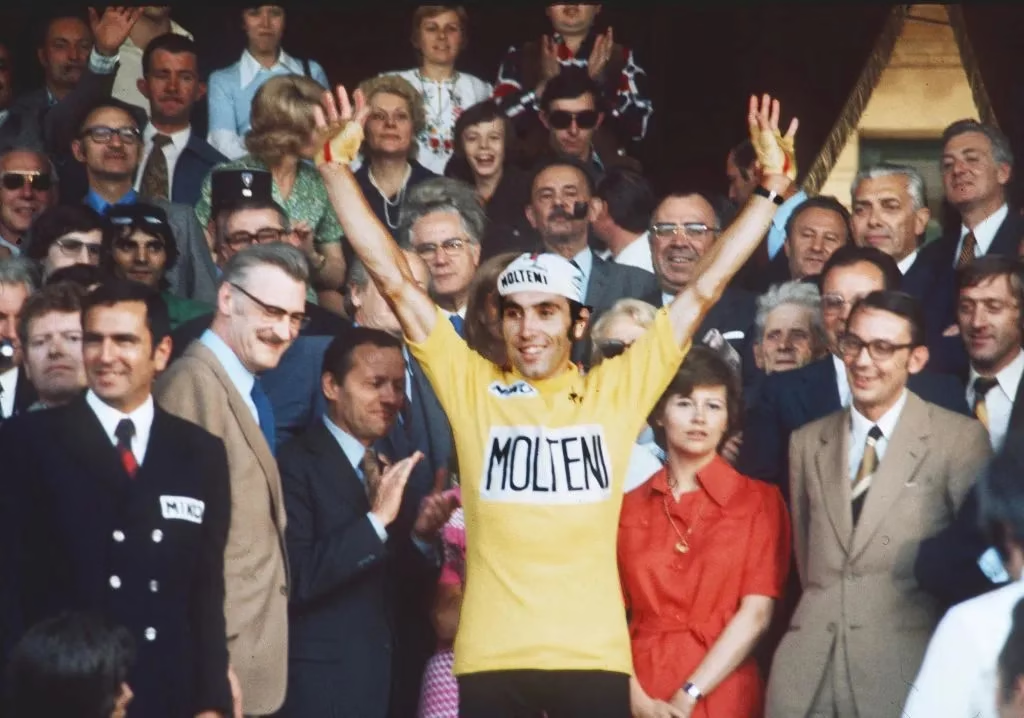
Merckx still has advantages underneath the five yellow jerseys
Matching Merckx’s five Tour victories does not mean Pogačar has matched every part of Merckx’s Tour record. The Belgian’s dominance extended far beyond the general classification, encompassing stage wins and secondary classifications on a scale that remains almost impossible to reproduce in an era of much greater specialisation.
That is why Merckx remains central to any ranking of the greatest Tour de France winners. Pogačar now has an identical number of overall victories, but Merckx can still point to a deeper body of achievement within the race itself.
Pogačar’s counterargument comes partly from what he does outside the Tour. Giro victories, Monuments and the world championship strengthen the same all-round comparison which has always made Merckx more than simply a five-time yellow jersey winner.
If Pogačar eventually wins six Tours, the overall victory number moves decisively in his favour. The broader Merckx comparison would still require more than counting yellow jerseys.
Pogačar is the youngest rider ever to reach five
The number most relevant to the future is Pogačar’s age.
He completed his fifth Tour at 27 years and 10 months, making him the youngest official five-time winner in race history. Merckx was 29 when he took his fifth title in 1974, while Anquetil and Hinault were 30 and Induráin 31.
| Rider | Fifth Tour win | Approximate age |
|---|---|---|
| Tadej Pogačar | 2026 | 27 years, 10 months |
| Eddy Merckx | 1974 | 29 years |
| Jacques Anquetil | 1964 | 30 years |
| Bernard Hinault | 1985 | 30 years |
| Miguel Induráin | 1995 | 31 years |
The significance is not that a sixth victory is inevitable. It is that Pogačar has reached the historic ceiling with more theoretical peak years remaining than anyone before him.
For every other five-time winner, the record was reached when the end of a Tour-winning career was already much easier to imagine. Pogačar could attempt six in 2027 before his 29th birthday.
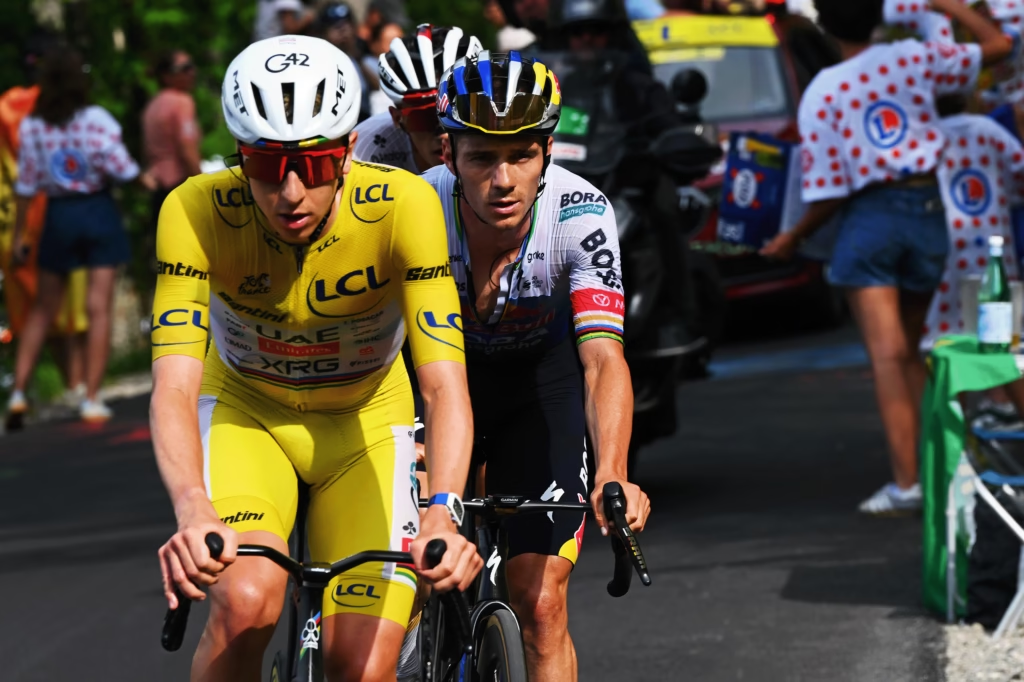
Five has stopped everyone before him
Nobody has officially won the Tour de France six times. Anquetil stopped at five, Merckx stopped at five, Hinault stopped at five and Induráin stopped at five. Lance Armstrong’s seven titles were stripped, with those editions left without an official winner, so five remains the recognised record.
Each of the great champions discovered a different reason why six was harder. Merckx returned in 1975 after winning his fifth the previous year but was beaten by Bernard Thévenet. Hinault won his fifth in 1985, finished second to Greg LeMond in 1986 and then retired. Induráin won five consecutively from 1991 through 1995 before attempting a sixth in 1996 and finishing 11th.
Pogačar reaches the same point younger than all of them. That does not remove the sporting challenge, particularly with Vingegaard, Evenepoel and a new generation emerging, but it makes him the rider best positioned historically to test whether five really has to remain the limit.
A sixth Tour would be a record, not another tie
This is what makes the 2027 question so significant. Another Tour victory would not move Pogačar alongside somebody else. It would make him the first official six-time winner and give him sole ownership of the most important numerical record in the history of the race.
That would immediately separate him from Anquetil, Hinault and Induráin in a Tour-only comparison. The Merckx debate would become more complicated because Pogačar would have surpassed him in overall victories while still trailing some of the Belgian’s extraordinary stage and classification totals.
Six would therefore settle one argument while intensifying another. Pogačar would indisputably have won the Tour more often than any recognised champion, but cycling would still be left debating whether greater Tour longevity outweighs the extraordinary completeness of Merckx’s domination.
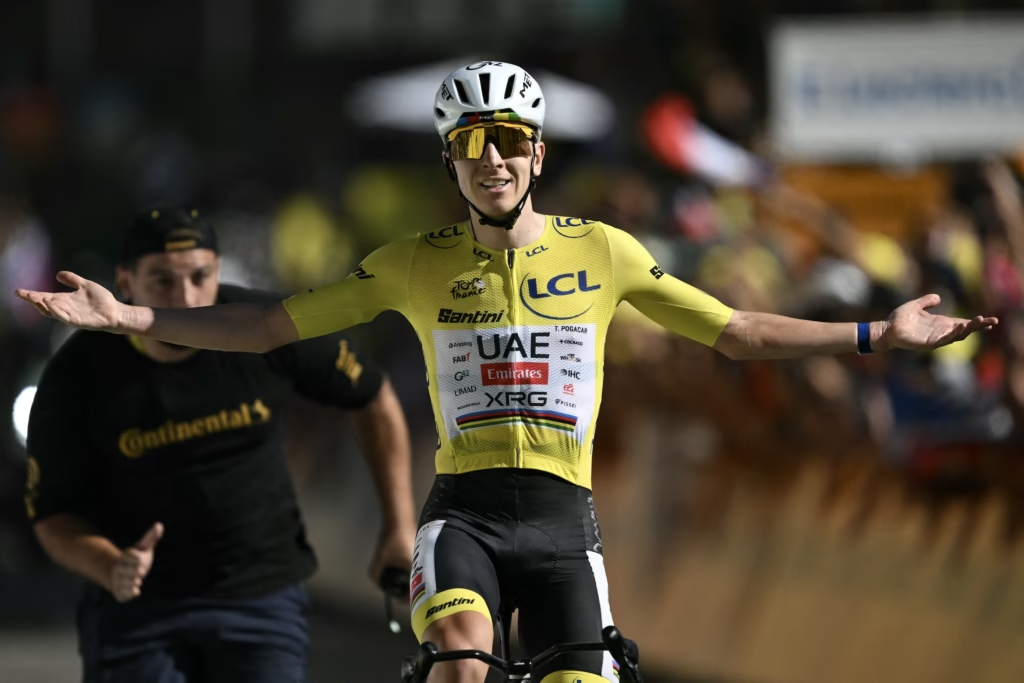
Alpe d’Huez gave the fifth Tour its iconic victory
Pogačar already had the 2026 Tour under control when the race reached Alpe d’Huez on Stage 19. He began the day 4:32 ahead of Evenepoel and faced an even harder mountain stage the following afternoon, so there was no strategic need to chase the stage at all costs.
But Alpe d’Huez remained one of the conspicuous omissions from his Tour record. Before the stage, we asked whether Pogačar would finally win on Alpe d’Huez.
The answer was emphatic. The Stage 19 race report showed Pogačar attacking with the breakaway still well ahead, chasing the remaining leaders and eventually passing them before accelerating again to take his fifth win of the race.
It became exactly the sort of victory that gives a Tour campaign a lasting image. Winning yellow matters most, but the greatest Tour careers also become associated with particular mountains. Pogačar now has Alpe d’Huez alongside the Tourmalet and the other climbs where he has shaped the race.
The Pantani benchmark added another historical dimension
Pogačar’s climbing time made the Alpe d’Huez win more significant still. He covered the commonly compared ascent in around 35:27, approximately 1:13 quicker than the widely cited 36:40 benchmark associated with Marco Pantani’s 1995 climb.
As ever with historic climbing times, the comparison is not exact. Timing points vary, as do race situations, equipment, road surfaces and weather. It would be simplistic to turn two ascent times separated by more than 30 years into a direct physiological comparison between riders.
The scale of the performance remains clear. Pogačar did not simply add Alpe d’Huez to his stage-win collection. He produced one of the fastest climbing performances ever seen on the Tour’s most famous summit.
For a fifth Tour victory, it supplied the kind of individual performance that will still be discussed long after the final GC gaps have been forgotten.
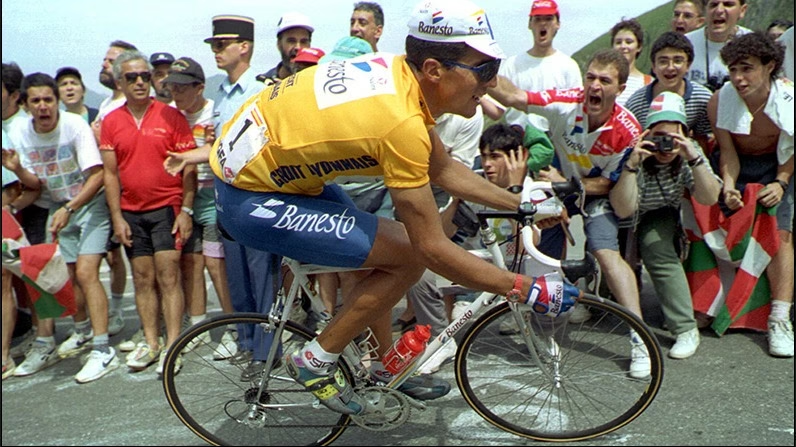
Induráin still owns one record Pogačar cannot replicate
Miguel Induráin remains the only rider to win the Tour five consecutive times, controlling every edition from 1991 through 1995. Pogačar cannot reproduce that particular sequence because Vingegaard interrupted his run in 2022 and 2023.
The shape of Pogačar’s five is therefore different. He won twice, lost twice and then returned to win three more. Induráin’s five represent uninterrupted dominance, while Pogačar’s five include a period where control of the Tour passed to another rider before being reclaimed.
That makes Induráin’s sequence cleaner. Pogačar’s route arguably contains more adversity. Neither distinction changes the number of yellow jerseys, but it helps explain why comparing five-time champions requires more than placing five names in one table.
Hinault may be the most useful comparison
Bernard Hinault’s Tour record now looks particularly similar to Pogačar’s on the surface. Hinault won five editions and finished second twice, exactly matching Pogačar’s current record of five wins and two runner-up finishes.
Stylistically there is another connection. Hinault was never simply a Tour specialist. He won all three Grand Tours, became world champion and approached major races with an aggression that often went beyond what the situation strictly required. Pogačar’s increasing willingness to chase Monuments and win throughout the season makes the comparison more natural.
The difference is how quickly Pogačar has accumulated the results. Hinault’s five victories and two second places were spread across a longer period. Pogačar has produced the same basic finishing record in his first seven Tour appearances.
His worst result remains second.

The stage-win record is becoming realistic too
At 26 Tour stage victories, Pogačar is close enough to the historic totals that another record chase could develop almost accidentally alongside his pursuit of six yellow jerseys.
Hinault’s 28 could be passed in a single strong Tour. Merckx’s 34 requires nine more victories to equal, while Cavendish’s outright record of 35 is ten away.
Ten Tour stages would normally represent a substantial career on their own. Pogačar has won five in the 2026 edition alone.
That does not mean he will reach 36. His willingness to contest stages could change as his career develops, while future Tours may offer fewer opportunities suited to him. He may also decide to prioritise other races.
But for the first time, a rider who is not a pure sprinter has brought the Cavendish record into plausible view.
Other races may eventually matter more to Pogačar than a sixth Tour
Being only 27 creates an obvious temptation to project Pogačar’s current trajectory forward. If he has five Tours now, why not six, seven or even more?
Careers rarely progress that neatly.
Pogačar has already raced seven consecutive Tours at a level good enough to finish first or second, an enormous physical and psychological commitment to one race. More importantly, his ambitions extend far beyond July.
The Vuelta a España remains an obvious missing Grand Tour. Paris-Roubaix remains one of the biggest possible additions to his one-day palmarès. More Giro wins, world titles and Monuments could strengthen his overall historical case even if he never wins another Tour.
That distinguishes him from riders whose legacy becomes increasingly tied to maximising the number of yellow jerseys. Pogačar does not need six for his career to feel complete.
He may want it because six would make him unique.
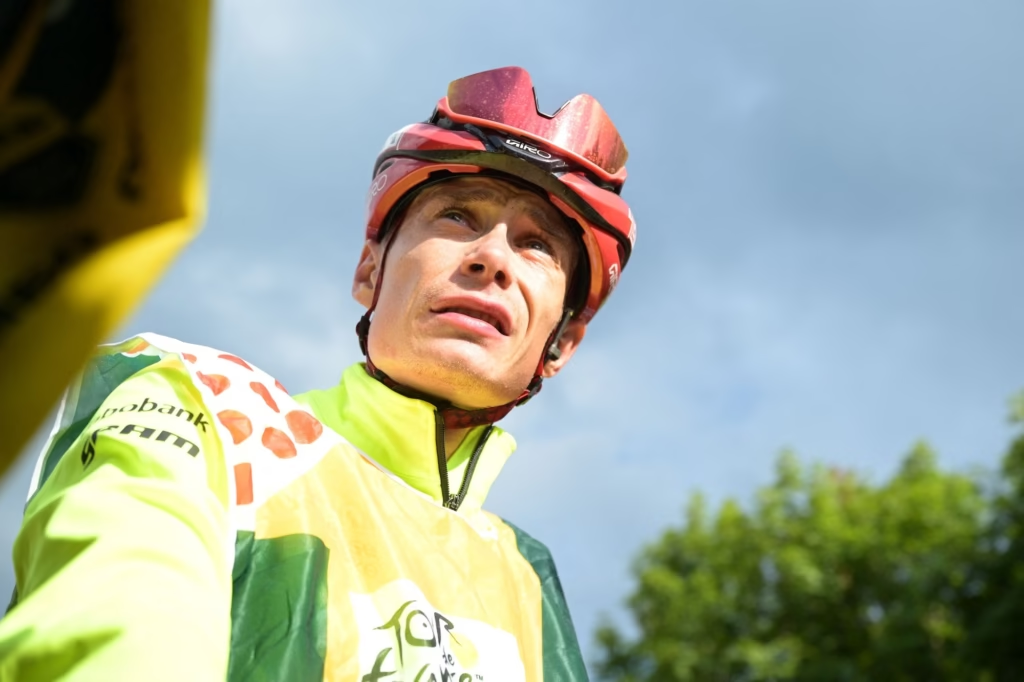 Photo Credit: Getty
Vingegaard remains the clearest reason not to assume the record
The 2026 Tour should not erase Jonas Vingegaard from the discussion simply because his race ended in a crash.
Pogačar was comfortably ahead when Vingegaard abandoned, but the Dane remains the only active rider to have beaten him twice at the Tour. He did it in 2022 and again in 2023, proving that Pogačar can be beaten across three weeks rather than simply caught by an unusual race situation.
There is also increasing depth behind them. Evenepoel reached Paris second in 2026. Del Toro finished third on his Tour debut, while Paul Seixas finished fourth at only 19.
Pogačar has reached five younger than anyone before him, but he has not reached an era without meaningful opposition. Six will still have to be won on the road.
Seven starts and seven top-two finishes may be the defining statistic
The five yellow jerseys are the number history will remember first, but Pogačar’s consistency may be just as extraordinary.
Seven Tour starts have produced five wins and two second places.
There has been no collapse to eighth, no Tour lost through an ordinary bad year and no edition where he arrived simply to build form or chase stages. Every time Pogačar has started the Tour, he has reached Paris first or second overall.
That gives the fifth title an unusual context. He has not needed a long career to accumulate five victories through persistence. He has reached them in seven attempts while remaining competitive for the win every single year.
The worst Tour of his career is a result most riders would consider their defining achievement.
Five already changes where Pogačar belongs in Tour history
Before 2026, Pogačar could still be placed just beneath the very top historical group. Four wins put him alongside Chris Froome, but the five-time champions retained a numerical distinction that carried enormous weight.
That distinction has disappeared.
The Tour de France winners list now has Pogačar alongside Anquetil, Merckx, Hinault and Induráin at the official record. He is the youngest rider in the group, has already reached 26 stage victories and has finished second in the only two Tours he has not won.
He is no longer the modern champion who may eventually reach the historical greats.
He has reached them.
-
 Photo Credit: A.S.O./Gaëtan Flamme

The real Merckx debate probably begins at six
If Pogačar stopped at five, Merckx would still have a very strong claim to being the greatest Tour rider because of everything beneath the five overall victories. More stage wins, extraordinary secondary-classification dominance and the sheer completeness of his control provide arguments that the yellow jersey count alone cannot settle.
A sixth Pogačar victory would change the balance.
Pogačar would own the official Tour record alone. Merckx would then have to be ranked ahead, if at all, because of how he won rather than how often he won. If Pogačar simultaneously continued moving towards Merckx’s stage total and adding victories elsewhere in cycling, that distinction would become increasingly difficult to maintain.
It is why the post-2026 discussion is so different from the one before the race. The question is no longer whether Pogačar can reach the five-time champions.
The question is whether he can become the first rider to move beyond them.
Paris was the end of one chase and the start of another
Pogačar’s fifth Tour was not created on the Champs-Élysées. It began at La Planche des Belles Filles in 2020, was reinforced by the dominance of 2021 and then complicated by the defeats to Vingegaard in 2022 and 2023. The Giro-Tour double of 2024 began the second phase of his Tour career, the fourth yellow jersey followed in 2025 and the fifth arrived after another five-stage campaign in 2026.
This year’s route added another set of places to the story. Les Angles. The Tourmalet. Gavarnie-Gèdre. Le Lioran. Le Markstein. Alpe d’Huez. Then Paris, where the final Tour de France 2026 standings confirmed Pogačar 6:26 ahead of Evenepoel.
Anquetil reached five. Merckx reached five. Hinault reached five. Induráin reached five. Every one of them stopped there.
Pogačar has reached the same number at 27, with 26 stage wins already behind him and enough time for at least one serious attempt at going somewhere none of them managed to reach.
His fifth Tour de France victory closes the chase for the record.
A sixth would create a new one.

