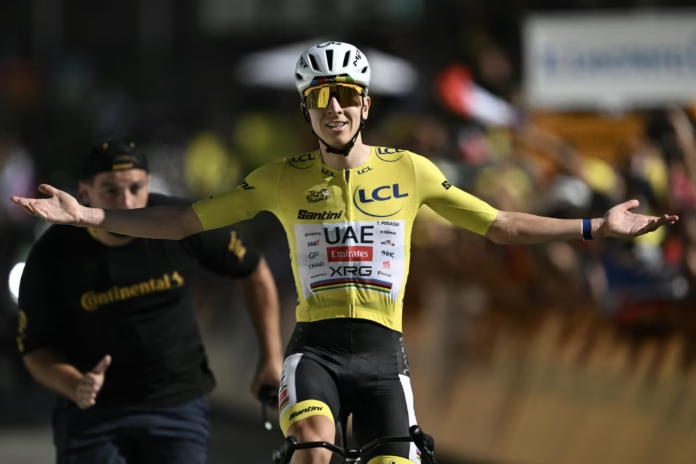
Tadej Pogačar won stage 19 of the 2026 Tour de France on Alpe d’Huez, attacking from the GC group on the final climb, catching the breakaway inside the final 3 kilometres and sprinting clear to take his fifth stage victory of this year’s race.
The UAE Team Emirates-XRG rider bridged across to Richard Carapaz and Lenny Martinez after a long solo pursuit on the 21 hairpins, then accelerated again in the final kilometre to win one of the most prestigious stages of the Tour. Martinez finished second at 6 seconds, with Carapaz third at 9 seconds after another huge day in the mountains.
Sepp Kuss was fourth at 1:14 for Team Visma | Lease a Bike, while Tobias Halland Johannessen finished fifth for Uno-X Mobility. Remco Evenepoel, Isaac del Toro, Mattias Skjelmose and Paul Seixas came in between 2:29 and 2:45 after the final climb split the podium and white jersey fights behind the yellow jersey.
A short stage with a brutal start
Stage 19 from Gap to Alpe d’Huez was the shortest road stage of the 2026 Tour, covering 127.9 kilometres, but it was never likely to be gentle. The race began uphill on the Col Bayard, continued to the Col du Noyer, then crossed more rolling and climbing terrain before the iconic final ascent of Alpe d’Huez.
The stage was also the first of two consecutive finishes on Alpe d’Huez. That gave the day extra weight, but also created a tactical question. Would the GC riders save energy for the following day’s harder mountain stage, or would the prestige of the 21 hairpins make the race impossible to control?
Pogačar began the day with a comfortable yellow jersey lead after a controlled finish at Orcières-Merlette. Evenepoel was second overall, Del Toro third, Seixas fourth and Ayuso fifth. The biggest tension was not whether Pogačar was vulnerable, but whether UAE Team Emirates-XRG still had the mountain support to control the final Alpine block.
That question became more relevant almost immediately.
Paret-Peintre takes over polka dots early
The Col Bayard came straight from kilometre zero and immediately brought the mountains classification into focus. Valentin Paret-Peintre attacked the opening climb with Carapaz, continuing the duel that had shaped the previous stage to Orcières-Merlette.
Paret-Peintre won the first KOM sprint, taking 5 points ahead of Carapaz. That moved him into the outright lead of the mountains classification, ahead of Pogačar, who had worn the polka-dot jersey by right for much of the race but was already in yellow.
The pace was brutal. Within the first few kilometres, riders were being dropped from the bunch, including some fast men and tired domestiques. Tim Wellens and Florian Vermeersch were also distanced early for UAE, another sign that Pogačar’s team was no longer as deep in the mountains as it had looked earlier in the Tour.
A large breakaway began to form over and after the climb, with around 40 riders eventually moving clear. It was a powerful group, packed with stage winners, climbers, green jersey workers and riders hunting a final-week result.
Forty riders go clear
The breakaway was unusually deep. It included Adam Yates for UAE, Kuss, Matteo Jorgenson, Bruno Armirail and Davide Piganzoli for Team Visma | Lease a Bike, Pedersen, Mathias Vacek, Quinn Simmons and Derek Gee-West for Lidl-Trek, plus Carapaz, Ben Healy and Alex Baudin for EF Education-EasyPost.
There were also strong climbers and stage hunters such as Martinez, Thymen Arensman, Ben O’Connor, Ion Izagirre, Tobias Halland Johannessen, Pablo Castrillo, Raúl García Pierna, Marc Hirschi, Michael Storer, Clément Braz Afonso and Guillaume Martin-Guyonnet.
The composition made the stage hard to control. UAE had Yates up the road, but the team had already lost Brandon McNulty the previous day and several riders were struggling. Red Bull-Bora-Hansgrohe helped control behind at times, but the breakaway’s depth meant the race had a genuine chance of being decided from the front.
The opening hour was only 36.3 kilometres, which says plenty about the terrain and intensity. The attacks had started immediately, and the breakaway had to fight for every metre.
Paret-Peintre wins again on Col du Noyer
The Col du Noyer was the next major climb and another key point in the mountains classification. Paret-Peintre again beat Carapaz at the summit, taking 10 more points and moving to 84 in the competition. Carapaz took 8, while Arensman, Simmons, Kuss and Matthew Riccitello also scored.
It was another important moment in the polka-dot contest. Paret-Peintre had started the day needing to keep scoring before Pogačar had any chance to take points on Alpe d’Huez. He did exactly that, putting pressure on both the yellow jersey and Carapaz.
The break continued to work well over the top, with Lidl-Trek particularly visible. Gee-West drove the move with Pedersen behind, while Vacek and Simmons gave the Danish green jersey leader even more support.
Behind, UAE Team Emirates-XRG were not chasing flat out, but they were not entirely passive either. Vermeersch returned after the Col Bayard and helped set tempo, while Nils Politt and Felix Großschartner were later visible around Pogačar.
Pedersen strengthens green
The intermediate sprint at Le Périer gave Pedersen another chance to protect his green jersey lead, and Lidl-Trek handled it perfectly.
Pedersen won the sprint, taking 25 points. Michael Matthews was second, Tobias Foss third, Vacek fourth and Armirail fifth. Simmons, Baudin, García Pierna, Castrillo, Arensman, Kuss, Carapaz and others followed in the points.
The result gave Pedersen a significant buffer over Jasper Philipsen after the Belgian had slashed his advantage the previous day in Voiron. With Philipsen absent from the break and unlikely to score on this mountain stage, Pedersen’s green jersey position suddenly looked much stronger again.
It was also the seventh intermediate sprint Pedersen had won in the race. That has been the foundation of his points classification: not just surviving sprint stages, but repeatedly putting himself into the right moves on harder days and taking points when his rivals cannot follow.
After that, the race returned fully to the stage fight and the GC implications. The break still had more than 4 minutes on the bunch, but the final climb was always going to ask a different question.
Visma and EF push the break on the penultimate climb
On the third climb of the day, the breakaway began to fracture. Armirail drove hard for Team Visma | Lease a Bike, thinning the front group and dropping several big names. Yates, Pedersen, Vacek, O’Connor, George Bennett, Damien Howson and Antonio Tiberi were among those distanced as the gradients and accumulated effort began to bite.
Paret-Peintre also lost contact, having spent heavily in the KOM battle earlier in the stage. That suggested his polka-dot push had come at a cost. He had taken the points he needed, but his stage-winning chances were fading.
Carapaz, by contrast, still looked strong. He took the KOM points at the summit of the day’s third climb, ahead of Armirail, Tobias Foss and Arensman. That brought him closer in the mountains classification and kept him in the stage conversation after winning at Orcières-Merlette the previous day.
The GC group was also shrinking. Großschartner set the pace, with Pogačar, Evenepoel, Maxim Van Gils, Jai Hindley, Del Toro, Skjelmose, Seixas, Tom Pidcock, Ayuso and Nicolas Prodhomme among the 11 riders left in the yellow jersey group near the summit.
Alpe d’Huez begins with the break still clear
The breakaway hit Alpe d’Huez with around 3 and a half minutes over the peloton. The final climb measured 13.8 kilometres at 8.1 per cent, carrying the history, noise and pressure that always comes with the Tour’s most recognisable summit finish.
Team Visma | Lease a Bike took responsibility at the front of the break. Armirail drove the opening slopes, with Kuss and Arensman well positioned. Martinez moved up immediately, while Tiesj Benoot and Mattia Cattaneo were distanced.
The first selection at the front included Kuss, Martinez and Carapaz, while Arensman also tried to animate the group. Kuss then lifted the pace 11.5 kilometres from the summit, with Carapaz and Martinez able to follow.
Behind them, Pogačar was still in the GC group, but the race was beginning to tilt. The breakaway had the advantage, but not certainty. The climb was long enough for the yellow jersey to make a decision.
Pogačar attacks with 13 kilometres to go
That decision came early. Pogačar attacked around 13 kilometres from the finish, with the leaders still 3 minutes ahead.
It was not a short acceleration to test rivals. It was a long solo pursuit. The Slovenian immediately rode away from the Evenepoel, Del Toro and Seixas group, opening a gap of 40 seconds and then more than a minute.
Yates, dropped from the break, became briefly useful up the road. Pogačar caught his teammate, then continued alone once Yates was done. The gap to the leaders fell steadily: 3 minutes, then 2:45, then under 2 minutes.
At the front, Kuss, Carapaz and Martinez were not working smoothly. Carapaz repeatedly attacked, Martinez followed, and Kuss returned. Their stop-start rhythm gave Pogačar exactly the opening he needed.
Carapaz keeps attacking
Carapaz was the strongest and most aggressive rider at the front. He attacked with 10.5 kilometres to the summit, again with 9 kilometres remaining, and again inside the final 7 kilometres. Each time Martinez followed, while Kuss was distanced and then clawed back.
Those repeated moves were not enough to crack Martinez, but they did prevent a steady collaboration. That mattered. Pogačar was behind, riding at his own rhythm through the crowds, and every hesitation in the lead group made his chase more realistic.
By 7 kilometres to go, the gap to Pogačar was down to 1:15. By 6 kilometres, it was close to a minute. Kuss tried to increase the pace, but the trio still could not find a sustained common effort.
Carapaz eventually went again with 3 kilometres to the summit, countering a Kuss move and finally opening a gap. But by then Pogačar was only 30 seconds behind, and the breakaway’s margin had almost disappeared.
Pogačar catches the leaders
The catch came in the final 3 kilometres. Pogačar first passed Kuss, then caught Martinez, with Carapaz only a few seconds ahead. Soon afterwards, Pogačar and Martinez reached Carapaz, and the stage was back together at the front.
For a few moments, it looked like Martinez might be able to fight for the win. The French climber had responded to Carapaz all the way up the mountain, survived the Pogačar catch and still had enough left to stay in the front trio.
But Pogačar had not chased across the mountain to lose the sprint. Inside the final kilometre, he accelerated again, and this time nobody could answer. Martinez held on for second, 6 seconds behind, while Carapaz finished third at 9 seconds.
It was a crushing finish to the breakaway’s hopes, especially for Carapaz, who had looked capable of winning for much of the climb. Instead, Pogačar turned Alpe d’Huez into another personal statement.
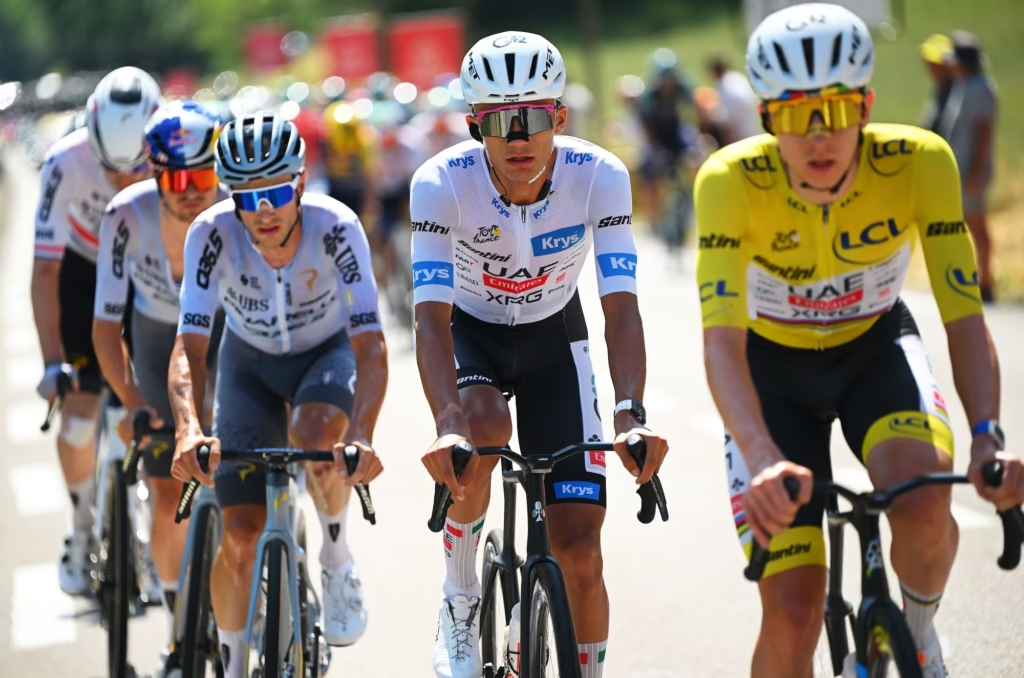
Fifth stage win of the Tour
Pogačar’s victory was his fifth stage win of the 2026 Tour and his 26th Tour stage win since 2020. More importantly, it was a win on Alpe d’Huez, the summit that carries a different kind of weight in Tour history.
He did not win it through team control. UAE were under pressure, short of mountain support and visibly weaker than earlier in the race. He won it because he decided to go from distance, rode the climb almost entirely alone and caught a strong breakaway on one of the most famous ascents in cycling.
That made the performance more impressive. Pogačar already had yellow under control. He did not need to attack from 13 kilometres out. But Alpe d’Huez is not a stage finish riders treat like any other, and once the chance was there, he took it.
For the GC, the win strengthened his already commanding lead. He now leads Evenepoel by 7:11, with Del Toro third at 9:42 and Seixas fourth at 10:06.
Carapaz takes polka dots despite missing stage win
Carapaz did not get the stage, but he did take the polka-dot jersey. By the end of the day, he led the mountains classification with 91 points, just ahead of Pogačar on 90 and Paret-Peintre on 84.
That was some consolation after coming so close to back-to-back stage victories. Carapaz had won at Orcières-Merlette the day before, then went on the attack again from the break, fought Paret-Peintre for points and repeatedly tried to crack Kuss and Martinez on Alpe d’Huez.
He was also named the most combative rider of the day for the fourth time in this Tour. That tells its own story. Carapaz has become one of the defining attackers of the final week, and now he has the mountains jersey to show for it.
The fight is not over, especially with another Alpe d’Huez stage still to come and Pogačar still capable of scoring heavily. But Carapaz has dragged himself right into the centre of the polka-dot battle.
Martinez moves into fifth overall
Martinez’s second place was a major result for Bahrain Victorious. The Frenchman had started the day seventh overall, far enough back to be allowed into the break but close enough to threaten places ahead of him if the move survived.
He did more than survive. He followed Carapaz’s repeated attacks, stayed ahead of the GC group and then resisted Pogačar almost all the way to the line. The result moved him to fifth overall, 13 minutes down on Pogačar but ahead of Skjelmose.
That is a significant rebound in a race where Martinez has drifted in and out of the main podium picture. He may not be close enough to challenge for the top three, but a top-five Tour finish is now very much alive.
Skjelmose is sixth at 13:09 after also limiting his losses reasonably well on the final climb. Ayuso’s place in the top five has gone, though, after another stage where the final week continued to turn the young rider and GC hierarchy around.
Del Toro distances Seixas
The white jersey battle also moved again on Alpe d’Huez. Del Toro attacked late from the group containing Seixas, Matthew Riccitello and Skjelmose, creating a small but important gap.
He finished seventh on the stage at 2:41, while Seixas and Skjelmose came in at 2:45. The time difference was small, but the message mattered. Del Toro had been under pressure from Seixas for several stages, especially after the French rider briefly took white earlier in the race, but he found enough on Alpe d’Huez to strengthen his grip.
Overall, Del Toro is now third at 9:42, with Seixas fourth at 10:06. That leaves the Mexican 24 seconds ahead in both the podium and young rider fight.
The battle remains close, but Del Toro’s late move was exactly what UAE needed on a day when the team’s support looked stretched. Pogačar won the stage, Del Toro protected the podium, and the team escaped with the two most important jerseys still intact.
Evenepoel limits the damage
Evenepoel finished sixth on the stage at 2:29, having eventually set off from the chasing group after Pogačar had already gone clear. He could not follow the yellow jersey, but he kept his own race under control.
The Belgian remains second overall, now 7:11 behind Pogačar. That gap is bigger than before, but his position behind the yellow jersey still looks solid. The bigger movement happened behind him, where Del Toro, Seixas, Martinez and Skjelmose are fighting over the final podium and top-five positions.
Evenepoel’s ride was not spectacular in the way his Plateau de Solaison win or Thonon-les-Bains time trial had been, but it was effective. He did not crack, did not lose second place, and kept enough separation over the young riders behind.
The question is whether he has any chance to attack Pogačar on the final mountain day. Based on Alpe d’Huez, that still looks unlikely. But as a race for second, his Tour remains in strong shape.
Alpe d’Huez belongs to Pogačar
This was the kind of stage that adds weight to a Tour victory. Pogačar already looked set to win the race overall, but winning on Alpe d’Huez gives the dominance a symbolic centrepiece.
The breakaway had the riders to win: Carapaz, Martinez, Kuss, Arensman, Jorgenson, Tobias Halland Johannessen and others. The gap was large enough to make it possible. UAE were not at full strength. Yet Pogačar still came across from the GC group, through the crowds, and took the stage.
That is the difference between control and conquest. He did not need the win. He wanted it.
Carapaz left with polka dots, Martinez moved up the overall, Pedersen strengthened green and Del Toro held white. But the image of the day was Pogačar alone on the 21 hairpins, chasing down a breakaway on cycling’s most famous mountain and finishing the job at the top.
Tour de France 2026 stage 19 result
| Position | Rider | Team | Time/gap |
|---|---|---|---|
| 1 | Tadej Pogačar | UAE Team Emirates-XRG | 3:17:57 |
| 2 | Lenny Martinez | Bahrain Victorious | +0:06 |
| 3 | Richard Carapaz | EF Education-EasyPost | +0:09 |
| 4 | Sepp Kuss | Visma | Lease a Bike | +1:14 |
| 5 | Tobias Halland Johannessen | Uno-X Mobility | +2:07 |
| 6 | Remco Evenepoel | Red Bull-BORA-hansgrohe | +2:29 |
| 7 | Isaac del Toro | UAE Team Emirates-XRG | +2:41 |
| 8 | Mattias Skjelmose | Lidl-Trek | +2:45 |
| 9 | Paul Seixas | Decathlon CMA CGM Team | +2:45 |
| 10 | Harold Tejada | XDS Astana Team | +3:22 |
Main photo credit: Getty