Célia Géry, silver medallist in the 2025 European under-23 cyclocross championship, returns as one of the main contenders for Sunday’s title in Zeddam. She faces an intriguing challenge from Barbora Bukovská, who steps up after winning both the European junior title in 2025 and the junior world championship in 2026. The race begins at 13:00 CET, or 12:00 GMT.
The UEC also identifies France’s Amandine Muller and Dutch rider Lauren Molengraaf as serious contenders. Defending champion Leonie Bentveld is not among the names in the published 2026 under-23 entry reporting, so this preview does not assume she will start.
Géry has the strongest recent under-23 championship result
Géry finished second behind Bentveld in 2025, with Muller third. That gives her a direct result against high-level opposition in this age group. Her challenge is to convert that experience into a win on a circuit where running and remounting could interrupt the rhythm of a powerful rider.
Géry has discussed an iliac artery problem and plans for surgery after the European Championships. That is relevant to her season, but it does not justify guessing how she will perform on Sunday. She is listed among the UEC’s principal contenders, and her actual race condition will be established on the course.
The Zeddam course
The 2026 championships return to the village that hosted the 2006 World Championships. The organisers have rebuilt the famous staircase, which rises out of the sand pit towards the Gildekoat museum area. A new bridge near the Grafelijke Korenmolen adds another distinctive feature. The official map gives a lap of about 2.97 kilometres, with repeated transitions between riding, running and remounting.
The stairs make position essential. Riders entering behind a slower competitor can lose momentum even if they are physically strong enough to keep pace. After the steps, efficient remounting and the ability to accelerate immediately may be as important as running speed. Wet weather would put a premium on grip and bike changes, but no particular surface condition should be assumed before race day.
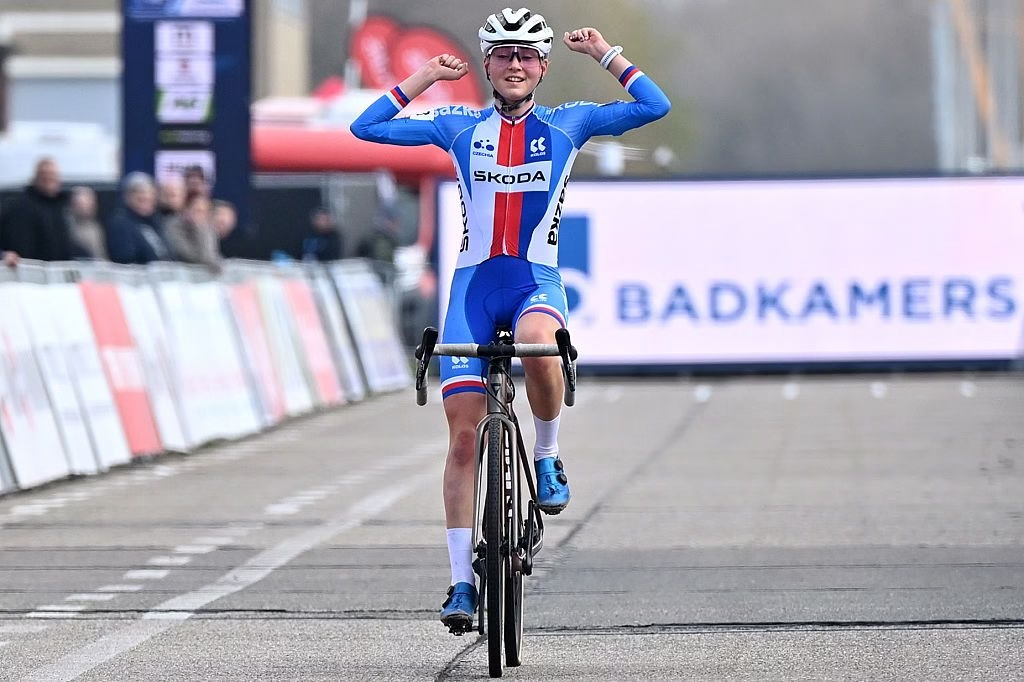
Bukovská makes an important step up
Bukovská won the 2025 junior European title and the 2026 junior world championship. Her move into the under-23 category raises the level of opposition, but her junior results demonstrate the ability to perform in championship conditions.
The question is whether she can maintain her technical execution and power when more experienced riders force repeated accelerations. A strong first lap would put her in contention, but the final laps may be the real measure of how comfortably she has made the transition.
Muller and Molengraaf widen the contest
Muller is more than a supporting French name. The UEC highlights her third place at Middelkerke and she has a previous European under-23 podium. If Géry is forced into an early chase, Muller could have the opportunity to follow the leaders rather than commit to the same effort.
Molengraaf is a principal Dutch contender, supported by a broader home-country entry that includes Mae Cabaca, Bloeme Kalis, Puck Langenbarg, Noï Moes and Rianne Nieuwenhuis in published reporting. The depth of that selection makes it difficult to assume the title will be decided only between the French and Czech favourites.
The tactical problem
The start is likely to be particularly important because the staircase creates a potential bottleneck. A rider who enters the technical sections among the first few has control of the line, while a rider further back may have to stop behind somebody else’s mistake. That is not a prediction that the first lap will decide the title, but it does explain why positioning can matter as much as outright speed.
The course should reward repeatability. A single attack is less valuable if the rider then loses time through an untidy remount. The most convincing contenders will be those who can ride consistently at a high pace and keep their concentration when fatigue makes the technical features harder.
British riders and the rest of the field
The published under-23 women’s entries include Alice Colling, Kacey Eyeington, Hope Inglis, Ellie Mitchinson and Zoe Roche for Great Britain. Their presence gives UK readers several riders to follow even if the early selection is dominated by the headline contenders.
The event draws riders from Belgium, Italy, Germany, the Czech Republic and other countries. In a field of this size, a mechanical problem or a missed line at the staircase can rapidly change the front group. The final start list will establish which nominated riders actually take the grid.
A new champion and a changing age group
The move from junior to under-23 racing is not a minor administrative detail. Bukovská is stepping into a field that includes riders with several seasons of high-level experience. She may be faster through individual technical sections than some of them, but sustaining that advantage across an entire race is a different test. Her junior titles establish potential rather than guaranteeing a podium.
Géry and Muller have already demonstrated their ability to reach a European under-23 podium. That experience can help when the race becomes tactical: knowing when to follow a move, when to recover and when to accept a short gap rather than risk a crash. Molengraaf has the added challenge of racing in front of a home crowd, with attention on the Dutch riders throughout the weekend. None of those factors guarantees a result, but each offers a more useful way of assessing the race than simply counting the number of names on a national entry list.
Where the race may be won
Géry has the most obvious recent under-23 European championship reference, while Bukovská brings the momentum of a successful junior career. Muller and Molengraaf can disrupt any attempt to frame the race as a two-rider contest.
A clean passage through the staircase followed by an efficient remount may create the decisive seconds. The favourite who makes the fewest mistakes over repeated laps may have a better chance than one who launches a single spectacular acceleration.
The championship programme
The junior men start on Sunday, 8 November at 11:00 CET, the under-23 women at 13:00 and the elite men at 15:00. Those are 10:00, 12:00 and 14:00 GMT respectively. Three other titles are contested on Saturday. The UEC reports 299 registered athletes from 25 nations across the whole weekend.
The official UEC entries are nominations, not immutable start lists. The governing body says final start lists are available the day before each race. Any late changes should therefore be checked before the start. For television information see our Zeddam broadcast guide, while our championship history covers the past winners.