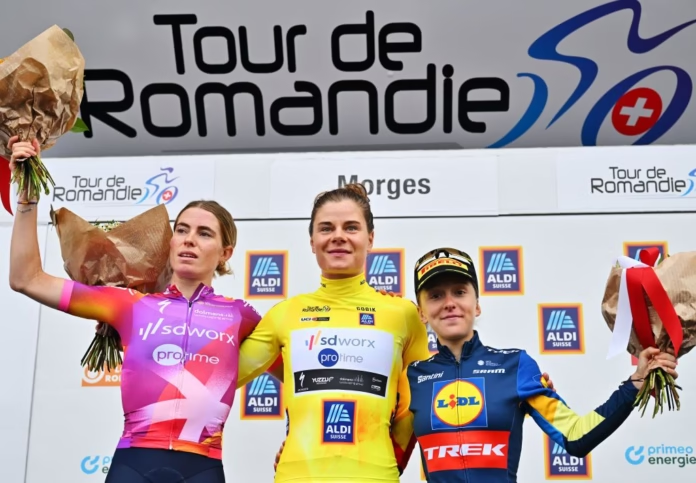
The 2025 Tour de Romandie Féminin began in disarray after five of the sport’s top Women’s WorldTour teams were excluded from the opening time trial over a dispute with the UCI about the introduction of GPS safety tracking devices. Canyon SRAM, EF Education-Oatly, Lidl-Trek, Team Picnic PostNL and Team Visma | Lease a Bike did not start the race from Huémoz to Villars-sur-Ollon, leaving the peloton noticeably diminished for the three-day Swiss event.
The new trackers were introduced as part of the UCI’s SafeR project in the wake of the death of 18-year-old Muriel Furrer during last year’s UCI Road World Championships in Glasgow. The system, weighing just over 60 grams, transmits a rider’s position in real time to race control and medical staff, with the aim of improving incident response times. Romandie was chosen as the first test ahead of full deployment at next month’s World Championships in Rwanda, where every rider will be required to carry the device.
However, the teams involved said they had not been properly consulted and were concerned about the process, liability, and fairness of the trial. Under the UCI’s specific race rules for Romandie, one rider per team was to carry the tracker across all three stages. Team managers objected to nominating a single rider, arguing this placed that rider at a disadvantage compared with team-mates and the rest of the peloton.
In their joint statement, the five absent teams – plus AG Insurance-Soudal, who later agreed to start – said they fully supported measures to improve safety, pointing to a successful whole-peloton trial at the Tour de Suisse earlier this year, which had been developed with stakeholder input. They accused the UCI of acting unilaterally to impose the system for the benefit of its own World Championships, bypassing the usual collaborative process.
The statement emphasised that the right to mount any device on a rider’s bike lies with the team, and that consent should be sought. It also objected to the UCI granting itself, or a partner, the power to attach devices without permission, and made clear that team staff would not install, remove, charge, or manage the trackers. They would not accept liability for any accidents or damage arising from the equipment and would record the identities of anyone attaching a tracker.
Crucially, the teams refused to select a rider to carry the device, putting the onus on the UCI to nominate someone. Jonathan Vaughters of EF Education-Oatly summarised the standoff by stating the teams were not disqualified for rejecting the GPS outright, but for declining to choose which rider would carry it and instead asking the UCI to decide.
The UCI’s response condemned the refusal to participate, calling it “surprising” and accusing the teams of undermining efforts to improve safety. It insisted that the rules had been clearly communicated on 7th August and again at the sport directors’ pre-race meeting, and that the Romandie test was part of a broader plan developed by SafeR with input from organisers, teams, and riders. The governing body also noted that most of the absent teams are members of Velon, the commercial entity that operates its own rider data transmission system and has been developing GPS tracking technology.
That Velon connection has raised questions about whether commercial interests played a role in the refusal. Some insiders suggested the UCI’s chosen system was similar to Velon’s, and that teams feared losing return on their investment if the UCI’s device became the sport-wide standard.
The absence of Canyon SRAM, EF Education-Oatly, Lidl-Trek, Team Picnic PostNL, and Team Visma | Lease a Bike has stripped the race of several headline riders and significantly reduced the field. AG Insurance-Soudal, originally part of the protest group, agreed to race under the UCI’s terms. The prologue went ahead as planned, but with a thinner start list and lingering uncertainty over relations between the governing body and some of the sport’s most prominent teams.
If the UCI proceeds with its planned full-scale rollout in Rwanda, this Romandie confrontation may prove to be only the opening round in a wider dispute over how safety technology is introduced and who controls the data it produces.