Moreno Argentin was one of the defining Ardennes specialists the sport has seen, but that label only tells part of the story. He built his reputation on explosive uphill finishes and his repeated command of Liège-Bastogne-Liège, yet he also won Il Lombardia, the Tour of Flanders and the World Championships. In the second half of the 1980s and into the early 1990s, he became one of the standout one-day riders in the peloton, particularly when races turned selective without becoming outright attritional. His place in men’s cycling history rests on that blend of specialisation and range.
Rider history
Argentin turned professional in 1981 and made an immediate impression by winning two stages of that year’s Giro d’Italia. That was not a one-off. He kept taking Giro stages through the first half of the decade and steadily built a reputation as one of Italy’s most dangerous puncheurs. By 1985, though, his career had moved beyond stage-hunting and into the territory of major one-day wins, because that was the year he claimed the first of his four Liège-Bastogne-Liège victories.
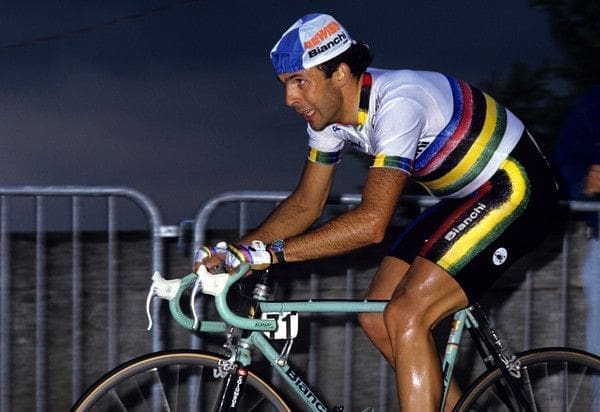
The years that followed established Argentin as the dominant Ardennes rider of his era. He won Liège-Bastogne-Liège three times in a row from 1985 to 1987, a sequence that only a handful of riders in history could match in any Monument. In between, he won the 1986 World Championships, giving him the rainbow jersey that marked the peak of his status within the sport. Then, in 1987, he added Il Lombardia, proving that his one-day strength extended beyond the Ardennes terrain that suited him best.
After a quieter 1988 in terms of major wins, Argentin returned in impressive fashion. In 1990 he won the Tour of Flanders, still one of the more surprising Monument victories of the era given the race’s cobbled demands and his broader reputation as an Ardennes specialist. That same season he also won La Flèche Wallonne for the first time and took his first Tour de France stage win. A year later he returned to winning ways in Liège, claiming a fourth title there, which left him second only to Eddy Merckx in the race’s all-time standings. He also won La Flèche Wallonne again in 1991.
Argentin came close to a far broader Monument collection than he ultimately finished with. In the 1992 Milan-San Remo, he looked poised to add the race to his palmarès before Sean Kelly came back to him after the Poggio descent and beat him in the sprint on the Via Roma. It remains one of the more painful near-misses of his career because it would have given him a third Monument on very different terrain.
His final season also left one of the more uncomfortable markers of the era. Argentin’s 1994 La Flèche Wallonne win came as part of the infamous Gewiss-Ballan domination, with Argentin, Giorgio Furlan and Evgeni Berzin attacking from 72 kilometres out and taking the first three places. The performance, and the discussion that followed around team doctor Michele Ferrari and EPO, has since come to symbolise the beginning of a darker period in professional cycling. It gives Argentin’s career an awkward late chapter, but it is part of the historical record and cannot be separated from how that race is remembered.
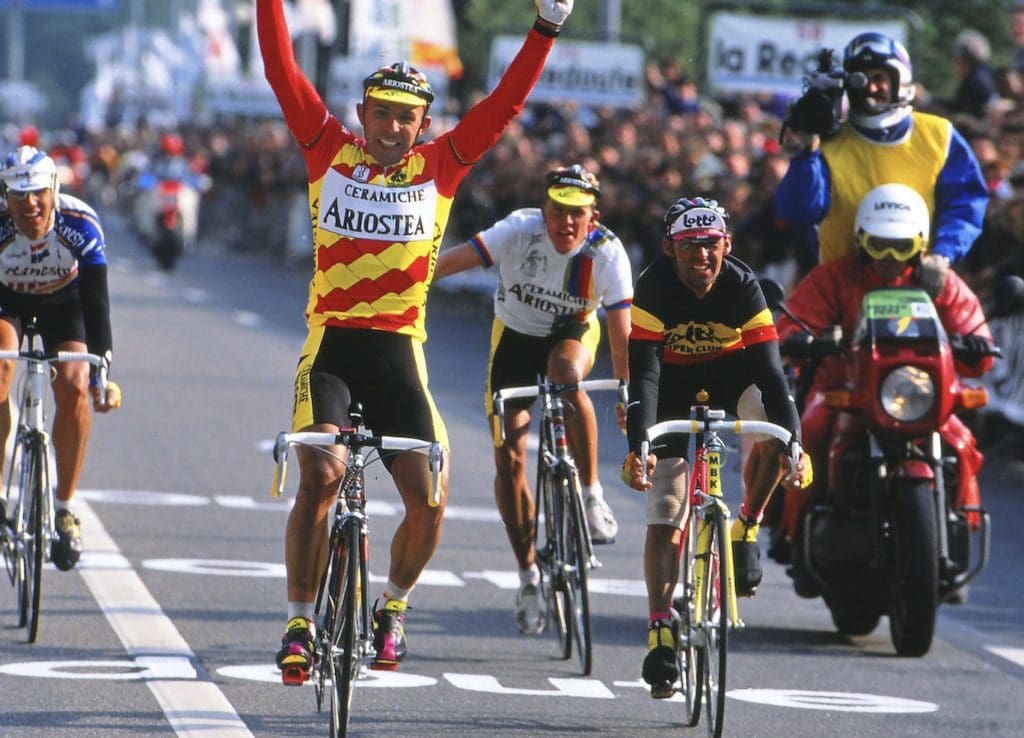
Greatest race victory
1987 Liège-Bastogne-Liège
There is a strong case for Argentin’s 1987 Liège-Bastogne-Liège as the finest one-day win of his career because it looked lost until the final moments. He arrived at the race with questions over his condition and the extra pressure of wearing the rainbow jersey, then found himself in a finale that seemed to be slipping away from him. After the selection had been made and the race reached its decisive phase, Stephen Roche and Claude Criquielion went clear and built what looked like a winning advantage.
For a while, it appeared certain that one of those two would take the race. Their lead stretched towards a minute, and with only a handful of kilometres left the logic of the situation was obvious. But Liège has always been a race where timing matters as much as strength, and both riders hesitated just enough. Behind them, Argentin kept coming. He had help initially, but when the gap began to collapse he sensed the moment immediately and committed fully. Roche and Criquielion were caught inside the final 500 metres, and Argentin sprinted through to take the win.
What makes that victory so compelling is the contrast between how unlikely it looked and how decisively Argentin finished it once the chance appeared. This was not a simple uphill knockout or a controlled sprint from a reduced group. It was a race won through patience, judgement and a refusal to accept that the result had already gone. In that sense, it captures Argentin at his best: dangerous on the climbs, sharp in the finale and always capable of reading a one-day race better than the riders around him.
Spring Classics palmarès
Monuments
Liège-Bastogne-Liège
1985, 1986, 1987, 1991
Tour of Flanders
1990
Il Lombardia
1987
Classics
La Flèche Wallonne
1990, 1991, 1994