
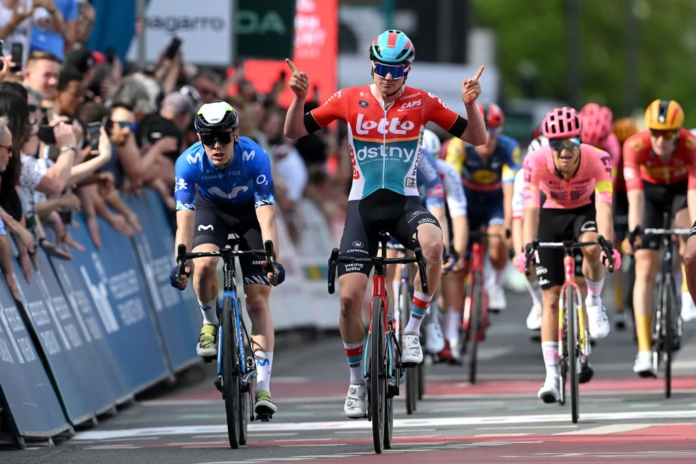
Eschborn-Frankfurt 2026 takes place on Friday 1st May and marks a clear shift in the identity of Germany’s biggest one-day race. Long known as a WorldTour Classic that could still fall the way of the faster finishers, the 2026 edition has been made significantly harder. The organisers have described it as the most demanding edition in race history, with 211.4km of racing and more than 3,300 metres of elevation gain.
The changes are not cosmetic. Two ascents of the Feldberg now come via the more selective south-western approach, the Mammolshainer Stich is used as a more decisive double climb, and the Burgweg in Schmitten-Niederreifenberg appears for the first time. That should make the Taunus section much more than a mid-race obstacle. It becomes the central battleground of the race.
For readers wanting the wider race context first, this sits naturally alongside ProCyclingUK’s Beginner’s guide to Eschborn-Frankfurt 2026, the Men’s Amstel Gold Race 2026 contenders preview and the Men’s Liège-Bastogne-Liège 2026 route guide.
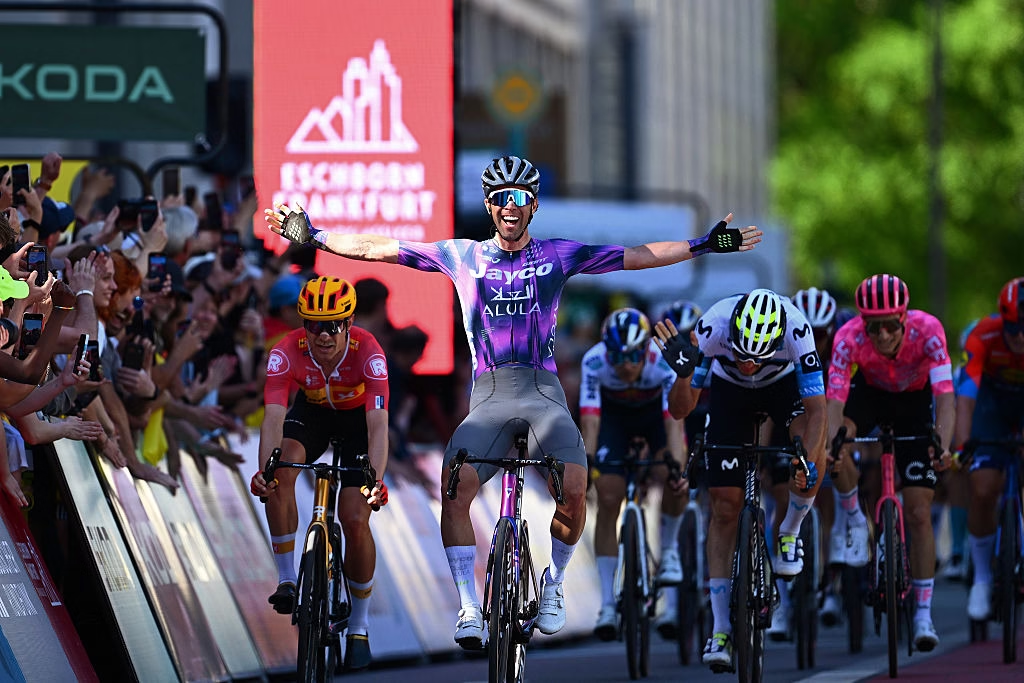 Photo Credit: Getty
What the 2026 route looks like
The race still follows the familiar broad pattern of Eschborn-Frankfurt. It starts in Eschborn, moves through Frankfurt, heads into the Taunus hills and then returns towards the city for the finish near the Alte Oper. That blend of urban start, hilly middle and fast city finale is part of the race’s character.
What has changed is the difficulty of the hilly section. The race now covers more than 3,300 metres of climbing, which moves it further away from the flatter, sprinter-friendly versions of its past. It is still not a mountain Classic in the way Liège-Bastogne-Liège is, but it is no longer a race where the fastest finishers can assume the hills will be survivable.
That is the key tactical change. Eschborn-Frankfurt has often asked whether the climbs are hard enough to remove the sprinters. In 2026, the question becomes sharper: can the climbing-capable Classics riders make the race too difficult for the faster men to come back at all?
The Feldberg becomes more important
The Feldberg has long been the major climb associated with Eschborn-Frankfurt, but its role has been strengthened for 2026. Both ascents now use the steeper south-western side, which should create earlier pressure and give aggressive teams more reason to commit before the final third of the race.
The Feldberg is not only about the gradient. It changes the rhythm of the race. It forces teams to work uphill for longer, tests whether heavier riders can stay close, and creates the kind of fatigue that may only show properly later on the Mammolshainer Stich.
Two climbs of the Feldberg also make the race harder to control. A team that wants a sprint finish cannot simply survive one long climb and then reset. It has to manage repeated pressure, descents, regrouping phases and another major selection before the race has even reached its final decisive ramps.
 Photo Credit: Rothfoto
The Mammolshainer Stich remains the race’s sharpest weapon
The Mammolshainer Stich has always been one of the defining climbs of Eschborn-Frankfurt. It is short, steep and awkward, the sort of climb that can shred a group quickly if the pace is high enough. In 2026, the race again uses it as a central feature, but now with a more decisive double passage.
That makes the finale more dangerous for riders hoping to hang on. The Mammolshainer Stich is not long enough to feel like a traditional mountain pass, but its steepness changes the race in a different way. It forces explosive efforts after the field has already been softened by the Taunus. If the peloton reaches it tired, the climb becomes much more than a hill on the profile.
This is where the race could tip away from the sprinters. A strong attack on the final ascent, or even a hard acceleration that splits the front group, could leave the fastest riders chasing with too little road and too few teammates to bring it back.
The new Burgweg climb adds another layer
The debut of the Burgweg climb in Schmitten-Niederreifenberg is one of the most interesting additions to the 2026 route. The organisers have described it as brutally steep, and its inclusion gives the Taunus section another point where the race can be forced open.
New climbs can change rider behaviour. Teams do not have the same accumulated race memory of how the peloton reacts there, and that can make the first edition with a new feature more unpredictable. Burgweg should encourage earlier aggression, especially from riders who know they are unlikely to win from a larger group in Frankfurt.
It also helps explain why the 2026 field is expected to lean more towards climbing-capable Classics riders than pure sprinters. The route is no longer just a question of surviving one or two familiar hills. It asks for repeated punch, handling, positioning and recovery across a heavier day.
-
 Photo Credit: Getty


The return to Frankfurt
After the Taunus section, the race returns towards Frankfurt and the familiar city finish near the Alte Oper. That final urban section is still important because Eschborn-Frankfurt has not become a race that finishes on a climb. Any group that survives together after the hills will still need to manage the run-in, positioning and the possibility of a sprint.
This is what keeps the race interesting. The route is harder, but not one-dimensional. It gives attackers more tools, yet it still leaves enough road after the climbs for a chase to organise if there are enough riders and teams with something to gain.
That balance is the central tactical question of the 2026 edition. If the Taunus section creates a small, committed group, the city finish could reward a strong all-rounder with a sprint. If the race comes back together, the reduced group sprint remains possible. What looks much less likely is a completely straightforward bunch sprint.
How the 2026 race could unfold
The most likely scenario is a reduced and selective race shaped by the repeated climbs in the Taunus. The first Feldberg ascent should soften the peloton, the second should make the race more serious, and the Mammolshainer Stich should decide whether the faster finishers are still part of the front group.
The Burgweg adds another point where a strong team can lift the pace before the best-known climbs. That could make the race more open than previous editions because the hard moments are spread more evenly rather than being concentrated into one familiar late pattern.
A small group arriving in Frankfurt now feels more plausible than a large sprint. A reduced bunch is still possible, especially if several teams want the same outcome, but the upgraded route gives attackers more credibility. It also rewards riders who can climb repeatedly without losing their finish after 200km.
What the 2026 route change means
The harder route changes the identity of Eschborn-Frankfurt without removing what makes the race recognisable. It still begins in Eschborn, still uses Frankfurt’s city backdrop, still passes through the Taunus, and still finishes away from the climbs. But it now asks much more of the field before that final run-in.
That should make the race more relevant to Classics riders who might once have viewed it as too likely to favour the sprinters. It also gives German fans a more selective WorldTour race, with the Taunus climbs playing a bigger tactical role than before.
For the season as a whole, Eschborn-Frankfurt now looks more than a post-Ardennes standalone. Coming after Liège-Bastogne-Liège and before the Giro d’Italia fully takes over the road calendar, it has the route strength to act as a serious one-day target for riders who can handle both climbs and speed.
For more context around that part of the calendar, ProCyclingUK’s How to watch Men’s Liège-Bastogne-Liège 2026 in the UK and How to watch Men’s Tour de Romandie 2026 in the UK help place Eschborn-Frankfurt within the transition from the Ardennes to the Giro build-up.
Eschborn-Frankfurt 2026 route at a glance
- Date: Friday 1st May
- Distance: 211.4km
- Elevation gain: more than 3,300 metres
- Start: Eschborn
- Finish: Frankfurt, near the Alte Oper
- Key climbs: Feldberg, Mammolshainer Stich, Burgweg
- Route style: harder, hillier and more selective than previous editions
- Likely race outcome: reduced group, attacking race or selective sprint rather than a full bunch finish

