

Beryl Burton’s career is one of the great British cycling stories, but it is also one of the most uncomfortable. Not because her achievements are difficult to admire. They are almost impossible to overstate. The discomfort comes from the fact that she did so much, for so long, with so little of the recognition, money, support or public attention that a rider of her level should have received.
Burton was not simply the best British woman cyclist of her generation. She was one of the greatest cyclists Britain has ever produced, full stop. Across road racing, track pursuit and time trialling, she built a career that still feels slightly unreal: seven world titles, more than 90 British titles, decades of domestic dominance, and a 12-hour time trial record that briefly stood above the men’s mark as well as the women’s.
Her story does not fit neatly into the modern language of pathways, marginal gains or elite development. A polished performance programme did not shape Burton. She came out of Yorkshire club cycling, hard work, routine, stubbornness and an almost frightening refusal to accept the limits placed in front of her. She was introduced to cycling through her husband Charlie, then proceeded to ride away from almost everyone.
That is why Burton still matters. She did not just win within the boundaries of women’s cycling in her era. She kept stretching those boundaries until they looked inadequate. In doing so, she left a legacy that belongs alongside the biggest names in women’s cycling history, British sport and the wider story of endurance racing.
A champion forged far from the spotlight
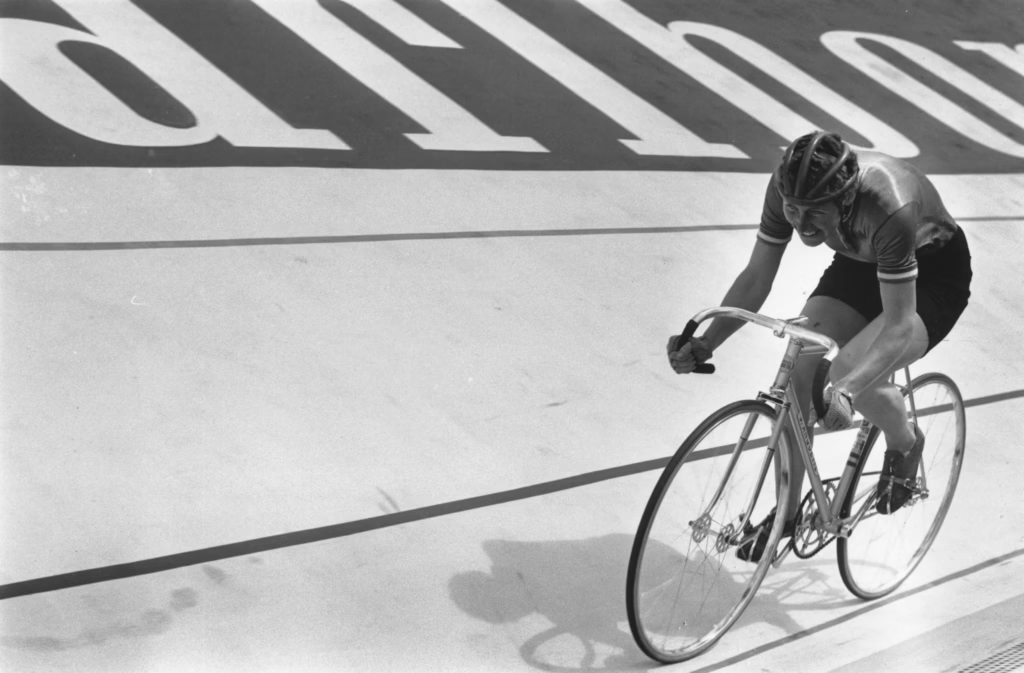
Beryl Burton was born Beryl Charnock in Leeds in 1937 and spent most of her life in Yorkshire. Her route into cycling was not that of a carefully identified prodigy. She had serious health problems as a child, left school early, and later came into the sport through Charlie Burton, whom she married in 1955. What followed was not immediate perfection, but rapid transformation.
The early versions of the story are almost modest. Burton was not presented as a natural superstar from the first ride. She improved, adapted, trained, watched, learned and then overtook the people around her. Within a few years, she had gone from being pulled along by club riders to becoming the rider they could not follow.
That club background is important because it shaped the whole career. Burton’s racing was rooted in the British time trial scene, in early starts, measured efforts, domestic roads and a culture where toughness mattered as much as presentation. She was never packaged as a glamorous professional. She worked, trained, raced, recovered and repeated the process with a severity that became part of her legend.
Her life was not separated cleanly into athlete and everything else. She worked on a rhubarb farm, raised a family, trained around ordinary responsibilities and still produced performances that would have been remarkable under the best conditions. That tension is central to understanding her. Burton’s greatness was not created by comfort. It was carved out of constraint.
World titles on road and track
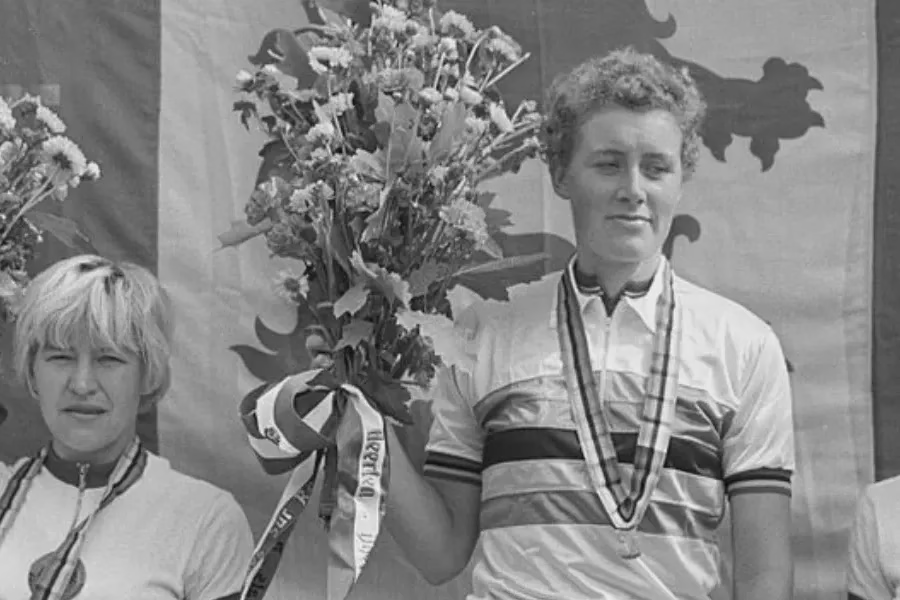
Burton’s international record alone would be enough to secure her place among cycling’s greats. She won the world road race title in 1960 and again in 1967, proving that her strength was not confined to British time trials or familiar domestic roads. She could win against the best in the world, in races where positioning, timing and tactical sense mattered as much as raw endurance.
Her 1960 victory also deserves to be treated properly in the British cycling story. Tom Simpson is often the easier reference point for Britain’s early road world championship success, but Burton had already won the women’s road world title five years before Simpson became men’s world champion. That matters, because the history of the rainbow jersey is broader than the version that is most often repeated. The wider list of cycling world champions makes Burton’s place in that story clear.
On the track, she was even more consistently decorated. Burton won the world individual pursuit title five times, in 1959, 1960, 1962, 1963 and 1966. She also took a string of silver and bronze medals across a long international career, stretching her presence across three decades of world championship competition.
The individual pursuit suited her perfectly. It rewarded sustained power, mental control and the ability to impose a rhythm without needing permission from anyone else. Burton’s best racing often had that quality. She did not need a race to become theatrical. She needed a distance, a clock and a reason to keep pressing harder than anyone else could bear.
Yet her road titles matter just as much because they resist the idea that she was only a time trial engine. Burton could race. She could read a contest, handle pressure and deliver on days when the race did not unfold in a straight line. That breadth is what separates her from being merely a specialist. She was a complete racing cyclist in an era that rarely gave women the calendar or the platform to show that properly.
The 12-hour ride that still defines the legend
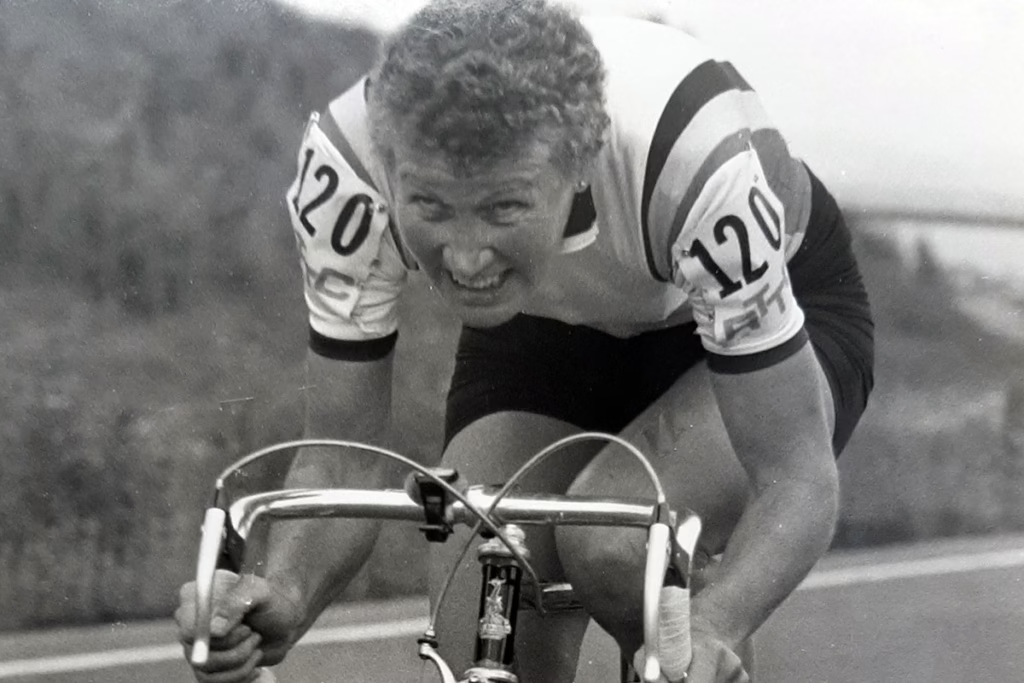
If one ride captures the scale of Burton’s ability, it is her 12-hour time trial performance in 1967. She covered 277.25 miles, a distance that surpassed the men’s record at the time. In a sport so often structured around male benchmarks, Burton did something beautifully awkward: she rode beyond one of them.
The details have become part of British cycling folklore. During the ride, she caught and passed Mike McNamara, who was himself on the way to setting a men’s record. The story goes that Burton offered him a liquorice allsort as she went by. It is a small image, almost comic on the surface, but it says a great deal. She was not just competing in parallel to men’s cycling. On that day, she was literally riding through it.
The number still has force because 277.25 miles in twelve hours is difficult to make ordinary, even with modern equipment in mind. Burton did it in an age before today’s aerodynamic obsession, before modern nutrition systems, before power meters, before the layers of support that now surround elite endurance performance. Her record was not a laboratory product. It was the result of extraordinary physical capacity and a mind trained to stay inside discomfort for longer than almost anyone else.
As a women’s record, it stood for half a century. That is the clearest measure of its severity. Some records last because nobody tries seriously to break them. Burton’s lasted because it was brutally hard. It belongs in the same long tradition of women using the clock to expose what the sport had underestimated, a theme that also runs through the history of the women’s hour record.
Domestic dominance on a scale that barely makes sense
Burton’s British record is staggering. She won 96 national titles across time trialling, road racing and track pursuit. That figure alone risks becoming abstract, because it is difficult to visualise what it means to dominate a national scene across so many years and formats. The more specific details are even more revealing.
She won the British Best All-Rounder competition for 25 consecutive years, from 1959 to 1983. That was not a short peak. It was a generation-long occupation of the summit. Riders came through, improved, challenged and disappeared. Burton remained. Every year, the standard moved. Every year, she kept meeting it.
Her time trial record was particularly absurd: national titles at 25 miles, 50 miles and 100 miles, records across multiple distances, and performances that lasted far beyond the era in which they were set. This was not a rider winning one championship repeatedly because the competition was weak. It was a rider who kept recalibrating what domestic excellence looked like.
The brutality of time trialling suited Burton because it removed excuses. There was nowhere to hide, no soft tactical route, no chance to sit in and wait for a sprint. The result came down to what a rider could sustain. Burton’s answer, over and over again, was more than anyone expected.
Uncompromising was not just a description
Burton’s reputation for toughness is central to her story, but it needs careful handling. It is easy to turn her into a simple myth of northern grit, as if determination alone explains everything. That underplays both her talent and the complexity of her personality. She was not great only because she was hard. She was great because she combined talent, discipline, intelligence and an unusually severe relationship with competition.
Still, uncompromising is the right word. Burton did not appear to have much interest in softening herself for public consumption. She could be generous, funny and loyal, but she was also ferociously competitive. She expected a lot from herself and, at times, from those closest to her. Her daughter Denise also became a successful racing cyclist, and the family dynamic around competition was not always simple.
That makes Burton more human, not less. Great champions are rarely frictionless. The same qualities that make them capable of extraordinary performances can make ordinary life more difficult. Burton’s drive was her gift and her burden. It pushed her beyond existing limits, but it also meant there was rarely much peace in merely being good enough.
In that sense, she belongs with the most compelling figures in sporting history: not easy, not polished, not built for bland celebration, but impossible to ignore. Burton made excellence look less like inspiration and more like obligation. Once she knew what could be done, she seemed unable to accept doing less.
A British legend without the rewards of modern fame
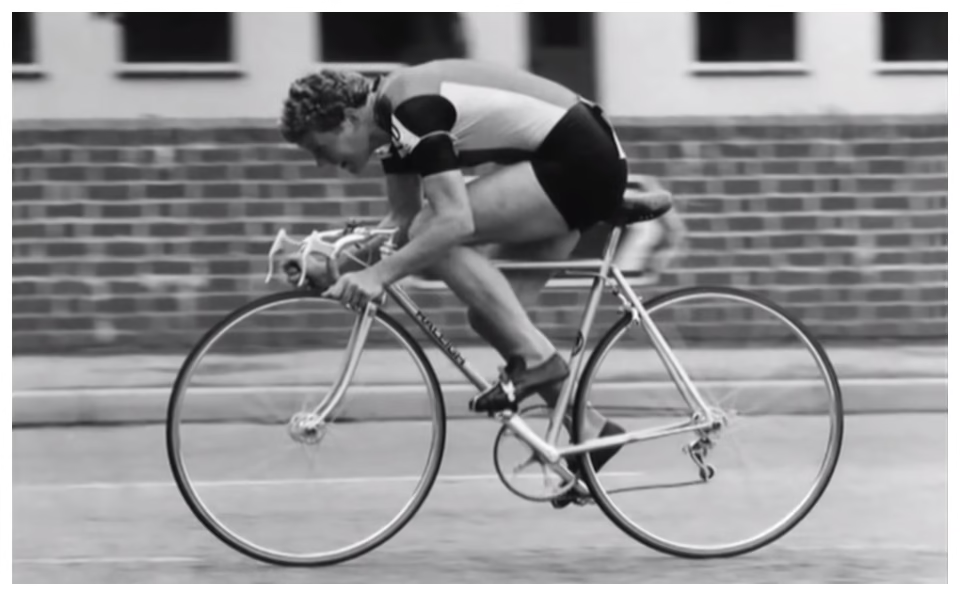
One of the striking things about Burton’s career is how little it resembles modern sporting celebrity. Today, a British cyclist with her level of dominance would be a household name, a sponsorship magnet and a central figure in national sports coverage. Burton won in an era when women’s cycling was marginalised, underfunded and often treated as a curiosity rather than a serious elite discipline.
That does not mean she was unknown within cycling. Far from it. Within the sport, her authority was immense. But the wider public recognition never matched the scale of the achievement. Her career sits in that frustrating space occupied by many women’s sporting greats of the 20th century: respected by those who knew, under-celebrated by those who should have known.
There is a temptation to frame that as a quaint detail of the past. It was more serious than that. Lack of attention affects opportunity, income, legacy and historical memory. Burton’s greatness survived anyway, but it had to survive without the machinery that preserves the reputations of male champions. The fact her name still carries such weight says plenty about the force of what she achieved.
Her story also helps explain why modern women’s cycling history matters. The current Women’s WorldTour, the growth of races such as the Tour de France Femmes, and the visibility of today’s leading riders did not appear from nowhere. They sit on a long foundation built by riders who had to force open space that should already have existed.
A Yorkshire story that still connects to the future
Burton’s Yorkshire background is not a decorative detail. It is central to how she is remembered. The roads, clubs and racing culture of the county shaped the rider she became, and her presence still sits inside Yorkshire’s wider cycling identity. When the Tour de France Femmes confirmed its 2027 Grand Départ in England, Yorkshire’s women’s cycling heritage was impossible to separate from the story. Burton belongs at the centre of that lineage.
That connection matters because British women’s cycling is not only a modern success story built around Olympic programmes, WorldTour contracts and improved visibility. It has deeper roots, and Burton is one of the strongest. The current generation of British riders now has a clearer platform than she ever did, but the expectation that British women can shape the biggest races was not invented in the 21st century.
That is why Burton’s story sits naturally alongside more recent British figures. Nicole Cooke forced wider questions about recognition, equality and what British cycling chose to celebrate. The current wave of British riders is racing in a more visible and more professional sport. But Burton remains the hard, early reference point, the rider who made the argument through performance before the sport was ready to listen.
-
 Photo Credit: quentinphotographiebe
 -
 Photo Credit: Getty
Why Burton belongs in the conversation with Britain’s greatest riders
British cycling has no shortage of great names. Tom Simpson, Chris Boardman, Nicole Cooke, Bradley Wiggins, Mark Cavendish, Chris Froome, Geraint Thomas, Laura Kenny and others all occupy major places in the national story. Burton belongs in that conversation without needing special pleading or a separate category.
The case is simple. She won globally on road and track. She dominated domestically for decades. She set records that lasted for extraordinary lengths of time. She did it across disciplines and distances. She was not merely successful within the women’s field. At her most astonishing, she crossed into territory that forced comparison with male performance too.
That does not mean every achievement can be compared cleanly across eras. Cycling has changed too much for that. Equipment, calendars, competition depth, training science and opportunity all shift the meaning of results. But historical greatness is not only about direct comparison. It is about how far a rider stood above her time, how much she changed expectations, and how long her performances continued to echo.
By those measures, Burton’s place is secure. She was not a footnote before the modern era. She was one of the pillars that made later conversations possible.
The legacy of a rider who refused to shrink
Beryl Burton died in 1996, aged 58, after becoming unwell while out on her bike. There is a starkness to that ending that feels almost inseparable from the life that came before it. Cycling had been her arena, her discipline, her expression and her measure. It was not something she stepped neatly away from.
Her legacy has grown in the years since, helped by books, plays, plaques, memorials and a wider willingness to look again at women whose achievements were underplayed in their own time. But the best way to understand Burton is still through the scale of the performances. The 12-hour record. The world titles. The 25 consecutive Best All-Rounder crowns. The national championships that kept accumulating until the total became almost unreasonable.
She was not a symbol first and a cyclist second. She was a cyclist of astonishing seriousness, and that is what gives the symbolism its force. Burton did not ask permission to be exceptional. She rode as though possibility itself was something to be tested, broken and rewritten.
That is why her story still cuts through. Beryl Burton was uncompromising, sometimes difficult, often under-recognised and almost impossibly dominant. She did not simply win races. She changed the scale of what British cycling, and women’s cycling, could imagine.

