

Vuelta a Burgos Feminas 2026 reaches its decisive final stage on Sunday, 24th May, with the peloton heading from Gumiel de Mercado to Lagunas de Neila. After three days shaped by sprint control, punchy terrain and SD Worx-Protime dominance, the race now reaches the climb that should decide the overall classification.
Stage 4 is 120km long and finishes on the Lagunas de Neila summit, one of the most recognisable mountain finishes in Spanish stage racing. The route includes around 2,400 metres of climbing, with Alto de Arroyo, Alto de Tolbaños and the final climb to Lagunas de Neila forming the key sequence in the second half of the stage. The final climb is listed at just under 6km at around 10 per cent, which makes this a proper GC finish rather than a reduced sprint stage.
Lorena Wiebes starts the day still in the leader’s jersey after winning the opening two stages and finishing third behind teammate Mischa Bredewold and Mireia Benito on stage 3. That leaves SD Worx-Protime in control of the race, but Lagunas de Neila is a very different test. Wiebes has defended the jersey well through three days, yet the final stage should favour the climbers and GC riders.

When does Vuelta a Burgos Feminas 2026 stage 4 start?
Stage 4 takes place on Sunday, 24th May.
The route runs from Gumiel de Mercado to Lagunas de Neila over 120km. The listed stage start is 11:25 BST, with the race finishing in the afternoon on the summit climb.
Because this is a mountain stage rather than a sprint stage, the decisive racing may come earlier than the final kilometre. Alto de Tolbaños arrives inside the final 20km, before the road drops and rises again towards Lagunas de Neila. That makes the final hour the essential viewing window.
How to watch Vuelta a Burgos Feminas 2026 stage 4 in the UK
UK viewers should check HBO Max and TNT Sports for live coverage and race updates. HBO Max is the main streaming home for Warner Bros. Discovery’s cycling coverage in the UK and Ireland, while TNT Sports remains the relevant platform for listings, race pages and any linear coverage.
RTVE Play is also listing live Spanish-language coverage of Vuelta a Burgos Feminas, with its usual live broadcast window from 13:30 BST. That should cover the key final phase of stage 4, including the approach to Alto de Tolbaños and the final climb to Lagunas de Neila. UK access can depend on rights restrictions on the day.
What time should UK viewers tune in?
The best time to tune in is from around 13:30 BST, when the live Spanish broadcast window is scheduled to begin. That should bring viewers into the decisive part of the stage, with the early breakaway situation established and the peloton moving towards the final climbing sequence.
For viewers short on time, the essential window should begin from around 14:00 BST. By then, the race should be close to the section where Alto de Tolbaños and Lagunas de Neila begin to shape the final GC battle. The final climb is steep enough that even a small group at the foot can fragment quickly.
Anyone following the overall classification closely should watch the full final hour. This is not a stage where the last kilometre alone tells the story. The positioning before Alto de Tolbaños, the descent before the final climb and the first steep slopes of Lagunas de Neila could all decide who wins the race.
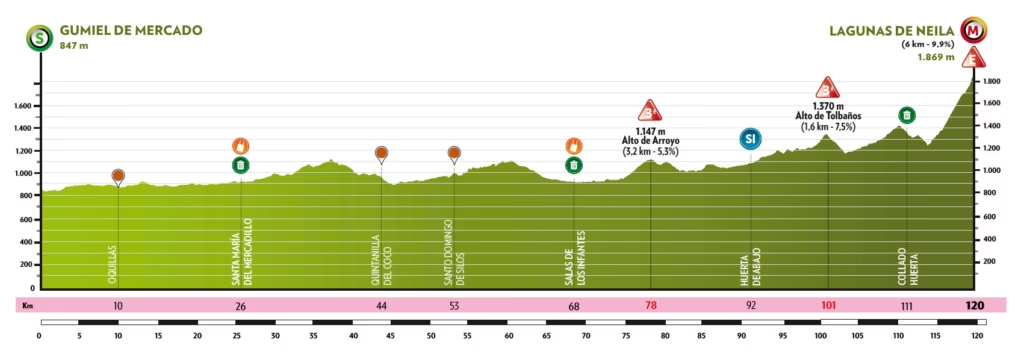
The stage 4 route
Stage 4 starts in Gumiel de Mercado and finishes at Lagunas de Neila. The stage is listed at 119.6km, with around 2,404 metres of climbing, making it the hardest day of the race on paper.
The first major climb is Alto de Arroyo, a third-category ascent of 3.26km at 5.4 per cent, coming with around 42km remaining. That climb may not decide the stage, but it should begin to reduce the peloton and test which teams still have riders available for the finale.
The intermediate sprint comes at Huerta de Abajo with around 27.6km remaining, before the race moves towards Alto de Tolbaños. That climb is short but sharp, listed at 1.58km at 6.9 per cent, and provides one final chance to thin the group before the summit finish.
Then comes Lagunas de Neila itself. The climb is listed at 5.96km at 10 per cent and takes the riders up to the finish. That makes it the clearest GC test of the entire race. With gradients steep enough to separate the true climbers from riders who have survived the race through positioning and sprint strength, the final climb should decide the stage and almost certainly the overall classification.
Why Lagunas de Neila should decide the race
Lagunas de Neila is the stage 4 headline for a reason. The opening three stages created pressure, bonus seconds and tactical shifts, but this is the first day where the terrain should force a clean climbing hierarchy.
Wiebes has carried the leader’s jersey brilliantly through the race so far, and SD Worx-Protime have won every stage through either Wiebes or Bredewold. But a 6km climb at around 10 per cent changes the calculation. This is no longer about lead-outs, reduced sprints or late attacks on rolling roads. It is about climbing depth and how much time riders can take on the final ascent.
The stage also comes at the end of four consecutive days of racing. That matters. Some riders who looked comfortable in the opening stages may feel the accumulated effort once the road rises towards Lagunas de Neila. The climb is steep enough to expose fatigue quickly.
What SD Worx-Protime need to do
SD Worx-Protime start the final stage with control of the race, but not with a simple tactical job. Wiebes is still in the leader’s jersey, while Bredewold’s stage 3 win showed that the team has another rider capable of shaping the race on harder terrain.
The key question is whether the team tries to protect Wiebes for as long as possible or uses Bredewold more aggressively. Wiebes has shown impressive resilience, but Lagunas de Neila is likely to be too hard for a pure sprint-based defence if the climbers attack properly.
Bredewold gives the team a stronger climbing card. Her move on stage 3 showed good legs and excellent timing, and she may be the better option if the final climb turns into a direct GC fight. That gives SD Worx-Protime flexibility, but it also forces them to make decisions quickly if Wiebes begins to struggle.
Which riders can challenge on stage 4?
The final climb should bring the strongest GC riders and climbers to the front. Riders such as Ashleigh Moolman-Pasio, Evita Muzic, Yara Kastelijn, Usoa Ostolaza, Amanda Spratt, Shirin van Anrooij, Cédrine Kerbaol and Silke Smulders were all present in the key selection on stage 3, and they should be central again on Lagunas de Neila.
Moolman-Pasio has the experience and climbing pedigree for a summit finish like this. Muzic is also well suited to a steep final climb and should see stage 4 as her clearest chance to reshape the overall. Kastelijn has the punch and aggression to make the race hard before the final kilometres, while Ostolaza should be particularly motivated on a stage where sustained climbing matters.
Spratt and Van Anrooij give Lidl-Trek options, and Kerbaol remains dangerous if the final becomes more tactical than expected. Smulders’ stage 3 presence also showed that Liv AlUla Jayco should not be overlooked.
The mountain jersey picture
The mountains classification should also be decided on stage 4. Oda Aune Gissinger made an immediate impact earlier in the race by taking the red mountain jersey on her Women’s WorldTour debut, and stages 3 and 4 were always the key days for that competition.
Stage 4 offers points on Alto de Arroyo, Alto de Tolbaños and Lagunas de Neila, so the jersey can still shift depending on who gets into the break and who reaches the final climb first. A strong breakaway rider could collect enough early points to change the classification before the GC favourites take over on the summit finish.
The problem for the mountain jersey contenders is that the final climb overlaps with the fight for the overall. Once the GC race opens, the best climbers are likely to dominate the final points.
-
 Photo Credit: quentinphotographiebe
 -
 Photo Credit: Getty



What kind of race should viewers expect?
The most likely pattern is an early breakaway, followed by controlled tension until the second half of the stage. Teams without a GC favourite may try to get riders up the road before the final climbs, especially because the early and middle sections offer a chance to build a lead before the race becomes more selective.
The GC teams should begin to take over on Alto de Arroyo or on the approach to Alto de Tolbaños. That is where positioning becomes more important. A rider caught too far back before the final climbs could spend energy chasing before the real summit finish even begins.
Lagunas de Neila should decide the stage and the race. The climb is steep enough for repeated accelerations, but also long enough that a rider who goes too early can still pay for it. The best tactic may be controlled pressure in the first half of the climb, followed by sharper attacks once the gradient and altitude begin to bite.
Prediction
Stage 4 should finally move Vuelta a Burgos Feminas away from sprint control and into a pure GC test. SD Worx-Protime start in the strongest position, but Lagunas de Neila gives the climbers a direct chance to undo three days of dominance.
Wiebes has defended the leader’s jersey impressively, but the final climb looks too steep and too sustained for a simple defence. Bredewold may become SD Worx-Protime’s best GC card, while Moolman-Pasio, Muzic, Kastelijn, Ostolaza and Van Anrooij all have the terrain to attack.
Prediction: the overall classification to be decided on the final climb, with Evita Muzic and Ashleigh Moolman-Pasio among the strongest options if the race becomes a pure climbing contest on Lagunas de Neila.

