
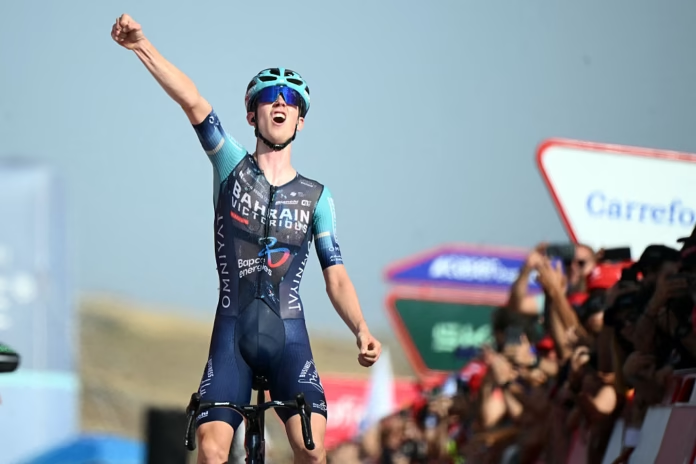
Jakob Omrzel won stage 12 of the 2026 Vuelta a España on Calar Alto, taking the biggest victory of his young career after riding away from the breakaway on the final climb.
The 20-year-old Bahrain Victorious rider attacked from the remnants of a large escape group with 13 kilometres remaining, dropped Urko Berrade shortly afterwards and held on alone to win at the highest summit finish of this year’s Vuelta.
Berrade finished second for Equipo Kern Pharma, 1:56 behind, with Santiago Buitrago third at 2:13 after another aggressive day in the mountains competition. Alexey Lutsenko was fourth for NSN Cycling Team, ahead of Mauri Vansevenant of Soudal Quick-Step.
Enric Mas finished sixth at 2:56, but the red jersey was one of the clear winners of the day. He attacked the GC group on the lower slopes of Calar Alto, used teammate Raúl García Pierna from the breakaway, and gained 27 seconds on Primož Roglič, Felix Gall and Richard Carapaz. Oscar Onley lost more time after a day that began with a crash and ended with him slipping to fifth overall.
Mas now leads Roglič by 1:45, with Gall third at 2:06, Carapaz fourth at 3:53 and Onley fifth at 4:29. Omrzel’s stage win also lifted him to sixth overall, 4:59 behind Mas.
Calar Alto offers a breakaway chance and a GC test
Stage 12 took the Vuelta from Vera to Calar Alto over 166.6 kilometres, with more than 4,500 metres of climbing and a summit finish at 2,153 metres.
It was a day that always looked difficult to control. The route began climbing early on the Alto del Cabecico, then continued over the Alto de Cóbdar and the long Collado García before the double finale of the Alto de Velefique and Calar Alto. The final climb was listed at 17.5 kilometres at 5.6 per cent, but the average did not tell the whole story. The lower slopes were the hardest, with the road then changing rhythm higher up towards the observatory.
That profile created two races at once. The breakaway had a genuine chance if Movistar decided not to chase hard all day in defence of Mas. Behind, the GC riders still had enough climbing to test each other, especially after the Vuelta had been reshaped by Tadej Pogačar’s stage 8 abandon.
Omrzel used both openings. He got into the right move, survived the selection inside the break, then rode strongly enough on Calar Alto to win the stage and climb back into the top six overall.
Onley crashes early as attacks fly
The stage started aggressively.
Ethan Hayter was the first rider to attack, and several riders tried to force their way into the move as soon as the race reached the first climb. Wout van Aert quickly showed his intentions, following moves and targeting the mountains points as well as the green jersey battle.
The early kilometres also brought a scare for Onley. The Netcompany Ineos Cycling Team rider crashed at a roundabout, remounted with his white jersey covered in dirt and had to chase back behind the team car. Luke Tuckwell also went down, while Frederik Wandahl had already crashed earlier and returned to the bunch.
Onley did get back, but the incident mattered. This was a day where the white jersey needed to defend against Omrzel and other young riders, and the crash meant he had already spent energy before the main climbs arrived.
At the front, the first small groups were still being caught and replaced. The race needed time before the decisive break finally settled.
Thirty riders go clear
The move that shaped the stage was huge.
A large group of around 30 riders eventually went clear, including Omrzel, Buitrago and Pello Bilbao for Bahrain Victorious, Van Aert for Team Visma | Lease a Bike, João Almeida, Ivo Oliveira and Kevin Vermaerke for UAE Team Emirates-XRG, Léo Bisiaux for Decathlon CMA CGM, Jack Haig and Axel Laurance for Netcompany Ineos Cycling Team, Alexey Lutsenko for NSN Cycling Team, Mauri Vansevenant for Soudal Quick-Step, Urko Berrade for Equipo Kern Pharma and several others.
That composition made the move dangerous immediately. Bahrain had three riders and a clear mountains-classification objective through Buitrago. UAE Team Emirates-XRG had numbers and could make the race hard even without Pogačar. Decathlon CMA CGM had Bisiaux as a satellite for Gall. Movistar had riders up the road in Pablo Castrillo and García Pierna, giving Mas potential help later.
Most importantly, Omrzel was there. He began the day 8:05 down on Mas, which was not close enough to force a full Movistar chase, but close enough to make the break more complicated. As the gap moved beyond 5 minutes, then towards 7 minutes, he became a real virtual GC threat.
Movistar allowed the elastic to stretch, but not to snap completely.
Van Aert and Buitrago fight for points
Van Aert and Buitrago animated the early and middle climbs.
Van Aert led over the Alto del Cabecico, then took maximum points again on the Alto de Cóbdar. Buitrago was repeatedly second, collecting points of his own while defending his lead in the mountains classification. The pair then went head to head again on the Collado García, where Van Aert again came out on top.
It was an unusual subplot on a day that would later become a pure climbing stage. Van Aert had already been building a strong green jersey campaign, but here he was also collecting mountain points and briefly moving towards the upper end of the polka-dot battle.
Buitrago had a different purpose. He was riding for Bahrain’s stage and mountains ambitions, and later his work would help shape the group that produced Omrzel’s victory. The Colombian’s repeated scoring kept him central to the race even before the final climbs.
After the intermediate sprint at Velefique, Van Aert sat up. His job was done: more green jersey points, more mountains points, and another aggressive day completed.
Almeida powers the break before Velefique
As the race approached the Alto de Velefique, Almeida took control of the breakaway.
The UAE Team Emirates-XRG rider set a heavy tempo that began shedding riders from the front group. It was not immediately clear whether he was riding for himself, for Vermaerke, or simply because he was the strongest rider there, but the effect was obvious. The large break began to reduce, and the strongest climbers moved forward.
Behind, Movistar rode steadily rather than desperately. Mas looked comfortable in the red jersey, but the team was already beginning to thin. Orluis Aular dropped out of the line, and Iván Romeo took on a major workload in the peloton. With García Pierna and Castrillo up the road, Movistar still had a possible late plan, but the chase was not being run as a full stage-winning pursuit.
That gave the breakaway real belief. With the gap close to 7 minutes before Velefique, it was becoming clear that the stage winner would probably come from the front of the race.
Omrzel still had to prove he was the strongest of them.
Carapaz attacks before the final climb
Richard Carapaz made the first serious GC move of the day, attacking on the Alto de Velefique with around 39 kilometres to go.
The EF Education-EasyPost rider had already lost ground in the overall fight and needed to do more than follow. His move was bold. He went clear from a reduced GC group, passed dropped riders from the break and briefly opened around 30 seconds over Mas and the other favourites.
It was a move that forced Movistar to respond. Romeo produced a huge turn to bring Carapaz back, with the GC group continuing to shrink under the pressure. The attack did not last, but it changed the tone of the stage. It showed that the favourites were not simply waiting for Calar Alto, and it forced Mas’ team to spend one of their last remaining domestiques before the final climb.
Up front, Omrzel and Bisiaux briefly opened a small gap before being brought back near the summit of Velefique. Buitrago then took the maximum 10 points ahead of Lutsenko, continuing his mountains-classification push.
The stage was moving towards its decisive climb with the break still ahead and the GC group already reduced.
Nine riders reach Calar Alto in front
Nine riders began the final climb together.
Tuckwell, García Pierna, Bisiaux, Haig, Buitrago, Omrzel, Lutsenko, Vansevenant and Berrade hit Calar Alto with a little over 5 minutes on the GC group. That gap made the stage a battle inside the break, but it also kept Omrzel’s GC move alive.
The first section of Calar Alto was the steepest, and the selection came quickly. García Pierna and Vansevenant were dropped first as Buitrago set the pace. Haig, Tuckwell and Lutsenko also began to fade, leaving the strongest climbers at the front.
Buitrago’s work again helped Bahrain’s broader plan. He had been chasing points all day, but he also helped put Omrzel in position to win. Bisiaux remained there for Decathlon CMA CGM, partly as a possible satellite rider for Gall behind, while Berrade showed real strength to stay with the Bahrain pair.
With 15 kilometres remaining, the front of the race was down to Buitrago, Berrade, Bisiaux and Omrzel.
Decathlon explode the GC group
Behind, Decathlon CMA CGM tried to crack the race open for Gall.
Callum Scotson, Matthew Riccitello and Gregor Mühlberger drove the GC group as the final climb steepened. Their pace quickly put Mattias Skjelmose and Sepp Kuss in trouble, and reduced the group to only the strongest contenders: Gall, Mas, Roglič, Onley and Carapaz, with Mühlberger still there for Decathlon CMA CGM.
It was a powerful team move, and it created the conditions Gall wanted. The Austrian had started the day third overall, 1:39 behind Mas and only 21 seconds behind Roglič. If he could drop the Slovenian or force Mas into difficulty, the whole podium picture could change.
Gall attacked with around 13 kilometres remaining. Mas and Roglič followed, but Onley could not. Mühlberger and Carapaz were just behind, and the GC group had split.
That was the moment when the stage became a full GC battle, even with the breakaway still several minutes up the road.
Omrzel makes the winning move
At almost the same time as the GC race exploded, Omrzel made his own move at the front.
The young Slovenian attacked with 13 kilometres remaining. Only Berrade could follow at first, while Bisiaux tried to chase and Buitrago began to fade after his long day of work.
Then Omrzel went again. With 12 kilometres remaining, he dropped Berrade and went solo.
It was a huge commitment. Calar Alto still had a long way to run, the road was uneven, and the gap back to Mas was beginning to fall. Omrzel was no longer only chasing the stage. He was also riding into the top 10 overall, towards the youth classification fight, and into the most important result of his career.
For a while, there was still suspense. At 10 kilometres to go, Omrzel had 1:15 on Berrade and 3:50 on Mas. The stage looked likely, but not guaranteed. If the red jersey continued to accelerate, the gap could still come down quickly.
Omrzel did not falter.
Mas attacks Roglič and Gall
Mas responded to Gall’s move, then delivered the decisive GC attack himself.
When Gall first accelerated, Mas and Roglič were able to follow. Onley was dropped, while Carapaz and Mühlberger were left trying to limit the damage. But Mas was not content simply to sit on.
With around 13 kilometres remaining, the red jersey attacked. He rode away from Roglič and Gall quickly, with neither able to match his acceleration. It was another major statement from the Movistar rider, who had already won on Alto de Aitana and now looked intent on extending his lead rather than defending it.
Mas then reached García Pierna, who had dropped back from the breakaway and immediately became a crucial helper. That was the tactical payoff from Movistar placing riders in the early move. García Pierna gave Mas a wheel and helped him hold the gap over Gall and Roglič.
Behind, Gall was doing most of the work, with Roglič contributing little. Tuckwell and Bisiaux later returned to the chase group, giving it more structure, but Mas still held around 40 seconds over the Roglič-Gall group deep into the climb.
Omrzel holds on for a landmark win
Omrzel entered the final kilometres alone and visibly tired, but still in control.
Berrade was more than a minute behind, Buitrago was further back, and Mas was not close enough to threaten the stage. The final section of Calar Alto steepened again near the top, but the Bahrain Victorious rider had enough in hand.
He crossed the line in 4:29:53, taking the first Grand Tour stage victory of his career and one of the standout breakthrough wins of the race.
At 20 years old, Omrzel had used the day perfectly. He made the big break, survived the early selection, let Buitrago and others do damage through the mountains points battle, then attacked at the right moment on the final climb. Once he was alone, he rode the last 12 kilometres as though he fully understood what was at stake.
Berrade took second at 1:56, another strong result for Equipo Kern Pharma on Vuelta terrain that has often suited the team. Buitrago finished third at 2:13, rewarded for a day spent chasing mountains points and shaping the front of the race.
Mas gains again in red
Mas finished sixth on the stage, 2:56 behind Omrzel, but the more important gap was behind him.
Gall, Roglič and Carapaz came in at 3:23, losing 27 seconds on the road to the red jersey. Mühlberger finished at 3:50, while Onley came in 5:05 down on the stage winner, losing more than 2 minutes to Mas.
That changed the general classification again. Mas now leads Roglič by 1:45, with Gall third at 2:06. Carapaz sits fourth at 3:53, Onley fifth at 4:29 and Omrzel sixth at 4:59 after his breakaway victory.
This was another important day for Mas because he did not just survive a climb where Decathlon CMA CGM tried to isolate him. He attacked first among the major favourites, used his teammate from the break, and gained time on every direct rival.
Since inheriting red after Pogačar’s abandon, Mas has done exactly what he needed to do: win on Aitana, stay safe on the sprint days, then gain again on Calar Alto.
Roglič loses more ground
Roglič remains second overall, but the direction of the race is becoming more difficult for him.
The Red Bull-Bora-Hansgrohe rider followed Gall’s first attack and stayed with the Austrian for much of the climb, but he could not match Mas when the red jersey accelerated. That is now the pattern Roglič has to break.
He did not crack completely. Finishing with Gall and Carapaz meant he protected second place, and he still holds a 21-second advantage over Gall in the general classification. But Mas has now gained on him in consecutive major mountain tests.
The Slovenian still has experience, racecraft and time left in the Vuelta. Yet on Calar Alto, as on Aitana, Mas looked sharper at the decisive moment.
That matters. Roglič can still win this race, but he needs to start taking time back rather than limiting losses.

Gall’s aggression does not bring the reward
Gall and Decathlon CMA CGM again made the race hard.
Their work on Calar Alto was clear and committed. Scotson, Riccitello and Mühlberger reduced the GC group, dropped Kuss and Skjelmose, and gave Gall the platform to attack from distance. In tactical terms, the team did what it needed to do.
The problem was the result. Gall’s attack forced the selection, but Mas then countered and rode away. Gall ended up doing much of the chase behind, with Roglič not always sharing the workload, and the Austrian finished alongside Roglič and Carapaz rather than gaining time.
Still, Gall remains close to second overall. At 2:06 behind Mas and only 21 seconds behind Roglič, he is firmly in the podium fight. Decathlon CMA CGM also moved Mühlberger into the top 10 overall, giving them another strong presence in the general classification.
The team had strength. Mas had the better final move.
Onley pays for a brutal day
Onley’s day never really settled after his early crash.
The British rider remounted and returned to the peloton, but the effort and impact may have mattered later. When Gall attacked on Calar Alto, Onley could not follow the first selection. He tried to chase behind with Mühlberger and Carapaz initially, but the gap to Mas, Roglič and Gall widened as the climb continued.
By the finish, he had lost significant time and dropped to fifth overall, 4:29 behind Mas. He remains ahead of Omrzel by 30 seconds in the general classification, but the comfort he had in the youth classification has almost disappeared.
It was a hard day for Netcompany Ineos Cycling Team too. Haig and Laurance had been in the break, but Onley’s crash and later time loss changed the feel of the stage.
After looking like a podium contender on Aitana, Onley now has to steady the race again.
Carapaz attacks but cannot follow Mas
Carapaz was aggressive again, but the result was mixed.
His long-range attack on Velefique showed intent. He refused to wait for the final climb, opened a useful gap and briefly forced Movistar to chase hard. That kind of move is exactly what Carapaz needed after losing time earlier in the race.
But once he was brought back, he did not have the same response on Calar Alto. When Gall attacked and Mas followed, Carapaz was not able to stay with the best three. He eventually finished with Roglič and Gall, which limited the damage, but he still lost time to Mas.
Carapaz moved to fourth overall because Onley lost more, but he remains 3:53 down on the red jersey. The ambition is still there. The question is whether he can turn that aggression into a meaningful time gain before the final week.
Bahrain win the day twice
Bahrain Victorious were the team of the stage.
Omrzel won the race, but Buitrago’s work was just as important to the team story. He fought Van Aert for mountains points all day, pushed the pace inside the break, took maximum points over Velefique, and still finished third on the stage. Bilbao had earlier helped in the break too, giving Bahrain numbers and control when the move was still large.
That combination allowed Bahrain to pursue several objectives at once. Buitrago strengthened his grip on the mountains classification, Omrzel won the stage and moved into the top six overall, and the team took two places on the podium at the highest summit finish of the race.
For Omrzel, the win will understandably dominate. For Bahrain, the full performance was even more impressive.
They did not just get into the break. They shaped it, used it and finished it off.
The Vuelta keeps changing shape
Stage 12 gave the Vuelta another twist.
Pogačar’s abandon had opened the race. Mas’ win on Aitana had made him the clear leader. Calar Alto confirmed that he is not only defending red, but actively strengthening it. Roglič remains close enough to threaten, Gall is still climbing into the podium fight, Carapaz continues to attack, and Onley has been pushed onto the back foot.
Omrzel adds another layer. His victory moved him into sixth overall and into the youth-classification fight, while also giving Bahrain a second major storyline through Buitrago’s mountains campaign.
The stage had almost everything: an early crash for the white jersey, a huge breakaway, Van Aert chasing points, Buitrago building his polka-dot lead, Carapaz going long, Decathlon CMA CGM trying to break the race, Mas attacking again, and a 20-year-old Slovenian riding alone to victory on Calar Alto.
The red jersey is still on Mas. The stage belonged to Omrzel. And the Vuelta, without Pogačar, continues to find new ways to stay alive.
Vuelta a España 2026 stage 12 result
| Position | Rider | Team | Time/gap |
|---|---|---|---|
| 1 | Jakob Omrzel | Bahrain Victorious | 4:29:53 |
| 2 | Urko Berrade | Equipo Kern Pharma | +1:56 |
| 3 | Santiago Buitrago | Bahrain Victorious | +2:13 |
| 4 | Alexey Lutsenko | NSN Cycling Team | +2:49 |
| 5 | Mauri Vansevenant | Soudal Quick-Step | +2:53 |
| 6 | Enric Mas | Movistar Team | +2:56 |
| 7 | Felix Gall | Decathlon CMA CGM | +3:23 |
| 8 | Primož Roglič | Red Bull-BORA-hansgrohe | +3:23 |
| 9 | Richard Carapaz | EF Education-EasyPost | +3:23 |
| 10 | Gregor Mühlberger | Decathlon CMA CGM | +3:50 |
Main photo credit: Getty

