
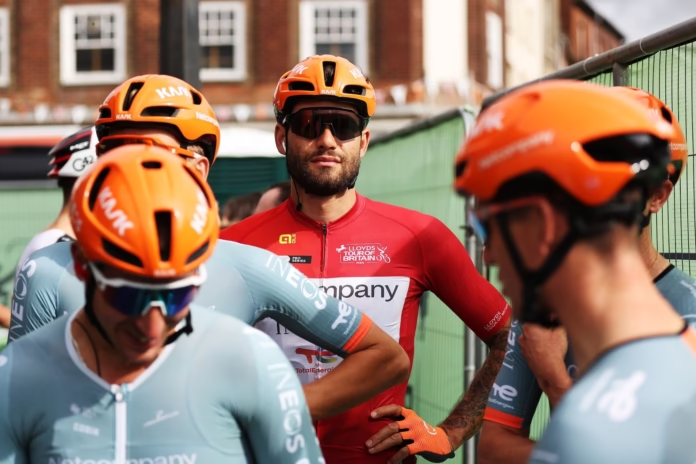
The 2026 Tour of Britain Men reaches East Yorkshire on Friday for a stage that should give the sprinters another opportunity, but the 194.1km route from Hull to Beverley is considerably harder to control than Thursday’s run into Skegness.
Stage 3 contains 1,612 metres of climbing, three categorised ascents through the Yorkshire Wolds and four passages of a 16km finishing circuit around Beverley. The final road rises towards Beverley Racecourse, changing the balance slightly away from the pure speed that decided Stage 2 and towards riders who can still sprint after almost 200km of repeated accelerations.
That immediately brings Olav Kooij into focus. The Dutchman finished second behind Tim Merlier in Skegness and already knows exactly how to win at Beverley Racecourse, having taken victory here during the 2023 Tour of Britain. Merlier remains the fastest rider in the field after an emphatic Stage 2 win, while Sam Bennett, Matteo Moschetti, Ethan Vernon and Sam Welsford all get another opportunity.
The general classification has also changed significantly. Lewis Askey still leads, but Thursday’s crosswinds and an unfortunately timed puncture cost Filippo Ganna 1:43. The Italian has dropped from second to tenth overall at 1:53, leaving Tim Wellens as Askey’s closest challenger at 12 seconds.
The wider GC battle and why small time gaps matter so much in this five-stage race are covered in our Tour of Britain Men 2026 preview.
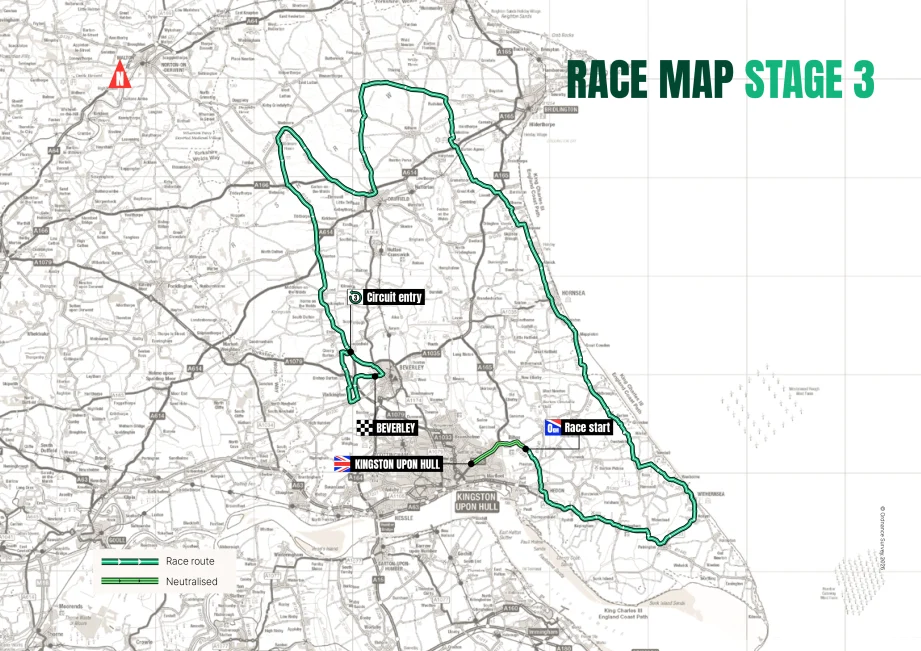
Tour of Britain Men Stage 3 at a glance
| Detail | Stage 3 |
|---|---|
| Date | Friday 4 September 2026 |
| Start | Hull |
| Finish | Beverley Racecourse |
| Distance | 194.1km |
| Elevation gain | 1,612m |
| Stage type | Rolling / sprint |
| Categorised climbs | 3 |
| Finishing circuit | 16km, four passages |
| Official race start | 10:45 BST |
| Fastest expected finish | Around 14:43 BST |
| Main favourites | Olav Kooij, Tim Merlier |
| Defending Beverley stage winner | Olav Kooij, 2023 |
The route starts in Hull’s East Park before heading east to the coast, travelling through Withernsea, Hornsea and Skipsea. From Burton Agnes it turns inland into the Yorkshire Wolds, where the three categorised climbs arrive before the race drops through Driffield and Wetwang towards Beverley.
Unlike Stage 2, the decisive part of Friday’s race is not simply a flat run towards the sea. The climbs, finishing circuit and rising final kilometre provide several places where teams can make the race uncomfortable before the sprinters take over.
Stage 2 showed that a flat profile does not guarantee a quiet race
Thursday’s Stage 2 from Boston to Skegness looked straightforward on paper and ended with the expected Merlier-Kooij sprint.
Almost everything between those two points was less predictable.
The peloton finally split in the crosswinds with around 60km remaining, and the timing could scarcely have been worse for Ganna. The Netcompany INEOS rider punctured as the race divided and needed a bike change just as the strongest teams accelerated at the front.
INEOS spent most of the remaining distance chasing, at one point reducing the deficit to less than 30 seconds, but UAE Team Emirates-XRG, Soudal Quick-Step, Decathlon CMA CGM and Tudor Pro Cycling Team all had reasons to keep the front group moving.
The gap eventually opened again.
Ganna crossed the line 1:43 behind the leading group, turning a nine-second GC deficit into 1:53 in the space of one flat stage.
It was exactly the danger highlighted in our Stage 2 live viewing guide: the terrain itself did not have to produce time gaps if the wind and positioning did it instead.
Stage 3 should reinforce the message. Nobody with GC ambitions can simply sit at the back and wait for Saturday’s harder terrain.
Merlier was comfortably the fastest in Skegness
Once Florian Vermeersch’s late attack had been caught with around 2km remaining, Stage 2 finally became the sprint everyone expected.
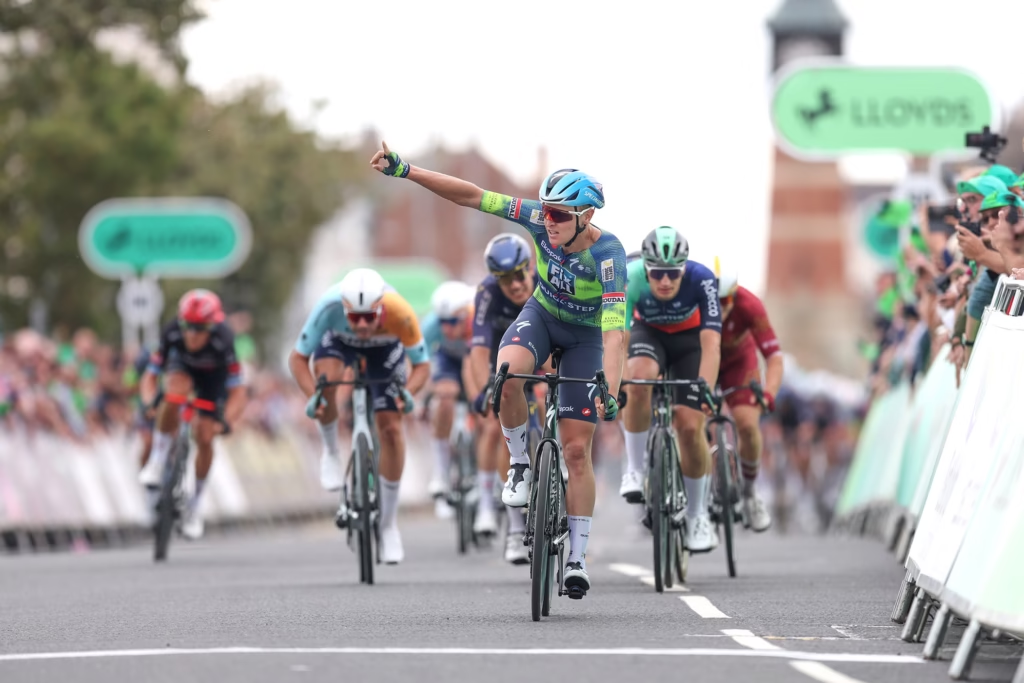
Tim Merlier won convincingly.
Jasper Stuyven helped Soudal Quick-Step control the closing kilometres, although Merlier was not delivered perfectly onto his teammate’s wheel. It hardly mattered. The Belgian launched from further back with around 200 metres remaining, surged through the field and opened a clear advantage.
Kooij finished second without ever really threatening to come past.
Sam Bennett took third for Pinarello Q36.5, followed by teammate Matteo Moschetti and Ethan Vernon.
The Stage 2 top five was:
| Position | Rider | Team |
|---|---|---|
| 1 | Tim Merlier | Soudal Quick-Step |
| 2 | Olav Kooij | Decathlon CMA CGM |
| 3 | Sam Bennett | Pinarello Q36.5 |
| 4 | Matteo Moschetti | Pinarello Q36.5 |
| 5 | Ethan Vernon | NSN Cycling Team |
Merlier therefore starts Stage 3 with the psychological advantage.
The question is whether Beverley gives Kooij enough additional difficulty to reverse the order.
Lewis Askey leads a very different GC after Stage 2
Askey did almost everything right on Thursday.
The Stage 1 winner in Lincoln stayed in the front group when the crosswinds split the race and safely negotiated the sprint finish, ensuring that Ganna’s misfortune strengthened rather than weakened his position.
The new GC is:
| Position | Rider | Team | Gap |
|---|---|---|---|
| 1 | Lewis Askey | NSN Cycling Team | Leader |
| 2 | Tim Wellens | UAE Team Emirates-XRG | +12s |
| 3 | Matteo Trentin | Tudor Pro Cycling Team | +19s |
| 4 | Daan Hoole | Decathlon CMA CGM | +21s |
| 5 | Jasper Stuyven | Soudal Quick-Step | +21s |
| 6 | Florian Vermeersch | UAE Team Emirates-XRG | +25s |
| 7 | Rick Pluimers | Tudor Pro Cycling Team | +33s |
| 8 | Elliot Rowe | Great Britain | +33s |
| 9 | Paul Wright | Modern Adventure Pro Cycling | +40s |
| 10 | Filippo Ganna | Netcompany INEOS | +1:53 |
Ganna has not mathematically disappeared from the race, particularly with Stage 4 still to come, but his situation has changed completely.
Instead of needing nine seconds, he now needs almost two minutes.
Wellens becomes the obvious immediate threat to Askey, while Trentin, Stuyven and Vermeersch are all close enough for bonus seconds and small splits to matter.
That makes Stage 3 more than a sprint stage.
Hull sends the race back towards the coast
The riders depart from East Park in Hull, with the racing beginning at approximately 10:45 BST.
The first part of the route heads east through Bilton towards Holderness before reaching the coast around Withernsea. From there, the race turns north and follows the East Yorkshire coastline through Hornsea and Skipsea.
This section is not especially difficult in terms of elevation, but Stage 2 provided a useful warning about exposed roads.
East Yorkshire offers plenty more of them.
The forecast is less severe than Thursday’s Lincolnshire wind, with overnight rain expected to clear during the morning and brighter conditions developing as the race progresses. Temperatures around 19-20°C should be comfortable, although a generally breezy day means the peloton will again have to pay attention whenever the road changes direction.
The roads could also remain damp early after overnight rain.
It is not a forecast that automatically screams echelons, but neither is it one that allows riders to switch off.
Burton Road starts the climbing sequence
The first categorised ascent comes once the race has turned inland from the coast.
Burton Road measures 3.3km at approximately 2.5%.
That is barely enough to trouble a professional peloton and should not remove any sprinter interested in the stage. Its value is mainly cumulative, beginning a much more rolling section after the flatter opening half.
For the breakaway, it also introduces another objective.
Three categorised climbs packed relatively close together mean riders interested in the mountains classification can collect useful points without needing to survive all the way to Beverley.
For the sprint teams, the priority is simply preventing the race becoming overly aggressive.
Decathlon and Soudal Quick-Step will want the break controlled rather than allowing a strong group of Classics riders to attack repeatedly through the Wolds.
Tire Ewe Hill is short enough to be raced hard
The second climb is Tire Ewe Hill, measuring approximately 1.1km at 5.1%.
This is still nowhere near difficult enough to drop Kooij or Merlier through gradient alone.
What it can do is encourage attacks.
A kilometre at around 5% is exactly the sort of terrain where a strong rouleur or puncheur can accelerate hard enough to force other teams into decisions. Nobody will win Stage 3 here, but riders can make the race much more expensive for the sprint trains.
That matters because Friday is almost 200km long.
Merlier survived Stage 2 comfortably, but doing repeated high-intensity efforts before an uphill sprint is different from sitting in a large group across the flat Lincolnshire roads.
Kooij generally benefits when the race becomes harder without becoming mountainous.
The more teams use the Wolds to raise the workload, the more the balance shifts towards him.
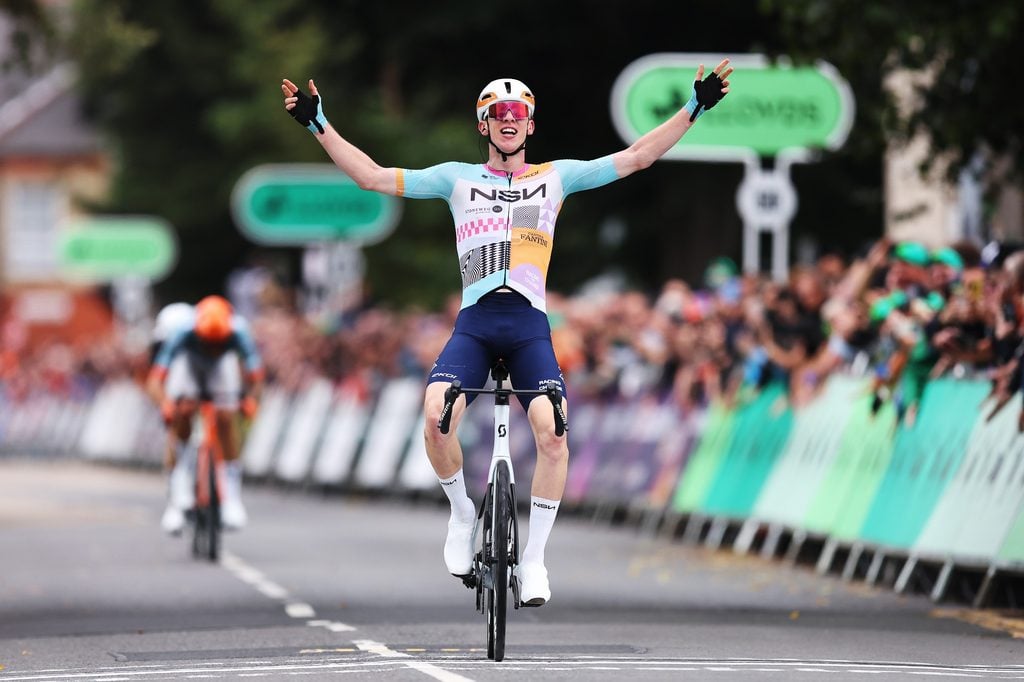 Photo Credit: Getty
Keepers Hill is the final classified chance to damage the sprinters
The third and final categorised climb is Keepers Hill, approximately 1.6km at 4.1%.
Again, the numbers are modest.
The combination is more important.
By this point the riders have accumulated the three climbs in relatively quick succession, and the stage is heading towards its final third. A team willing to ride hard can begin reducing the number of domestiques available to the sprint trains even if the favourites themselves remain comfortably attached.
After Keepers Hill, the route heads through Driffield before dropping towards Wetwang.
That descent and transition towards Beverley should allow some regrouping, which is why a bunch sprint remains the most likely outcome.
The climbs are tools for making the sprint harder rather than realistic launchpads for a 60km solo victory.
Four passages of Beverley change the character again
Once the race reaches Beverley, the riders enter a 16km finishing circuit, with four passages before the finish at Beverley Racecourse.
That matters because the peloton repeatedly sees the roads that will eventually decide the stage.
Teams learn where the corners tighten.
Lead-out riders see where positioning becomes difficult.
Attackers know exactly which sections give them a chance of opening a gap.
Unlike a simple point-to-point sprint, the circuit provides opportunities for stronger one-day riders to anticipate the final kilometre rather than accepting a direct contest with Merlier.
Stuyven and Trentin are obvious examples.
Neither wants to sprint against Merlier from a full peloton if another option exists.
Askey himself is another rider whose characteristics fit an aggressive final circuit. His priority is defending green, but an opportunity to pick up bonus seconds while other GC contenders hesitate would be difficult to ignore.
The finish at Beverley Racecourse is not completely flat
The final approach rises towards Beverley Racecourse.
It is not a climb in the normal sense, and pure sprinters have won here before, but the uphill drag changes the way the final 300 metres need to be ridden.
Starting too early becomes expensive.
A rider who normally launches at 250 metres may prefer to wait.
A sprinter with slightly better climbing durability can carry speed longer than somebody whose acceleration has already been blunted by the previous 190km.
This is precisely why Kooij becomes so interesting.
He has enough pure speed to beat most of the field but is generally at his most dangerous when the road has taken something away from the fastest specialists first.
Merlier showed on Thursday that nobody should assume he will be dropped simply because a stage contains more climbing.
Beverley at least gives his rivals a better chance.
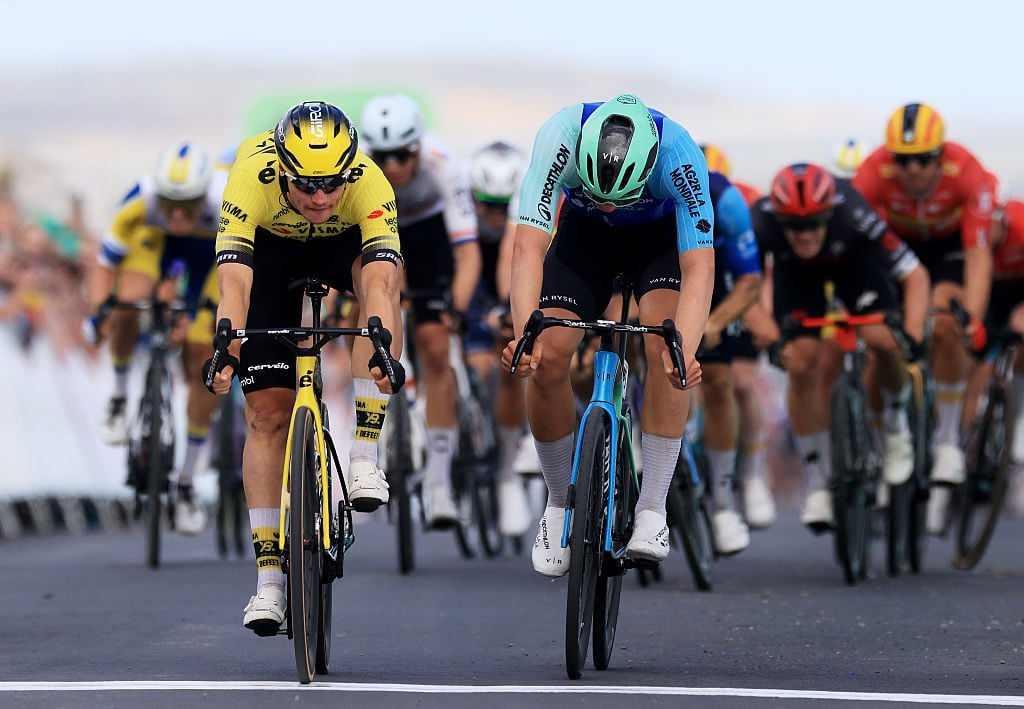
Kooij has already won at Beverley
There is another reason Kooij will start among the favourites.
He has done this before.
The Tour of Britain last finished at Beverley Racecourse in 2023, when Kooij won ahead of Danny van Poppel and Ethan Vernon.
It was his third consecutive victory of that edition and part of the remarkable Tour of Britain record that now stands at seven stage wins.
The course is not identical in every detail, but the finish is familiar and the demands are similar: survive a rolling day, stay positioned through Beverley and retain enough speed for the uphill drag to the line.
Kooij’s 2025 Tour of Britain began with another sprint victory in Southwold, and his history in Britain has become difficult to ignore whenever a stage even vaguely suits him.
He was clearly beaten by Merlier in Skegness.
Friday gives him a much better opportunity to answer.
Merlier remains the rider everyone has to beat
A slightly harder stage does not suddenly make Merlier an outsider.
Thursday showed the size of the problem facing everyone else.
He was not perfectly positioned, did not receive an immaculate lead-out and still won by a clear margin.
Soudal Quick-Step also have an excellent squad for keeping him alive through the Wolds. Stuyven, Dylan van Baarle, Pascal Eenkhoorn and Laurenz Rex can handle far harder terrain than anything on Stage 3.
That allows Merlier to conserve energy while teammates cover attacks.
The danger for Soudal is the GC.
Stuyven sits only 21 seconds behind Askey, giving the team another reason to be involved in an aggressive finale. A late move with Stuyven might be more useful to the overall race than sacrificing every rider to deliver Merlier.
The team have two good outcomes available.
That makes them harder to control.
Sam Bennett showed he still has the speed
Third place in Skegness was a good result for Sam Bennett.
The Irishman finished behind the two strongest pre-stage favourites but ahead of teammate Moschetti, Vernon and the rest of the reduced sprint field.
Beverley should be manageable for him.
Bennett has always been capable of surviving more climbing than his reputation as a pure sprinter sometimes suggests, and the uphill finish gives him an opportunity if Merlier and Kooij misjudge their effort.
Pinarello Q36.5 also have the advantage of Moschetti.
The Italian finished fourth on Stage 2, immediately behind Bennett, confirming that the team have two riders capable of being present in the final 500 metres.
The roles should become clearer by Beverley, but having both riders available offers useful insurance if one is badly positioned or caught behind a split.
Ethan Vernon gets a finish that should suit him better
Ethan Vernon took fifth in Skegness and now gets a more interesting finish.
The British rider does not need a completely flat road to sprint effectively, and the rising run towards Beverley Racecourse should suit his power.
NSN also have far more to think about than just the stage.
Askey leads the race, while Jake Stewart finished ninth on Stage 2 and gives the team another quick rider capable of surviving a harder finale.
That creates options.
If the final circuit is controlled, Vernon remains the sprint choice.
If Stuyven, Trentin or Vermeersch begins attacking and Askey follows, NSN do not need to sacrifice the race leader merely to bring everything back for Vernon.
That freedom could make the finale unusually tactical.

Welsford needs a cleaner day from INEOS
Sam Welsford finished 12th on Stage 2, but the headline for Netcompany INEOS was Ganna’s puncture rather than the sprint.
The team spent enormous energy trying to repair their GC problem after the crosswind split, leaving the sprint operation secondary.
Friday provides a reset for Welsford.
Ganna is now 1:53 down, meaning INEOS have less reason to control every movement around him in the first three stages. They can still race aggressively to try to recover time, but their original GC position has already been badly compromised.
Welsford should therefore get more support if the race reaches Beverley together.
The stage also carries extra significance for Ben Swift, who will retire at the end of 2026. Swift’s experience is valuable both for Welsford’s positioning and any attempt by INEOS to make the finishing circuit harder.
Trentin and Stuyven should not wait for the sprint
The most interesting riders on Stage 3 may be those who are quick but know they are unlikely to beat Merlier and Kooij directly.
Matteo Trentin is third overall at 19 seconds.
Jasper Stuyven is fifth at 21 seconds.
Both are excellent Classics riders.
Both can sprint.
Neither has much reason to accept a conventional bunch finish if an attack on the Beverley circuit offers another route.
Bonus seconds are especially important for Trentin. One intermediate sprint on Stage 2 was enough to improve his GC position, and the absence of a time trial means every second collected before Saturday counts.
Stuyven’s situation is similarly interesting because Soudal have Merlier.
If Stuyven attacks and forces NSN or UAE to chase, Merlier gets a free ride behind.
If nobody chases, Stuyven becomes a GC threat.
It is exactly the sort of two-pronged strategy a team wants on a finishing circuit.
Florian Vermeersch may try again
Florian Vermeersch has already attacked late on both opening stages.
It nearly worked in Lincoln.
It kept Stage 2 alive until around 2km from the finish.
There is little reason to expect UAE to suddenly tell him to stop.
Vermeersch sits sixth overall at 25 seconds, while Wellens is second at 12. UAE therefore have two riders who can put Askey under pressure without asking Benoît Cosnefroy or Felix Großschartner to become involved.
The team were among the strongest drivers of the Stage 2 crosswind split even without a specialist sprinter to race for.
Friday gives them even more reason to attack.
Wellens can target the overall.
Vermeersch can go from distance.
Other teams then have to decide which threat matters more.
Ganna now needs to gamble
Ganna’s puncture has changed his entire Tour of Britain.
After Lincoln, he was nine seconds from the race lead and looked like one of the strongest overall favourites.
After Skegness, he is 1:53 behind.
There is no time trial waiting later in the race to repair that damage.
Simply following Askey and Wellens through Beverley achieves nothing.
Netcompany INEOS now need to find opportunities rather than avoid risks, and Stage 3 may provide one before the much harder Yorkshire stage on Saturday.
Ganna attacking from distance on the finishing circuit would force NSN to work.
Nobody wants to tow a rider of his power back once he has established a gap on rolling roads.
His GC deficit is large enough that Askey may not immediately respond personally, but small enough that NSN cannot give him several minutes.
That makes Ganna more tactically dangerous even as his chances of actually winning the Tour have fallen sharply.

The weather looks less threatening than Stage 2
Friday morning should begin wet around Hull and Beverley after overnight rain, but the current forecast has conditions improving before and during the stage.
Light rain is expected to clear during the morning, with cloud and sunny intervals following and temperatures reaching around 19-21°C.
The more important detail is that it should remain breezy.
Stage 2 proved how quickly an apparently routine race can change once the peloton begins riding across an exposed landscape. Friday again spends substantial time close to the coast before travelling through open East Yorkshire countryside.
The wind is not currently expected to be as central to the stage as it was in Skegness.
After what happened to Ganna, nobody will take that for granted.
How Stage 3 is likely to unfold
A conventional early break should have a reasonable opportunity to establish itself once the race leaves Hull.
NSN have the leader’s jersey but little reason to control the entire 194km themselves. Soudal Quick-Step and Decathlon CMA CGM have the two main sprint favourites and should eventually contribute to the chase, although neither needs to bring a harmless escape back too early.
The coastline provides the first tactical danger.
If the wind is strong enough, the GC teams will move forward and the race could become nervous long before the Wolds. After Thursday, Ganna’s rivals have seen exactly how much can be gained from one badly timed mechanical or positioning mistake.
The three categorised climbs should then increase the pace rather than eliminate the sprinters outright. Tire Ewe Hill and Keepers Hill are short enough to invite attacks, but there is sufficient road afterwards for regrouping.
Beverley is where the final argument begins.
Decathlon will want a sprint for Kooij.
Soudal can choose between Merlier and Stuyven.
UAE have every incentive to send Vermeersch forward while Wellens watches Askey.
Tudor can use Trentin or Pluimers.
INEOS now need to make something happen with Ganna rather than simply follow.
NSN have to defend green while still giving Vernon a chance.
That is why Stage 3 should be more interesting than its likely result suggests.
A sprint remains the most probable outcome, and Kooij versus Merlier is again the obvious headline. But reaching that sprint requires surviving almost 200km, three climbs, potentially exposed coastal roads and four passages around a circuit containing several riders who would rather attack than wait.
Kooij has already shown he knows how to win at Beverley Racecourse.
Merlier has just shown that even imperfect positioning may not be enough to stop him.
Friday determines which of those two facts matters more.

