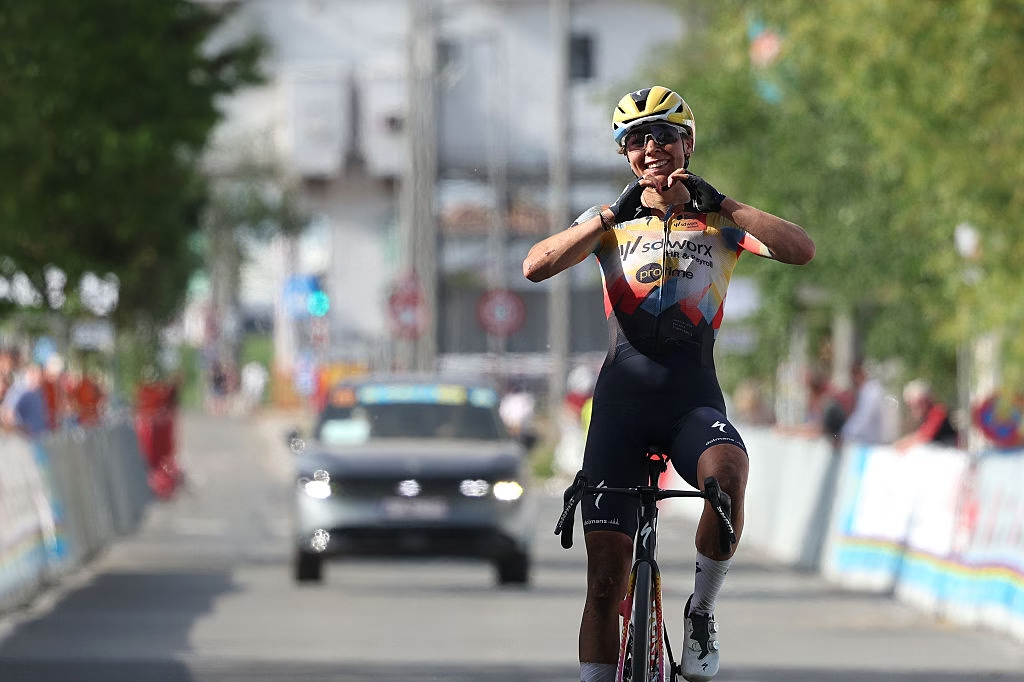
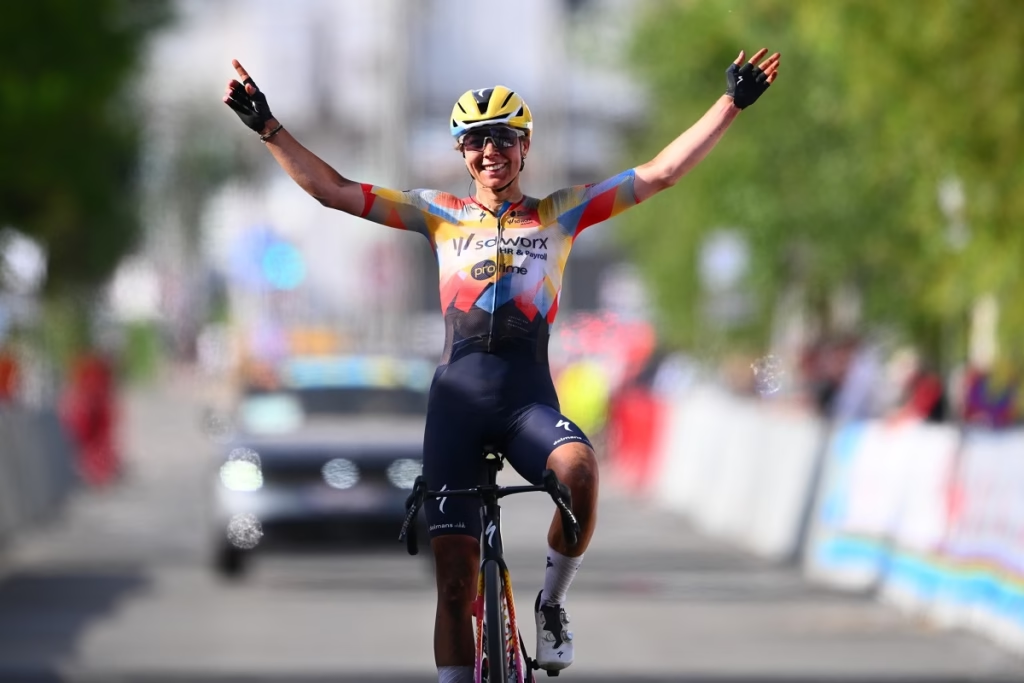
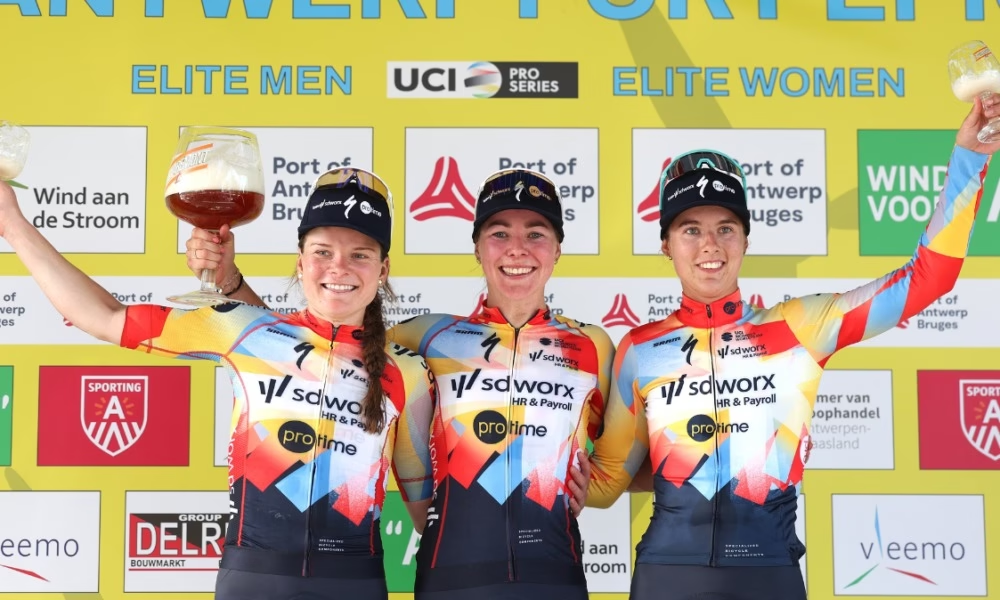
Antwerp Port Epic Ladies 2026 did not just produce a strong winner. It produced one of those results that says something about the direction of the race, the strength of SD Worx-Protime and the kind of rider this event now rewards. Femke Markus won alone after repeated attacks, while Marta Lach and Femke Gerritse completed a full SD Worx-Protime podium sweep.
That made the result striking, but the way it happened mattered even more. This was not a simple case of the strongest team controlling a flat race and setting up a sprint. Antwerp Port Epic Ladies again proved that its profile is misleading. The combination of gravel, cobbles, exposed roads, heat, crashes and repeated changes of rhythm turned it into a selective race where strength, positioning and timing all carried equal weight.
For a race that is still relatively young, Antwerp Port Epic Ladies already has a recognisable personality. It is not trying to be Tour of Flanders Women, Paris-Roubaix Femmes or another traditional Flemish semi-Classic. Its appeal is more industrial, more exposed and more attritional. The 2026 edition reinforced that identity clearly.
SD Worx-Protime still know how to turn depth into dominance
The headline lesson is obvious: SD Worx-Protime had the strongest collective race by a distance. A podium sweep at this level is never accidental, especially in a race that was so difficult to control. Markus won solo, Lach finished second, and Gerritse made it three riders from the same team in the top three.
The result worked because SD Worx-Protime were not dependent on one scenario. Markus was able to attack, be brought back, go again and still have enough strength to make the decisive move stick. Lach and Gerritse then gave the team the perfect safety net behind. Once Markus had gone clear, rivals had the awkward problem of chasing one SD Worx-Protime rider while two more waited in the group behind.
That is the kind of tactical advantage that only works when the legs are there. A numerical advantage is useful, but it only becomes decisive when the riders in that position are strong enough to use it. Antwerp showed that SD Worx-Protime’s depth is not just about star names. It is also about having riders who can take ownership of hard races when the opportunity appears.
Femke Markus is becoming a more convincing one-day threat
Markus’s victory was the most important individual statement of the day. She has long looked like a rider suited to demanding northern races, with the physical strength, positioning sense and stubbornness needed for days where the surface and weather do as much damage as the climbs.
Her Antwerp win was particularly impressive because it was not built on one perfectly timed late attack alone. She had already been active earlier in the race, first in a move with Anneke Dijkstra and then again as part of another dangerous selection. By the time she launched the winning attack, the race had already demanded repeated efforts.
That matters. Some riders can make one clean move when everything has been saved for the final. Fewer can keep trying on a course that punishes each acceleration. Markus winning after multiple attacks made the performance feel more substantial. It was not opportunism. It was pressure applied until the race finally cracked.
Her move with around 26km remaining also showed confidence. On a flatter course, that is a long way from home. On this course, with rough sectors, exposed roads and tired legs behind, it became a distance where commitment could outweigh hesitation. Markus understood that better than the riders forced into the chase.
The race is no longer just a sprint alternative
Antwerp Port Epic Ladies can look, at first glance, like a race for fast finishers who can handle rough roads. That is still partly true. Previous editions have shown that a sprint from a reduced group is possible, and the race will always interest riders with speed after a hard day.
But 2026 showed that it is becoming more than a sprint alternative. The winning move came from an aggressive rider who used the route to make separation, not from a sprinter surviving to the final 200 metres. That distinction is important for how teams should approach this race in future.
A rider who waits too long may find that the winning move has already gone. A team that treats the event as a straightforward reduced sprint may spend too much time reacting rather than shaping the day. The combination of gravel, cobbles and port roads gives attackers repeated chances to force mistakes, especially once fatigue and heat start to build.
That makes Antwerp Port Epic Ladies tactically interesting. It can still end in a sprint, but it does not have to. The 2026 edition strengthened the argument that the race favours riders with a Classics engine first and a sprint second, rather than the other way round.
The rough sectors are doing exactly what the race needs
The defining feature of Antwerp Port Epic Ladies is not elevation. It is interruption. The race constantly breaks rhythm through rough roads, cobbled sections, gravel sectors, exposed port stretches and technical changes of direction. That makes it harder than the profile suggests.
In 2026, those sectors again had the desired effect. They forced splits, encouraged attacks and made chasing complicated. When a rider went clear, the group behind could not simply organise a smooth pursuit on wide, predictable roads. The route kept changing the calculation.
This is where Antwerp has found its identity. The race does not need a famous climb to be selective. It has built difficulty through surface, exposure and repetition. That gives it a different flavour from many Belgian one-day races, and it helps explain why the strongest team did not merely win, but dominated.
For more on the race’s character, ProCyclingUK’s Antwerp Port Epic Ladies 2026 route guide explains why the flat profile is only a small part of the story.
Heat changed the feel of the race
The weather also played a role. Antwerp Port Epic Ladies has often carried a reputation for rough, exposed and weather-affected racing, but 2026 was shaped more by heat than classic Belgian gloom. That changed the physical demands of the day.
Heat makes repeated accelerations more expensive. It also makes concentration harder, especially on a course where positioning, surface changes and road furniture already keep riders under pressure. A crash or a missed split can become much harder to recover from when the body is already operating under thermal stress.
That may partly explain why the race became so selective and why the repeated attacks from Markus were so damaging. It was not just about one rider being stronger. It was about one rider still being able to produce meaningful efforts when others were already paying for the day’s accumulated load.
Positioning remains the hidden battle in this race
Like many rough-road races, Antwerp Port Epic Ladies is partly decided before the obvious decisive moment. The winning attack is easy to see. The work needed to stay near the front before each rough sector is less visible, but just as important.
In a race like this, the cost of being poorly positioned is constant. A rider at the back has to brake more, accelerate more, avoid more danger and spend more energy closing gaps. Over one sector, that may be manageable. Over a long sequence of sectors, it becomes a serious disadvantage.
SD Worx-Protime were able to race from the right part of the peloton. That gave their riders more control over when to follow, when to attack and when to sit on. Other teams were often forced into reaction. That difference matters enormously in a race where the route offers so little time to reset.
The attacking depth made the SD Worx-Protime sweep more impressive
The dominance of SD Worx-Protime should not obscure the fact that the race had several important phases before Markus finally got away. Christina Schweinberger was part of one of the dangerous moves, while Anneke Dijkstra had already shown willingness to race aggressively earlier in the day.
That matters because the podium sweep did not come from a race that collapsed immediately into one team’s control. There were attacks, regroupings, crashes and changes of momentum before the final shape became clear. Markus had to keep racing through those phases rather than wait for a pre-arranged final.
That makes the result stronger. SD Worx-Protime did not simply arrive with the best numbers in the final group. They survived the disorder, placed riders in the correct moves, and then used their strength once the race had already done damage.
The race’s 1.Pro status feels right
Antwerp Port Epic Ladies sits at UCI 1.Pro level, and the 2026 edition showed why that status fits. It is not yet a Women’s WorldTour race, but it has enough sporting weight, route identity and quality of field to feel like more than a standard one-day event.
That middle ground can be valuable. Not every important race needs immediate WorldTour status, and not every strong one-day event needs to chase the same profile. Antwerp’s role is becoming clearer: a tough, distinctive late-spring race where strong teams can test rough-road depth and aggressive riders can take a major result.
Its history is still short, but the winners list is already useful. Marthe Truyen won the first edition in 2023, Lara Gillespie won in 2024, Susanne Andersen took the 2025 race, and Markus has now added SD Worx-Protime to the roll of honour. That is a varied set of winners, but all make sense for a race that rewards strength, speed and resilience in different proportions.
ProCyclingUK’s brief history of Antwerp Port Epic Ladies looks at how the race has developed since its first edition and why it has already built a clear niche on the women’s calendar.
What does it mean for the rest of the season?
For Markus, this is a result that should carry beyond Antwerp. A solo win in a ProSeries one-day race, especially one built on repeated attacks, gives her a stronger case as a protected option in similar races. It also adds another layer to SD Worx-Protime’s options in rougher terrain.
For Lach and Gerritse, the podium places matter too. Both showed that they could survive the race’s hardest phases and still be there when the decisive group formed behind. In a team as competitive as SD Worx-Protime, those results are important currency.
For the rest of the peloton, the lesson is more tactical than emotional. Antwerp Port Epic Ladies cannot be raced passively against a team with that much depth. Once SD Worx-Protime had multiple riders in the front group, the race became extremely difficult to manage. Future rivals may need to make the race harder earlier, isolate them sooner or commit more decisively when dangerous moves begin.
Antwerp Port Epic Ladies 2026 verdict
Antwerp Port Epic Ladies 2026 confirmed the race’s growing value on the women’s calendar. It gave a clear winner, a dominant team performance and a tactical pattern that made sense of the route. Markus won because she was strong enough to keep attacking, brave enough to go from distance and backed by a team that gave her the perfect situation behind.
The bigger lesson is that Antwerp Port Epic Ladies has become a race with its own language. It is flat but not easy, fast but not predictable, rough without being a copy of anything else. In 2026, SD Worx-Protime mastered that language better than anyone.
Antwerp Port Epic Ladies 2026 result
Results powered by FirstCycling.com