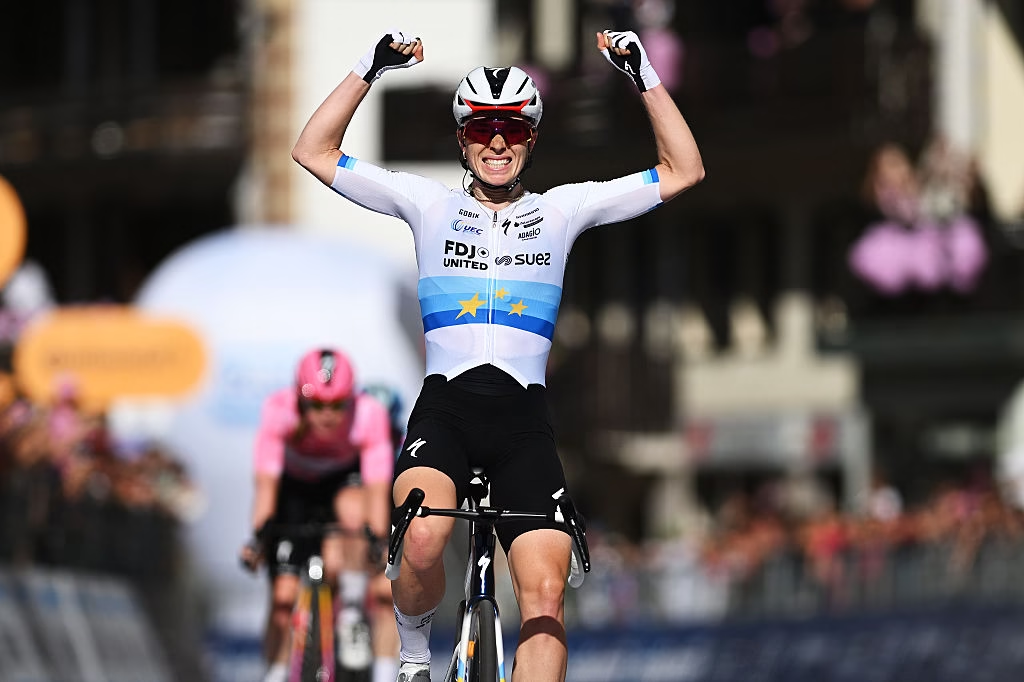
Demi Vollering took her first victory of the 2026 Giro d’Italia Women on stage 5, winning a four-rider sprint in Santo Stefano di Cadore after a relentlessly tactical day in the Dolomites. The FDJ United-SUEZ rider beat maglia rosa Anna van der Breggen, Antonia Niedermaier and Isabella Holmgren after a stage that repeatedly split, reformed and shifted pressure between the leading GC contenders.
Table of Contents
ToggleVan der Breggen finished second and retained the overall lead, but Vollering’s stage win and 10 bonus seconds reduced the gap at the top of the general classification to 1 minute. Niedermaier continued her impressive Giro with third on the stage and remains third overall, while Holmgren confirmed her growing GC status with fourth on the day, 2 seconds behind the leading trio.
The 146-kilometre stage from Longarone to Santo Stefano di Cadore was the first true mountain road stage of this Giro, with 3,200 metres of elevation gain and very little recovery. The route packed in the Passo Tre Croci, Passo di Sant’Antonio and two ascents of Costa, creating a stage that was hard enough for major GC action but open enough for tactical uncertainty.
Early pressure before a dangerous break goes clear
The stage began in Longarone, a town with deep Giro history and a tragic past linked to the Vajont Dam disaster of 1963. Once the flag dropped, attacks started almost immediately. The opening unclassified climb to Pieve di Cadore, 5 kilometres at 5.4 per cent, did not immediately produce a decisive move, but it helped soften the race before the long road towards the first-category Passo Tre Croci.
For the opening 25 kilometres, the race remained largely together despite repeated accelerations. Team Visma | Lease a Bike were visible at the front early, with Marion Bunel among their options for a big climbing day. SD Worx-Protime, meanwhile, had a more complicated task. Van der Breggen was in pink after her dominant Nevegal time trial, but the team had started the stage weakened after losing riders earlier in the race.
The decisive early move finally formed after the unclassified opening section, and it was not a harmless break. Around 30 riders went clear, including several placed close enough overall to change the shape of the race. Lauren Dickson was the most dangerous name, having started the day sixth overall at 1:38. With the FDJ United-SUEZ rider up the road, Vollering’s team had placed immediate pressure on Van der Breggen and SD Worx-Protime.
There was also a useful counterweight for SD Worx-Protime in the same move, with Valentina Cavallar present. She began the day 14th overall at 2:53, giving Van der Breggen’s team an option in the front group and creating a tactical stand-off. FDJ had Dickson up the road, SD Worx-Protime had Cavallar, and the maglia rosa group had to decide how much responsibility it wanted to take.
Breakaway becomes a serious GC threat on Tre Croci
By the time the race reached the Passo Tre Croci, the break had become a genuine GC factor. The climb was 8 kilometres at 7.3 per cent, rising above 1,800 metres, and the front group contained a string of riders who were close enough overall to matter. Alongside Dickson and Cavallar, the group included Nadia Gontova, Cecilie Uttrup Ludwig, Mie Bjørndal Ottestad, Mireia Benito, Viktória Chladoňová, Maya Kingma and Emilie Morier, all within 5 minutes of Van der Breggen before the stage.
That forced the chase to become more serious. SD Worx-Protime and Movistar worked in the maglia rosa group, with Marlen Reusser sitting second overall at the start of the day and needing her own team to keep the race under control. The gap, which had approached 5 minutes, began to fall on the climb.
Caroline Andersson took maximum points at the top of the Passo Tre Croci, while the Van der Breggen group remained more than 3 minutes behind. The long descent that followed gave the break some breathing room, but the stage was only beginning. With the Passo di Sant’Antonio still to come, the early GC threat from the break remained very real.
FDJ use Dickson as Vollering attacks behind
The Passo di Sant’Antonio, 7.5 kilometres at 8.4 per cent, became the stage’s first major flashpoint. Amber Kraak returned to the bunch and began working for FDJ United-SUEZ before the climb, and Eva van Agt then took over in the favourites’ group as the gap to the break began to fall.
At the front, Dickson was doing a huge amount of work in the breakaway, but FDJ were also racing from behind through Vollering. That dual strategy repeatedly stretched the race. Célia Gery was sent off the front of the favourites’ group, then Reusser launched a powerful move. Vollering bridged to her, while Van der Breggen was briefly distanced before Longo Borghini helped bring her back.
The favourites’ group shrank rapidly. Dickson, Cavallar, Benito, Gontova and Bunel emerged as the strongest riders at the head of the race, while behind, Vollering continued to test the group. Longo Borghini struggled with the repeated changes of pace, while Reusser also spent energy trying to create separation.
Dickson took maximum mountain points over the Passo di Sant’Antonio and the break led by 1:27 onto the technical descent. The stage was now fully alive, with the front group splintering, the favourites closing, and several GC riders already showing signs of pressure.
Costa climb creates repeated GC splits
The race reached the first ascent of Costa with the break beginning to fracture. The climb, 4.3 kilometres at 8.6 per cent, was tackled twice on the finishing loop and became the main arena for the GC battle. Trinca Colonel attacked as the favourites approached, trying to bridge towards the front, while Nadia Gontova continued to ride strongly after spending the day in the move.
Vollering made one of the most important attacks on the climb. Her acceleration split the group, with Longo Borghini and Holmgren among those briefly distanced. Dickson then dropped back from the break to work for Vollering, immediately lifting the pace and putting Van der Breggen and Reusser into difficulty.
Van der Breggen managed to return, but the race had become unstable. Reusser was dropped or forced into energy conservation, Longo Borghini fought to regain contact, and the front group kept changing shape as riders from the break were caught and absorbed.
Vollering continued to press over the top, but she could not shake the core GC group. Van der Breggen, Niedermaier, Holmgren, Cavallar and others remained close enough, while Longo Borghini used her descending skills to regain contact after being distanced. Reusser, however, lost more ground, and her podium position was beginning to look vulnerable.
Trinca Colonel attacks before final Costa ascent
On the descent after the first Costa climb, Trinca Colonel attacked again and opened a useful gap. The Liv AlUla Jayco rider had started the day fifth overall, 1:31 behind Van der Breggen, so her move could not be ignored. Van der Breggen was forced to lead the chase, with Longo Borghini, Vollering, Niedermaier and Holmgren on her wheel.
For a short period, Trinca Colonel’s advantage stretched to more than 30 seconds as the chase behind hesitated. Lore De Schepper also attacked for AG Insurance-Soudal, but Valentina Cavallar responded and helped bring the move back. Once again, Dickson returned to the front to work for Vollering, underlining her importance to FDJ’s race plan.
The second ascent of Costa finally formed the decisive selection. Trinca Colonel began the climb with a gap, but Vollering accelerated on the steep lower ramps. Niedermaier, Holmgren and Van der Breggen were the only riders able to follow, while Longo Borghini and Fisher-Black were left chasing behind.
Trinca Colonel was caught and dropped, leaving four riders at the front: Vollering, Van der Breggen, Niedermaier and Holmgren. Longo Borghini and Fisher-Black hovered behind at around 20 to 40 seconds, while Reusser’s group was further back and losing ground.
Four riders go clear before downhill finish
Van der Breggen took control near the top of the final Costa climb, riding out of the saddle and marking the group. Niedermaier looked composed and strong, while Vollering kept trying to lift the pace without quite producing the punch needed to drop the others.
Van der Breggen took maximum points at the top of the final climb, with Vollering, Niedermaier and Holmgren on her wheel. Longo Borghini and Fisher-Black were 43 seconds behind, while Reusser’s group crossed around a minute down. With 16.3 kilometres still to race from the summit, the stage was not yet decided, but the front quartet had the strongest tactical position.
The road over the top included a plateau and a small additional rise before the descent towards Santo Stefano di Cadore. Vollering led over the small climb with around 10 kilometres to go, and from there the final 5 kilometres ran mostly downhill along the Piave Valley. Van der Breggen descended strongly and briefly gapped the others on the steeper slopes, but the group came back together.
Longo Borghini and Fisher-Black chased behind, but they could not close the gap. Reusser, after starting the day second overall, was more than a minute back in the closing kilometres and set to lose ground in the general classification.
Vollering wins the four-up sprint
Inside the final 3 kilometres, Niedermaier tried to lift the pace, but the front group remained together. Holmgren also tried her luck, but the Canadian could not get clear. That left the stage to a four-rider sprint, with Vollering the clear favourite if she still trusted her finish after a day full of attacks.
Niedermaier tried again inside the final kilometre and ended up leading into the last 500 metres, with Van der Breggen on her wheel. Holmgren went long, but Vollering waited and then opened her sprint decisively. Once she launched, there was little doubt. She crossed the line first in 4:23:47, taking the stage and 10 bonus seconds.
Van der Breggen finished second, taking 6 bonus seconds and limiting the damage in the general classification. Niedermaier was third, confirming her place among the strongest riders in the race, while Holmgren finished fourth at 2 seconds.
Longo Borghini was fifth at 15 seconds, with Fisher-Black sixth on the same time. Reusser finished seventh at 53 seconds alongside Magdeleine Vallieres and Femke de Vries, while Lore De Schepper completed the top 10 at 56 seconds.
Van der Breggen stays in pink as Vollering closes in
Van der Breggen retained the maglia rosa, but the overall race tightened behind her. Vollering moved to 1 minute down after her stage win and bonus seconds, while Niedermaier sits third at 1:24. Holmgren climbed to fourth overall at 2:01, just ahead of Reusser at 2:03, with Longo Borghini sixth at 2:12.
The day was a setback for Reusser, who had begun the stage second overall but struggled when the repeated climbing accelerations and tactical surges came. Longo Borghini also had moments of difficulty, particularly when Vollering’s attacks split the group, but she limited the loss well enough to remain in the GC picture.
For Vollering, the victory was important in more than one way. She had not quite looked at her sharpest over the opening days, but she was never close to being dropped and still had the sprint to finish the job after a brutal mountain stage. FDJ United-SUEZ also produced one of the defining team rides of the race so far, with Kraak, Van Agt and especially Dickson helping to shape the stage from multiple positions.
Van der Breggen still holds the advantage, but the Giro now has a different feel. Her Nevegal time trial created the gap, yet stage 5 showed that Vollering, Niedermaier, Holmgren and others can keep applying pressure across harder road stages. The Dolomites did not decide the race outright, but they made the hierarchy far more dynamic.
Giro d’Italia Women 2026 stage 5 result
Results powered by FirstCycling.com
Main photo credit: Getty