Anyone joining Tour de France stage 10 during its final hour will quickly hear three names repeated: Puy Mary, Col de Pertus and Le Lioran.
They describe a sequence rather than three separate summit climbs.
Puy Mary is where the race can begin to fracture. Col de Pertus is the shorter and steeper opportunity to create a decisive gap. The Col de Font de Cère then carries the survivors towards Le Lioran, but the finish itself is not at the top of a major mountain.
The Tour de France 2026 stage 10 preview covers a 166.6km route from Aurillac to Le Lioran with approximately 3,800 metres of climbing. The seven categorised ascents are concentrated heavily into the second half, with Puy Mary crested 30.9km from the finish, the Col de Pertus at 14.5km and the Col de Font de Cère only 2.7km from the line.
Understanding that final sequence explains why the stage can produce two races at once. The breakaway may still be fighting for victory while Tadej Pogačar, Jonas Vingegaard and the other general classification riders begin attacking behind.
Tour de France stage 10 final climbs
| Climb | Official distance | Average gradient | Category | Distance remaining at summit |
|---|---|---|---|---|
| Puy Mary-Pas de Peyrol | 7.8km | 6% | Category 1 | 30.9km |
| Col de Pertus | 4.4km | 8.5% | Category 1 | 14.5km |
| Col de Font de Cère | 3.1km | 5.8% | Category 3 | 2.7km |
| Le Lioran finish | Final rise after a short descent | Around 6% in the closing metres | Finish | 0km |
The official numbers make the Col de Pertus look like the hardest individual climb, but the way the roads connect is more important than any one gradient.
Puy Mary comes after more than 130km of repeated climbing and descending. Pertus arrives before riders have properly recovered. Font de Cère then prevents anyone from settling into a straightforward chase before the finish.
The complete sequence, including the earlier climbs and official timings, is available on the Tour de France stage 10 route page.
Why Puy Mary and Pas de Peyrol are both used
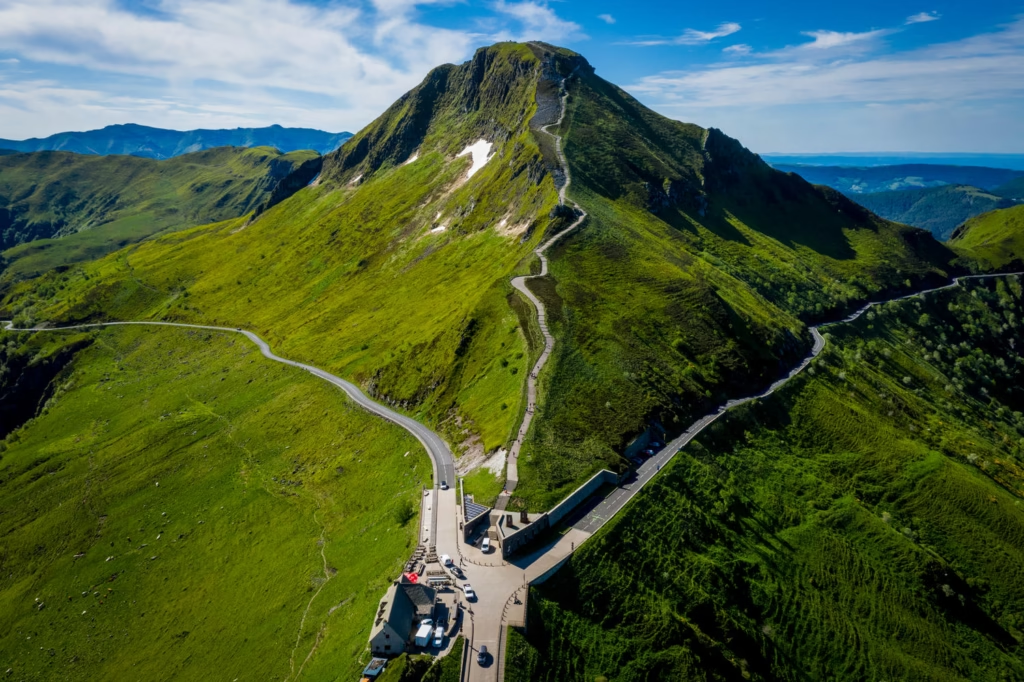
Puy Mary is the recognisable volcanic peak that dominates the landscape, but the road does not climb to its 1,783-metre summit.
Instead, the Tour crosses the Pas de Peyrol, the road pass beneath the peak at an altitude of 1,589 metres. The official race name combines the two as Puy Mary-Pas de Peyrol, which is why television commentators may alternate between them.
A footpath continues from the pass towards the summit of Puy Mary, while the race turns onto the descent towards the Jordanne valley. For the purposes of following the stage, Puy Mary and Pas de Peyrol refer to the same decisive point on the route.
The climb has also become one of the most recognisable features of the Tour’s visits to the Massif Central. The wider importance of this terrain is covered in the Tour de France 2026 Massif Central guide.
Puy Mary is where the final hour begins
Puy Mary is the first of the two late category-one climbs. It measures 7.8km at an average of 6%, with the summit coming after 135.7km and 30.9km before Le Lioran.
Those figures do not make it look overwhelming. The average gradient is lower than the Col de Pertus, while the 2026 approach is less severe than some of the other roads leading towards the pass.
Its importance comes from its position.
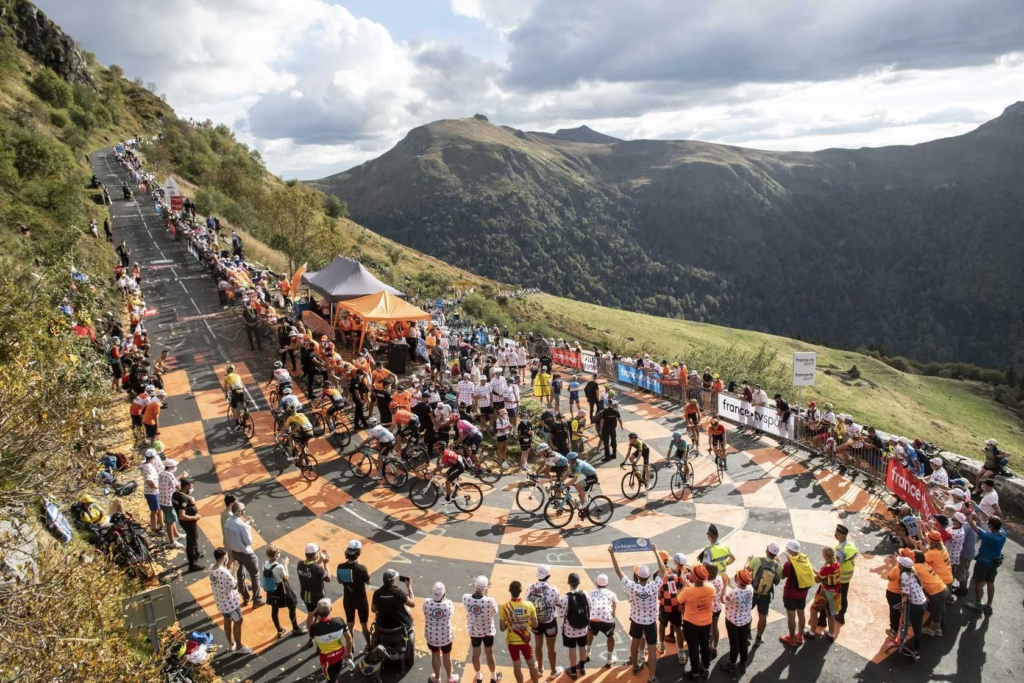
Before reaching Puy Mary, the riders have already crossed the Côte de Pailherols, Col de la Griffoul, Col de Prat de Bouc and Côte de Murat. None is likely to decide the general classification alone, but together they remove the easy kilometres from the stage.
Domestiques who looked comfortable earlier in the day may begin disappearing on Puy Mary. Breakaway riders who have spent several hours fighting for position may discover they no longer have the power to respond. General classification teams can increase the pace without asking their leader to attack immediately.
Puy Mary is therefore less likely to create the final gap than to establish the conditions for one.
 Photo Credit: A.S.O./Pauline Ballet
Watch the number of team-mates, not only the attacks
The most useful thing to watch on Puy Mary is not necessarily who attacks first. It is which leaders still have support.
If UAE Team Emirates-XRG reaches the steeper part of the climb with several riders around Pogačar, Visma-Lease a Bike may struggle to create tactical uncertainty. If the yellow jersey becomes isolated, Vingegaard has greater freedom to accelerate, slow down and then attack again.
The same applies further down the standings. Riders defending podium positions can lose control of the situation before they are physically dropped if their domestiques disappear early.
A hard but controlled pace can therefore be more damaging than an immediate attack. It prevents riders from eating and drinking comfortably, stretches the group and forces weaker climbers to fight continuously for position.
By the summit, the GC group may still contain 15 or 20 riders. That does not mean Puy Mary has failed to make a difference. The damage may only become visible on the descent or the Col de Pertus.
The descent can widen or erase the first gaps
The summit of Puy Mary comes with 30.9km remaining, leaving too much road for a small climbing advantage to guarantee success.
The descent initially passes the Col de Redondet before continuing towards Mandailles-Saint-Julien. The riders then reach the foot of the Col de Pertus with approximately 19km remaining.
An attacker has several ways to increase an advantage. A strong descender can extend the gap, while a leader with a team-mate waiting from the breakaway may gain valuable assistance before Pertus.
The opposite is also possible. A rider who attacks near the top of Puy Mary may spend considerable energy on the descent and approach the next climb with only a narrow advantage. A reduced chasing group can recover ground if several teams cooperate.
That is what makes the final hour difficult to control. A gap can look decisive on one road and almost disappear on the next.
Col de Pertus is the more explosive climb
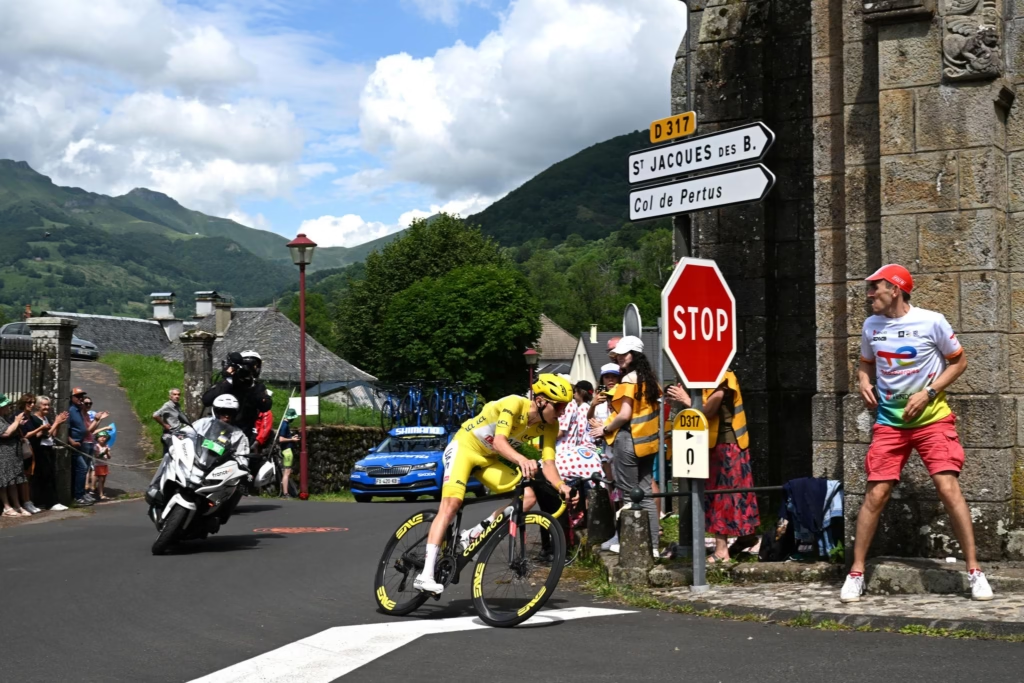
The Col de Pertus is where the race becomes more direct.
It is only 4.4km long, but its average gradient of 8.5% makes it significantly steeper than Puy Mary. The summit comes after 152.1km, leaving just 14.5km to the finish.
A climb of this length rewards acceleration. There is less reason to conserve energy for a long, steady effort because the steeper section can be completed relatively quickly.
It also arrives after the previous selection has already been made. Riders dropped on Puy Mary may return during the descent, but they will have spent energy doing so. Others may still be in the leading group while already riding close to their limit.
That makes Pertus ideal for a second attack. The first acceleration can remove the remaining domestiques, while the next creates the separation between the leaders.
The climb is not long enough to guarantee enormous gaps, but it is perfectly positioned to expose anyone who has overreached earlier in the stage.
Why the gradient suits explosive attacks
The Col de Pertus should suit riders capable of producing a sharp acceleration and then maintaining high power for several minutes.
There is enough gradient to create separation immediately. The climb is also short enough for a contender to commit heavily without facing another 20 minutes of climbing before the summit.
That does not automatically make it a Pogačar climb. Vingegaard has already shown how effectively he can manage his effort on the same road, particularly when another rider attacks too early.
The tactical question is how the leading contenders reach Pertus.
If Pogačar begins the climb with team-mates and Vingegaard isolated, UAE can control the opening kilometres before its leader attacks. If Visma has weakened the yellow jersey’s support on Puy Mary, Vingegaard can create a less predictable sequence of moves.
The Col de Pertus rewards explosive power, but the previous 150km determine how that power can be used.
Stage 10 is therefore one of the more intriguing days included in the best Tour de France 2026 stages for GC attacks.
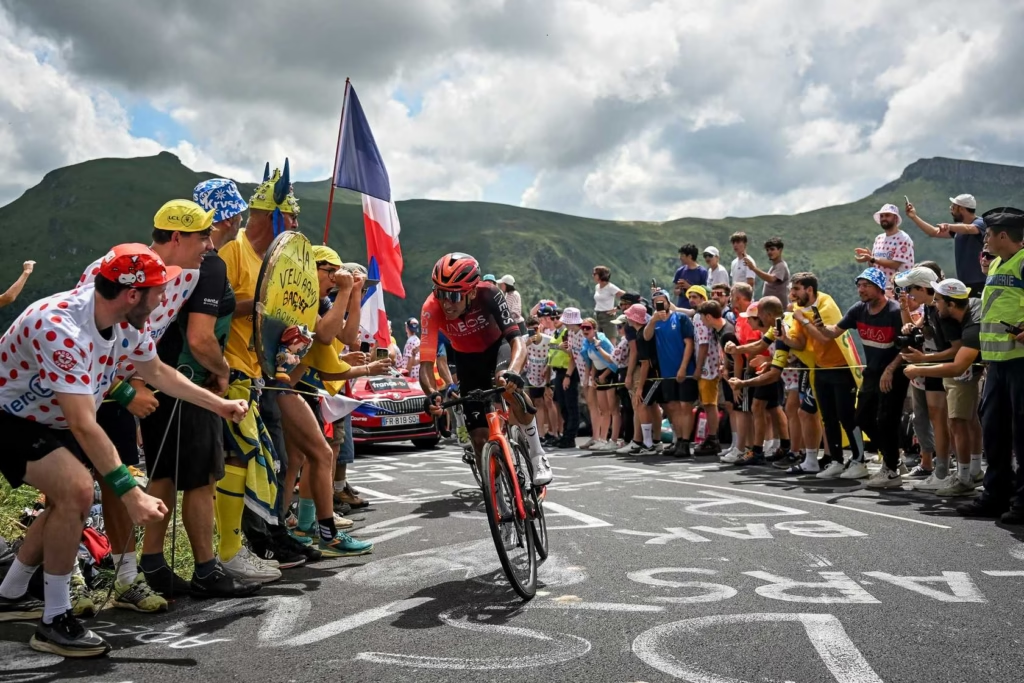 Photo Credit: A.S.O./Billy Ceusters
What happened on the Col de Pertus in 2024?
The 2024 Tour provided the clearest demonstration of how Puy Mary and the Col de Pertus work together.
Pogačar attacked near the summit of Puy Mary and extended his advantage on the descent. At one point, Vingegaard appeared to be losing the stage and potentially more time in the general classification.
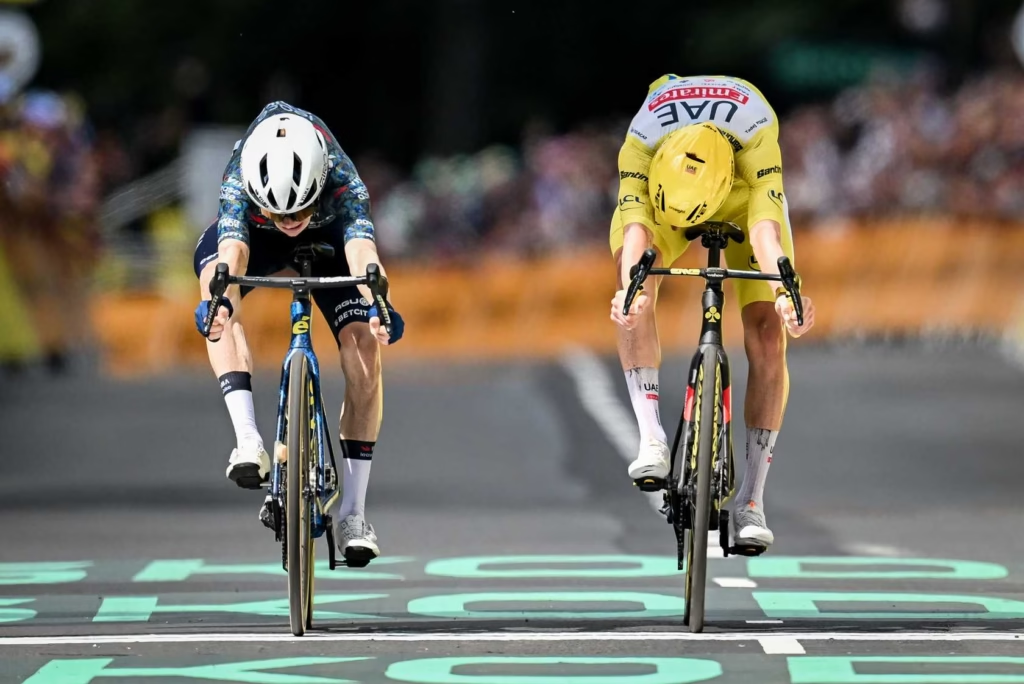
The Danish rider continued at his own pace and gradually reduced the deficit on the Col de Pertus. He caught Pogačar close to the summit before the pair continued towards Le Lioran, where Vingegaard won the sprint.
Pertus was not where the first attack happened. It was where the balance changed.
The full story of that finish is covered in our report on Vingegaard beating Pogačar at Le Lioran in 2024.
That distinction remains important in 2026. The rider who looks strongest on Puy Mary may not be the rider in control by the top of Pertus.
Pertus can also decide the breakaway
The Col de Pertus is not only a general classification launchpad.
In 2016, Greg Van Avermaet dropped Thomas De Gendt on the climb before riding alone to victory at Le Lioran. Eight years later, it became the point where Vingegaard regained contact with Pogačar.
The same road has therefore decided stages through two very different types of race.
That history explains why the breakaway and GC contests can overlap. A strong escape may reach Puy Mary with several minutes in hand, but its climbers will begin attacking one another because waiting until Le Lioran carries its own risks.
Behind them, the leading teams may start their own battle. If the GC pace becomes intense enough, the surviving escapees can be caught between Pertus and the finish.
Alternatively, UAE may allow a non-threatening breakaway to keep its advantage. The front riders can then contest the stage while Pogačar and Vingegaard race over the same roads several minutes later.
Both groups can be engaged in decisive attacks at the same time. That possibility is explored further in the Tour de France 2026 stage 10 live viewing guide.
Why Le Lioran is not a normal summit finish
Le Lioran appears as the finish location, but stage 10 does not end with one continuous climb to a summit.
After the Col de Pertus, the riders descend for roughly six kilometres towards Saint-Jacques-des-Blats. The road then begins rising again, with the official Col de Font de Cère section measuring 3.1km at 5.8%.
Font de Cère is crested with 2.7km remaining. The route then drops slightly before the final few hundred metres rise towards the line.
That changes the way gaps behave.
On a conventional summit finish, an attacker can continue climbing until the line. At Le Lioran, riders must descend, accelerate, corner and then climb again.
A rider who crosses Pertus with a narrow advantage cannot simply settle into one rhythm. A small chasing group may work together on the faster roads, while a lone leader must continue producing power without assistance.
The final rise still matters, particularly if two or three riders reach it together, but it is unlikely to create the largest difference of the day. The serious selection should already have happened.
Col de Font de Cère is the final filter
The Col de Font de Cère is officially a category-three climb, but it can become more damaging than its classification suggests.
It arrives after Puy Mary, the Col de Pertus and the descent to Saint-Jacques-des-Blats. A rider who has survived by following wheels may finally lose contact when the road begins rising again.
Its 5.8% average is not severe enough to guarantee attacks from the strongest climbers. That can make it tactically awkward.
If a rider is already ahead, the shallower gradient allows them to carry speed and defend the advantage. If a small group remains together, the pace can become hesitant because nobody wants to lead their rivals towards the final kick.
The climb may therefore extend gaps created on Pertus rather than create entirely new ones.
It is also the final realistic point for a sustained GC attack. Waiting until the closing few hundred metres limits the potential gain to seconds and bonus time.
 Photo Credit: Getty
Where the breakaway and GC races could meet
The breakaway’s survival will depend on three factors: its advantage at the foot of Puy Mary, the strength of the remaining riders and the intentions of the GC teams.
A gap of several minutes may be enough if UAE is interested only in protecting the yellow jersey. The escapees can attack one another while the main favourites mark each other behind.
A smaller advantage becomes vulnerable once Puy Mary begins. The best GC climbers can cover these roads much faster than riders who have already spent most of the day in the break.
The overlap is most likely on the Col de Pertus. By then, the escape will have split, while the GC group may be travelling at its highest speed of the stage.
Television coverage can therefore become confusing. One rider may be attacking for the stage at the front while Pogačar or Vingegaard launches a move behind. The most important gap may not be between first and second on the road, but between the yellow jersey group and a rival further back.
What to watch when live coverage reaches Puy Mary
With 31km remaining, the race reaches the top of Puy Mary. This is the point to stop treating the stage as a broad mountain day and begin focusing on the final sequence.
Watch the breakaway’s advantage and whether it contains a rider dangerous enough to force UAE to chase. A strong climber several minutes ahead may still be riding for victory, while a weaker escape can disappear quickly once the GC teams raise the pace.
In the main group, count the remaining domestiques. A high pace from Visma or UAE may be more meaningful than an early attack.
Also watch the riders near the back. Puy Mary can begin splitting the group long before the television cameras notice that a major name has lost contact.
What to watch on the Col de Pertus
With approximately 19km remaining, the leaders begin the most explosive climb of the finale.
This is where repeated attacks are most likely. Any rider who reaches the summit alone has 14.5km left to defend the gap, including a descent and the Col de Font de Cère.
Watch how the riders respond rather than only who attacks first. A brief hesitation can become decisive on an 8.5% gradient.
Team support also becomes particularly valuable. A leader with a team-mate ahead can gain help on the descent, while an isolated rider must decide whether to commit alone or wait for cooperation.
What to watch after Pertus
Do not assume the race is settled at the summit.
A rider ten seconds ahead can still be caught on the descent. A group that appears to have reformed can split again on Font de Cère. Riders who have overextended themselves may suddenly lose much more time on the shallower final climb.
The final 14.5km contains almost every type of terrain: descent, valley road, moderate climbing, another crest, a slight drop and a short uphill finish.
That variety is why Le Lioran can produce larger differences than a conventional profile might suggest.
-
 Photo Credit: Getty
Where is stage 10 most likely to split?
Puy Mary is where the group should begin breaking. The Col de Pertus is where the strongest riders can create the decisive separation.
The distinction matters.
Puy Mary is long enough and late enough to remove domestiques, weaken riders and force the leading teams to reveal their intentions. Pertus then provides the steeper gradient needed for a direct, explosive attack.
Font de Cère and the run into Le Lioran determine whether that advantage survives.
The most likely sequence is gradual pressure on Puy Mary, a smaller group entering the Col de Pertus and direct attacks on its steeper slopes. The riders then face a difficult chase towards Le Lioran rather than a simple uphill drag race.
Why the final hour is so difficult to predict
Stage 10 does not offer one obvious place where every contender must attack.
A move on Puy Mary risks coming too early. Waiting until Pertus leaves less road on which to build a substantial advantage. Waiting until Font de Cère may reduce the contest to one short acceleration and a sprint.
The breakaway creates another tactical question. If the stage victory remains available, teams may ride harder. If it disappears up the road, the GC leaders can concentrate entirely on one another.
This is also the first stage after the rest day. Some riders may return refreshed, while others discover immediately that their legs have lost their normal rhythm.
The route creates possibilities rather than certainty.
Puy Mary begins the selection. Pertus sharpens it. Font de Cère carries the consequences towards the line.
By the time the riders reach Le Lioran, the decisive move may already be several climbs old.