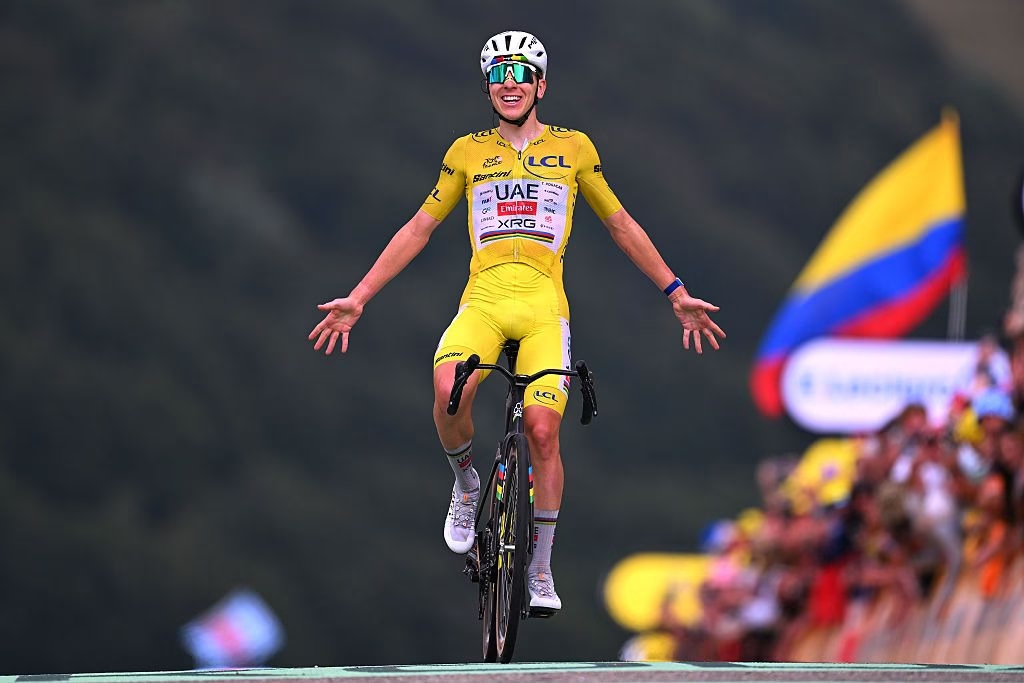
Tadej Pogačar won stage 14 of the 2026 Tour de France at Le Markstein, attacking in the final 2 kilometres of the Col du Haag to take his fourth stage victory of this year’s race and extend his overall lead.
The UAE Team Emirates-XRG rider waited until Jonas Vingegaard had reduced the yellow jersey group to its final contenders, then accelerated 1.5 kilometres from the top of the final climb. Vingegaard tried to limit the damage, Paul Seixas briefly held close behind, and Isaac del Toro returned on the plateau, but Pogačar was already gone.
Del Toro won the sprint for second at 38 seconds, ahead of Seixas and Vingegaard. Remco Evenepoel, Florian Lipowitz and Juan Ayuso came in a few seconds later after a final climb that reshaped the podium fight more than it threatened Pogačar’s grip on yellow.
Pogačar turns Le Markstein into another UAE target
Stage 14 from Mulhouse to Le Markstein was only 155.3 kilometres, but it packed in around 3,800 metres of climbing across a brutal Vosges route. With the Grand Ballon, Col du Page, Ballon d’Alsace and Col du Haag all packed into the day, it was always likely to become one of the defining GC stages of the second week.
UAE Team Emirates-XRG made no secret of their intent. After letting the huge breakaway win in Belfort on stage 13, they returned to their usual Tour script: control the race, keep the escape close enough, and deliver Pogačar into position to attack on the final climb.
Pogačar began the day in yellow after his wins on Les Angles, Gavarnie-Gèdre and Le Lioran. Vingegaard was still second overall, but the fight behind him had tightened after Tom Pidcock’s breakaway move to fourth in Belfort. That added a second layer to the stage: Pogačar versus the rest for the win, and a compressed podium battle behind him.
The weather also played its part. Rain and thunderstorms made the descents more dangerous, while the crowds on the Vosges climbs gave the stage the feel of a major mountain set-piece.
No attacks before the sprint
Despite the severity of the route, the stage began unusually calmly. The intermediate sprint came after only 12 kilometres, and the peloton appeared content to wait until that had been contested before the main breakaway fight began.
Alpecin-Premier Tech controlled the bunch for Jasper Philipsen, who still had green jersey ambitions. Philipsen duly won the sprint ahead of Mads Pedersen, Max Kanter and Biniam Girmay.
That tightened the points classification again, with Pedersen still in green but Philipsen continuing to chip away. After the sprint, Pedersen led with 397 points, Philipsen had 361 and Girmay 347, with Tim Merlier further back on 307.
Only then did the attacks start in earnest as the race turned towards the first major climb, the Grand Ballon.
Pidcock gets into the move again
The first climb immediately changed the race. The Grand Ballon was long, 21.6 kilometres at 4.8 per cent, with the average softened by a short descent halfway up. EF Education-EasyPost were among the teams to make the first serious moves, with Ben Healy and Richard Carapaz lifting the pace.
A large breakaway group formed containing several riders with clear stage, mountains or tactical ambitions. Carapaz, Egan Bernal, Thymen Arensman, Antonio Tiberi, Quinn Simmons, Marc Hirschi, Healy, Lennert Van Eetvelt, Mattia Cattaneo, Einer Rubio, Tobias Halland Johannessen, Matteo Jorgenson and Valentin Paret-Peintre were among the names in the move.
Most significantly, Pidcock was there again. After jumping to fourth overall on stage 13, the Pinarello-Q36.5 rider was too dangerous to be allowed much freedom, and UAE quickly settled into a steady tempo behind. They did not panic, but they kept the group within reach.
Pidcock’s presence meant the escape was never going to get the kind of gap that had been allowed the previous day. He had turned himself from stage hunter into GC threat, and every team around the podium battle now had to account for him.
Paret-Peintre and Carapaz fight for KOM points
The Grand Ballon also brought the mountains classification into play. Pogačar began the day leading that competition on 42 points, with Vingegaard on 27, Carapaz on 19, Pidcock on 18 and Paret-Peintre also on 18.
EF Education-EasyPost tried to set up Carapaz for the points at the top, with Georg Steinhauser and Healy working for him. But Paret-Peintre timed it better and beat Carapaz in the sprint over the summit. The pair then pressed on down the descent, using the KOM fight to form the stage’s first real selection.
Carapaz and Paret-Peintre were joined by Healy and the Johannessen brothers on the descent, creating a front group that began to distance the rest of the break. Arensman, Rubio and Pablo Castrillo chased behind, while the Pidcock group drifted further back and began to lose cohesion.
The peloton, still led by UAE, remained close enough to make the break’s survival uncertain. This was not going to be another Belfort.
Rain, errors and a shrinking race
The Col du Page was the next major test. The leading group continued to work, while Rubio bridged across and Arensman was delayed by a mechanical. Paret-Peintre again had his eyes on the KOM points, with Carapaz his main rival.
The weather then deteriorated. Heavy rain fell on the descent, making the roads sketchy and forcing the riders to take fewer risks. EF’s riders had a brief scare when Healy and Carapaz went wrong on the turn onto the Ballon d’Alsace and were held up, but they managed to get back to the other leaders.
At the top of the Col du Page, Paret-Peintre again beat Carapaz, with the pair moving closer to Pogačar in the mountains standings. By that point, the KOM fight had become almost a race within the race. Pogačar still held the official lead, but Paret-Peintre was closing fast.
The Ballon d’Alsace, climbed for the second day in a row, then shifted the dynamic again. Paret-Peintre won the sprint over the summit ahead of Carapaz, moving to 43 points and briefly taking the virtual lead in the mountains classification. Pogačar remained on 42, Carapaz moved to 38 and Vingegaard stayed on 27.
UAE bring the race back under control
While the breakaway was fighting for mountains points, UAE were gradually taking the stage away from them. Their pace on the Ballon d’Alsace reduced the gap and brought the Pidcock group back into view.
The large escape that had looked dangerous early on was now breaking apart. By 50 kilometres to go, the Pidcock group had been caught, leaving only six riders ahead of the peloton. They still had around 2 minutes, but with the Col du Haag waiting and UAE controlling behind, it looked increasingly unlikely to be enough.
Nils Politt and Florian Vermeersch had done the early stabilising work. Later, Brandon McNulty and the rest of the UAE mountain train kept the pressure high enough to stop the break ever feeling safe.
There was brief concern for Lenny Martinez, who was dropped from the peloton on a descent, but Bahrain Victorious and Netcompany INEOS helped bring him back. Behind the surface calm, teams were already thinking about the podium fight and the danger of losing riders before the final climb.
Carapaz tries to save the break
Inside the final 30 kilometres, the leading group was down to a handful of riders, with Healy eventually dropped after a long shift. Uno-X Mobility briefly took over through Anders Halland Johannessen working for his brother Tobias, but the gap was only around 1:30 as the race approached the Col du Haag.
The final climb was the real stage. The Col du Haag rose for 11.2 kilometres at 7.2 per cent, hard enough to create genuine gaps among the GC riders and steep enough to reward a late, explosive Pogačar attack.
Carapaz knew the break needed to move first. As the climb began, Anders Halland Johannessen was done, leaving only four riders at the front, and Carapaz launched what became a last-ditch attempt to win the stage.
For a few kilometres, it looked as though he might at least force UAE to work deeper into the climb. But Decathlon CMA CGM took over from UAE on the lower slopes, changing the rhythm behind and quickly thinning the yellow jersey group.
Decathlon and Visma light the final climb
Decathlon CMA CGM’s move was one of the most important tactical moments of the finale. Tiesj Benoot worked, then another Decathlon rider took over, with Seixas protected behind. The pace immediately did damage.
McNulty, who had been part of UAE’s earlier work, was dropped. Adam Yates was also distanced, leaving Del Toro as Pogačar’s final teammate in the front group. Pidcock, still high on GC after his breakaway gain in Belfort, was dropped too, signalling that his podium push would not survive the first true GC climb after his raid.
The front of the race narrowed quickly. Carapaz went clear of Tobias Halland Johannessen, while behind Sepp Kuss took over for Team Visma | Lease a Bike. Soon there were only 11 riders left in the GC group: Kuss, Vingegaard, Pogačar, Del Toro, Evenepoel, Lipowitz, Seixas, Ayuso, Skjelmose, Martinez and Yannis Voisard.
Then the favourites began to move. Lipowitz attacked first, with Seixas following. Kuss dragged them back, then Vingegaard took over the pace himself.
Vingegaard reduces the group
Vingegaard’s turn was the most sustained pressure applied by any of Pogačar’s rivals. It was not an attack in the explosive sense, but it was hard enough to reduce the front group to only six riders: Seixas, Lipowitz, Evenepoel, Ayuso, Del Toro, Pogačar and Vingegaard himself.
Evenepoel was briefly dropped, but rode his own tempo well and stayed close enough to return. The same has happened more than once in this Tour: he loses a wheel when the climb becomes sharp, but limits the damage by refusing to panic.
Up ahead, Carapaz was joined again by Tobias Halland Johannessen, but their lead was down to around 20 seconds. Vingegaard dragged the GC group across, and with around 10 kilometres remaining the stage had effectively become a GC contest.
The break had animated the day, but the winner was now almost certain to come from the favourites.
Pogačar attacks 1.5 kilometres from the summit
The expected Pogačar move came 1.5 kilometres from the top of the Col du Haag. He had waited longer than on some of his previous stage wins, partly because Vingegaard had been setting such a hard pace and partly because the final 2 kilometres were a section he knew well.
When he did go, the gap was not instantly enormous, but it opened steadily. Vingegaard was the first chaser, while Seixas held third on the road and Del Toro, Lipowitz, Ayuso and Evenepoel were stretched behind.
Pogačar’s lead grew to 10 seconds, then 23 seconds by the summit. Vingegaard crested behind with Seixas, while Del Toro was only a few seconds further back. Lipowitz, Ayuso and Evenepoel followed, still close enough to limit their losses but not close enough to threaten the stage.
Over the top, the hardest part of the climb was done, but Pogačar was not coming back. Vingegaard and Seixas did not make inroads on the plateau, and Del Toro was able to return to them without contributing, with his teammate up the road.
Fourth stage win for Pogačar
Pogačar went under the flamme rouge with 37 seconds in hand and finished the job at Le Markstein. It was his fourth stage win of the 2026 Tour and the 125th victory of his career.
Behind him, Del Toro won the sprint for second at 38 seconds, ahead of Seixas and Vingegaard. Evenepoel, Lipowitz and Ayuso came in a few seconds later, having paced the final climb well enough to avoid a major collapse.
Pogačar said afterwards that the team had marked the stage from the beginning and that he had waited until the final 2 kilometres to see how the race would unfold. He also acknowledged that Del Toro was not at 100 per cent, which influenced how he approached the finale.
“I felt good, and the last 2km I know very well,” Pogačar said. “There were so many crowds that it gives you an additional boost to go to the top. I gave it a go today, I had good feelings, so I grabbed and took the opportunity.”
The victory also restored him to the top of the mountains classification. Paret-Peintre had briefly moved ahead earlier in the day, but Pogačar’s summit points on the Col du Haag put him back in control of yellow and polka dots.
Seixas takes white and moves up
The biggest jersey change came in the young rider classification. Seixas took the white jersey from Ayuso after another mature ride, and his third place on the stage confirmed that he is no longer just surviving his first Tour de France. He is becoming one of its central GC riders.
The French teenager crested the Col du Haag with Vingegaard and finished ahead of the Evenepoel, Lipowitz and Ayuso group. That moved him up to fourth overall and into serious podium contention.
It is a significant shift. Seixas has spent much of the race riding smartly and cautiously, avoiding unnecessary surges and keeping himself in the right place. On Le Markstein, he looked strong enough to follow when others began to crack.
For Decathlon CMA CGM, the day was also a statement. They took control of the lower final climb, helped reduce the group, and set Seixas up to race directly against the biggest names. The stage win went to Pogačar, but Seixas may have delivered the performance that most changed expectations.
Pidcock slides back after Belfort high
Pidcock’s day moved in the opposite direction. After gaining time from the break on stage 13 and jumping to fourth overall, he was dropped on the Col du Haag and finished 3:34 down.
That saw him slide back to ninth overall. It does not erase his excellent ride to Belfort, but it does suggest that defending a podium place in the high mountains is a different challenge from using breakaways to move through the standings.
Pidcock may still be a stage-win threat, especially if he can get into another break on the right terrain. But stage 14 showed that when the pure GC group is reduced by sustained climbing pressure, he does not yet have the same climbing level as Pogačar, Vingegaard, Seixas, Evenepoel, Lipowitz, Del Toro and Ayuso.
That matters for the shape of the race. Pidcock remains dangerous, but more as an aggressive outsider than a locked-in podium contender.
The podium fight tightens behind Pogačar
Pogačar’s lead now looks even more secure, but the battle behind him is more alive than ever. Vingegaard limited the damage better than most, but he still lost time to Pogačar and could not follow the decisive attack.
Evenepoel rode a measured final climb after being distanced, keeping himself in the podium fight. Lipowitz and Ayuso also limited their losses, while Del Toro’s second place showed that even short of full strength, he remains a major factor for UAE.
Seixas, though, is the rider who most changed the conversation. Moving into fourth overall and taking white puts him directly into the fight with Evenepoel, Ayuso, Lipowitz and Del Toro. Vingegaard remains second, but his margin over the rest is not so comfortable that he can ignore them.
Stage 14 did not produce a total GC explosion, but it did sort the hierarchy. Pogačar is clearly above everyone else. Behind him, the race for the podium is still full of tension.
UAE execute the plan again
UAE Team Emirates-XRG were not as overwhelming in numbers at the end as they sometimes are, but the plan worked. They controlled the break, kept Pidcock from gaining too much, brought the race back for the final climb, and left Pogačar in position to use the last 2 kilometres.
Adam Yates said afterwards that the stage had been a major target.
“Today was a big objective for us,” Yates said. “On paper it was a nice stage. We controlled the beginning, it was a hard day, with the rain also and thunderstorms. But I think everyone did what we needed to do, and you saw the result.”
That result was another Pogačar stage win, another extension of the yellow jersey lead, and another sign that UAE can still decide how many stages they want to chase.
Sunday’s stage is likely to be harder again, and Pogačar himself suggested it would not be straightforward. But on Le Markstein, the pattern held: others could animate the race, but once Pogačar decided to attack, nobody could stop him.
Tour de France 2026 stage 14 result
Results powered by FirstCycling.com
Main photo credit: Getty