
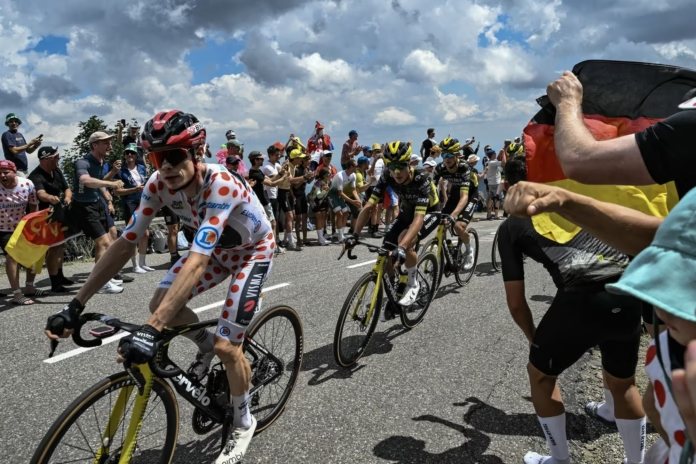
Stage 15 of the 2026 Tour de France takes the race from Champagnole to the Plateau de Solaison on Sunday 19 July, ending the second week with one of the steepest summit finishes of the entire race.
The 183.9km route contains approximately 3,950 metres of climbing and becomes increasingly difficult as the peloton moves from the Jura towards Haute-Savoie. The final 48 kilometres include the Col de la Croisette, the Côte du Mont and the hors catégorie ascent to Plateau de Solaison.
Tadej Pogačar strengthened his control of the Tour with victory at Le Markstein on Stage 14. He now leads Jonas Vingegaard by 4:30, with Remco Evenepoel third at 5:04.
Behind them, the podium contest has tightened considerably after strong performances from Paul Seixas and Isaac del Toro, while Tom Pidcock dropped from fourth to ninth overall.
Plateau de Solaison should provide a more direct examination than the irregular Col du Haag. The final climb is long, consistently steep and finishes at the summit. There will be nowhere to hide and very little tactical ambiguity once the road begins to rise.
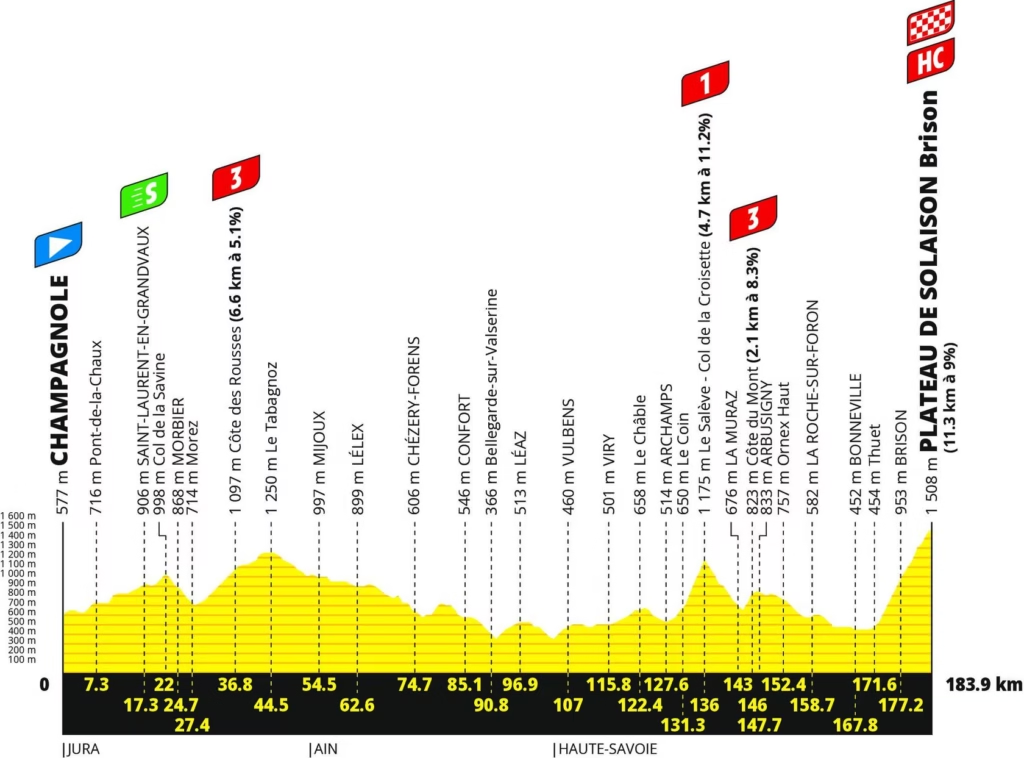
Tour de France 2026 stage 15 route
- Date: Sunday 19 July 2026
- Start: Champagnole
- Finish: Plateau de Solaison
- Distance: 183.9km
- Stage type: Mountain
- Total climbing: Approximately 3,950 metres
- Final climb: 11.3km at 9%
- Highest point: Plateau de Solaison, 1,508 metres
The opening half of the stage is less severe than the finish suggests, but it is rarely flat.
The riders leave Champagnole and climb gradually through the Jura before reaching the Côte des Rousses after 36.8km. The third-category ascent measures 6.6km at 5.1% and should help determine the composition of the breakaway.
A long transition follows as the route moves towards the outskirts of Geneva and the foothills of Haute-Savoie. The terrain may allow a strong break to build an advantage, but the final sequence is difficult enough for the GC teams to close several minutes.
The decisive racing should begin with approximately 48 kilometres remaining.
Stage 15 completes the eastern mountain sequence covered in our Tour de France 2026 Vosges and Jura guide. It follows the breakaway stage to Belfort and the Col du Haag finish at Le Markstein before taking the race towards its second rest day.
Stage 15 climbs
| Climb | Distance into stage | Length | Average gradient | Category |
|---|---|---|---|---|
| Côte des Rousses | 36.8km | 6.6km | 5.1% | Category 3 |
| Le Salève via Col de la Croisette | 136km | 4.7km | 11.2% | Category 1 |
| Côte du Mont | 146km | 2.1km | 8.3% | Category 3 |
| Plateau de Solaison | 183.9km | 11.3km | 9% | Hors catégorie |
The official route contains only four categorised climbs, but those statistics disguise the difficulty of the day.
The final three ascents are concentrated inside the last 48 kilometres. The Col de la Croisette averages 11.2%, the Côte du Mont adds another sharp effort shortly afterwards and the Plateau de Solaison provides an unforgiving summit finish.
That places Stage 15 among the hardest mountain stages of the 2026 Tour de France, even if it does not contain the altitude or total climbing of the final Alpine weekend.
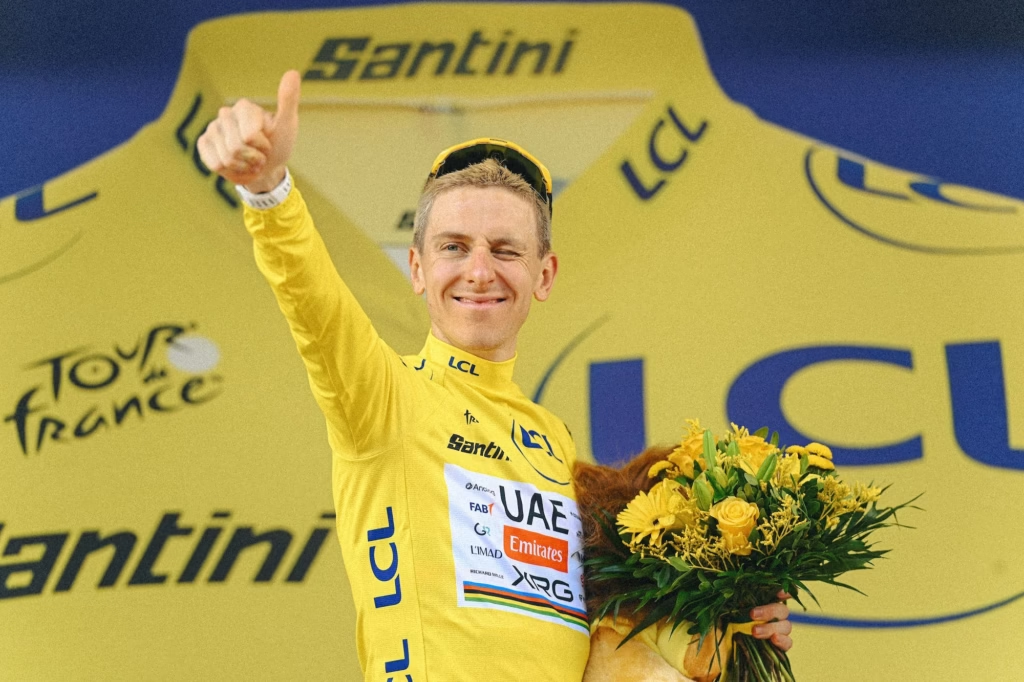
The Col de la Croisette can start the GC battle
The climb to Le Salève via the Col de la Croisette is only 4.7km long, but its average gradient of 11.2% makes it one of the steepest categorised climbs of the 2026 Tour.
There is almost no opportunity to settle into a comfortable rhythm.
A climb this steep rewards lighter riders and punishes anyone carrying fatigue from Stage 14. It could also reduce the influence of domestiques quickly, particularly if Visma-Lease a Bike or another GC team drives the pace from the lower slopes.
The Croisette is likely to be the point where the main battle begins. That is significant because its summit arrives almost 48km from the finish rather than directly before Plateau de Solaison.
An attack from one of the leading favourites would be ambitious at that distance. A harder team tempo is more likely, designed to isolate rivals and create fatigue before the final climb.
The descent and Côte du Mont then offer limited time to reorganise. Riders who lose contact on the Croisette may spend much of the remaining stage chasing.
Plateau de Solaison is a pure climbing test
The final ascent begins near Bonneville and rises for 11.3km at an average of 9%.
Those numbers place Plateau de Solaison among the hardest summit finishes of the race.
Unlike the Col du Haag, there is no descent or rolling section after the summit. The finish line sits at 1,508 metres, and every second gained on the climb will count directly towards the general classification.
The road is narrow as it climbs through the villages of the Bornes massif. That should make positioning important before the ascent begins, but once the group thins out, the gradient will determine the outcome.
An average of 9% means there are few meaningful recovery sections. Riders who begin to struggle cannot rely on a flatter kilometre to regain contact. Gaps could open gradually before becoming substantial over the final three or four kilometres.
Stage 15 is one of the five official summit finishes at the 2026 Tour de France, alongside Gavarnie-Gèdre, Orcières-Merlette and the two finishes at Alpe d’Huez.
The climb has previously appeared in the Critérium du Dauphiné, where Jakob Fuglsang won in 2017 and Jonas Vingegaard took victory in 2022. Stage 15 marks its first appearance as a Tour de France finish.
Will the breakaway win Stage 15?
A breakaway victory is possible, but the balance favours the general classification riders.
The relatively gentle opening may allow a large group to establish itself before the Côte des Rousses. Climbers who lost time earlier in the Tour will see Stage 15 as one of their best remaining opportunities before the final Alpine block.
However, the final sequence is difficult to defend.
A breakaway arriving at the Col de la Croisette with four or five minutes could see that advantage disappear quickly if the GC teams begin racing. The steepness of the Croisette and Plateau de Solaison allows the strongest favourites to gain time without needing an exceptionally high speed on the flatter roads.
The stage still appears among the best breakaway opportunities on the 2026 Tour route, but its summit finish makes it less favourable than Stage 13 to Belfort or some of the rolling stages earlier in the race.
UAE Team Emirates-XRG also showed on Stage 14 that it is prepared to chase a stage victory even when Pogačar already holds a comfortable yellow jersey advantage.
Isaac del Toro finished second at Le Markstein, demonstrating that UAE has the strength to control the race and still place another rider deep into the finale. If the team adopts the same approach, the breakaway may need a very large advantage before the final 50km.
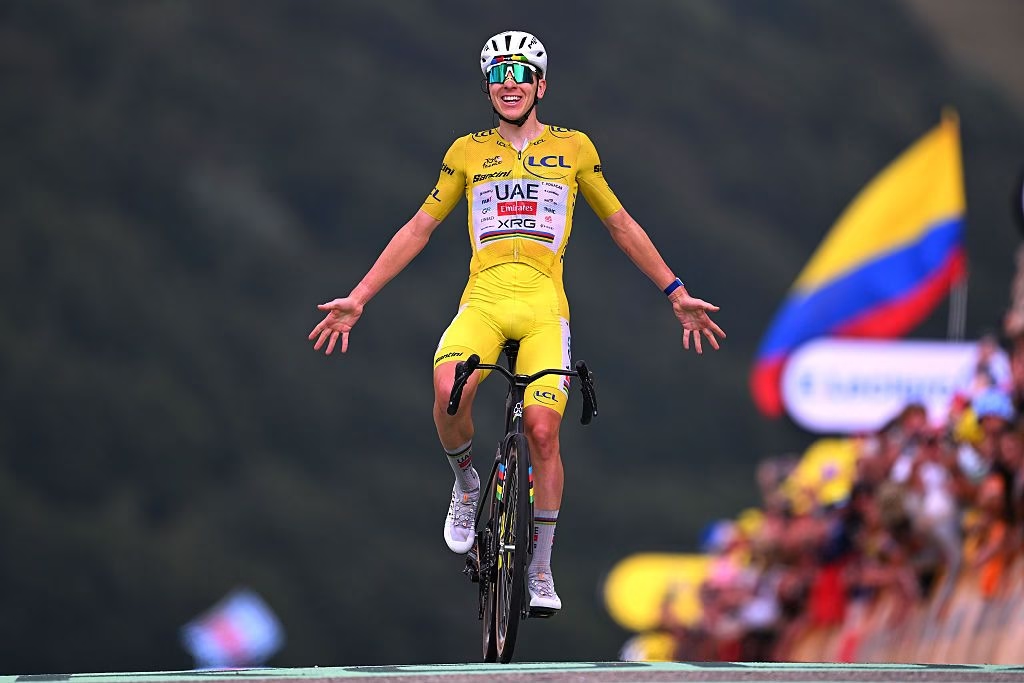
Pogačar begins as the clear favourite
Pogačar enters Stage 15 after producing another decisive attack on the Col du Haag.
He waited until the steepest section before accelerating away from Vingegaard and the rest of the leading group, winning by 38 seconds and extending his overall advantage to 4:30.
Plateau de Solaison offers a different challenge, but it is no less suitable.
The sustained gradient should allow UAE to set a hard tempo before Pogačar attacks during the final kilometres. His advantage means he does not need to move early, while every rival around him must balance trying to gain time with the risk of losing considerably more.
Pogačar also leads the mountains classification after Stage 14. A victory on the hors catégorie finish would strengthen his grip on the polka-dot jersey as well as yellow.
His position as the strongest climber in the race was already central to our best climbers at the Tour de France 2026 guide. The first two weeks have done little to challenge that assessment.
The main question is not whether he is capable of winning. It is whether UAE decides another stage victory is worth the effort after such an aggressive day in the Vosges.
Vingegaard needs to change the pattern
Vingegaard remains second overall but lost another 54 seconds to Pogačar, including the stage winner’s time bonus, at Le Markstein.
The deficit is now 4:30.
That is large enough to require a change in approach. Matching Pogačar for most of a climb before losing time to one decisive acceleration is no longer sufficient.
Plateau de Solaison carries positive memories for Vingegaard because he won there at the 2022 Dauphiné. He knows the final climb and has already demonstrated that its sustained gradient suits him.
Visma may therefore attempt to make the stage difficult before the final ascent.
The Col de la Croisette offers an obvious opportunity for Sepp Kuss or another teammate to increase the pace. The objective would be to reduce UAE’s numbers, force Pogačar to spend energy and prevent the yellow jersey from reaching Plateau de Solaison surrounded by support.
A long-range attack from Vingegaard remains unlikely unless Pogačar shows weakness. He may instead need to make the final climb as hard as possible and hope that the sustained gradient produces a different result from the explosive Col du Haag.
Stage 15 is one of the key pre-Alps battlegrounds identified in our analysis of where the 2026 Tour de France can be won before the Alps.
Evenepoel’s podium position is under pressure
Evenepoel remains third overall at 5:04, but the fight behind him has changed again.
Paul Seixas is now fourth, only 15 seconds behind the Belgian. Juan Ayuso, Florian Lipowitz and Isaac del Toro are also close enough to challenge for the final podium place.
Evenepoel limited his losses reasonably well on Stage 14, finishing only four seconds behind Vingegaard. The result kept him third, but it did not create any meaningful margin over the younger riders behind.
Stage 15 may be more difficult for him.
The final climb is long and steep, with fewer opportunities to use his aerodynamic strength or descending ability. Evenepoel must manage his effort carefully and avoid following accelerations that take him beyond his sustainable pace.
He also has the Stage 16 individual time trial in his favour after the rest day. That gives him a reason to ride defensively on Plateau de Solaison. Remaining close to Seixas, Ayuso and the other podium contenders may be enough before a discipline in which he should gain time.
The danger is that a defensive ride becomes a major loss. Once gaps open on a 9% climb, they can expand rapidly.
The position of the stage immediately before the second rest day and individual time trial is explained in our Tour de France 2026 transfer days guide.
 Photo Credit: Getty
Paul Seixas faces his biggest Tour test
Seixas was one of the strongest riders on Stage 14.
The 19-year-old finished third at Le Markstein, collected four bonus seconds and moved into fourth overall. He also took the white jersey from Ayuso by three seconds.
His performance was impressive because it was based on judgement as much as raw strength. Seixas did not attempt to follow every acceleration immediately. He rode at his own pace and returned to several riders who had gone too deep.
Plateau de Solaison is familiar territory. Seixas has family connections to the area and knows the roads around the final climb.
That local knowledge may help with pacing and understanding where the gradient changes. The greater challenge is recovery.
Stage 15 follows immediately after his strongest Tour performance and includes another demanding final hour. Seixas must prove he can repeat that level without a chance to recover.
He is now close enough to the podium that other teams will treat him differently. Evenepoel cannot allow him freedom, while Ayuso and Lipowitz will see him as a direct rival rather than an impressive young outsider.
Seixas entered the Tour among the riders discussed in our Tour de France 2026 dark horses for the general classification. He is no longer racing like an outsider.
Del Toro gives UAE another tactical option
Del Toro produced one of the strongest rides of Stage 14, finishing second behind Pogačar and moving to within 46 seconds of the podium.
His presence creates an awkward tactical problem for the other teams.
UAE can use Del Toro as a protected GC rider, a late attacker or a bridge for Pogačar. If he attacks before the final climb, Red Bull-Bora-Hansgrohe, Decathlon CMA CGM and Lidl-Trek may be forced to chase while Pogačar remains protected.
Del Toro also appears capable of challenging for the stage himself if UAE does not commit entirely to Pogačar.
The Mexican is climbing well and has a fast finish from a reduced group. Plateau de Solaison may be too selective for a sprint, but he could again finish among the leading riders if he manages the Croisette efficiently.
His route fit was one reason he featured prominently among the Tour de France 2026 GC favourites and outsiders.
Ayuso and Lipowitz remain in the podium fight
Ayuso begins the stage fifth overall, three seconds behind Seixas and 18 seconds away from Evenepoel.
The Lidl-Trek leader lost only two seconds to Evenepoel on Stage 14 but surrendered the white jersey because of Seixas’s bonus seconds. His Tour remains consistent rather than spectacular, yet that may be enough to place him on the podium if rivals begin to fade.
Plateau de Solaison should suit Ayuso’s ability to maintain a strong tempo on longer climbs. He needs to avoid becoming isolated too early, particularly if Lidl-Trek expends riders protecting its lead in the team classification.
Lipowitz is sixth overall and 40 seconds behind Evenepoel.
Red Bull now has two riders inside the podium battle, which gives the team tactical flexibility. Lipowitz could attack while Evenepoel follows wheels, or he could be used to support the Belgian if the pace becomes too difficult.
That flexibility only matters if both riders survive the Col de la Croisette. The 11.2% gradient could separate teammates as quickly as rivals.
Can Tom Pidcock recover?
Pidcock’s podium challenge suffered a major setback at Le Markstein.
After gaining more than seven minutes from the Stage 13 breakaway, he lost 3:34 to Pogačar on Stage 14 and fell from fourth to ninth overall. He now trails the yellow jersey by 7:59.
The result showed the difference between gaining time tactically and defending it during a direct mountain confrontation.
Plateau de Solaison is unlikely to offer an immediate recovery. The long, steep final climb does not provide the descending or technical opportunities that normally favour Pidcock.
His most realistic target is now limiting his losses and preserving a top-10 position before the rest day.
Q36.5 could also allow him to ride more aggressively if the podium is no longer considered realistic. However, he is still too close to the leading riders to be given freedom in a breakaway.
Stage 15 may determine whether Pidcock continues as a GC rider or returns to hunting stages during the final week.
The British rider’s rapid rise and subsequent setback underline why the question of whether Tom Pidcock can make the Tour de France podium changed so quickly across Stages 13 and 14.
Stage 15 contenders
Tadej Pogačar
The clear favourite after his Stage 14 victory. Plateau de Solaison is steep enough for Pogačar to create another significant gap, while UAE has the strength to control the breakaway.
Jonas Vingegaard
A former winner on Plateau de Solaison and the rider most likely to challenge Pogačar directly. Visma must decide whether to make the race hard from the Croisette or save everything for the final climb.
Isaac del Toro
Second at Le Markstein and climbing strongly. Del Toro can be used tactically by UAE but is also capable of contesting the stage if Pogačar rides more conservatively.
Paul Seixas
The emerging story of the podium battle. Seixas knows the roads around Plateau de Solaison and enters the stage with confidence, although consecutive mountain stages will test his recovery.
Remco Evenepoel
Still third overall but under pressure from several riders. Evenepoel may ride defensively with the time trial ahead, but he cannot afford a substantial loss on the final climb.
Juan Ayuso
Only 18 seconds from the podium and likely to prefer the sustained final ascent. Ayuso has remained consistent and could move into the top three if Evenepoel or Seixas struggles.
Florian Lipowitz
Another genuine podium contender. Lipowitz’s role may depend on Evenepoel, but the German has the climbing ability to finish close to the favourites.
Richard Carapaz
Carapaz has repeatedly entered breakaways and attacked during the mountain stages. He is far enough behind overall to receive some freedom, although UAE’s willingness to chase reduces his chance of surviving.
Sepp Kuss
Kuss may be required to support Vingegaard, but he would become a major stage threat if Visma placed him in the breakaway as a satellite rider.
Lenny Martinez
The steep percentages suit Martinez, particularly if Bahrain Victorious can place him in the early move. His ability to survive the transition between the Croisette and Plateau de Solaison will be crucial.
More of the riders suited to this type of stage are covered in our Tour de France 2026 stage hunters to watch guide.
-
 Photo Credit: SWPix.com
Tour de France 2026 stage 15 prediction
Stage 15 is more likely to produce a GC victory than a successful breakaway.
The early terrain gives attackers an opportunity to establish a move, but the final 48 kilometres are severe enough for UAE or Visma to reduce a large advantage. Plateau de Solaison should reward the strongest climber rather than tactical hesitation.
Vingegaard knows the finish and needs to change the direction of the Tour. That should encourage Visma to increase the pace on the Col de la Croisette and make the final hour as difficult as possible.
The problem is that every hard kilometre may also help Pogačar.
The yellow jersey has repeatedly shown that he can absorb the pressure before producing the strongest acceleration. With UAE controlling the numbers and Del Toro providing another tactical option, Pogačar remains the most likely winner.
Behind him, the most important battle may be for third place. Evenepoel has only 15 seconds over Seixas and less than a minute covering the next four contenders. Plateau de Solaison could reorder that group completely before the second rest day of the 2026 Tour de France.

