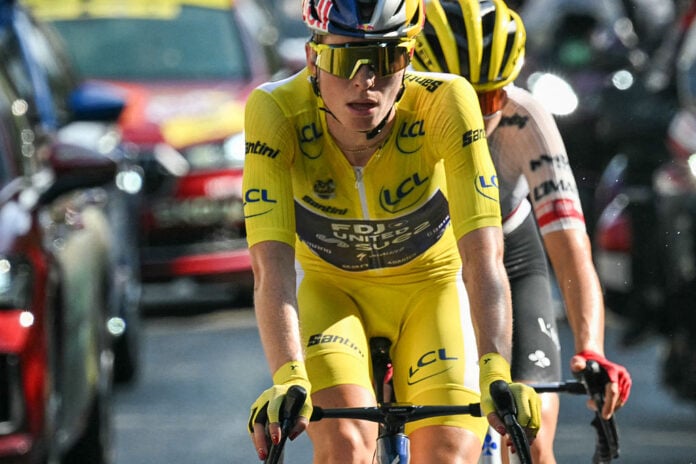
Demi Vollering won stage 9 of the 2026 Tour de France Femmes in Nice, attacking Kasia Niewiadoma-Phinney on the final ascent of the Col d’Èze before soloing to both the stage victory and her second overall Tour title.
The FDJ United-Suez rider began the day with only 8 seconds over Niewiadoma-Phinney, but turned the final stage into a controlled statement. She followed the Canyon SRAM leader’s early moves on the last climb, then attacked before the summit, opened a gap on the descent and reached Nice alone in yellow.
Niewiadoma-Phinney chased behind before being caught by the Longo Borghini group with 9 kilometres remaining, while Elisa Longo Borghini rode herself onto the final podium after Marlen Reusser was dropped and later crashed on the descent. It was a brutal final stage, raced over four ascents of the Col d’Èze, and it gave the Tour one last change in shape before Vollering closed it down completely.
A final stage built for one last fight
The final stage was short, but it was never going to be simple. The riders faced a circuit around Nice built almost entirely around the Col d’Èze, with four ascents packed into a 90-kilometre stage and very little room for anyone to hide.
The first three climbs used the classic side of the Col d’Èze, 7.7 kilometres at 5.9 per cent. The final loop was different and steeper, taking the race over the Chemin du Vinaigrier and Quatre-Chemins before rejoining the main road to the summit. That final version measured 6 kilometres at 7.6 per cent, with the hardest section stretching for 3.8 kilometres at 8.6 per cent and ramps up to 14 per cent.
It was a stage made for tension. Vollering had yellow, but not by enough to ride defensively. Niewiadoma-Phinney had lost the race lead by only 8 seconds in Nice the previous day and still had one clear chance to take it back. Reusser began the day third overall at 1:12, while Longo Borghini was fourth at 3:05 and still close enough to attack the podium if the race split apart.
The route gave everyone a reason to move. UAE Team L’IMAD wanted attrition. Canyon SRAM needed to isolate Vollering. FDJ United-Suez had to protect the smallest possible yellow jersey lead. The stage started like a final day should: immediately uphill and immediately aggressive.
UAE try to make every kilometre count
The flag dropped and the attacks began at once. Loes Adegeest and Lorena Wiebes were among the first to try to go clear, but the peloton was quickly dragged onto the opening climb of the Col d’Èze.
UAE Team L’IMAD were the first team to show real intent. Mavi García set a fierce pace on the lower slopes, then Dominika Włodarczyk attacked, with Juliette Berthet reacting for FDJ United-Suez. Even when the move was caught, Włodarczyk kept the pressure on.
It was clear what UAE wanted. Longo Borghini needed time on Reusser for the podium, Blasi still had the white jersey battle in range, and Włodarczyk had been one of the most consistent young riders of the race. A passive final stage would not help them.
The first ascent already reduced the bunch. Several domestiques were distanced early, including riders from FDJ and UAE, and the peloton was down to around 30 riders at the front. The Tour’s final day had no neutral phase.
Squiban returns to the attack
Maëva Squiban, who had crashed hard on the descent during stage 8, attacked on the first ascent and took maximum points over the summit. It was a striking response after the pain and disappointment of the previous day, and it gave UAE Team L’IMAD another visible presence in the race.
Paula Ostiz crossed second for Movistar, with Berthet third and Magdeleine Vallieres fourth. Squiban’s move continued briefly onto the descent, where Zoe Bäckstedt crashed after touching Wiebes on a hairpin. The Canyon SRAM rider quickly got back on her bike, but it was an early reminder that the descents would be as important as the climbs.
The first lap had already split and stretched the race. Many riders later returned, with around 30 making it back to the front after the descent, but the pattern was set. Every climb was going to take something from the field.
Wiebes secures green
The intermediate sprint came in Nice after the opening loop, and it settled the points classification. Malwina Mul of Cofidis took the sprint ahead of Paula Ostiz, becoming the first Polish rider to win an intermediate sprint in the Tour de France Femmes avec Zwift.
Wiebes crossed third, taking 17 points. That moved her to 181 points, giving her a 49-point lead over Vollering with only 20 points left available at the finish. It confirmed the green jersey for the SD Worx-Protime rider after a race she had begun by winning the first two stages in yellow.
It was an important consolation and a significant classification win. Wiebes had dominated the opening weekend, survived the harder middle of the race and kept picking up points even when the route moved away from the sprinters.
After that, the race turned fully back towards yellow.
Bäckstedt tears the race apart
Canyon SRAM took over on the second ascent of the Col d’Èze, and Bäckstedt produced one of the most important domestique efforts of the stage.
The British champion rode at a huge tempo for Niewiadoma-Phinney and Niedermaier, stretching the yellow jersey group into a single line. Riders began to fall away rapidly. Kim Le Court-Pienaar was dropped along with Squiban, Émilie Morier and Célia Le Mouël. Then Nienke Vinke, Gery and Vallieres began to struggle.
By the upper slopes, only 17 riders remained at the front: Bäckstedt, Niedermaier, Niewiadoma-Phinney, Berthet, Gery, Vollering, Reusser, Blasi, Włodarczyk, Longo Borghini, Niamh Fisher-Black, Isabella Holmgren, Kerbaol, Vallieres, Femke de Vries, Nina Buijsman and Vinke.
Then Reusser cracked.
The Swiss rider had started the day third overall and still on the podium, but Bäckstedt’s pace finally exposed her. Reusser was dropped with 2 kilometres still to climb, riding with Buijsman, Gery and Vallieres as the front group moved away.
Reusser’s podium hopes collapse
At the top of the second ascent, the yellow jersey group had 50 seconds on the Reusser group. Bäckstedt took the QOM points ahead of Niedermaier, Niewiadoma-Phinney and Fisher-Black, but the more important damage was on GC.
Reusser’s podium position was now under serious threat. She had started the day 1:53 ahead of Longo Borghini, but the Italian was still in the front group while Reusser was already losing ground. The race had moved from a yellow jersey duel to a podium fight as well.
Then came the descent, and the situation became even worse. Reusser crashed on the downhill, was reported in tears with blood on her knee, and then got back on her bike surrounded by Movistar teammates.
It was a cruel end to her GC challenge. She had worn yellow after the Dijon time trial, defended well through the first hilly tests, and remained one of the defining riders of the race. But on the final day, she was first dropped, then crashed, and her podium hopes were effectively gone.
Holmgren goes solo
The race did not settle after Reusser’s crash. On the third ascent of the Col d’Èze, the yellow jersey group became cagey, with riders looking at one another rather than committing fully.
Isabella Holmgren used that hesitation. The Lidl-Trek rider attacked with 6.5 kilometres to the summit and quickly built a gap. Within a few kilometres she had 55 seconds, then more than a minute, while the yellow jersey group sat on Berthet’s tempo.
Holmgren crested the third ascent first, taking maximum QOM points, with Berthet second, Blasi third and Niedermaier fourth. She had 1:10 at the summit and still held a strong advantage as the race approached the final lap.
Her attack was not a GC threat to Vollering or Niewiadoma-Phinney, but it became a real stage-winning move for a while. It also forced the favourites to decide whether they wanted to chase the stage or keep their powder dry for the final ascent.
Holmgren’s ride later earned her the combativity prize, the first for Canada in the modern Tour de France Femmes avec Zwift.
The storm rolls in
As the riders approached the final lap, the weather began to change. Clouds gathered over Nice and the wind picked up, with a risk of storms over the city. The final descent was already technical enough without rain or gusts becoming a factor.
Holmgren still had around 1 minute at the start of the last ascent, but the gap began to shrink once the favourites reached the steeper version of the Col d’Èze. The stage was now down to one final climb and one final descent.
Berthet did her last work for Vollering before dropping away, ending an exceptional domestique ride for FDJ United-Suez. Niedermaier then moved to the front with Niewiadoma-Phinney and Vollering on her wheel.
The yellow jersey duel was exactly where it had been expected to be: on the final climb, with 8 seconds between the two main contenders and the Tour still alive.
Niewiadoma-Phinney attacks first
Niewiadoma-Phinney had to attack, and she did. With around 3.8 kilometres to the summit, the Canyon SRAM rider accelerated. Vollering sat firmly on her wheel.
It was the first test, but not the decisive one. Niewiadoma-Phinney tried to raise the pace and then accelerate again, but Vollering looked comfortable. The Dutch rider even moved briefly alongside and showed her wheel, a small but clear signal that she was not under the same pressure as she had been on Ventoux.
Behind them, Fisher-Black tried to climb back towards the front pair, with Longo Borghini and Niedermaier a few metres further back. Blasi and Holmgren were also still in the picture, and the front of the race briefly compressed again when Holmgren was caught with around 4 kilometres to the summit.
The stage win was back with the GC favourites. The Tour would be decided rider against rider.
Vollering waits, then strikes
Vollering made her first real acceleration around 3 kilometres from the summit, but Niewiadoma-Phinney held the wheel. The pair then cooperated briefly, both aware that Longo Borghini, Niedermaier, Blasi, Holmgren and Fisher-Black were close behind.
Then, with 800 metres to the summit, Vollering went again. This time Niewiadoma-Phinney could not follow.
The gap opened almost immediately. Vollering crested the Col d’Èze alone, taking maximum QOM points and beginning the descent with a lead of around 15 to 18 seconds over Niewiadoma-Phinney. Behind them, the group of Niedermaier, Blasi, Longo Borghini, Holmgren and Fisher-Black was just over 30 seconds down.
It was the decisive attack of the Tour. Niewiadoma-Phinney had needed to gain 8 seconds. Instead, she was now losing time to the yellow jersey.
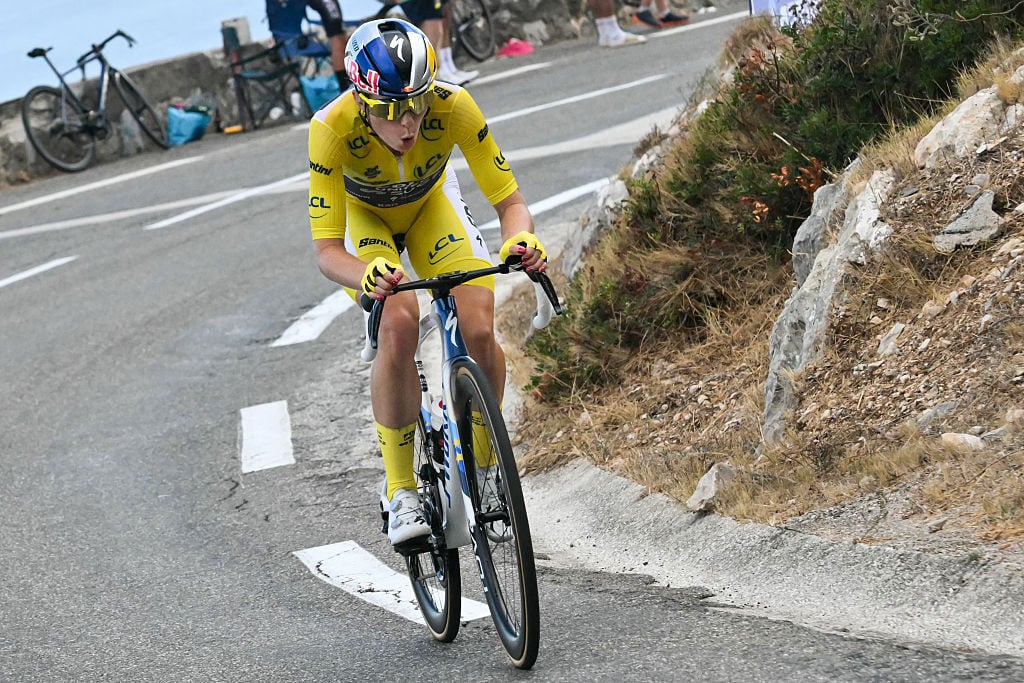 Photo Credit: Getty
Vollering descends towards the title
The descent became Vollering’s victory lap only in the final kilometres. At first, she still had to ride it hard.
With 10 kilometres remaining, her lead over Niewiadoma-Phinney had gone out to around 40 seconds, with the white jersey group just behind the Polish rider. Niewiadoma-Phinney was caught by the Longo Borghini group with 9 kilometres remaining, leaving Vollering alone at the front.
From there, the race was effectively decided. Vollering continued to gain time, pushing her advantage beyond 1 minute on the Niewiadoma-Phinney group and more than 2 minutes on Kerbaol’s group inside the final 5 kilometres.
The final descent and run-in to Nice could still have contained danger, especially with the threat of stormy weather, but Vollering stayed composed. She had taken the race lead on stage 8 through an attack and descent into Nice. On stage 9, she used the same pattern again, only with the authority of the yellow jersey.
Vollering wins in yellow
Vollering rode into Nice alone to win the final stage and seal her second Tour de France Femmes title.
It was the first time she had won a Tour stage while wearing yellow, and she became the third rider in Tour de France Femmes history, including the 1980s era, to win the final stage in the yellow jersey after Annemiek van Vleuten in 2022 and Pauline Ferrand-Prévot in 2025.
The victory completed a remarkable turnaround. Vollering had lost control on Ventoux when Niewiadoma-Phinney attacked into the hesitation between her and Reusser. She took yellow back on stage 8 with a late attack into Nice, then removed any doubt on stage 9 by dropping her rival on the final climb.
This was not a conservative GC defence. It was a yellow jersey rider winning the final stage by attacking uphill and descending alone into Nice.
Niewiadoma-Phinney fights but cannot respond
Niewiadoma-Phinney’s Tour ended in second overall after two days of huge swings. She had produced one of the rides of the race on Mont Ventoux, taking yellow with a solo attack that punished Vollering and Reusser for marking each other.
But stage 8 and stage 9 turned the race back. In Nice on Saturday, Vollering took yellow by 8 seconds. On the final stage, Niewiadoma-Phinney tried to reverse the damage but could not drop her rival on the final Col d’Èze.
Once Vollering attacked before the summit, the Polish rider had no answer. She was eventually caught by the Longo Borghini group, ending any realistic hope of retaking yellow.
It does not diminish her race. She won on Ventoux, wore yellow and once again shaped the Tour. But this time, unlike in 2024, the final day went against her.
Longo Borghini climbs onto the podium
Longo Borghini’s final-stage ride completed her move onto the podium. Reusser’s early collapse and crash opened the door, but the Italian still had to be in the right group and keep riding through a hard final stage.
She did exactly that. UAE Team L’IMAD had made the race aggressive from the start, using García, Włodarczyk, Squiban, Blasi and Longo Borghini to keep pressure on the race. By the end, Longo Borghini was part of the group that caught Niewiadoma-Phinney and finished behind Vollering.
It was a strong conclusion to a race where UAE repeatedly had numbers in the GC fight. Longo Borghini lost time on some of the sharper climbs earlier in the week, but she stayed close enough to capitalise when Reusser faltered.
The podium is the reward for consistency, depth and persistence across a volatile race.
Niedermaier seals white
Antonia Niedermaier finished the Tour as the best young rider, giving Canyon SRAM the white jersey even as they lost the overall battle.
Her final stage was strong and tactically important. She followed the key moves, paced on the final Col d’Èze and remained in the group fighting behind Vollering. With Paula Blasi still close in the young rider classification, Niedermaier could not afford a passive day.
She delivered. Blasi was active, attacking on the third ascent before being marked by Niedermaier, but Canyon SRAM kept the white jersey under control.
For the team, losing yellow after Ventoux will sting. But finishing second overall with Niewiadoma-Phinney and winning the young rider classification with Niedermaier still confirms the strength of their Tour.
Pieterse and Wiebes complete the jersey winners
Puck Pieterse finished the race as the polka-dot jersey winner after an extraordinary mountains campaign. By the final stage, she had already done the work. Her tally of 55 points put her clear of Vollering on 30 and Niewiadoma-Phinney on 28 after the final Col d’Èze.
Pieterse had built the classification through relentless point-scoring across the week, becoming the first rider in the modern Tour de France Femmes to pass 50 points in the mountains competition. She did not need to attack on the final stage. She simply had to finish.
Wiebes sealed the green jersey after the intermediate sprint in Nice, ending the race with a points lead that could not be overturned. Her Tour changed after the first two stages, when the mountains removed her from the yellow jersey fight, but she remained the dominant rider in the points classification.
The final podium of jerseys told the story of the race: Vollering in yellow, Wiebes in green, Pieterse in polka dots and Niedermaier in white.
Reusser’s race ends in frustration
Reusser’s final day was harsh. She had been one of the strongest riders of the first week, winning the Dijon time trial, taking yellow and defending it through a demanding sequence of hilly stages.
But the Col d’Èze exposed her before the crash did. She was dropped on the second ascent, already losing her podium position on the road, then went down on the descent and was left trying to finish with Movistar teammates around her.
Cycling can be brutal in that way. Reusser did not slowly fade from the Tour. Her podium hopes unravelled in the space of one climb and one descent.
Her race still deserves recognition. She changed the shape of the GC in Dijon and forced the climbers to chase. But by the time the Tour reached Nice for the final time, the overall fight had moved away from her.
A Tour defined by constant change
The 2026 Tour de France Femmes was a race of constant yellow jersey changes. Wiebes wore it first after Lausanne and Geneva. Sigrid Ytterhus Haugset took it after her extraordinary 88.5-kilometre solo to Poligny. Reusser moved into yellow after the Dijon time trial. Niewiadoma-Phinney conquered Ventoux and took the lead there. Vollering then seized it in Nice and defended it by winning the final stage.
Five different yellow jersey wearers made this a record edition for the modern race. It also made it one of the most unstable and compelling.
No team controlled the race for long. SD Worx-Protime dominated the opening sprints. Uno-X Mobility had the moment of the race in Poligny. Movistar changed everything in Dijon. Canyon SRAM seemed to have taken control on Ventoux. FDJ United-Suez then struck back twice in Nice.
By the end, Vollering was the rider who had absorbed the most setbacks and still finished strongest.
Vollering wins the Tour again
Vollering’s second Tour de France Femmes title was not a straight line. She missed the chance to close Niewiadoma-Phinney immediately on Ventoux, then admitted the mistake. The difference was what she did afterwards.
On stage 8, she attacked late and took yellow by seconds. On stage 9, she did not defend those seconds nervously. She attacked again, dropped her main rival, won the stage and ended the Tour with authority.
That is what will define this victory. Vollering did not merely survive the final weekend. She won it.
Niewiadoma-Phinney made her fight for every second. Reusser changed the race against the clock. Longo Borghini rode onto the podium late. Niedermaier, Blasi, Włodarczyk, Holmgren and others made the young rider battle a real feature of the Tour. But the final image belongs to Vollering in yellow, alone in Nice, sealing the Tour by attacking rather than waiting.
Tour de France Femmes 2026 stage 9 result
Data powered by FirstCycling.com
Tour de France Femmes 2026 final general classification
Data powered by FirstCycling.com
Main photo credit: Getty