
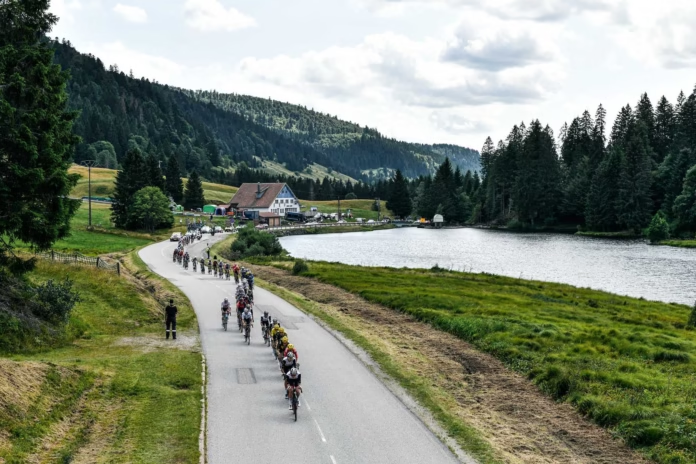
The Tour de France 2026 saves its most obvious drama for Alpe d’Huez, but the Vosges and Jura section may be where the final-week race is quietly set up. Stage 13 from Dole to Belfort, stage 14 from Mulhouse to Le Markstein Fellering and stage 15 from Champagnole to Plateau de Solaison form a difficult eastern sequence before the second rest day and before the race moves towards the Alpine finale.
This is not the highest mountain block in the Tour, but it is one of the most awkward. The stages are long, rolling, repeatedly uphill and tactically hard to control. The Vosges bring classic medium-mountain attrition, with Grand Ballon, Ballon d’Alsace and Col du Haag all packed into stage 14. The Jura brings transition, distance and fatigue, before stage 15 leaves Champagnole and pushes towards the steep Plateau de Solaison.
Together, these stages ask a different question from the Alps. They are not only about who can produce the biggest attack on the final climb. They are about who can handle three days of accumulated pressure, who has a team left, who can recover after the Pyrenees and Massif Central, and who arrives at the second rest day with their race still intact.
For the wider route context, see our Tour de France 2026 full route guide, Tour de France 2026 route analysis, Tour de France 2026 mountain stages ranked by difficulty and Tour de France 2026 climbs guide. The official Tour route summary is also available on the Tour de France 2026 overall route page.
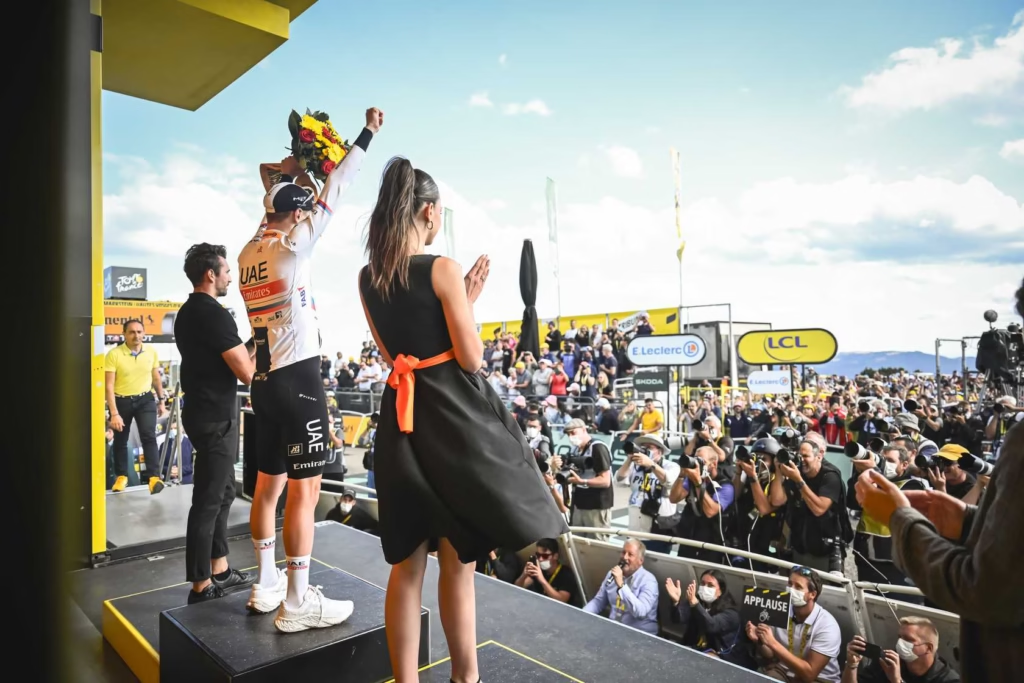
Why the Vosges and Jura matter in the 2026 Tour
The Vosges and Jura matter because they arrive at a dangerous moment. By stage 13, the Tour has already dealt with the Barcelona team time-trial, an early mountain finish at Les Angles, the Pyrenean stage to Gavarnie-Gèdre, the long transfer across the south-west, and the Massif Central stage to Le Lioran. The riders will have had the first rest day in Cantal, but the race will not have reset. It will have accumulated.
That is what makes this block important. The Vosges and Jura may not look as decisive as the Alps on paper, but they come when the Tour is ready to fray. The GC riders have already shown form. The domestiques have already spent energy. The sprinters are already thinking about survival. Breakaway riders are looking for terrain that gives them room to work. The polka-dot jersey contenders are beginning to count points seriously.
This section also leads directly into stage 16, the individual time-trial from Évian-les-Bains to Thonon-les-Bains. That changes the incentives. A GC rider who loses time on stage 14 or stage 15 faces the time-trial under pressure. A rider who gains time before the rest day can force rivals to chase before the Alps even begin.
That makes the Vosges and Jura more than a middle section. They are the bridge between the first mountain fight and the final mountain decision.
For more on how the race can shift before the Alps, see our feature on where the Tour de France 2026 can be won before the Alps, as well as our best time triallists at the Tour de France 2026 guide.
Stage 13: Dole to Belfort
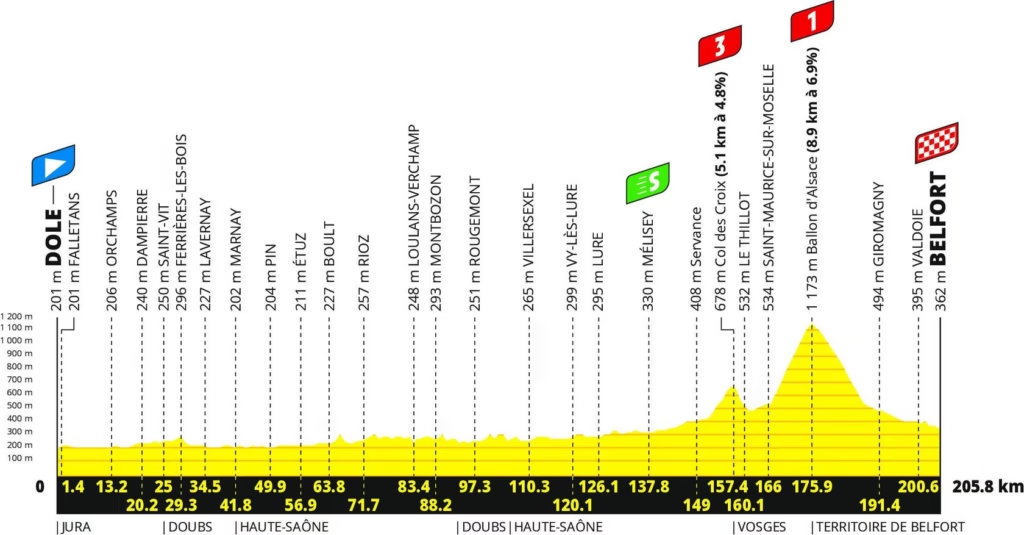
Stage 13 takes the race from Dole to Belfort over 205.8km. It is officially a hilly stage, with 2,400m of elevation gain, and it is the only stage in the 2026 Tour to pass the 200km mark. That alone gives it an old-fashioned weight. The full official route details are on the Tour de France stage 13 page.
This is the Jura-to-Vosges transition day. It may not carry the summit-finish status of the following two stages, but it is exactly the sort of day that can damage riders who are already tired. The length matters. The rolling terrain matters. The position before Le Markstein matters. No GC favourite will want to spend too much energy, but the same restraint could open the door to a strong breakaway.
The stage starts in Dole, in the Jura, and finishes in Belfort, close to the Vosges. That geography gives it a transitional feel. It is not a full mountain stage, but it is not a simple flat day either. Riders who have targeted the breakaway stages may look at this as one of the better opportunities in the second week. Cyclingnews also frames it as a day with strong breakaway potential in its Tour de France 2026 stage 13 preview.
The likely pattern is a hard fight to form the break, followed by a long period of management behind. The GC teams may not want a full chase before stage 14, especially with Le Markstein and Plateau de Solaison still ahead. That gives the attackers a plausible route to the stage win.
But stage 13 could still matter for the overall race. Long hilly stages can create small but costly errors: poor feeding, bad positioning, a crash in the wrong place, a leader briefly isolated, a domestique used too early. Nothing here screams race-winning move, but plenty points towards attrition.
The stage also passes through terrain with a strong French cycling memory, including the area around Mélisey, the home region of Thibaut Pinot. That gives the day a local emotional layer as well as its sporting value, with Cyclingnews covering Pinot’s Tour-related return to the spotlight in its piece on the race passing through his home village.
For the wider breakaway picture, see our Tour de France 2026 breakaway stages ranked guide.
Attack rating: 7/10
GC danger rating: 6/10
Breakaway rating: 9/10
Stage 14: Mulhouse to Le Markstein Fellering
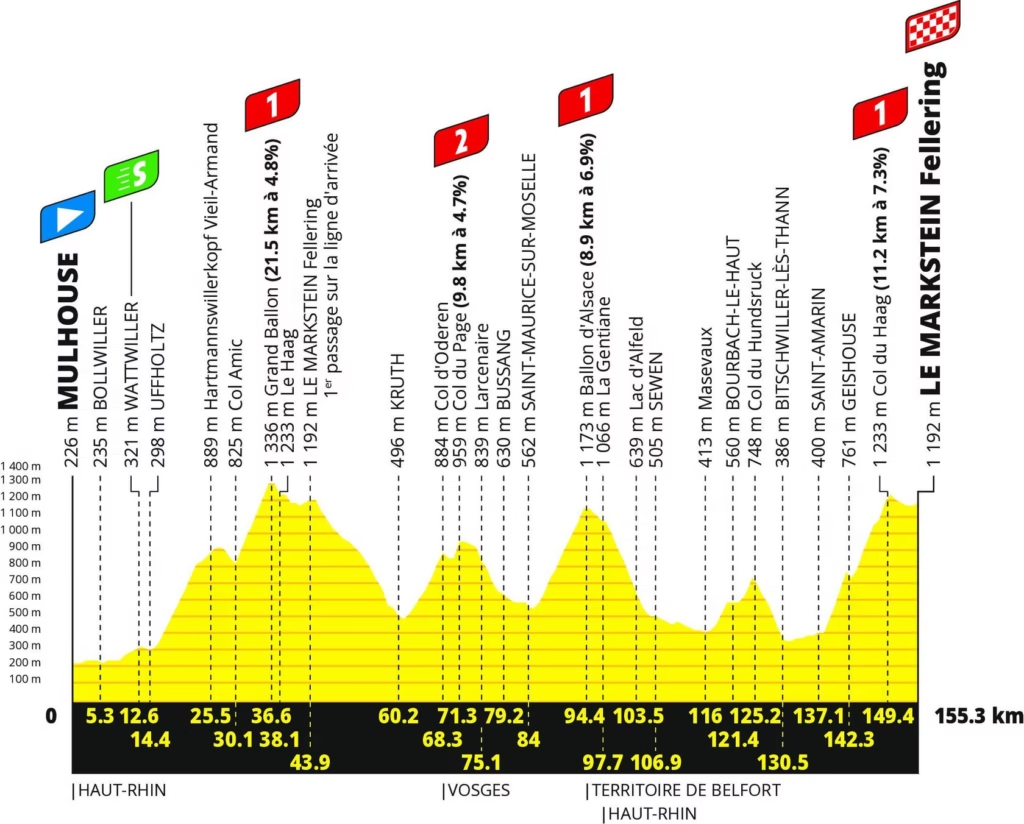
Stage 14 is the heart of the Vosges section. The route from Mulhouse to Le Markstein Fellering is 155.3km long, with 3,800m of elevation gain. It is officially a mountain stage and it carries far more danger than the distance suggests. The official race page has the full stage detail for Mulhouse to Le Markstein Fellering.
The stage includes Grand Ballon, Col du Page, Ballon d’Alsace and Col du Haag among its key climbs, with Le Markstein Fellering providing the final destination. The climbs are not Alpine in height, but they come thickly enough to create a day of continuous pressure. The Vosges are very good at this kind of racing: less spectacular than the high Alps, but awkward, uneven and hard to reduce to one decisive kilometre.
Grand Ballon arrives early enough to make the stage selective from the start. Col du Page keeps the rhythm climbing. Ballon d’Alsace brings Tour history and a more traditional mountain feel. Col du Haag, late in the day, looks especially important because it comes close enough to the finish to be used as the launch point for serious moves.
The key to stage 14 is not just the final climb. It is the sequence. Riders may be able to survive one climb, then another, then another. But by the time the race reaches the late climbs, the repeated accelerations and descents can start to break the elastic. A team with numbers can make this stage very difficult. A team with only one or two helpers left can quickly find itself chasing shadows.
The GC favourites may still be cautious because stage 15 and the Alps are still to come, but stage 14 offers a tempting chance to test recovery. It is the sort of day where a rider does not need to launch a 50km raid to gain time. A hard tempo into Col du Haag, one sharp attack, and a committed final push towards Le Markstein could be enough to take 20 or 30 seconds from a rival on a bad day.
This is also a major polka-dot jersey day. The number of climbs makes it one of the more important middle-mountain stages for the mountains classification. A breakaway climber who gets clear early can build a serious points haul.
For the wider mountains context, see our Tour de France 2026 climbers guide: who can win the polka-dot jersey? and our Tour de France 2026 jerseys explained guide.
Attack rating: 9/10
GC danger rating: 8/10
Polka-dot rating: 9/10
Stage 15: Champagnole to Plateau de Solaison
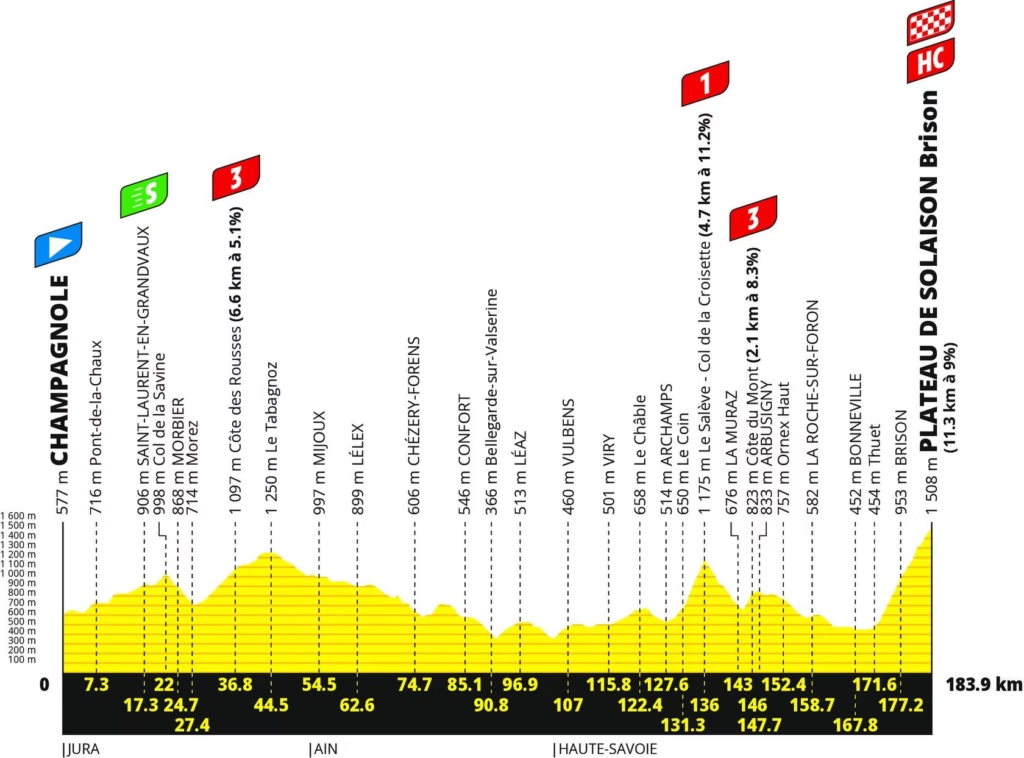
Stage 15 starts in Champagnole, in the Jura, and finishes at Plateau de Solaison after 183.9km and 3,950m of climbing. It is the last stage before the second rest day, and it is much more than a transition towards the Alps. The official Tour page lists the full details for Champagnole to Plateau de Solaison.
This is one of the hardest days of the Tour outside the final Alpine block. The route begins in Jura country, but the stage points towards Haute-Savoie and the pre-Alpine terrain. The official route framing highlights the climb to Le Salève via the Col de la Croisette, with close to five kilometres at an average of 11.2 per cent, before the final climb to Plateau de Solaison on a narrow road in the Bornes massif. Cyclingnews makes the same point in its stage 15 preview, stressing the role of the Col de la Croisette before the final climb.
That final climb is severe. Plateau de Solaison is 11.3km at 9.1 per cent, steep enough to create proper GC differences and hard enough to punish any rider who has been hiding fatigue across the previous days. It is not a climb where a leader can simply bluff. If the legs are gone, the road will expose it.
The stage’s position before the rest day adds another tactical layer. Riders can afford to spend more here than they might on a stage followed by another immediate mountain test. There is a rest day waiting, but there is also a time-trial after it. That means stage 15 can become a day for committed GC attacks, especially from climbers who know stage 16 may cost them time.
For a rider such as Jonas Vingegaard, this is a chance to put time into stronger time-triallists before the Lake Geneva test. For a rider such as Remco Evenepoel, it may be a day of controlled defence. For Tadej Pogačar, it is the kind of climb where he can either attack or simply put rivals under pressure by following the strongest move.
Stage 15 may end up being one of the most revealing stages of the whole race. It comes late enough for weakness to mean something, but early enough that a bad day does not finish the Tour. It can define who goes into the second rest day confident, and who spends that rest day calculating what they must recover in the time-trial and the Alps.
For more on how Plateau de Solaison fits into the full mountain picture, see our Tour de France 2026 summit finishes guide and Tour de France 2026 mountain stages ranked by difficulty.
Attack rating: 9/10
GC danger rating: 9/10
Rest-day pressure rating: 10/10
The key climbs of the Vosges and Jura block
The climbs in this section do not all carry the same fame, but together they create one of the most important terrain changes in the race.
Grand Ballon is the symbolic and sporting centre of the Vosges stage. It is long enough to set the tone and high enough to make the peloton work from early in the day. It may not decide stage 14 by itself, but it can help decide how hard the rest of the stage becomes.
Ballon d’Alsace brings Tour history. It is one of those climbs that connects the modern race with its older mountain identity, and its place in the middle of stage 14 adds both sporting and narrative weight.
Col du Haag looks like the most important late-stage launch point on stage 14. Coming near the end and carrying real gradient, it should be the climb where stage-winning and GC-relevant moves become possible.
Le Markstein Fellering is the finish location, but the danger is really in the full Vosges sequence. A rider who reaches the final kilometres already under pressure may not need a brutal summit finish to lose time.
Le Salève via Col de la Croisette is the bridge between Jura and the pre-Alps on stage 15. Its steep section is exactly the kind of terrain that can strip a group down before the final climb.
Plateau de Solaison is the final test before the second rest day. At 11.3km and 9.1 per cent, it is a full GC climb. Riders cannot treat it as a transition climb. It is the stage’s decisive obstacle and potentially one of the most important summit finishes before Alpe d’Huez.
For the full climb hierarchy, see our Tour de France 2026 climbs guide, which places the Vosges and Jura climbs alongside the Pyrenees, Alps and Massif Central.
Why stage 14 may be harder to control than it looks
Stage 14 is one of those days where the profile can slightly mislead. It is not a towering Alpine stage and it does not have the final-week glamour of Alpe d’Huez, but the terrain is difficult to manage.
The Vosges often produce restless racing because the climbs are frequent, the roads can be narrow, and the gradients rarely allow a team to settle into a simple tempo for long periods. That makes stage 14 hard for GC teams that want total control. A strong breakaway can be hard to pull back. A domestique group can disappear quickly. A leader who has a small weakness can be exposed before the final 10km.
The stage also falls immediately after the long hilly day to Belfort. That matters. Stage 13 may not decide the race, but it can soften the peloton. Stage 14 then arrives with enough climbing to punish anyone who spent too much energy the day before.
The most likely GC scenario is selective pressure rather than all-out chaos. But the stage has the ingredients for something bigger: a strong break, a polka-dot battle, a team trying to isolate rivals and a late move on Col du Haag.
That is why stage 14 belongs high in any ranking of the Tour de France 2026 route’s best GC attack days and sits naturally alongside the route’s other hard-to-control mountain stages.
Why Plateau de Solaison could shape the yellow jersey race
Plateau de Solaison is one of the most important climbs in the 2026 Tour because of where it sits in the race.
By the time riders reach it, the early mountain hierarchy should already be clear. The Pyrenees will have shown who can climb. Le Lioran and Le Markstein will have tested recovery. Stage 15 then asks a more direct question: who can still produce a proper summit-finish effort before the second rest day?
The climb itself is difficult enough to create time gaps. At 11.3km and 9.1 per cent, it rewards sustained climbing and punishes riders who rely on wheels. Drafting helps less when the gradient is severe. Team support matters less once the front group is reduced. At some point, it becomes a rider-versus-slope test.
That makes it especially important for the GC riders who are not expected to gain time in the stage 16 time-trial. They cannot afford to ride passively into the rest day, knowing that the stopwatch may shift the race against them two days later. Plateau de Solaison is their chance to change the numbers before the time-trial.
For more on how the time-trial changes the surrounding mountain stages, see our best time triallists at the Tour de France 2026 and Tour de France 2026 route analysis.
Which riders benefit most from this block?
The Vosges and Jura block should suit riders who can handle repeated climbing without needing the highest Alpine passes. That makes it a strong area for punchy GC riders, resilient climbers and breakaway specialists.
Tadej Pogačar should like this terrain. Stage 14 gives him rolling, selective climbs where he can test rivals without needing a long Alpine assault. Stage 15 gives him a summit finish steep enough to make a proper difference. He does not have to attack, but he has several places where he can make others uncomfortable. For more on his route fit, see our Tadej Pogačar at the Tour de France 2026 feature.
Jonas Vingegaard will be especially interested in Plateau de Solaison. The steeper final climb gives him a chance to apply pressure before the stage 16 time-trial. He may not need to attack in the Vosges, but he cannot afford to let every pre-time-trial mountain chance pass by. His wider route is covered in our Jonas Vingegaard at the Tour de France 2026 analysis.
Remco Evenepoel’s aim may be more about control. Stages 14 and 15 are dangerous because they come before a time-trial that should suit him. He has every reason to stay close, avoid unnecessary risk and make the climbers spend energy before stage 16. For more on that balance, see our Remco Evenepoel at the Tour de France 2026 feature.
The next layer could include riders such as Felix Gall, Kévin Vauquelin, Matteo Jorgenson, Florian Lipowitz, Carlos Rodríguez, Oscar Onley, Thymen Arensman and Paul Seixas. This block suits riders aiming to move into the top five or top ten because it offers multiple chances to exploit fatigue without waiting for the Alps.
For more on that wider group, see our Tour de France 2026 dark horses for the general classification, Tour de France 2026 young riders to watch and best French riders to watch at the Tour de France 2026 guides.
What this block means for the polka-dot jersey
The Vosges and Jura section should be one of the central battlegrounds for the mountains classification.
Stage 14 is especially important because it offers a cluster of categorised climbs in one day. A rider in the right breakaway can take points early, continue scoring through the middle of the stage and still be present late. That makes it one of the more valuable non-Alpine days for a polka-dot contender.
Stage 15 then adds a major summit finish. The Plateau de Solaison points could be decisive, especially if the mountains classification is already beginning to separate. A breakaway climber may try to take points before the final climb, but the GC favourites could also sweep up the biggest finish points if the stage is ridden hard by the general classification teams.
The key question is whether a polka-dot contender can survive both days. Stage 14 rewards aggression. Stage 15 rewards climbing depth. A rider who can do both leaves the second rest day in a strong position before the Alps.
For more on that competition, see our Tour de France 2026 climbers guide: who can win the polka-dot jersey? and Tour de France 2026 jerseys explained.
What this block means for sprinters
For sprinters, the Vosges and Jura block is about survival and energy management.
Stage 13 may be long and hilly rather than mountainous, but it still has enough difficulty to drain fast men already carrying fatigue. Stage 14 is a clear survival day. Stage 15 is another major climbing stage before the rest day. Any sprinter chasing green has to get through this section without losing too much freshness.
That matters because the 2026 Tour gives the sprinters enough chances, but not an easy road between them. Jonathan Milan, Jasper Philipsen, Tim Merlier, Biniam Girmay, Arnaud De Lie and others will need to manage the mountains carefully. The green jersey battle can be decided as much by who survives these blocks efficiently as by who is fastest on a flat finish.
The points competition may pause in terms of stage wins, but it does not pause in terms of attrition. A sprinter who loses too much energy here may be less dangerous when the next flat opportunity comes.
For more on that side of the race, see our Jonathan Milan at the Tour de France 2026, Tour de France 2026 sprint stages ranked and Tour de France 2026 sprinters guide.
What this block means for breakaway riders
Breakaway riders should see this as one of the best sequences of the Tour.
Stage 13 has the length and terrain for a strong move to survive. Stage 14 has enough climbs to reward aggressive climbers and polka-dot hunters. Stage 15 could be harder for a breakaway if the GC teams decide to control the final climb, but the route still gives attackers plenty of terrain before Plateau de Solaison.
The key is team strategy. If the GC teams want to save energy before stage 15 and the time-trial, stage 13 and even stage 14 could become breakaway-friendly. If a GC battle is already close and several teams need time, the breakaway window narrows.
This is where the race can become tactically layered. The breakaway may be racing for the stage win, the polka-dot jersey and team objectives at the same time, while the peloton behind is calculating energy for the second rest day, time-trial and Alps.
For the wider attacking picture, see our Tour de France 2026 breakaway stages ranked guide.
Best places to watch the Vosges and Jura stages
For roadside fans, the Vosges and Jura block offers a different experience from the Alps. The climbs are often more accessible, the crowds may be slightly less overwhelming, and the racing can still be excellent.
Stage 13 is best suited to fans who want a long roadside day without the pressure of a full summit finish. Belfort should offer a strong finish atmosphere, while the earlier rolling terrain could suit those looking for less crowded viewing points.
Stage 14 is the best pure Vosges viewing day. Grand Ballon, Ballon d’Alsace, Col du Haag and Le Markstein all offer strong options. The finish area at Le Markstein Fellering will likely be the biggest draw, but the earlier climbs may offer a better view of the race as it begins to break apart.
Stage 15 is the most important GC viewing day in the block. Plateau de Solaison should be the main target for fans who want to see the favourites under full pressure, but the earlier steep climbing around Le Salève and Col de la Croisette could also be attractive for spectators who want to see the race before the final selection.
For official access, stage information and spectator guidance, the race organiser’s pages for stage 13, stage 14 and stage 15 are the safest starting points. For UK fans planning to watch from home, see our how to watch Tour de France 2026 in the UK guide.
-
 Photo Credit: David Pintens / BELGA MAG/AFP via Getty Images
 -
Photo Credit: BELGA MAG/AFP via Getty Images
Best Vosges and Jura stages ranked
⦿ Stage 15: Champagnole to Plateau de Solaison
The biggest GC stage in this block, with a steep summit finish before the second rest day.
⦿ Stage 14: Mulhouse to Le Markstein Fellering
A demanding Vosges mountain stage with repeated climbing and major polka-dot implications.
⦿ Stage 13: Dole to Belfort
The longest stage of the 2026 Tour, and a prime breakaway day that can soften the race before the mountains return.
Prediction
The Vosges and Jura block will not receive the same attention as Alpe d’Huez, but it may be where the Tour starts to narrow properly.
Stage 13 should be a breakaway day, with the length and hilly terrain making it awkward for sprint teams and too early for full GC warfare. Stage 14 should be one of the best days for climbers outside the Alps, with Le Markstein and the preceding climbs giving the race a real chance to split. Stage 15 should be the decisive GC stage of the block, especially because Plateau de Solaison comes just before the second rest day and stage 16 time-trial.
Pogačar has the range to use all three days. Vingegaard may see stage 15 as the key pre-time-trial climbing chance. Evenepoel will want to manage risk and arrive at stage 16 close enough to use his time-trial strength. Riders like Gall, Vauquelin, Jorgenson, Lipowitz, Rodríguez, Onley, Arensman and Seixas could find major opportunities here.
The most important stage is stage 15. The most unpredictable stage is stage 14. The best breakaway day is stage 13. Together, they make the Vosges and Jura section one of the most important transition blocks of the 2026 Tour.
For the next phase of the race, see our Tour de France 2026 Alps guide and Tour de France 2026 queen stage guide. For full race coverage, visit our Tour de France hub.

