
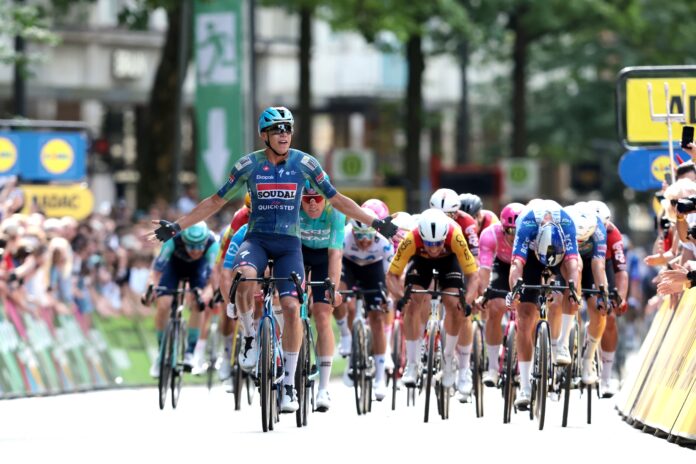
Paul Magnier won the 2026 ADAC Cyclassics in Hamburg, sprinting to victory on Mönckebergstraße after Soudal Quick-Step controlled the final kilometres of a race shaped by the repeated ascents of the Waseberg.
The Frenchman beat Mike Teunissen of XDS Astana and Laurence Pithie of Red Bull-Bora-Hansgrohe to claim his first WorldTour one-day victory and continue a strong season that had already included three stage wins at the Giro d’Italia. It was also a measure of revenge for Magnier, who had finished third in Hamburg a year earlier.
The decisive selection came on the final ascent of the Waseberg, where Isaac del Toro accelerated for UAE Team Emirates-XRG and caused a major split. Jonathan Milan and Olav Kooij were among the sprint favourites caught behind, while Magnier survived in the front group before Soudal Quick-Step took control inside the final 10 kilometres.
A Hamburg Classic shaped by the Waseberg
The 29th edition of the ADAC Cyclassics took the riders over 205.3 kilometres from Buxtehude to Hamburg, with the finish once again in the Mönckebergstraße area of the city.
The Waseberg was the key feature of the course. It is short, only around 700 metres, but averages close to 10 per cent and includes ramps up to 16 per cent. Covered five times, it gave the race its familiar tension: hard enough to drop tired sprinters, but not long enough to guarantee that attackers would stay away.
That balance is what makes Hamburg difficult to read. A pure bunch sprint is always possible, but the repeated late climbs give teams without a top sprinter a clear tactical route. UAE Team Emirates-XRG had Isaac del Toro and Benoît Cosnefroy, but no obvious Milan-style finisher. Soudal Quick-Step had Magnier, and their task was different: keep him in the front selection, avoid losing control on the Waseberg, then use the final flat run-in to set up the sprint.
By the finish, both strategies had shaped the race. UAE blew it open. Quick-Step finished it.
Six riders form the early break
The day’s early move contained six riders: Filip Maciejuk of Movistar, Jonas Rutsch of Lotto-Intermarché, Dries De Pooter of Jayco AlUla, Benjamin Thomas of Cofidis, and the Team Visma | Lease a Bike pair of Niklas Behrens and Loe Van Belle.
The group built a useful advantage, but never enough to make the peloton panic. Their gap stayed below 5 minutes, with the sprint and Classics teams keeping the race within reach before the repeated Waseberg circuits began to bite.
The early phase was also marked by crashes. Michael Matthews of Jayco AlUla and Mattia Agostinacchio of EF Education-EasyPost were both forced to abandon, while Del Toro also hit the deck but was able to continue.
That mattered later. Del Toro would become one of the most important riders in the finale despite the earlier crash, turning the Waseberg into the selection point UAE had clearly been waiting for.
Cosnefroy opens the attacking phase
The first ascent of the Waseberg after around 90 kilometres did little immediate damage, with the break still holding around 3 minutes as the riders passed through Hamburg.
The second ascent, with around 75 kilometres remaining, changed the tone. Cosnefroy attacked for UAE Team Emirates-XRG, drawing out Brandon Rivera of Netcompany INEOS, Tim Rex of Team Visma | Lease a Bike and Brent Van Moer of Pinarello-Q36.5.
It was not the move that decided the race, but it showed UAE’s plan. They were not going to wait for a reduced sprint against faster riders. They wanted repeated pressure, especially on the Waseberg, to make the race harder and force the sprint teams to chase.
The Cosnefroy move was eventually neutralised as Team Visma | Lease a Bike accelerated behind, but it had already helped drag the peloton into a more aggressive phase.
The Vermeersch move keeps the pressure on
The next attack came from the two Vermeerschs, with Florian of UAE Team Emirates-XRG and Gianni of Red Bull-Bora-Hansgrohe going clear for several kilometres.
Again, it was not a race-winning move, but it added to the sense of pressure before the final twin ascents of the Waseberg. By the penultimate passage of the finish line, just over 50 kilometres from the end, the peloton was still 1:25 behind the original breakaway, but the chase was now entering its decisive phase.
Up front, the break began to fracture. Thomas and Rutsch moved clear before Behrens and Van Belle caught them, leaving four riders still trying to survive as the race headed back towards the west of Hamburg.
Behind, the major teams were preparing for the final use of the Waseberg. The early break had done its job by shaping the day, but the winner would come from the peloton.
Girmay crashes out of contention
One of the race’s key sprinters lost his chance before the final Waseberg. Biniam Girmay crashed on a right-hand bend and needed a bike change at exactly the wrong moment.
With UAE beginning to lift the pace into the decisive part of the race, Girmay had little realistic chance of returning to the front. It was a major loss for NSN Cycling Team and removed one of the riders who could have challenged Magnier in a reduced sprint.
His crash also added to the pressure on other sprinters trying to survive the final climb. Milan and Kooij were still in the race, but the last Waseberg ascent was about to change that.
-
 Photo Credit: A.S.O./Billy Ceusters
Del Toro splits the race
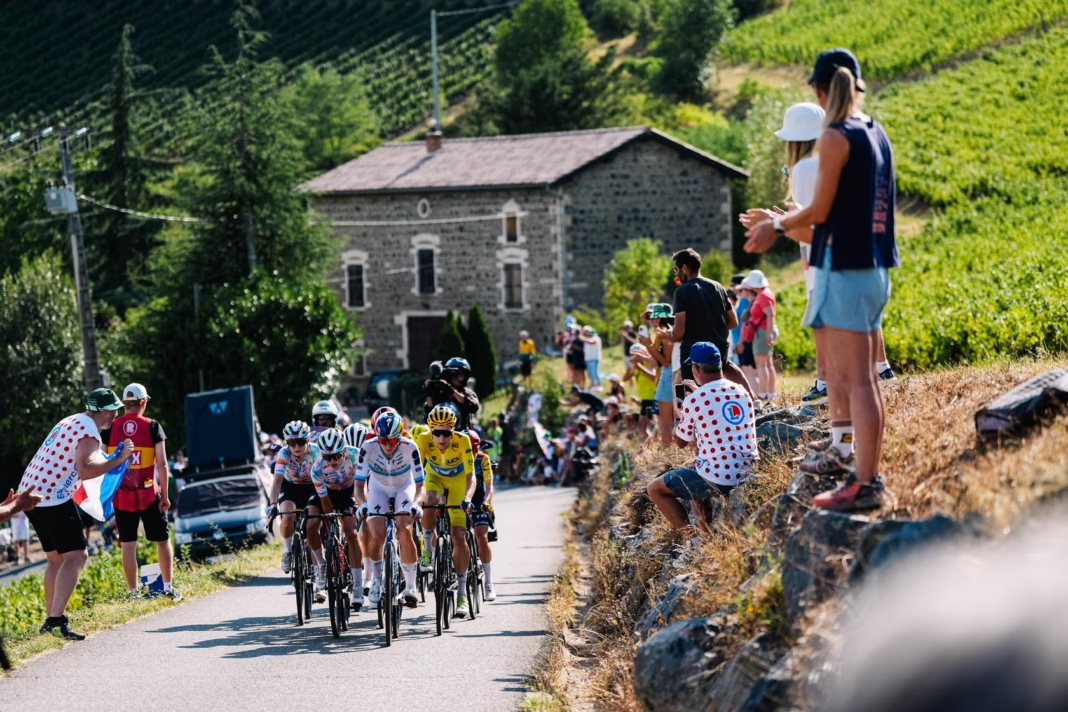
The expected Del Toro attack came on the final ascent of the Waseberg, around 15 to 16 kilometres from the finish.
The Mexican could not get clear alone, but the point of the move was not only to ride away. It was to split the peloton, and that worked. The acceleration forced a major selection and put Milan and Kooij into difficulty, cutting off two of the most dangerous sprint favourites from the front group.
That was the tactical hinge of the race. Magnier survived the climb in the front selection. Milan and Kooij did not. UAE had succeeded in making the race too hard for some of the pure sprinters, but they still had to find a way to stop the riders who had survived.
Del Toro tried again after the final remnants of the break, Thomas and Rutsch, had been brought back. Others also looked for openings in the final kilometres, but the race never fully broke apart.
Instead, the front group and the chasing Milan-Kooij group became the central battle.
Quick-Step keep Milan and Kooij away
Inside the final 10 kilometres, the Milan and Kooij group looked close to returning. That was the danger for Soudal Quick-Step. Magnier had survived the Waseberg, but if the race came fully back together, the sprint field would become much more complicated.
Quick-Step made the decisive choice. They came to the front, helped keep the pace high and ensured the dropped sprinters did not make it back. Uno-X Mobility and Team Visma | Lease a Bike also contributed to the speed, but Quick-Step had the clearest interest. They had the fastest rider in the front group and needed only to keep the selection intact.
That work turned the final kilometres from a chase into a lead-out problem. Quick-Step had done enough to remove the biggest threats, but they still had to deliver Magnier through a reduced and restless peloton.
They took charge from around 3 kilometres out.
Magnier finds the gap
Quick-Step dominated the approach, putting two riders in front of Magnier deep into the finale. The lead-out was not perfect, with the final man Jasper Stuyven forced to swing off around 500 metres from the line, leaving Magnier with work still to do.
That might have been a problem for a less confident sprinter. It was not for Magnier.
As Red Bull-Bora-Hansgrohe tried to swarm into position, Magnier stayed calm, slotted into the right wheel and waited for the sprint to open. Once it did, he moved decisively clear in the final 150 metres.
The gap at the line told the story. Magnier did not just edge the sprint. He had daylight over the rest, beating Teunissen and Pithie after a finish where his team had done the hard work and his own speed made the difference.
A first WorldTour one-day win
For Magnier, this was a landmark victory. He had already shown his finishing ability across the season, including three Giro d’Italia stage wins, but Hamburg gave him a different kind of result: a WorldTour one-day race won after repeated climbs, selection pressure and a reduced sprint.
“I’m super proud to take my first WorldTour one-day victory,” Magnier said. “I think I can really thank my team, every single rider worked really hard, and in the final team really put me in the perfect position and I could make a perfect sprint.
“We also knew the breakaway was really strong. We didn’t want it to happen like last year. Ayco Bastiaens and Yves Lampaert had to work really hard to bring everything back together. Then the whole lead-out train helped me to always survive this steep climb every loop. I also felt strong in the last lap to follow the move of Del Toro. I knew I had a really strong lead-out and was really confident in them and super proud to finish it off.”
That reference to last year mattered. Magnier had been third in Hamburg in 2025. This time, he came through the climb, trusted the team and finished the job himself.
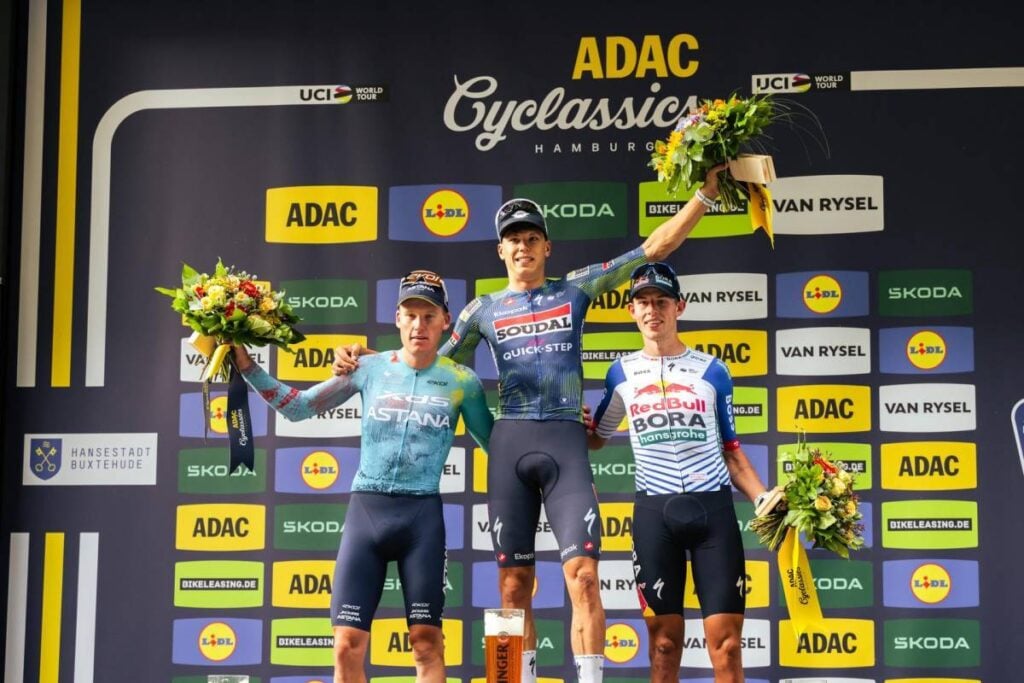
Teunissen and Pithie complete the podium
Teunissen’s second place was a strong result for XDS Astana, especially in a finale where positioning became difficult once the reduced sprint formed. He survived the Waseberg selection and had the speed to beat almost everyone in the front group.
Pithie’s third place gave Red Bull-Bora-Hansgrohe a podium after an aggressive race. The team had been represented in late moves through Gianni Vermeersch, then tried to organise in the finale, but Magnier’s acceleration was too strong.
The podium reflected the nature of the race. This was not a full bunch sprint for the pure fastest men. It was a sprint between those who had survived the climb, avoided the crashes, held position in the final 10 kilometres and still had the speed to contest Mönckebergstraße.
Magnier was comfortably the best of them.
UAE make the race, but not the result
UAE Team Emirates-XRG were one of the most influential teams in the race, even without taking the win. Cosnefroy attacked with 75 kilometres to go, Florian Vermeersch was part of another move, and Del Toro produced the acceleration that removed Milan and Kooij from the front group.
That made UAE central to the outcome. Without their aggression, the race may have finished with a larger group and a different sprint dynamic. With it, the finale became more selective and more open.
The problem was that they did not have the finishing weapon to turn that work into victory. Del Toro could split the race, but he could not get away. Once the attacks were neutralised and Quick-Step took control, UAE’s race-making work helped create the conditions for Magnier.
It was a strong tactical race, but not a winning one.
Hamburg gets a new French winner
Magnier became the first French winner of the ADAC Cyclassics since Arnaud Démare in 2012, adding a new name to the Hamburg honour roll and giving Soudal Quick-Step another major one-day success.
It was also a win that suited the modern identity of the race. Hamburg is often described as sprinter-friendly, but the Waseberg makes it more complicated than that. The race rewards sprinters who can survive repeated punchy climbs, handle high-speed stress and still sprint after being put under pressure late.
Magnier did all of that. He survived Del Toro’s final Waseberg attack, stayed in the reduced front group, benefited from Quick-Step’s work to keep Milan and Kooij away, then delivered the clearest sprint of the day.
One year after finishing third, he came back to Hamburg and won.
ADAC Cyclassics 2026 result
| Position | Rider | Time/gap |
|---|---|---|
| 1 | Paul Magnier | 4:17:55 |
| 2 | Mike Teunissen | same time |
| 3 | Laurence Pithie | same time |
| 4 | Paul Penhoët | same time |
| 5 | Henri Uhlig | same time |
| 6 | Milan Fretin | same time |
| 7 | Noah Hobbs | same time |
| 8 | Huub Artz | same time |
| 9 | Søren Wærenskjold | same time |
| 10 | Arnaud De Lie | same time |
Main photo credit: Getty

