
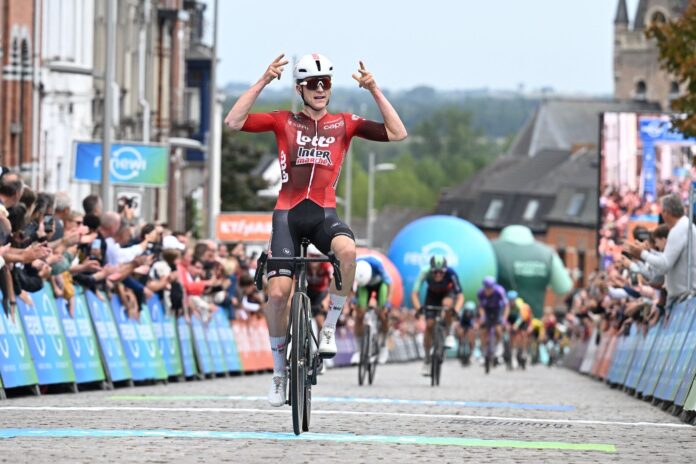
Jenno Berckmoes won stage 3 of the 2026 Renewi Tour in Geraardsbergen, turning a late attack with Alec Segaert into a dramatic solo victory on the cobbles of De Vesten.
The Lotto-Intermarché rider attacked with Segaert over the final ascent of the Muur van Geraardsbergen, then powered clear inside the final 500 metres as the reduced peloton closed in behind. Jasper Philipsen finished second at 3 seconds, ahead of Olav Kooij and Arnaud De Lie, but Philipsen lost the race lead to Berckmoes after a stage shaped by climbs, crashes, bonus seconds and a fragmented chase.
Berckmoes started the day 9 seconds down overall, but took 10 bonus seconds for the stage win and another 8 seconds during the Green Kilometre on the Bosberg. That was enough to move him into the leader’s jersey, 6 seconds ahead of Philipsen, with Kooij third overall at 12 seconds.
A Flanders-style stage to Geraardsbergen
Stage 3 was the first major selection point of the 2026 Renewi Tour. After two sprint finishes in Diest and Ardooie, the race moved onto much sharper terrain with a 184.6-kilometre route from Celles to Geraardsbergen.
The stage was built around the Flemish Ardennes and carried the feel of a one-day Classic inside a short stage race. The riders faced the Paterberg, Oude Kruisberg, Muur van Geraardsbergen, Bosberg, Onkerzeleberg and Denderoordberg, with the finish placed on the cobbled drag of De Vesten, partway up the famous Muur but before the steepest chapel section.
That made it a very different test from the opening two stages. Philipsen began the day in the leader’s jersey after winning stage 2 in Ardooie, but the question was whether he could survive repeated accelerations on the cobbles and still defend the lead against riders better suited to short climbs and hard racing.
The answer, ultimately, was almost. Philipsen was close enough to sprint for second, but Berckmoes had already taken the race away.
Milan abandons after stage 2 crash
The stage began with the after-effects of the crash-hit previous day still visible. There were four non-starters after stage 2: Kasper Asgreen, Simone Consonni, Tobias Bayer and Taco van der Hoorn.
Jonathan Milan did start after his heavy crash in Ardooie, but his race did not last long. The stage 1 winner and former race leader abandoned after around 15 kilometres, still suffering from the damage of the previous day.
That removed one of the fastest riders in the race and confirmed how costly the opening two stages had already been. Renewi Tour sprint stages are often nervous, but this edition had already produced enough crashes to reshape the race before the decisive climbing day even began.
There would be more crashes before Geraardsbergen.
Three-man breakaway heads for the Flemish Ardennes
The early phase included two short laps around Celles before the day’s main move went clear on the road towards the Flemish Ardennes.
Julius Johansen of UAE Team Emirates-XRG, Frederik Frison of Pinarello-Q36.5 and Michiel Lambrecht of Team Flanders-Baloise formed the breakaway and built a lead that moved towards 4 minutes.
It was a useful move, but not one that was ever completely safe. The route still had too many climbs waiting, and the peloton knew that the real race would begin once the cobbled bergs started to arrive.
The break still played an important role. They gave the race its early structure, forced the peloton to manage the gap and were still out front as the route moved into the more selective part of the stage.
The race starts to split
The breakaway ticked off the early climbs, including the Knokteberg, Paterberg and Oude Kruisberg, before the race reached the finishing circuit in Geraardsbergen.
By the first passage of the finish line, with 66 kilometres remaining, the gap had come down to around 2 minutes. The circuit then added another layer of difficulty. It started and finished on De Vesten, climbed up through the Muur towards the chapel, then moved on to the Bosberg, Onkerzeleberg and Denderoordberg before returning to Geraardsbergen.
That meant the stage was no longer about one climb. It was about repeating hard efforts, recovering on narrow roads and staying near the front before every acceleration.
The first serious movement from the peloton came on the Onkerzeleberg, where Lorenzo Milesi, Martin Svrček and Niklas Behrens attacked and bridged across to the leaders. That turned the front group into six riders and sharpened the race before the final lap.
Crashes disrupt the peloton again
As the pace increased, the crashes continued.
Biniam Girmay went down before a larger crash hit the race late on the first finishing lap, around a kilometre before the line. Magnus Sheffield and Vlad Van Mechelen were both forced out, adding to the list of riders removed from contention across a brutally attritional first three days.
The crash also changed the tactical shape of the stage. It split the peloton just before the race returned to the Muur and passed under the finish banner. A smaller front group emerged from the disruption, and Berckmoes and Segaert were both present when the race reached the steepest section.
That moment was decisive. The day’s early break was swallowed up, the peloton was no longer fully organised, and the strongest riders suddenly had a chance to turn the race into something much more dangerous than a reduced sprint.
Berckmoes and Segaert attack on the Muur
Berckmoes and Segaert made their move over the top of the Muur van Geraardsbergen with around 30 kilometres remaining.
Only the two Belgians were able to create the gap. Behind them, the reduced peloton was close enough to keep the move under pressure, but not organised enough to immediately close it. That became the central tension of the final half-hour.
The leading pair pushed on towards the Bosberg, where the Green Kilometre bonus seconds became a major part of the GC equation. Berckmoes took valuable seconds there, eventually finishing the day with 8 bonus seconds from the Green Kilometre in addition to the stage winner’s bonus.
That transformed the move. It was no longer just a stage-winning attack. It was also a direct bid for the leader’s jersey.
Philipsen chases, but the group hesitates
Behind, the chase never fully settled.
Philipsen was still in the front group and was clearly strong enough to remain in contention, but Alpecin-Premier Tech could not simply close everything alone. The group behind Berckmoes and Segaert was reduced to around 40 riders, yet it still lacked the clean organisation needed to bring back two committed attackers.
Philipsen was even forced to close gaps himself at one point, a sign that the leader’s jersey was beginning to become more burden than advantage. Others had teammates or stage ambitions, but few had a clear reason to sacrifice themselves completely.
Laurence Pithie then attacked with around 18 kilometres to go, which briefly disrupted the chase further. His move did not reach Berckmoes and Segaert, but it added to the stop-start rhythm behind and gave the leaders more breathing room.
Denderoordberg brings the gap down
The chase did come back into view before the final climb of the day.
A surge in the bunch on the approach to the Denderoordberg ended Pithie’s pursuit and cut the gap to Berckmoes and Segaert to around 10 seconds. At that point, the move looked close to being caught.
But the peloton again hesitated. Tomáš Kopecký attacked from behind, there was another lull, and the gap went out again. That was the pattern of the finale: close enough for the peloton to believe the catch was possible, but never controlled enough to make it happen.
That gave the two leaders a real chance. The final kilometres into Geraardsbergen included a fast descent and a technical entrance into town, so the peloton needed to catch them before the final uphill drag if it wanted a straightforward sprint.
It did not.
Berckmoes goes alone on De Vesten
The final move came inside the last 500 metres.
As the road tilted up onto the cobbles of De Vesten, Berckmoes attacked Segaert. It was the perfect moment. The peloton was coming quickly behind, Segaert was near the limit, and the finish line was close enough for one final burst to hold.
Berckmoes immediately opened a gap. Segaert could not follow and was swept up by the charging group behind, where De Lie launched the sprint and Philipsen came around him for second place.
Berckmoes, though, had enough left. He powered over the draggy cobbles, kept the speed high and held off the sprinters by 3 seconds.
It was not a conventional bunch finish, and it was not a long solo either. It was a perfectly judged late strike from a rider who had read the rhythm of the chase and understood exactly how much the final cobbled drag could give him.
Philipsen second, Kooij third, De Lie fourth
Philipsen took second place behind Berckmoes, with Kooij third and De Lie fourth in the same time, 3 seconds down on the winner.
That result showed how close the race had come to being pulled back into a sprint. Philipsen, Kooij and De Lie were all near enough to fight for the podium, but none of them reached Berckmoes before the line.
Robert Donaldson finished fifth at 6 seconds, ahead of Quinten Hermans and Mike Teunissen. Filippo Fiorelli, Pepijn Reinderink and Søren Wærenskjold completed the top 10.
For Philipsen, second place was a strong ride on terrain that was not built purely for him, but it still cost him the overall lead. For Kooij, third kept him firmly in the GC fight after three consecutive stages where positioning and sprint speed have mattered. For De Lie, fourth came after a strong team day from Lotto-Intermarché, even if Berckmoes was the rider who converted it.
Berckmoes takes the race lead
The double reward for Berckmoes was the stage win and the leader’s jersey.
He now leads the Renewi Tour by 6 seconds over Philipsen, with Kooij another 6 seconds back in third. De Lie sits fourth at 19 seconds, level on time with Hermans, while Teunissen is sixth at 22 seconds. Wærenskjold and Segaert are both at 23 seconds, with Donaldson and Matteo Trentin also inside the top 10 overall.
That is still a very tight race. The Renewi Tour is often decided by seconds, and stage 3 proved how important the bonus structure can be. Without the Green Kilometre seconds on the Bosberg, Berckmoes would not have created the same cushion. With them, he now controls the race heading into the final weekend.
The route still gives others chances. Stage 4 to Bilzen-Hoeselt and the final day around Leuven both offer terrain where positioning, bonus seconds and short climbs can still change the standings.
-
 Photo Credit: A.S.O./Billy Ceusters
Lotto-Intermarché turn the race around
Lotto-Intermarché were the biggest winners of the day.
Berckmoes took the stage and the overall lead, while De Lie finished fourth and moved into the top five overall. That gives the team two live cards going into the final two stages: a leader who can handle short climbs and hard finishes, and a sprinter-puncheur capable of taking bonuses and stage results.
The way the stage unfolded suited them perfectly. De Lie remained in the chasing group and became a major threat behind, while Berckmoes forced the others to chase from the front. If the move came back, De Lie had a sprint. If it stayed away, Berckmoes had the stage.
It is rare that a team gets both options working so cleanly in a chaotic finale. Lotto-Intermarché did, and Berckmoes made sure the aggressive option paid off.
A stage won through timing as much as strength
Berckmoes’ win was built on strength, but the timing was just as important.
He did not attack too early. He waited until the Muur had reduced the peloton and the earlier crash had fractured the chase. He then committed with Segaert at a point where the gap could remain small but still dangerous. On the Bosberg, he picked up bonus seconds that gave the move GC value. In the final kilometre, he attacked before the sprinters had fully reorganised.
That sequence mattered. A rider attacking alone from further out may have been caught. A rider waiting for the sprint would almost certainly have been beaten by Philipsen, Kooij or De Lie. Berckmoes found the space between those two outcomes.
The result was a classic Renewi Tour stage: short climbs, cobbles, crashes, hesitation, bonus seconds and a late move that survived by metres.
Geraardsbergen changes the race
After stages 1 and 2, the race looked like it might be defined by the sprinters. Milan had won in Diest, Philipsen had taken over in Ardooie, and Kooij had been constantly close.
Geraardsbergen changed that. Philipsen and Kooij are still very much in contention, but Berckmoes has shown that the race can be taken away from them on the right terrain. The final weekend now begins with a Belgian in the lead, two fast men within 12 seconds, and several Classics-style riders close enough to keep attacking.
Stage 3 did what the Renewi Tour often does best. It took a route that looked like a small Classic, put it inside a stage race, and let bonus seconds turn aggression into overall leadership.
Berckmoes was not the fastest rider in Geraardsbergen. He was the rider who made the sprinters arrive just too late.
Renewi Tour 2026 stage 3 result
| Position | Rider | Team | Time/gap |
|---|---|---|---|
| 1 | Jenno Berckmoes | Lotto-Intermarché | 4:09:11 |
| 2 | Jasper Philipsen | Alpecin-Premier Tech | +0:03 |
| 3 | Olav Kooij | Decathlon CMA CGM | +0:03 |
| 4 | Arnaud De Lie | Lotto-Intermarché | +0:03 |
| 5 | Robert Donaldson | Team Jayco AlUla | +0:06 |
| 6 | Quinten Hermans | Pinarello-Q36.5 Pro Cycling Team | +0:06 |
| 7 | Mike Teunissen | XDS Astana Team | +0:06 |
| 8 | Pepijn Reinderink | Soudal Quick-Step | +0:08 |
| 9 | Filippo Fiorelli | Team Visma | Lease a Bike | +0:08 |
| 10 | Søren Wærenskjold | Uno-X Mobility | +0:08 |
Main photo credit: Getty

