The Renewi Tour 2026 reaches its decisive final stage on Sunday 23 August, with 183.7 kilometres starting and finishing in Leuven on the short, sharp roads made famous by the 2021 World Championships. After four stages, the entire race has effectively come down to one afternoon.
Jasper Philipsen leads Jenno Berckmoes by just four seconds, having reclaimed the leader’s jersey with his Stage 4 victory in Bilzen-Hoeselt. Olav Kooij is only ten seconds behind, while Quinten Hermans, Mike Teunissen, Søren Wærenskjold, Alec Segaert and Matteo Trentin remain close enough that one successful attack, Green Kilometre raid or late split could transform the final classification.
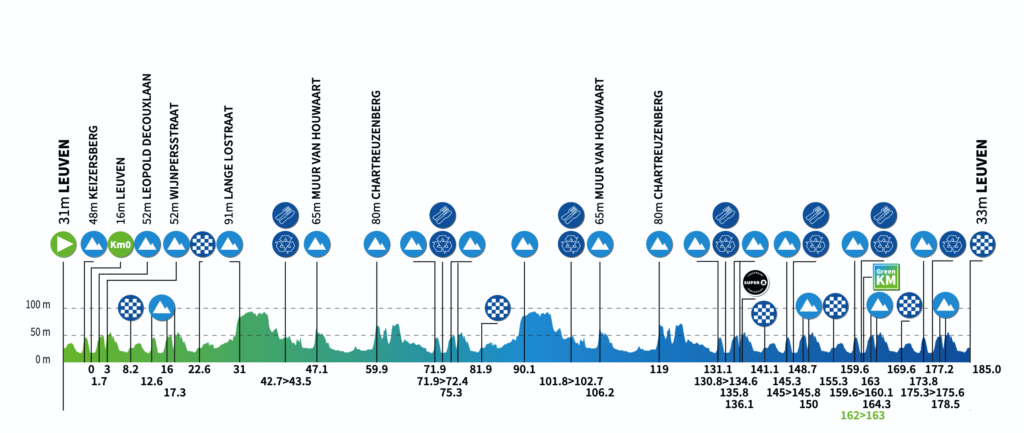
The Renewi Tour 2026 route guide always identified Leuven as the most important stage for the final GC. The riders repeatedly tackle the Keizersberg, Leopold Decouxlaan and Wijnpersstraat on the finishing circuit, while another Green Kilometre puts crucial bonus seconds on the road before the final sprint on Bondgenotenlaan.
Philipsen consequently has the fastest finish and the race lead, but he does not have the luxury of simply following wheels until the sprint. Berckmoes has already demonstrated how effectively he can use bonus seconds and late attacks, while Kooij remains close enough to win the entire race if the final stage unfolds in his favour.
Renewi Tour Stage 5 route
Date: Sunday 23 August 2026
Start: Leuven
Finish: Leuven
Distance: 183.7km
Stage type: Hilly Classics stage
Official start: 11:40 CEST / 10:40 BST
Expected finish: Around 15:55 CEST / 14:55 BST
Finish: Bondgenotenlaan
Key late climbs: Keizersberg, Leopold Decouxlaan, Wijnpersstraat
Final Wijnpers: Around 5.5km from the finish
Green Kilometre: Around 21km from the finish
The stage begins with a longer excursion away from Leuven before settling into the repeated city circuits that should determine both the stage and the overall race. The early kilometres through the Hageland contain additional climbing, but the spacing between those ascents makes them more likely to contribute fatigue than produce the decisive GC move.
The real race begins once the peloton reaches the Leuven circuits, where the climbs arrive quickly enough that teams have very little opportunity to reorganise between efforts.
The three recurring features are particularly important. Keizersberg is short and punchy, Leopold Decouxlaan provides another drag that gradually drains the legs, while Wijnpersstraat is the steepest and most obvious late launchpad. None is individually severe enough to create mountain-stage gaps, but repeated at full racing speed they can strip Philipsen and Kooij of teammates and turn the final laps into a much more difficult race to control.
The Renewi Tour 2026 team-by-team guide shows why this final stage suits so many different tactical approaches, with several teams bringing both fast finishers and Classics-style attacking options.
Jasper Philipsen starts with only four seconds to defend
Saturday could hardly have gone better for Jasper Philipsen.
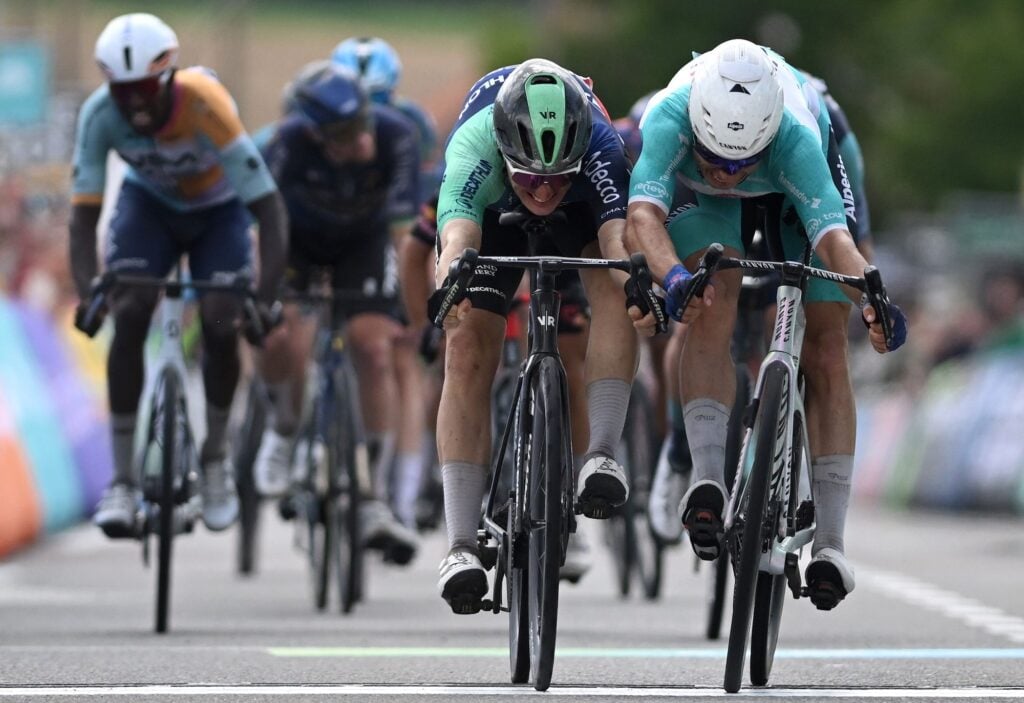
He won Stage 4 by the width of a tyre from Kooij and, through the finish bonus, reclaimed the overall lead from Berckmoes. Philipsen now starts the final stage four seconds ahead of the Lotto-Intermarché rider and ten ahead of Kooij.
That makes him simultaneously the favourite and the rider under the greatest pressure.
If Stage 5 ends in a reduced sprint with the main contenders together, Philipsen should be extremely difficult to remove from the overall lead. He has already won twice this week, survived the Geraardsbergen stage well enough to remain in contention and then handled the rolling Limburg circuit on Stage 4 before beating Kooij.
Leuven, however, is less controllable than Bilzen-Hoeselt.
The repeated city climbs give Berckmoes and the other Classics riders several opportunities to force Philipsen to respond personally. Alpecin-Premier Tech therefore need to preserve as many teammates as possible into the final 30 kilometres rather than spending them all chasing the first wave of attacks.
Philipsen’s advantage is that the stage does not necessarily need to be calm. If he survives the climbs, the race comes back towards his greatest strength. A reduced sprint of 30 or 40 riders still heavily favours him.
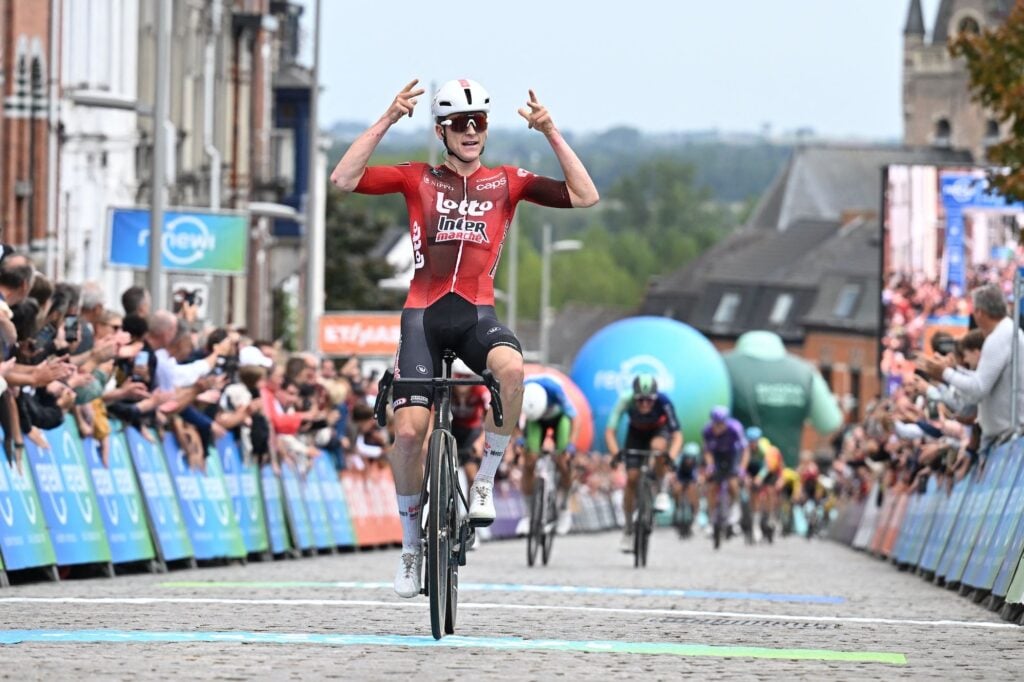
Jenno Berckmoes has to find four seconds somewhere
Jenno Berckmoes is only four seconds from winning the Renewi Tour.
That fundamentally changes how Lotto-Intermarché can race.
He does not need to drop Philipsen by half a minute. He needs only a handful of seconds, and the Renewi Tour provides several different ways of finding them.
Berckmoes already demonstrated that on Stage 3 in Geraardsbergen. His late attack and use of the available bonus seconds transformed his GC position and briefly put him into the leader’s jersey.
Sunday’s Green Kilometre could therefore be as important as the final climbs.
Three bonus sprints within a kilometre offer enough time to overturn Berckmoes’ four-second deficit before the riders even reach the final Wijnpers.
That gives Lotto a route towards the overall lead without needing to launch one spectacular long-range attack.
The difficulty is that everyone knows it.
Alpecin will be watching Berckmoes closely, while Kooij and several other riders have their own reasons to contest those seconds.
The Green Kilometre could decide the entire Renewi Tour
The Green Kilometre arrives shortly before the final circuit, at roughly 21 kilometres from the finish, and it could prove more important than any single climb.
The mathematics make it central to Sunday’s tactics.
Philipsen leads Berckmoes by four seconds.
Kooij is ten seconds down.
If Berckmoes takes a significant haul and Philipsen takes none, the virtual race lead can change before the finish. If Kooij collects several seconds, he can reduce his deficit enough that a stage victory and finish bonus become sufficient to threaten the overall classification.
Philipsen can also attack the bonuses himself.
That is perhaps the most intriguing possibility. Rather than simply defending, Alpecin can use Philipsen’s sprint speed to collect seconds and make the final circuits less dangerous.
The cost is energy.
The Green Kilometre comes close enough to the decisive laps that contesting every bonus can leave Philipsen more vulnerable on Wijnpersstraat.
That trade-off could define the race.
Olav Kooij can still win the Renewi Tour
Olav Kooij starts ten seconds behind Philipsen, and that gap is small enough to keep Decathlon CMA CGM completely committed to the GC battle.
Saturday showed how little separates the two sprinters.
Kooij looked capable of taking Stage 4 before Philipsen came past in the final metres, and that narrow defeat left him still within striking distance overall.
Kooij cannot overturn ten seconds simply by winning Stage 5 if Philipsen finishes on the same time and remains close enough to collect bonuses. He therefore needs either the Green Kilometre, a physical split or both.
That should encourage Decathlon to race much more aggressively than a normal sprint team.
Kooij himself can contest bonus seconds, while teammates can make the final Leuven circuits difficult enough to reduce Alpecin’s control. If Philipsen is briefly isolated, even a small split can suddenly become decisive.
The important point is that Kooij does not need a mountain-stage gap.
Ten seconds on these roads can disappear remarkably quickly.
Quinten Hermans needs a real attack
Quinten Hermans sits fourth overall, which puts him into a different tactical category from Berckmoes and Kooij.
Bonuses alone are unlikely to be enough.
Hermans needs to create a physical gap, but the Leuven circuit is exactly the type of terrain where that is possible.
Short climbs, narrow roads and repeated accelerations suit a rider with his punch. Pinarello-Q36.5 therefore have every reason to attack rather than protect fourth place conservatively.
The Wijnpers is the obvious launch point, but the better strategy may be to move earlier and force Philipsen’s team to chase repeatedly.
A single attack can be controlled.
Four or five attacks over consecutive laps are much harder.
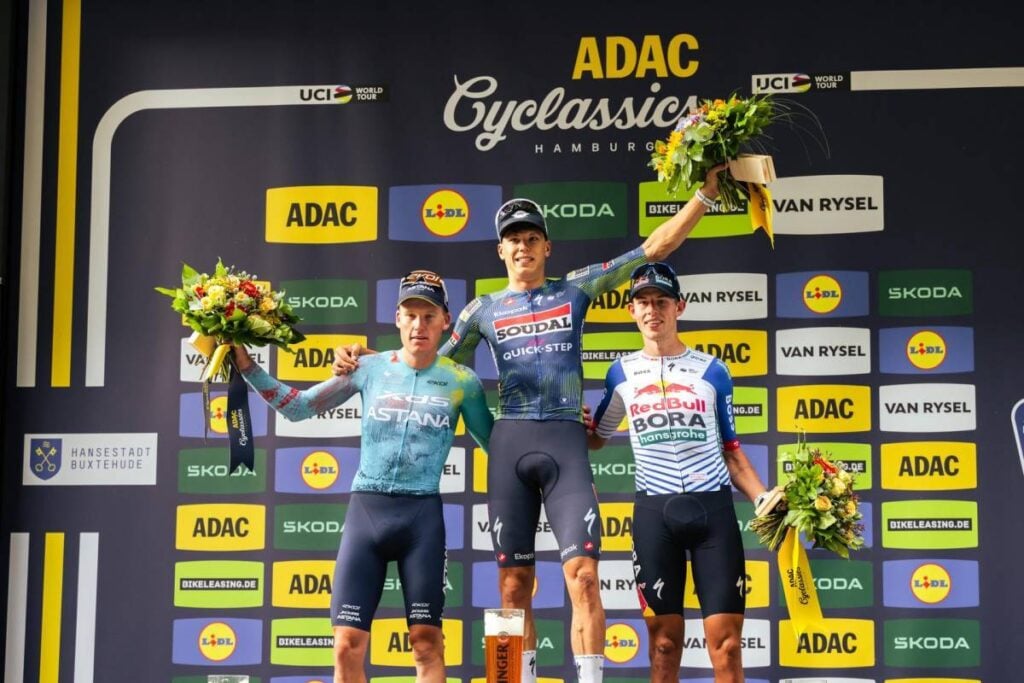
Mike Teunissen can use positioning as much as climbing
Mike Teunissen remains close enough to the podium fight to make Stage 5 important for XDS Astana.
His advantage is that Leuven rewards more than climbing power.
Positioning into each ascent matters enormously, and riders who enter Wijnpersstraat near the front can carry momentum over the top while those beginning 30 positions further back may already be chasing.
His sprint also gives him tactical freedom.
Teunissen does not necessarily need to attack from distance if the front group has already been reduced. A difficult final circuit followed by a sprint involving 15 or 20 riders could suit him extremely well.
The outright GC victory requires something much more dramatic, but the podium remains realistic if the race fragments.
Alec Segaert has already shown what he can do
Alec Segaert may be one of the most dangerous riders to allow any freedom.
He was central to the decisive Stage 3 move in Geraardsbergen, showing exactly the combination of repeated power and sustained speed required for a late Renewi Tour attack.
That performance matters because Leuven rewards many of the same qualities.
The climbs are shorter than the Muur and Bosberg, but the race still demands repeated high-power efforts and the ability to maintain speed between them. Segaert also possesses enough flat-road strength that once he establishes a gap, bringing him back becomes expensive.
He therefore looks like an obvious rider to attack before the final lap rather than waiting to sprint against Philipsen and Kooij.
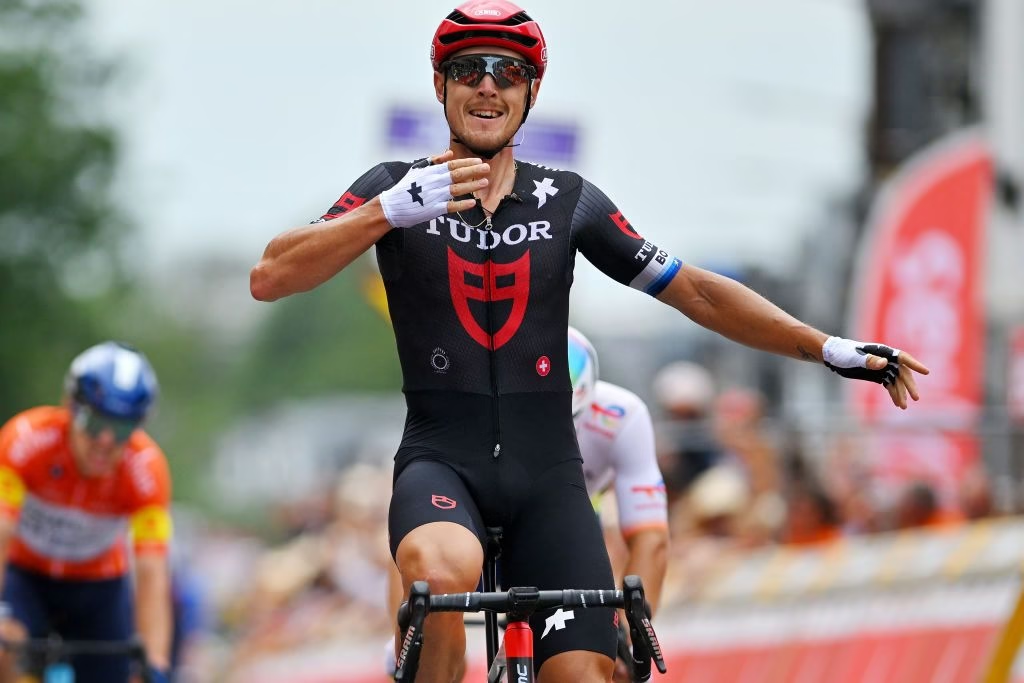
Matteo Trentin remains perfectly suited to Leuven
Matteo Trentin should be comfortable with almost every aspect of the final stage.
He can survive the short climbs, move efficiently through technical circuits and finish quickly from a reduced group.
His problem is that his GC deficit forces him to create separation from Philipsen.
That should encourage Tudor to use the repeated climbs proactively.
Trentin does not need to attack every ascent himself. The more chaotic the final 40 kilometres become, the more his experience and ability to read a Classics race begin to matter.
A straightforward sprint is the least favourable outcome.
A fragmented finale with groups continually forming and reforming is much more interesting.
Robert Donaldson has little reason to ride defensively
Robert Donaldson has quietly produced one of the more consistent Renewi Tour performances and enters the final stage with a chance to improve significantly if the race becomes chaotic.
For Jayco-AlUla, that creates very little downside to attacking.
Donaldson is close enough that a successful move can carry him several places up the classification, but far enough behind that Alpecin may initially be more concerned with Berckmoes and Kooij.
That is exactly the type of situation where an outsider can become dangerous.
If the favourites begin marking one another around the Wijnpers, Donaldson has every reason to use that hesitation.
Marijn van den Berg can target the stage
Marijn van den Berg is arguably more interesting as a stage contender than an overall threat.
The EF Education-EasyPost rider is particularly strong in reduced sprints after repeated climbing, which is exactly the scenario Leuven can produce.
He does not possess Philipsen’s outright speed on a flat boulevard, but every hard acceleration through the final circuits narrows that difference.
EF therefore have little incentive to help Alpecin keep the stage fully controlled.
They should want the group reduced and the sprint trains weakened before Bondgenotenlaan.
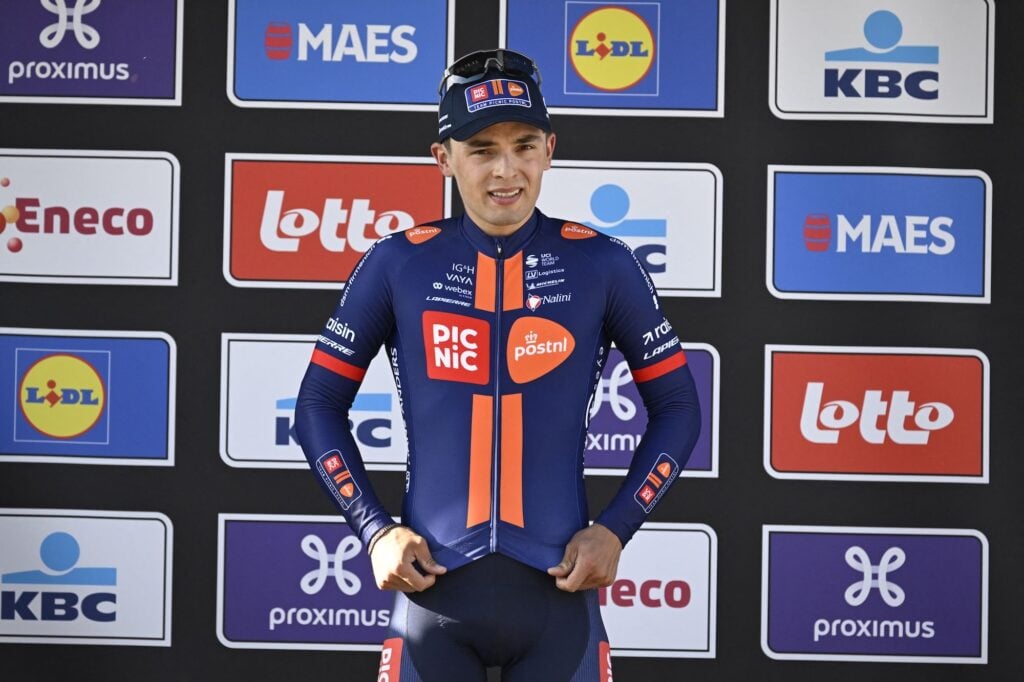
Pavel Bittner should survive deeper than many sprinters
Pavel Bittner is another rider who should welcome a hard final stage.
The profile suits a fast rider who can survive repeated short climbs rather than a pure sprinter who needs a fully organised lead-out.
Bittner’s ideal scenario is a group large enough that the race still comes down to a sprint, but small enough that Philipsen has lost most of his train.
The Leuven circuit naturally moves the race in that direction.
Bittner also heads towards a move to Pinarello-Q36.5 for 2027, but for now his Team Picnic PostNL role gives him one more strong WorldTour opportunity before the late-season calendar moves on.
Arnaud De Lie can race without GC pressure
One of the most interesting tactical changes concerns Arnaud De Lie.
The defending Renewi Tour champion is no longer central to the overall classification after losing substantial time on Stage 4, which removes any reason for him to ride defensively.
It can also strengthen Lotto’s tactical position around Berckmoes.
De Lie can attack without Philipsen needing to consider him an overall threat. If Alpecin chase him immediately, they spend resources that could otherwise be used against Berckmoes. If they allow him to go, they give one of the strongest Classics sprinters in the field a genuine chance to win the stage.
The route could hardly suit him better.
De Lie won the Leuven finale in 2025 before securing the overall Renewi Tour by only three seconds, a reminder of how easily the final stage can combine sprinting, bonus seconds and GC tactics.
That history is part of what makes the final day so important in the Renewi Tour 2026 route guide.
Jonathan Milan is no longer part of the sprint battle
One major sprint contender will be missing from the final stage.
Jonathan Milan is no longer in the race after the consequences of his heavy Stage 2 crash, having opened the Renewi Tour with victory in Diest.
That removes one of the riders who would ordinarily have been a major threat on Bondgenotenlaan.
It also makes Lidl-Trek more likely to approach the final stage through attacks rather than conventional sprint control.
Without Milan as the obvious finishing option, they have considerably more freedom to use their Classics riders aggressively around the Leuven circuits.
The final Wijnpers is the obvious attacking point
The final ascent of Wijnpersstraat comes with only around 5.5 kilometres remaining.
It is short enough that Philipsen can survive if he enters well positioned, but steep enough for a full-gas acceleration to create separation.
The timing makes it particularly dangerous.
There is not enough road afterwards for a large, organised chase to settle properly before the finish. Riders need to descend, negotiate the technical return towards the centre and immediately prepare for Bondgenotenlaan.
That makes the climb attractive to Hermans, Segaert, Trentin and the other riders who know their chances are much smaller in a direct sprint against Philipsen.
Alpecin’s objective will be simple: put Philipsen into the bottom of the climb near the front and prevent gaps opening ahead of him.
If he begins Wijnpersstraat too far back, the climb becomes much more dangerous than the gradient alone suggests.
Philipsen’s best defence may be to attack the bonuses
The temptation for a race leader with four seconds to defend is to race cautiously.
That may be the wrong approach here.
Philipsen is arguably the fastest rider among the main GC contenders, which means the Green Kilometre is an opportunity rather than simply a threat.
If he collects several bonus seconds, Berckmoes’ task becomes substantially harder. A bigger cushion would force Lotto to create a genuine physical gap rather than relying on bonus seconds and the final sprint.
The problem is how much energy Philipsen is willing to spend before the decisive final climbs.
Contest the Green Kilometre too aggressively and he risks reaching Wijnpersstraat with less in reserve.
Ignore it and Berckmoes can potentially move into the virtual race lead before the most dangerous part of the course even begins.
-
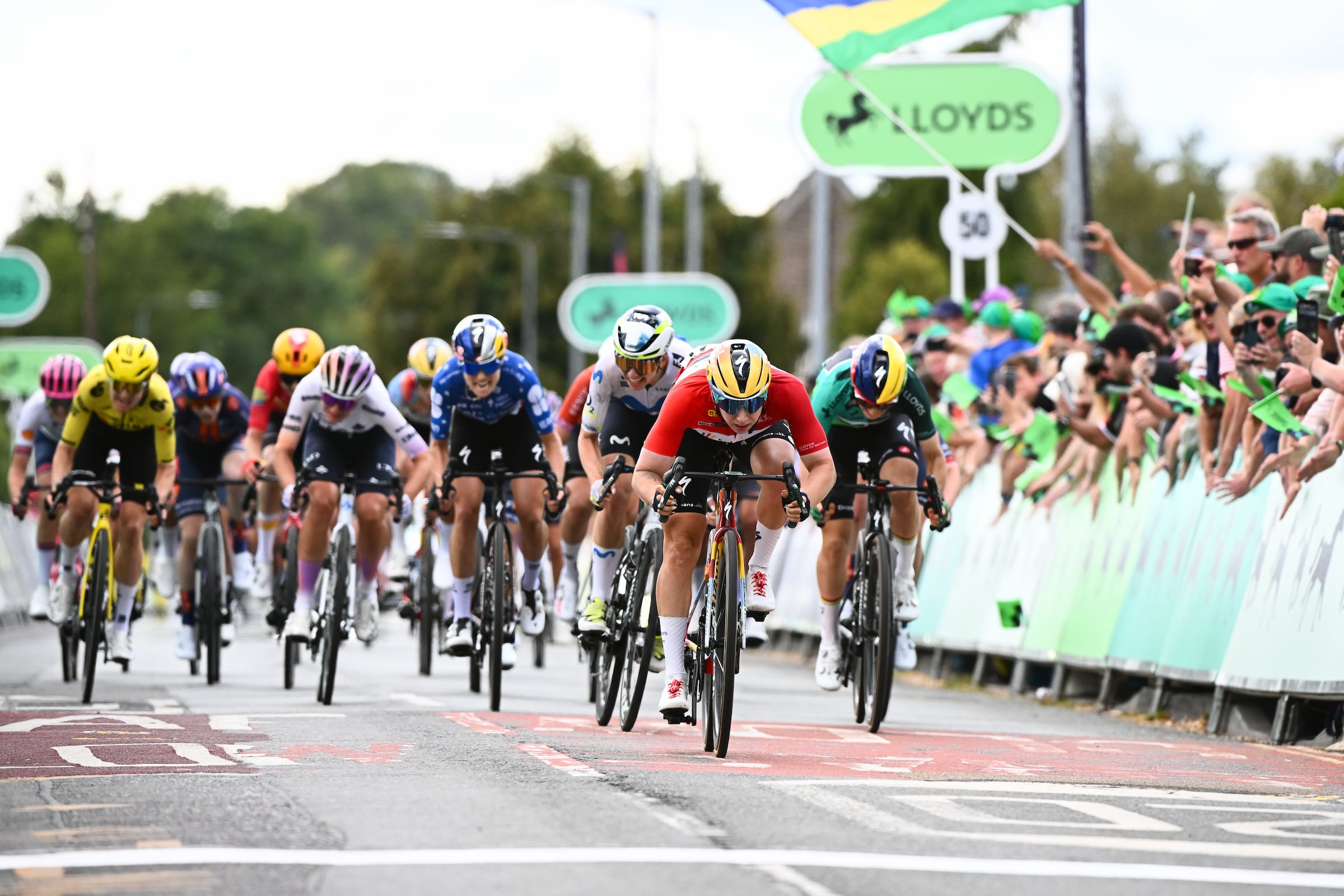 Photo Credit: Simon Wilkinson/SWpix.com

Can a breakaway win Stage 5?
A conventional early breakaway faces a difficult task because too many teams still have something to race for.
Alpecin need to protect Philipsen. Lotto need opportunities for Berckmoes. Decathlon have Kooij. Several riders close to the top of the classification need to attack, while others want the stage victory.
That makes it difficult for a harmless early move to build enough advantage.
The more dangerous escape is likely to form late.
Once the peloton reaches Leuven and the repeated climbs begin, a group containing strong Classics riders can become much harder to organise against.
Every GC favourite has slightly different interests, and that lack of cooperation can be exactly what a late attack needs.
Who wins Renewi Tour 2026 Stage 5?
Jasper Philipsen remains the strongest individual pick, but Sunday is much less straightforward than Stage 4.
He has already won twice, carries the overall lead and possesses the fastest finish among the riders still contesting the GC. If Alpecin-Premier Tech can keep the final group together, Philipsen has an excellent chance of winning both the stage and the Renewi Tour.
Olav Kooij is the obvious direct rival. Stage 4 was decided by centimetres, and the Dutchman remains close enough overall that the Green Kilometre and stage bonuses can still change everything.
Jenno Berckmoes is probably the most important rider tactically. Four seconds is little enough that he can win the race through bonuses, an attack or a combination of the two. Lotto also have De Lie available as a stage-hunting weapon without GC restrictions.
Behind them, Quinten Hermans, Alec Segaert, Matteo Trentin and Mike Teunissen should all welcome a much more aggressive finale. They need separation rather than a conventional sprint and possess the right characteristics for Leuven’s short climbs.
Marijn van den Berg and Pavel Bittner become more interesting if the peloton is reduced but ultimately comes back together, while De Lie may be the most dangerous rider capable of attacking without directly changing the GC calculations.
The most likely outcome remains a rapidly shrinking peloton repeatedly splitting and reforming around the Leuven circuit before a reduced sprint on Bondgenotenlaan. The important question is whether Philipsen remains in that front group every time.
He starts with four seconds over Berckmoes and ten over Kooij. There are bonus seconds available before the finish and several climbs capable of creating physical gaps.
After four stages, the Renewi Tour is still set up exactly as intended: the overall winner may not be decided until the final kilometres in Leuven.
For UK viewers, ProCyclingUK’s guide to watching the Renewi Tour 2026 in the UK has the live TV and streaming details for the final stage.