

The Vuelta a España 2026 reaches its first proper mountain finish on Monday 24 August, with Stage 3 taking the peloton 174 kilometres from Gruissan-Aude to Font-Romeu in the French Pyrenees.
The stage starts at 12:21 BST, with the finish expected between roughly 16:18 and 16:42 BST depending on the race speed. For UK viewers, live coverage is available on TNT Sports and HBO Max, with the wider broadcast details covered in ProCyclingUK’s guide to watching the Vuelta a España 2026 in the UK.
For anyone mainly interested in the GC fight, the most important viewing window begins from around 15:15 BST. The final 35.6 kilometres are dominated by the long climb towards the Col de Mont-Louis and then the summit finish at Font-Romeu, making this the first stage of the race where the general classification should be tested through sustained climbing rather than time trialling or bonus seconds.
What time does Vuelta a España Stage 3 start?
The key Stage 3 timings for UK viewers are:
Date: Monday 24 August 2026
Route: Gruissan-Aude to Font-Romeu
Distance: 174km
Stage type: Medium mountain / uphill finish
Stage start: 12:21 BST
Intermediate sprint: Around 15:01-15:17 BST
Col de Mont-Louis begins: Around 15:15-15:32 BST
Col de Mont-Louis summit: Around 15:52-16:14 BST
Final Font-Romeu climb begins: Around 15:59-16:21 BST
Expected finish: Around 16:18-16:42 BST
The exact times through the closing kilometres depend on the average race speed, but the practical advice is simple: viewers interested in the GC battle should be watching by 15:15 BST, while 16:00 BST is the latest sensible time to tune in if the main interest is the final climb.
The Vuelta a España 2026 route guide shows why Font-Romeu is so important. The race moves directly from this first sustained mountain test into a short, explosive Andorra stage on Tuesday, giving the favourites almost no opportunity to recover if they show weakness here.

How to watch Vuelta Stage 3 live in the UK
TNT Sports and HBO Max will show Stage 3 live in the UK.
TNT Sports remains the television home of the race, while HBO Max is the streaming option for viewers who prefer to watch online. DMAX provides the free-to-air highlights route later in the day rather than full live coverage.
The Vuelta a España 2026 UK viewing guide has the complete three-week television and streaming information.
Stage 3 is a day where watching before the final ten kilometres should be worthwhile. Once the race reaches the final 45 kilometres, the road begins to rise almost continuously, with the intermediate sprint followed quickly by the Col de Mont-Louis and then Font-Romeu.
What time should you start watching Vuelta Stage 3?
For viewers who want the entire live broadcast, tune in from the early afternoon.
For the most important racing, 15:15 BST is the key time. By then the peloton should be approaching or already beginning the long climb towards Mont-Louis, and the stage should have shifted from breakaway control into the first genuine GC test.
Anyone mainly interested in the summit finish should make sure they are watching by 16:00 BST.
Waiting until 16:15 risks missing the opening attacks on Font-Romeu if the stage is running towards the faster end of the official schedule.
The final hour should be particularly revealing because the route does not offer much recovery between the two climbs. Once the favourites reach Mont-Louis, the stage effectively becomes one sustained test all the way to the line.
When does the Col de Mont-Louis begin?
The Col de Mont-Louis begins with 35.6 kilometres remaining.
The climb is:
Length: 19.4km
Average gradient: 4.8%
Category: 1
Summit altitude: 1,571m
Distance from the finish at the summit: 16.2km
The gradients are relatively steady rather than brutally steep, but its length makes it the first serious climbing test of the Vuelta.
The crucial point is what comes next.
There is only a short transition after the summit before the road rises again towards Font-Romeu. A rider already struggling on Mont-Louis therefore has almost no opportunity to recover before the final climb begins.
That makes the Col de Mont-Louis summit an important point to watch even if none of the favourites has attacked yet.
What time will the riders reach the Col de Mont-Louis summit?
Depending on the race speed, the riders should reach the summit at approximately:
Fast schedule: 15:52 BST
Medium schedule: Around 16:03 BST
Slow schedule: Around 16:14 BST
That leaves just over 16 kilometres to race.
Anyone tuning in specifically for the GC fight should therefore be watching comfortably before 15:50 BST, because the main group could already be significantly reduced by the time the riders reach the top.

What time does the Font-Romeu final climb begin?
The final climb begins with 9.8 kilometres remaining.
Depending on race speed, that should be approximately:
Fast schedule: Around 15:59 BST
Medium schedule: Around 16:09 BST
Slow schedule: Around 16:21 BST
The climb to Font-Romeu averages around 5%, with the finish close to 1,900 metres above sea level.
On paper that gradient looks relatively moderate, but the context makes it more difficult. The riders arrive after almost 20 kilometres of climbing on Mont-Louis, and the altitude begins to become increasingly relevant as the stage approaches the finish.
The full Vuelta a España 2026 start list shows the depth of climbing talent that will be tested for the first time here.
Why Font-Romeu is the first major GC viewing point
Stages 1 and 2 established the early order through the Monaco time trial and the first road stage.
Stage 3 changes the nature of the Vuelta.
The final 35 kilometres are long enough for teams to increase the pace gradually rather than relying on one explosive attack. That means domestiques become important, positioning becomes less decisive than climbing strength, and riders cannot hide behind bonus seconds or a short finishing effort.
The Vuelta a España 2026 contenders preview identified the opening Pyrenean sequence as one of the first places where the pre-race hierarchy could begin to change.
Font-Romeu may not produce enormous gaps, but it should tell us much more about who genuinely has the legs to contend over three weeks.
Tadej Pogačar faces his first sustained climbing test in red
Tadej Pogačar begins Stage 3 in the red jersey, and this is the first day where UAE Team Emirates-XRG will have to defend his lead through climbing strength rather than simply controlling positioning and bonus seconds.
The question is how aggressively Pogačar wants to race.
He does not need to attack Font-Romeu to make Stage 3 successful. Remaining with the strongest riders and allowing his team to control the final climb would be enough, particularly with Tuesday’s much harder Andorra stage following immediately.
On the other hand, any weakness among his rivals creates an opportunity.
If a contender begins struggling on Mont-Louis, UAE have little reason to slow the race down and allow them back.
That gives the final hour a potentially reactive character. The first attack may come less from Pogačar deciding to win the stage and more from one of his rivals showing vulnerability.
The first mountain stage should reveal the real GC hierarchy
The wider Vuelta route contains much harder stages than Font-Romeu, but its position on Stage 3 makes it disproportionately important.
Nobody has had time to ride themselves into form.
Anyone who arrived slightly underprepared is exposed almost immediately.
That should make the final 35 kilometres particularly revealing for riders such as Pogačar, João Almeida, Mattias Skjelmose, Oscar Onley, Félix Gall, Ben Tulett and the other climbers targeting the overall classification.
A rider losing 15 seconds here may recover later.
A rider losing a minute could already be facing a serious problem before the race reaches Andorra.
The intermediate sprint comes just before the climbing begins
The intermediate sprint is positioned at Villefranche-de-Conflent with around 45 kilometres remaining.
Depending on the stage speed, the race should reach it between approximately 15:01 and 15:17 BST.
That makes it another reason to tune in from around 15:00 rather than waiting for Mont-Louis.
The sprint matters for the points competition, but its position immediately before the long climbing section can also influence tactics. Riders chasing points or bonus seconds have to expend energy just before the race begins rising for almost the entire remainder of the stage.
-
 Photo Credit: Getty
 -
 Photo Credit: Cs-wolves / Wikimedia Commons, CC BY-SA 4.0
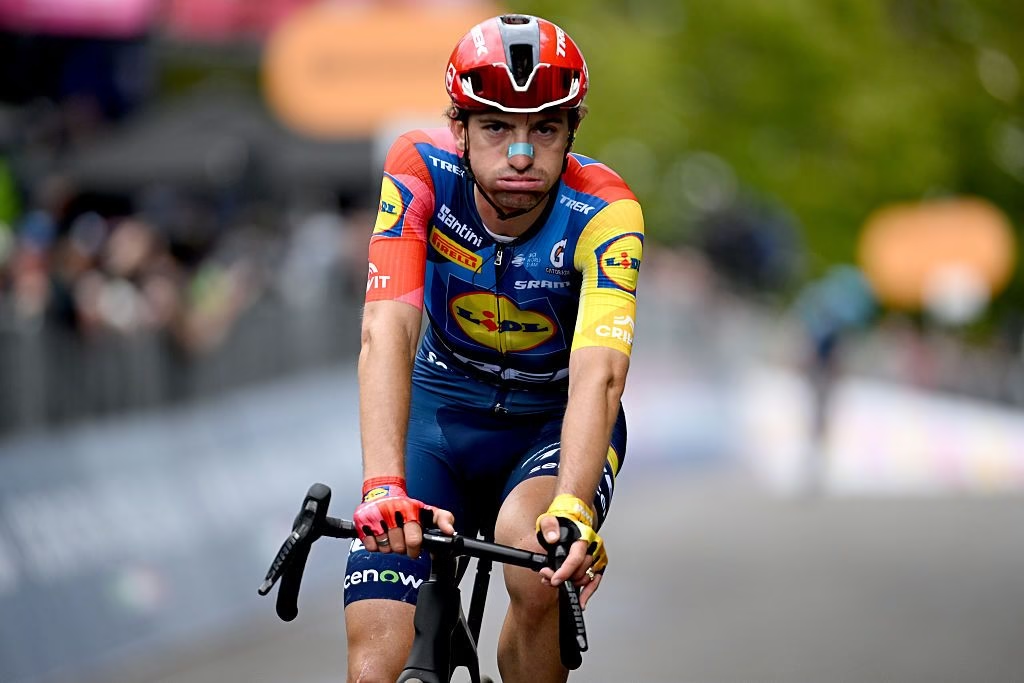

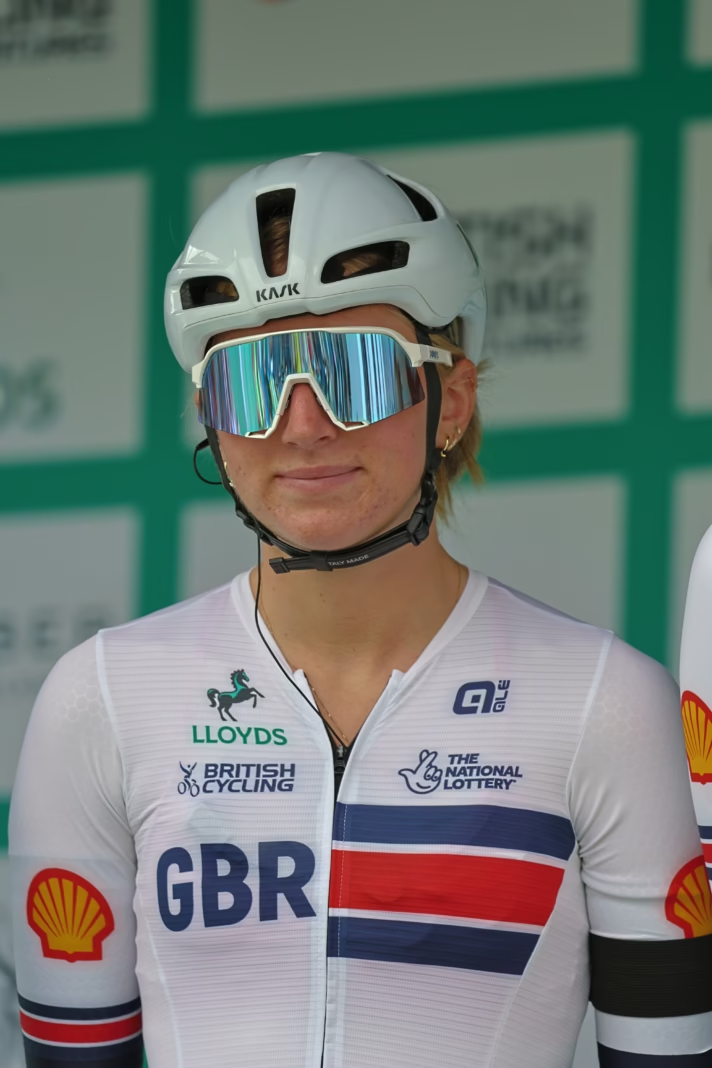
Can the breakaway survive to Font-Romeu?
Stage 3 gives the breakaway a much better opportunity than the opening weekend.
The finish is difficult enough that many of the fastest riders have no reason to chase, while the GC teams may be more interested in controlling one another than bringing back every stage hunter.
A strong group containing riders several minutes down overall could therefore be allowed considerable freedom.
The main complication is UAE.
If Pogačar wants the stage win and bonus seconds, the breakaway’s chances fall dramatically. If UAE are happy simply to defend red, the escape has a much more realistic route to Font-Romeu.
That uncertainty should become clearer during the first half of the broadcast.
If the break still has a large advantage by the time the peloton approaches Villefranche-de-Conflent, the stage victory and GC battle may effectively become two separate races.
Stage 3 live viewing summary
For UK viewers, the essential timings are:
12:21 BST: Stage 3 starts from Gruissan-Aude
Around 15:01-15:17 BST: Intermediate sprint at Villefranche-de-Conflent
Around 15:15-15:32 BST: Col de Mont-Louis begins
Around 15:52-16:14 BST: Col de Mont-Louis summit
Around 15:59-16:21 BST: Final Font-Romeu climb begins
Around 16:18-16:42 BST: Expected finish
For anyone who only wants the decisive racing, 15:15 BST is the best time to tune in. If the main interest is purely the summit finish, be watching no later than 16:00 BST.
Stage 3 is the first point where the 2026 Vuelta stops being about seconds collected through a technical time trial or sprint bonuses and starts asking the central question of the race: which of the GC contenders can handle sustained climbing when the road rises for almost the entire final hour?

