Bryan Coquard won stage 8 of the 2026 Vuelta a España in Xeraco, taking the first Grand Tour stage victory of his career on a day transformed by Tadej Pogačar’s race-ending crash.
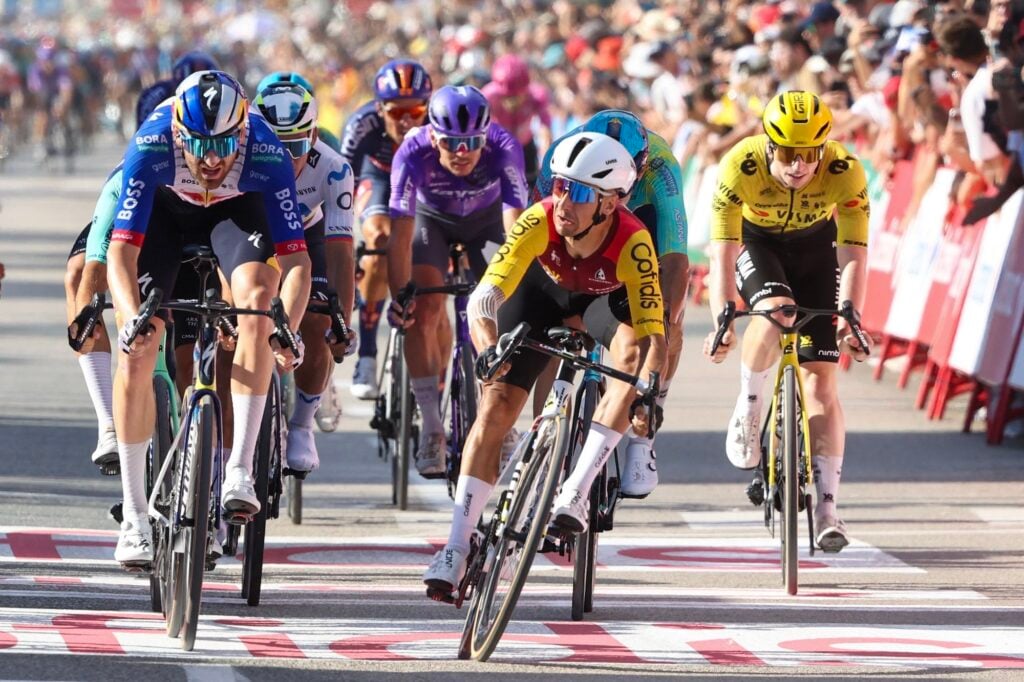
The Cofidis sprinter edged out Mads Pedersen in a chaotic bunch sprint after a crash-marred finale, with Jordi Meeus third for Red Bull-Bora-Hansgrohe. Coquard timed his effort perfectly in a headwind finish, coming through late to beat Pedersen and finally end a long wait for a Grand Tour stage win at the age of 34.
Yet the stage will be remembered above all for Pogačar’s abandon. The UAE Team Emirates-XRG rider crashed heavily just before the Puerto de Barx with around 32 kilometres remaining, tried to remount, then walked to the ambulance with visible injuries to his left arm and shoulder. His withdrawal handed the red jersey to Enric Mas, who chose not to wear it on the podium out of respect for the Slovenian.
A sprint stage with one late complication
Stage 8 took the race from Puçol to Xeraco over 171 kilometres, offering the sprinters one of their clearer opportunities of the opening week.
The route was mostly flat and carried just over 1,200 metres of elevation gain, but it was not a completely straightforward bunch sprint stage. The late obstacle was the Puerto de Barx, a 4.7-kilometre climb at 5.6 per cent that came with less than 30 kilometres remaining. It was not hard enough on paper to remove every fast rider, but it was placed late enough to create tension before the run back down towards the coast.
After the previous two GC days, the expectation was that the main overall contenders would try to get through safely before the much harder Alto de Aitana stage on Sunday. Pogačar began the day with a commanding advantage after winning three stages in the first week, while Mas, Primož Roglič, Felix Gall, Sepp Kuss, Oscar Onley and Richard Carapaz were already fighting their own podium battle behind him.
By the finish, that picture had been completely rewritten.
A nervous start brings early abandons
The day began badly, even before the racing had properly settled.
The start was delayed by mechanical incidents and then a crash in the neutralised section. Diego Uriarte of Equipo Kern Pharma and Floris Van Tricht of NSN Cycling Team were both forced out as a result, while Mattia Gaffuri of Team Picnic PostNL later abandoned after another crash in the opening phase.
That set the tone for a stage that never fully felt calm. On paper, it should have been one of the easier days of the race, but the combination of sprint ambitions, GC positioning and a late climb created exactly the kind of nervousness that often makes so-called simple stages dangerous.
Once the flag finally dropped, the day’s breakaway formed almost immediately.
Sinuhé Fernández goes alone
Sinuhé Fernández attacked as soon as the stage was under way.
The Burgos-Burpellet-BH rider had said before the stage that he wanted to go on the attack, and he did exactly that. His teammate José Luis Faura tried to join him, but the peloton closed that move down, leaving Fernández alone at the front.
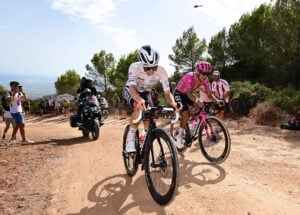
For a while, the bunch was happy to let him go. The gap rose quickly and reached a maximum of around 5:50 after 24 kilometres, giving Fernández a long spell alone in front of the race.
It was a lonely move, but not a meaningless one. The stage was unlikely to be won from that kind of solo attack, yet Fernández put his team on television, controlled the shape of the early day and forced the sprinters’ teams to take responsibility.
Behind him, Team Visma | Lease a Bike began to organise the chase. Their ambitions were clear: protect Wout van Aert’s points classification position, keep Matthew Brennan in contention for a third stage win, and make sure the race came back together before Xeraco.
Visma control as Van Aert eyes points
Steven Kruijswijk was among the riders doing early work on the front for Team Visma | Lease a Bike.
That was a sign that the Dutch squad had no intention of letting Fernández build an unmanageable advantage. Brennan had already won stages 2 and 5, and this was another finish that could suit him if he survived the climb and stayed well positioned in the final kilometres.
Van Aert also had a clear objective at the intermediate sprint. After several days of collecting points and helping teammates, he had moved into a strong position in that competition, and the sprint at Simat de la Valldigna came just before the road began to rise towards Barx.
The peloton gradually brought Fernández back. His long solo adventure ended at kilometre 133, just before the intermediate sprint. Van Aert took the 20 points on offer, confirming that Team Visma | Lease a Bike had controlled that phase of the race exactly as planned.
Then the tone of the stage changed in an instant.
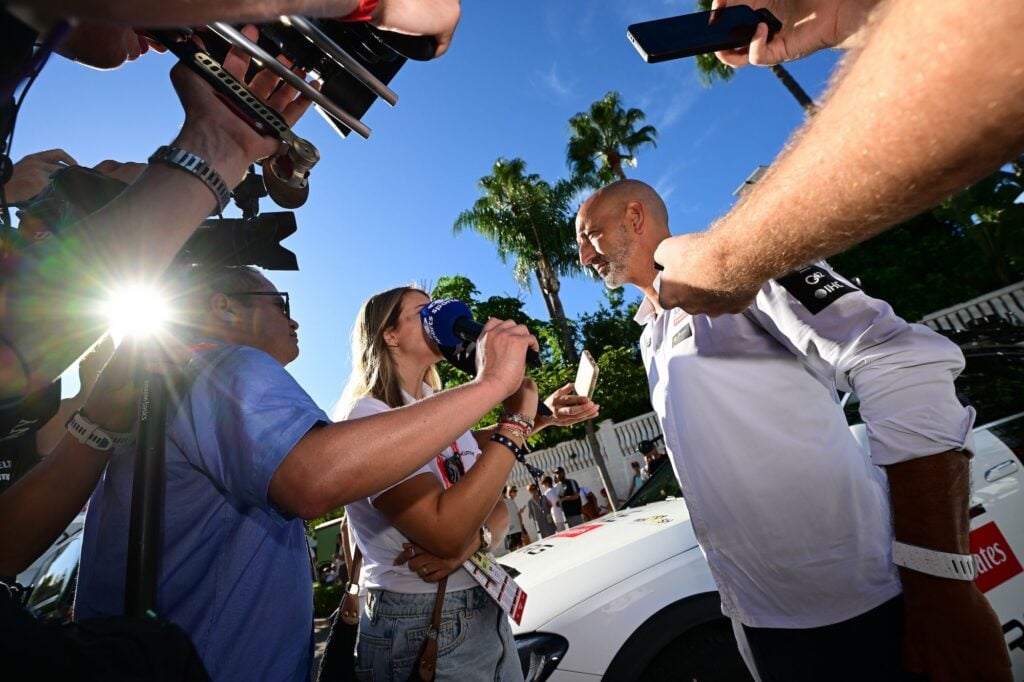 Photo Credit: Getty
Pogačar crashes before Puerto de Barx
Just before the climb to Puerto de Barx, Pogačar crashed.
The fall came at high speed in a nervous peloton, shortly after the intermediate sprint and before the road began to climb. The red jersey went down heavily and was left sitting on the ground as the race moved on around him.
At first, there was a brief hope that he might continue. Pogačar got up and tried to return to his bike, but the damage was immediately obvious. He was suffering from his left arm and shoulder, with visible blood on his face, and then sat down again before eventually walking to the ambulance.
It was a shocking end to a race he had dominated from the opening Monaco time-trial. He had won stages 1, 4 and 6, held more than 3 minutes over his nearest rival, and looked on course to complete the set of Grand Tour victories.
Instead, his Vuelta ended in the back of an ambulance on what had been expected to be a relatively controlled sprint day.
UAE confirm serious injuries
UAE Team Emirates-XRG later confirmed the severity of the crash.
The team said Pogačar was stable after medical assessment, but had suffered concussion, a displaced fracture of the left clavicle, a stable C7 cervical fracture and multiple abrasions. He will require further treatment and his season is now thrown into uncertainty.
It was the first time Pogačar had abandoned a stage race and the first time he had crashed out of a race since Liège-Bastogne-Liège in 2023. It also made him the first overall leader of the Vuelta to crash out of the race since Igor Antón in 2010.
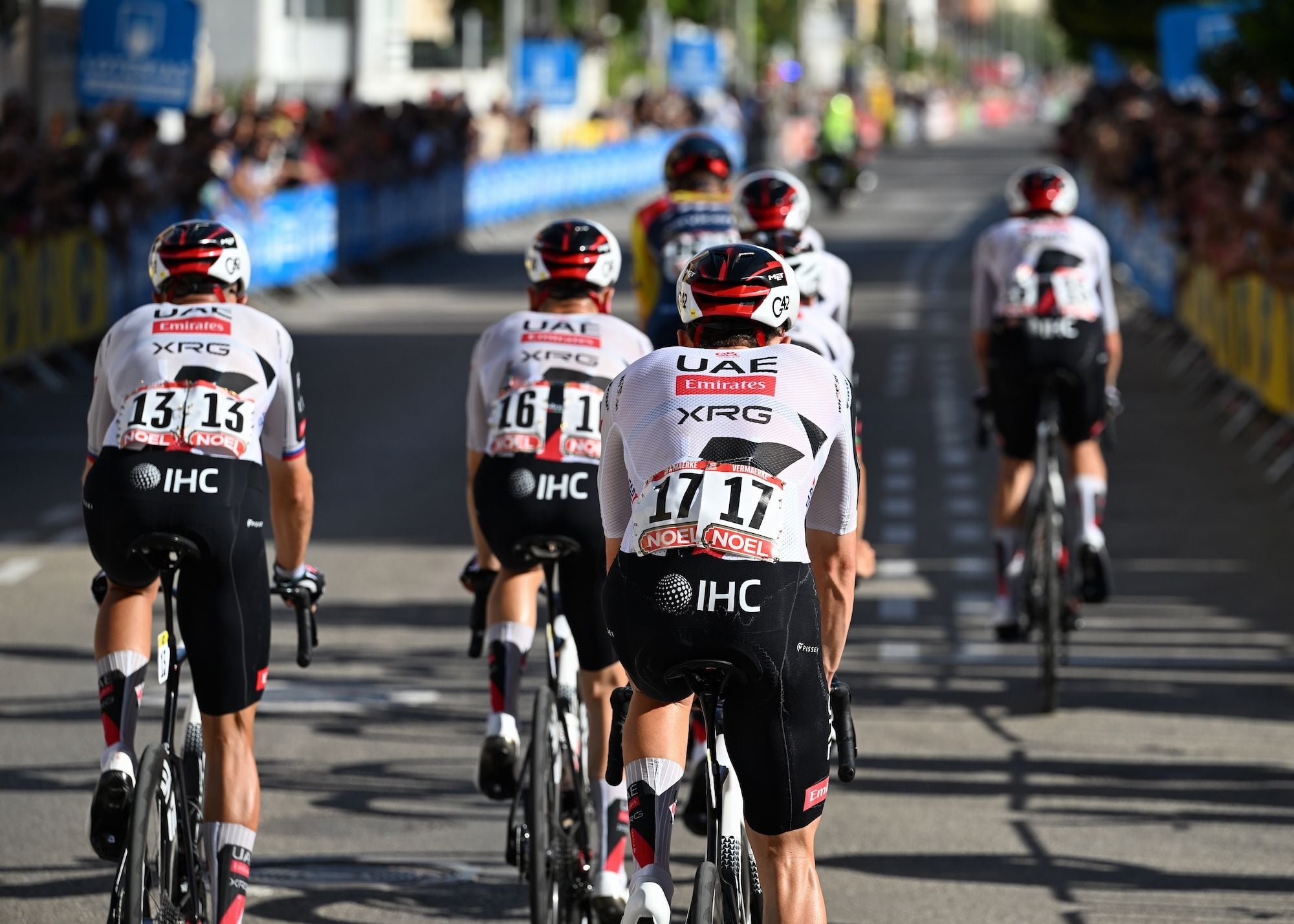
The rest of the UAE squad rode on together after the incident, visibly subdued. Their race had gone from total control to sudden collapse in one moment.
For the Vuelta, the sporting consequences were enormous.
Mas inherits red but refuses to wear it
Mas became the new race leader, but the circumstances were impossible to celebrate.
The Movistar rider had started the day second overall, 3:50 behind Pogačar, after riding strongly on the gravel climb of Puerto El Bartolo and again limiting his losses at Valdelinares. With Pogačar out of the race, Mas moved into the red jersey for the first time in his career.
On the podium, though, he held the jersey rather than putting it on.
Mas said afterwards that Pogačar had crashed and that he had not “won” the red jersey in the usual way. It was a simple gesture, but an important one. He is now the leader of the Vuelta, yet the handover came through injury rather than attack, time gain or tactical victory.
The race now belongs to Mas on paper. Emotionally, stage 8 belonged to something very different.
The climb passes quietly
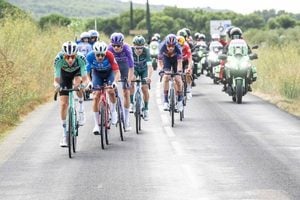
After the crash, the peloton went over Puerto de Barx at a relatively moderate pace.
That was understandable. The stage had lost its red jersey, the bunch had already been shaken by several crashes, and the main GC riders had no obvious reason to attack so soon after Pogačar’s abandon. The climb that had looked like the day’s tactical hinge instead became a strangely muted passage.
There was still racing to be done, but the mood had changed. The sprinters who survived the climb knew there was still a stage win available, while the GC contenders simply needed to avoid any further disaster before the finish.
Once the race dropped down from the climb and headed towards Xeraco, the sprint teams began to reorganise.
Azparren tries late
Xabier Mikel Azparren tried to prevent the bunch sprint.
The Pinarello-Q36.5 rider attacked on the run-in after the descent, using the unsettled mood of the race and the twisting roads to open a small gap. He pushed his advantage out to around 20 seconds and briefly threatened to make the sprint teams hesitate.
It was a clever move. After a crash, a climb and a disrupted peloton, there was always a chance that the chase might become disorganised. But the fast teams still had enough numbers and enough motivation.
Azparren was caught with 1.5 kilometres remaining, ending the final breakaway threat and setting up the sprint that had looked likely from the start of the day.
Even then, the chaos was not finished.
Another crash hits the finale
The sprint finish was also disrupted by a crash.
As the bunch launched into the final few hundred metres, riders went down again, further reducing the group contesting the win and adding another incident to a stage already defined by falls.
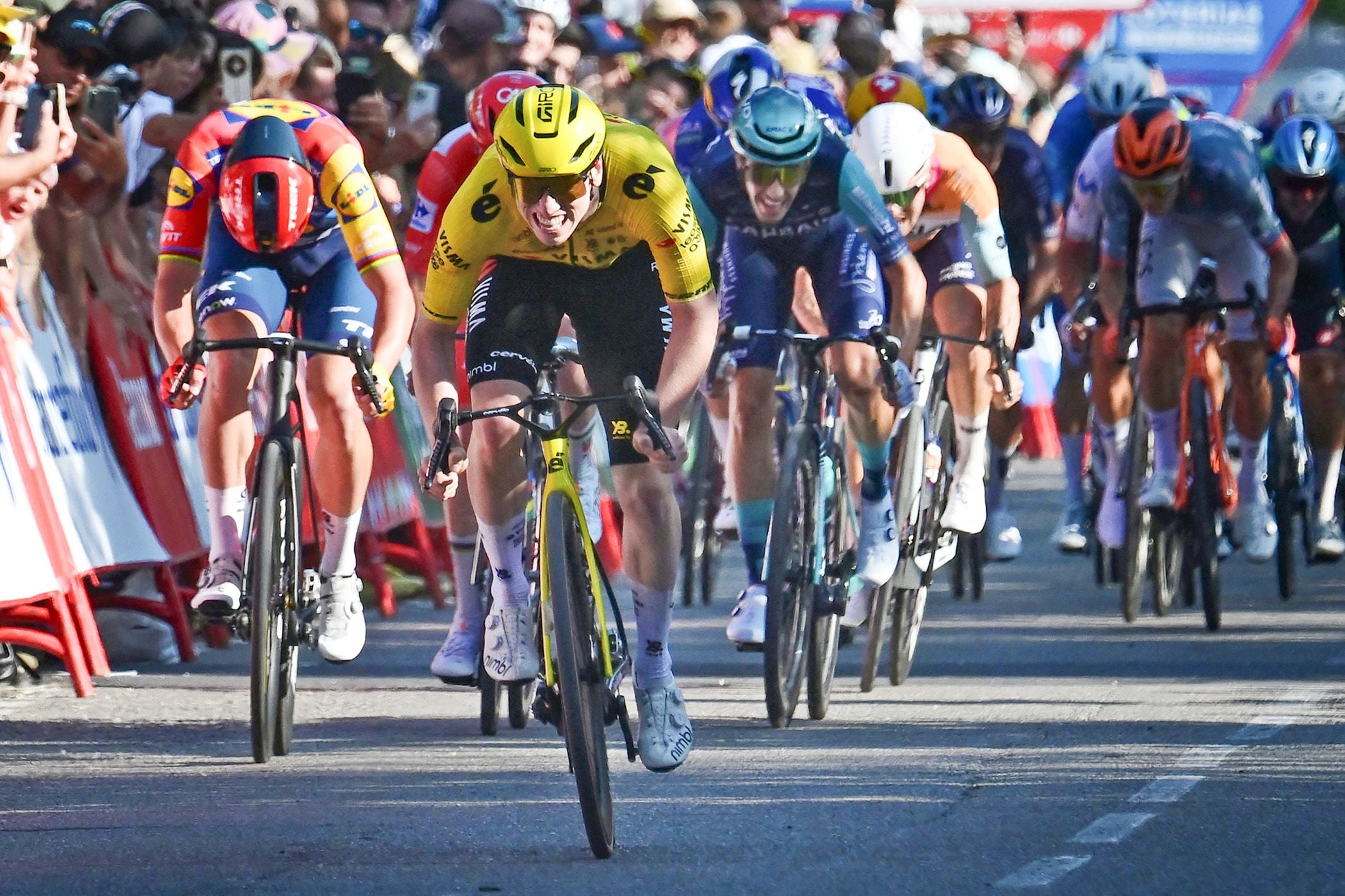
Brennan tried to come through on the left-hand side of the road, looking for a third stage win of the race after his victories in Manosque and Roquetes. Meeus was also well placed, while Pedersen looked set to use his power in the headwind finish.
Coquard, though, had waited.
The Cofidis rider had followed Alexis Renard deep into the finale, then watched Meeus and judged the timing carefully. With the wind in the riders’ faces, launching too early risked handing the sprint to someone coming from the slipstream. Coquard delayed his effort and then came through at exactly the right moment.
Coquard finally gets his Grand Tour win
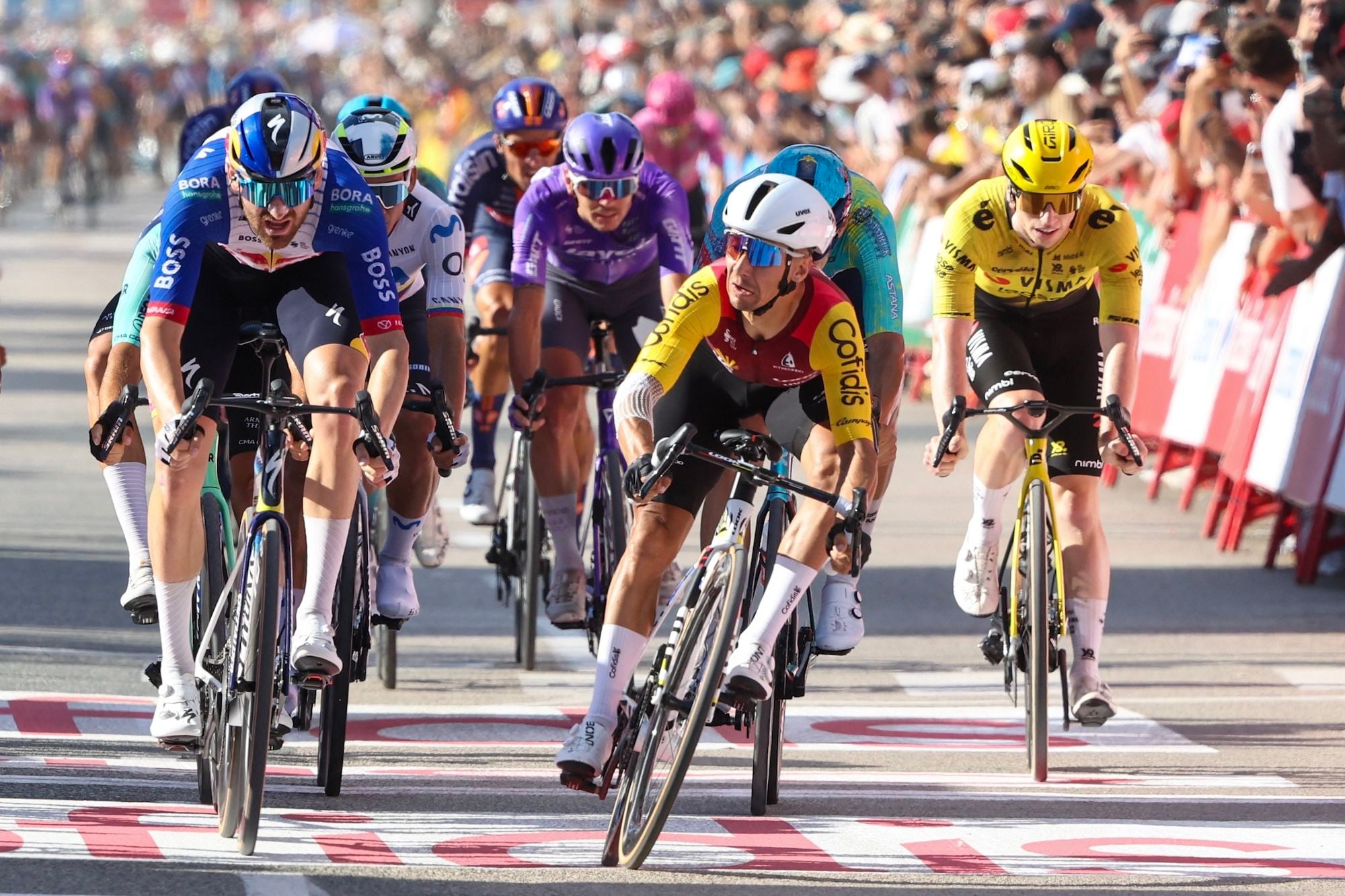
Coquard crossed the line first in Xeraco, edging Pedersen and Meeus to take the biggest win of his career.
It was his first stage victory in a Grand Tour, a remarkable statistic for a rider who has spent so many years close to this level. He had finished second in Grand Tour stages before, carried pressure into this Vuelta after poor positioning in earlier sprint chances, and had even been in the breakaway the previous day.
This time, everything came together. Cofidis placed him well, Renard kept him in position, and Coquard used the headwind to his advantage.
“It’s a lot of work,” he said afterwards. “I finished a lot of times second in Grand Tours. I’m 34 years old, and I’m so proud and happy.”
His emotion was easy to understand. The result gave Cofidis a major Vuelta win and gave Coquard the Grand Tour breakthrough that had repeatedly escaped him.
Pedersen and Meeus complete the podium
Pedersen finished second, narrowly beaten after another strong but frustrating sprint.
The Lidl-Trek rider had been one of the obvious favourites for this kind of finish. He had the durability to survive Barx, the power for a slightly messy sprint and the experience to handle the headwind. But Coquard came around him late, leaving Pedersen with another near miss.
Meeus finished third for Red Bull-Bora-Hansgrohe, continuing a strong run of sprint results in the opening week. He had been one of the riders Coquard specifically watched in the finale, and his move helped shape the sprint even if he could not finish it off.
Ben Turner was fourth for Netcompany Ineos Cycling Team, ahead of Jordan Labrosse, Bastien Tronchon, Alessandro Romele, Hugo Hofstetter, Orluis Aular and Brennan. Given the crashes and the late climb, the top 10 was a mix of sprinters, durable fast men and riders who had simply survived the day in the right place.
Brennan misses third win
Brennan’s attempt at a third stage victory fell short.
The Team Visma | Lease a Bike rider had been one of the key reasons his team worked through the day, and he was still in position when the sprint opened. His route down the left-hand side briefly looked promising, but the final acceleration was not there this time.
Tenth place was a long way from the dominance he showed in Manosque and Roquetes. The finale was more chaotic, the headwind complicated the timing, and the crash disrupted the sprint’s normal rhythm.
It does not change the success of Brennan’s race so far, but it did stop Team Visma | Lease a Bike turning a controlled chase into another stage win. Their day still produced points for Van Aert, but the stage went to Cofidis.
General classification reset
Pogačar’s abandon completely changed the Vuelta’s general classification.
Mas now leads the race, with Roglič second at 1:00 and Gall third at 1:11. Kuss is fourth at 2:15, just ahead of Onley at 2:16, while Carapaz is sixth at 2:22. Skjelmose sits seventh at 3:27, with Tejada eighth at 3:56, Mühlberger ninth at 5:39 and Jakob Omrzel 10th at 6:04.
The contrast with the morning could hardly be sharper. Before the stage, Pogačar had looked almost untouchable. Mas was nearly 4 minutes down, Roglič almost 5 minutes down, and the rest of the podium contenders were already trying to limit the damage.
Now the top six are separated by less than 2.5 minutes. The red jersey is on Mas’ shoulders, Roglič is suddenly back in a realistic winning position, Gall is only 11 seconds off second, and Kuss, Onley and Carapaz are all close enough to matter.
The Vuelta has gone from one-rider control to an open GC fight in a single crash.
Mas faces a different kind of pressure
Mas now enters the Alto de Aitana stage as race leader.
That brings a very different kind of pressure. He has ridden well enough to earn his place as the closest rival to Pogačar before the crash, especially with his strong response on Puerto El Bartolo. But defending red is not the same as chasing from second.
Movistar now have to control the race, manage Roglič, watch Gall and monitor Kuss, Onley and Carapaz, all while processing the unusual circumstances of how the jersey changed hands. The moral respect shown on the podium does not remove the tactical reality: Mas is the leader of the Vuelta.
Sunday’s stage to Alto de Aitana now becomes the first real test of his leadership. More than 5,000 metres of climbing will give every contender a chance to attack the new race order.
A stage that changed the race without a GC attack
Stage 8 was supposed to be a sprint stage with a late climb.
It became one of the defining days of the 2026 Vuelta. Fernández spent 122 kilometres alone out front, Coquard finally won a Grand Tour stage, and the sprint was decided by timing, nerve and headwind judgement. Yet all of that was overshadowed by Pogačar’s crash and abandon.
The race lost its dominant leader, the rider who had already shaped the first week with three stage wins and a huge GC advantage. It also gained a completely new sporting structure. Mas leads, Roglič is back in contention, Gall has a podium to chase, and riders who looked distant suddenly have reasons to believe again.
Coquard deserved his moment in Xeraco. But stage 8 will be remembered as the day the Vuelta changed completely.
Vuelta a España 2026 stage 8 result
Data powered by FirstCycling.com
Main photo credit: Getty