
The Wahoo TRACKR RADAR arrives in a cycling radar market that is no longer dominated by one obvious choice. Garmin established the category, but Wahoo now has a rear radar and light designed to sit naturally alongside its ELEMNT computers while remaining compatible with other ANT+ radar-capable devices. On paper, the TRACKR RADAR gets most of the fundamentals right: vehicle detection up to 150 metres, dual LEDs, useful adaptive light functions, USB-C charging and battery life that is competitive with the established alternatives.
The picture from independent testing is broadly positive, although not completely uniform. Several reviewers have found the radar accurate and dependable enough to compete directly with Garmin, while others have reported slightly later detection or occasional gaps on winding roads. That distinction matters because the TRACKR RADAR’s 35-degree radar beam is narrower than some premium rivals. It is therefore a convincing option, particularly for Wahoo users, rather than an automatic new benchmark for the whole category.
Transparency note: ProCyclingUK has not tested the Wahoo TRACKR RADAR directly. This assessment is based on Wahoo’s specifications and support documentation alongside findings from multiple independent tests and reviews.
This article contains affiliate links. As an Amazon Associate I earn from qualifying purchases. You can check the current Wahoo TRACKR RADAR price and availability on Amazon UK.
Wahoo TRACKR RADAR specifications
| Weight | 99g |
| Vehicle detection | Up to 150 metres |
| Radar beam width | 35 degrees |
| Connectivity | ANT+ and Bluetooth |
| Water resistance | IPX7 |
| High steady | 21 lumens, up to 10 hours |
| Low steady | 10 lumens, up to 15 hours |
| High flash | 53 lumens, up to 15 hours |
| Low flash | 18 lumens, up to 20 hours |
| Charging | USB-C |
| Mount | Wahoo quarter-turn standard with round/aero, D-shaped and flat wedges |
Radar performance is good, but the field of view matters
Wahoo claims the TRACKR RADAR can detect approaching vehicles from up to 150 metres behind. That puts it comfortably into the range where an alert can be useful rather than merely confirming a vehicle that is already close. Independent reviews have generally supported the view that its core radar performance is strong. Some testers have described detection as comparable with Garmin’s established Varia units, with reliable tracking of multiple approaching vehicles on normal roads.
There is a qualification. BikeRadar and road.cc both identified situations where detection could arrive a little later or become less consistent on winding roads. The likely practical issue is not the headline 150-metre range but the 35-degree beam width. A narrower field can matter when a vehicle is approaching through a bend rather than directly along the radar’s centre line. Riders who spend most of their time on straight or gently curving roads may rarely notice it, while those riding twisting lanes have more reason to consider the difference.
That makes the TRACKR RADAR a useful example of why range alone does not tell the whole story. Our radar rear light versus normal rear light guide explains the broader benefit of the category: radar adds another source of information about traffic behind, but it does not replace looking over your shoulder, listening or making your own judgement before changing road position.
The rear light and battery features are among its strengths
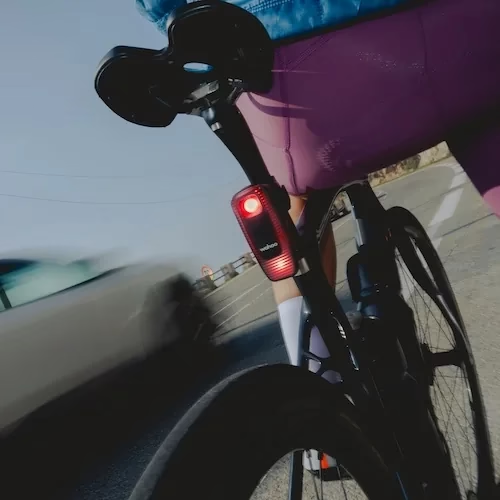
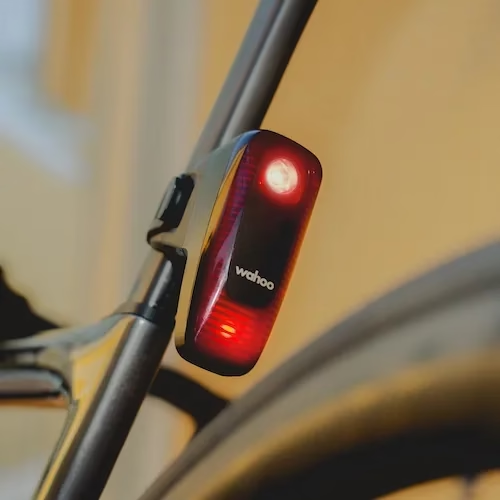
The TRACKR RADAR is not simply a radar pod with a token light attached. Wahoo uses a dual-LED design and offers four standard modes. High flash reaches 53 lumens with a claimed battery life of up to 15 hours, while low flash extends that figure to 20 hours. High and low steady modes are rated at 10 and 15 hours respectively. Those figures are useful for long road rides without pushing the unit towards the very high light outputs offered by some dedicated rear lights.
Three optional features make the lighting system more interesting. Brake Light uses the internal accelerometer to increase luminosity when the rider slows. Quick Alert changes the flash behaviour when a vehicle enters the radar’s detection zone, while Battery Saver reduces light output when no vehicles are detected. These functions are enabled through the Wahoo app and then operate independently of the bike computer. Wahoo notes that regional restrictions apply to some flashing-light functions, so riders travelling abroad should check local rules.
Battery performance has also been one of the more consistently praised aspects in independent testing. Exact run time naturally depends on the selected light mode and how often adaptive functions are triggered, but the combination of sensible claimed figures and Battery Saver gives the TRACKR RADAR a strong case for long training rides and endurance use. USB-C charging also means there is no need to keep an older cable solely for the rear light.
If those features fit your riding, the current Amazon UK listing for the TRACKR RADAR is here. Availability can vary, so it is worth checking the listing rather than relying on a fixed price.
Compatibility is broad, but the phone app has an important limitation
The strongest reason for a Wahoo ELEMNT owner to choose the TRACKR RADAR is straightforward integration. It pairs with compatible ELEMNT computers and supports the ANT+ radar standard, so it can also work with third-party cycling computers and selected sports watches that support ANT+ radar. Wahoo’s support documentation says the unit can maintain up to three simultaneous Bluetooth connections as well.
The distinction between configuration and riding is important. The Wahoo app is used for firmware updates, settings and the special light modes, but Wahoo says it is not a substitute radar display during normal riding. For live radar alerts, a compatible cycling computer or sports watch is required. Anyone hoping to buy the TRACKR RADAR and use only a phone on the handlebars should therefore look elsewhere or budget for a compatible head unit.
The mounting system is another point to check before buying. Wahoo supplies wedges for round/aero, D-shaped and flat seatpost arrangements, but the radar uses Wahoo’s quarter-turn mounting standard rather than Garmin’s. Wahoo specifically warns that Garmin radar mounts are not compatible unless they use a replaceable Wahoo-compatible puck. Riders with several bikes or an existing collection of Garmin mounts may find that unnecessarily awkward.
Wahoo TRACKR RADAR versus Garmin and Magene
The obvious comparison is Garmin. The Garmin Varia RearVue 820 is the more ambitious premium product, with a wider radar field and richer vehicle information when paired with compatible Garmin hardware. It is also considerably more expensive. The Wahoo is easier to justify if the priority is dependable rear-traffic awareness, a good integrated light and straightforward ELEMNT compatibility rather than Garmin’s additional traffic classification features.
At the other end of the decision is the Magene L508. It targets riders who want radar at a lower cost and makes a persuasive case on value. Wahoo’s advantage is a more cohesive package for ELEMNT owners, along with its adaptive light functions and established support ecosystem. The Magene remains relevant if price is the main barrier to trying radar.
The TRACKR RADAR therefore occupies a sensible middle ground. It does not try to win by being the cheapest or by offering the longest list of premium radar features. Its appeal is that the radar, light, battery management and Wahoo integration form a coherent package. Riders already using an ELEMNT computer are the clearest audience.
For buyers comparing those options now, you can check current TRACKR RADAR availability on Amazon UK before deciding whether the Wahoo-specific integration is worth the difference.
Who should buy the Wahoo TRACKR RADAR?
For an existing Wahoo ELEMNT user who wants rear radar, the TRACKR RADAR is one of the easiest products in the category to recommend for consideration. It integrates cleanly with the computer already on the bike, provides competitive detection range, has useful battery-saving behaviour and doubles as a capable daytime rear light. The 99g weight and IPX7 rating also make it practical for everyday road use rather than something that needs special treatment.
There are better fits for some riders. Those who prioritise the widest possible radar coverage or more detailed vehicle information should compare Garmin’s premium options. Riders mainly interested in price can look at Magene and other lower-cost radar lights. Anyone intending to use a smartphone as the live radar display should not buy the TRACKR RADAR on that assumption, because the Wahoo app is for configuration and firmware rather than in-ride radar alerts.
Verdict
The Wahoo TRACKR RADAR is a well-judged addition to a category that now has meaningful competition. Its strongest qualities are not a single headline specification but the combination of reliable radar performance reported by most testers, useful adaptive lighting, strong battery life and natural integration with Wahoo ELEMNT computers. The brake-light, Quick Alert and Battery Saver functions add practical value without turning the unit into an unnecessarily complicated accessory.
-
 Photo Credit: Getty



The reservations are equally clear. Its 35-degree radar beam is relatively narrow, some independent tests have found later detection or occasional blind spots on winding roads, and the proprietary mounting standard is less convenient for riders who already own Garmin-compatible mounts. The lack of live radar alerts through the Wahoo phone app is also worth knowing before purchase.
For riders already invested in Wahoo’s ecosystem, those compromises are unlikely to outweigh the overall package. For everyone else, the decision is closer and should come down to radar coverage, head-unit compatibility and price rather than brand alone. If the Wahoo combination suits your set-up, check the latest Amazon UK price and availability for the TRACKR RADAR.

