
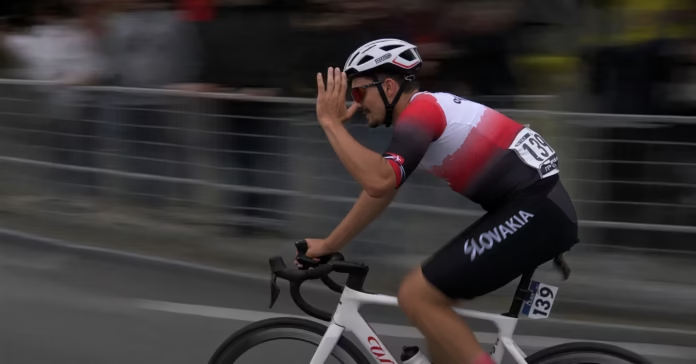
Slovakia produced one of the more unusual stories of the 2026 UCI Road World Championships when national-team masseur Vladimír Kováčik lined up in the elite men’s road race in Montréal.
The 28-year-old was not there because Slovakia believed a member of its support staff could suddenly compete with Remco Evenepoel, Mathieu van der Poel and the rest of the world’s best riders. Kováčik is a former racing cyclist, but had not competed seriously since 2017 and now works primarily as a masseur with the national team.
His appearance was instead a carefully calculated solution to a problem that could have affected Slovak cycling well beyond this World Championships.
Slovakia needed at least one eligible rider to start the elite men’s road race. With all of its conventional options unavailable and the replacement deadline already passed, Kováčik was the person already in Canada who could legally do it.
He duly took the start before withdrawing with 168km still remaining. By then, his job was effectively complete.
Slovakia lost all of its intended elite riders
Slovakia had qualified enough places to field a four-rider team in Montréal and had several riders capable of giving the country credible representation.
Lukáš Kubiš was the most obvious option after another strong season, while Martin Svrček and Matthias Schwarzbacher represented the younger generation coming through behind him.
None ultimately made it to the start.
Kubiš was not released for the World Championships by Unibet Rose Rockets because of his trade-team programme. Svrček and Schwarzbacher were both unavailable following physical problems, leaving Slovakia without any of its main elite options.
The timing made the situation significantly harder.
The registration deadline for the World Championships had already passed by the time the final withdrawals were confirmed. Slovakia could therefore not simply choose another rider at home and add them to the start list.
Using one of the country’s strongest under-23 riders was not an attractive solution either, because moving an eligible rider into the elite category could have cost them their opportunity to compete in their own age-group World Championships.
The federation was left looking at the people already travelling with the national team in Montréal.
That search led to Kováčik.
Who is Vladimír Kováčik?
Kováčik may now spend World Championships week treating riders rather than racing alongside them, but he does have a competitive cycling background.
He raced during his junior and under-23 years and appeared in events including junior Paris-Roubaix and the Slovak national championships. His last recorded competitive season came in 2017, when he finished 32nd in the Slovak national time trial championship.
That history became important nine years later.
Kováčik was already in Montréal as part of Slovakia’s support staff and still met the licensing requirements needed to enter the elite road race. With no normal replacement available, Slovakia suddenly had an eligible former rider standing inside its own team hotel.
National coach Jakub Vančo was clear that this was not an attempt to disguise Kováčik as a competitive selection. His participation was intended to be formal.
For Slovakia, simply getting an eligible rider onto the start line carried considerable value.
Why did Slovakia need somebody to start the World Championships?
The reason lies in the UCI points system and the status of national championships.
A country with representation in the elite World Championships road race can retain the higher points category for its national road championships the following season.
Without an elite starter in Montréal, Slovakia risked its 2027 national championships dropping from Category A to Category B.
That would substantially reduce the UCI points available to the leading riders.
The difference matters most for countries where riders do not have dozens of opportunities to collect large WorldTour points totals during the season. For Slovakia, national championship points form a meaningful part of the wider national ranking.
Vančo estimated that dropping category could cost Slovak riders hundreds of points across the championships.
Those points can affect future qualification and start allocations for the World Championships and European Championships, while 2027 will also form an important part of the qualification process towards the Los Angeles 2028 Olympic Games.
That turned what might otherwise have looked like an empty start place into something Slovakia considered worth protecting.
The federation did not need Kováčik to complete the World Championships. It needed him to satisfy the requirement of having a rider participate in the elite race.
Kováčik withdrew with 168km remaining
Once the race started, there was no pretence that Kováčik was going to try to survive an entire elite World Championship.
The Montréal course was demanding even for full-time professionals, with repeated climbing around Mount Royal following the opening section of the race.
Kováčik had not raced competitively for nine years.
He stayed in the race through the opening kilometres before eventually abandoning with 168km still to go.
That might look remarkable on a results sheet, but in the context of why he was there, it was almost irrelevant.
The important moment had already happened at the start.
Once Kováčik crossed the line with the peloton and Slovakia officially had representation in the elite men’s race, the federation had achieved the objective behind his selection.
There was little sporting value in asking a national-team masseur to continue riding deeper into a 2026 World Championships simply to delay the inevitable.
His World Championships therefore ended early, but exactly as Slovakia had expected.
 Photo Credit: Getty
It was not quite the same situation in the women’s race
Slovakia also faced a late problem in the elite women’s road race.
Nora Jenčušová had been expected to represent the country but ended her season prematurely because of injury and health problems.
There, Slovakia was able to find another eligible rider, with mountain biker Tereza Kurnická taking the start.
Kurnická herself has links to the national-team support structure, but unlike the situation in the men’s race, Slovakia at least had an active competitive cyclist available as a replacement.
The men’s problem was more extreme.
With Kubiš, Svrček and Schwarzbacher unavailable and no time left to nominate a conventional substitute, Kováčik became the only practical option already on site.
The situation was about protecting Slovakia’s next generation
The strange sight of a national-team masseur lining up at an elite World Championships makes more sense when viewed through Slovakia’s longer-term position.
Peter Sagan transformed the country’s profile in professional cycling during the previous decade, winning three consecutive elite road World Championships between 2015 and 2017.
Those years are now gone, but Slovakia has another promising generation emerging.
Kubiš has established himself as the country’s strongest current elite rider, Svrček continues to develop at WorldTour level and Schwarzbacher is another highly rated young prospect.
The strongest evidence of that future arrived earlier in the week when Viktória Chladoňová won the women’s U23 road race world title in Montréal.
Richard Riška also finished eighth in the men’s under-23 road race.
Those are exactly the sort of riders Slovakia wants to protect when future championship and Olympic places are being allocated.
Allowing the national championships to lose points value because nobody happened to be available for one elite race in Canada would have made that task unnecessarily harder.
A bizarre start with a very practical purpose
On the surface, Kováčik’s appearance looked like one of those World Championships curiosities that will be remembered long after the finer details of the race have been forgotten.
A national-team masseur, nine years removed from his last competitive season, lining up alongside the best riders in the world is unusual enough.
But Slovakia’s decision was not really about novelty.
It was an attempt to protect future UCI points, championship qualification and Olympic opportunities after a run of late withdrawals left the federation with almost no other option.
Kováčik did exactly what Slovakia required.
He put on the national jersey, took his place on the Montréal start line and gave Slovakia an elite men’s World Championships starter.
With 168km remaining, he climbed off.

By then, the most important part of his race had already been completed.

