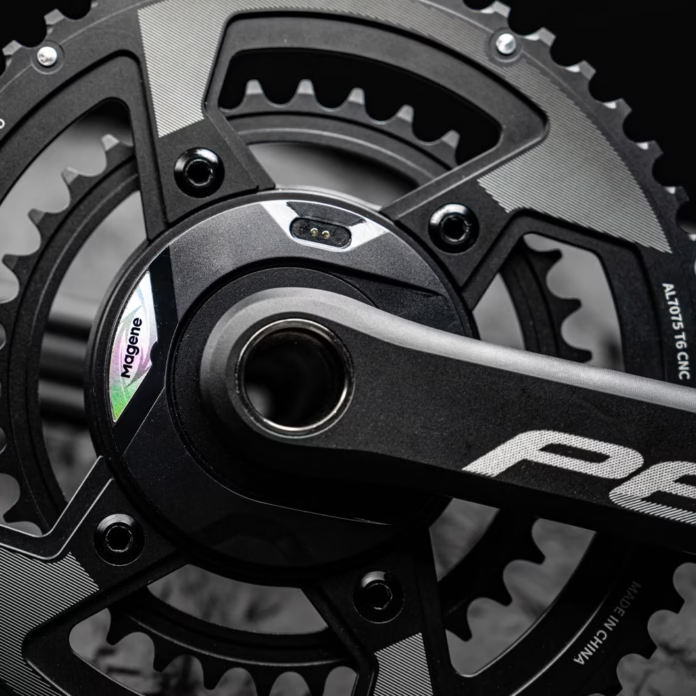
The Magene PES P515 has replaced the P505 as the alloy-crank power meter to consider in the company’s road range, and the update is substantial enough that recommending the older model no longer makes much sense. Accuracy improves from a claimed ±1.5% to ±1%, the spider is lighter, bottom-bracket compatibility is broader and battery life has increased markedly.
More importantly, the P515 now has useful independent testing behind it. GPLama spent two months testing both the PES alloy and TEO carbon versions against established reference power meters and found the P515 produced clean, consistent data across road, indoor and high-power efforts. That gives the current model a much stronger evidence base than the old P505 draft this article replaces.
This article contains affiliate links. ProCyclingUK may receive a commission from qualifying purchases. At the time of checking, Tredz had the PES P515 complete power-meter chainset for £349, with a £299 crank-and-spider option also listed.
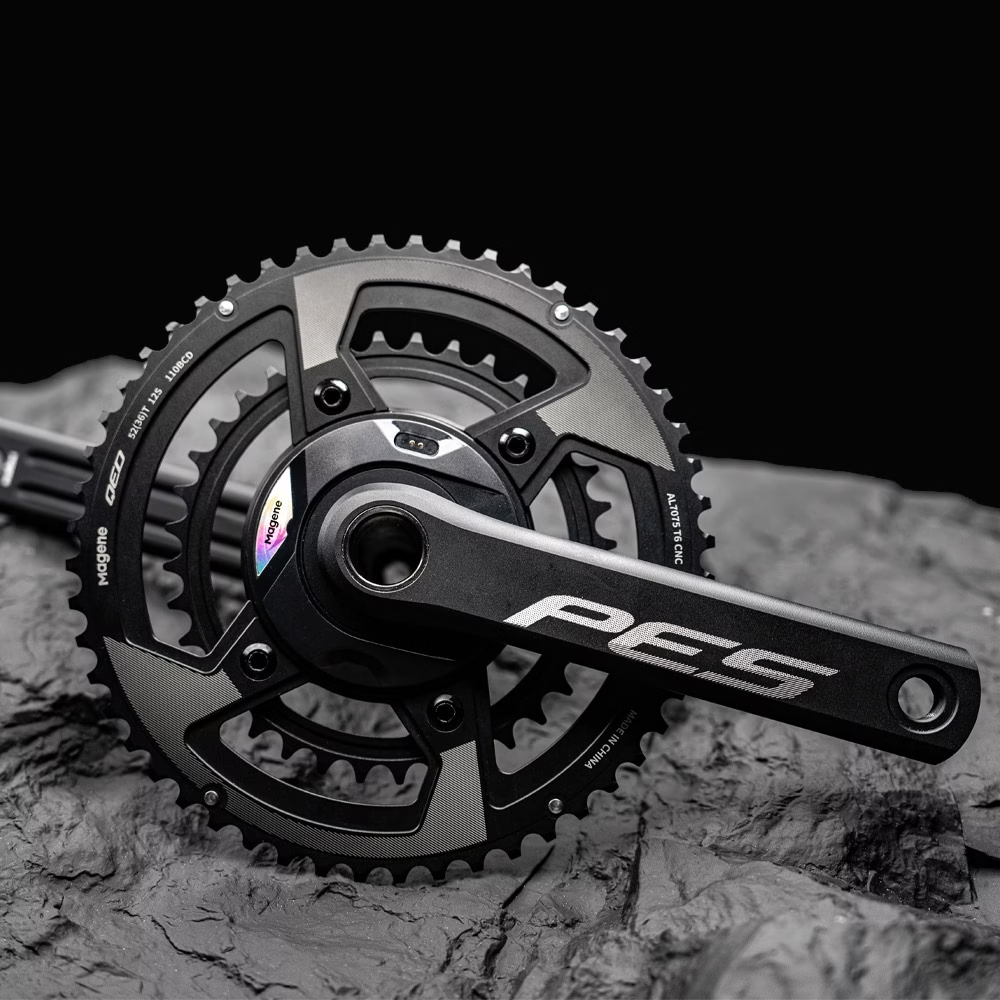
Magene PES P515 specifications
| Claimed accuracy | ±1% |
| Weight | 625g ±5g for 170mm crankset |
| Spider weight | 99g |
| Crank lengths | 165, 167.5, 170, 172.5 and 175mm |
| Spindle | 24mm steel |
| BCD | 110mm, four-bolt |
| Q-factor | 147mm |
| Power range | 0-2,500W |
| Connectivity | ANT+ and Bluetooth |
| Water resistance | IPX7 |
| Battery | Up to 380 hours claimed on current Magene specification |
The P515 fixes the important P505 limitations
Magene’s own comparison identifies the changes clearly. Claimed accuracy moves from ±1.5% on the P505 to ±1% on the P515, while the newer design adds compatibility for T47 and BB386 installations that caused problems for some P505 users. The complete 170mm PES system is also around 14g lighter.
Battery specifications have changed with firmware and documentation, with current Magene product pages quoting up to 380 hours. That is a large increase over the P505’s original 200-hour figure and means charging frequency is unlikely to be a meaningful concern for most riders. Charging remains magnetic rather than USB-C directly into the spider.
Independent testing gives the accuracy claim credibility
Accuracy is the only specification that really matters if a power meter cannot deliver repeatable data. GPLama’s 2026 testing is therefore important. Across the PES P515 and lighter TEO P515, comparisons against established reference meters showed close agreement during normal road riding, indoor sessions and harder efforts, without the obvious cadence instability or residual-torque problems that can undermine cheaper systems.
That does not mean every power meter will display exactly the same number. Measurement location, drivetrain losses and calibration can create small differences between a crank spider, pedals and an indoor trainer. The useful question is whether the P515 tracks changes consistently enough for structured training, and the independent evidence is reassuring.
For riders deciding between measurement formats, ProCyclingUK’s guide to power-meter pedals for training explains why a pedal system may still suit anyone who regularly moves a meter between bikes.
Spider measurement has advantages and limitations
The P515 measures at the spider, so it provides total power rather than genuinely independent left- and right-leg measurement. Magene reports left-right balance alongside cadence and pedalling smoothness, but riders needing separate measurement from each leg should look at a true dual-sided pedal system instead.
The upside is a tidy permanent installation and freedom to keep using a preferred pedal system. The 24mm spindle also makes the PES version straightforward for many Shimano-equipped road bikes, although frame, bottom bracket and chainring compatibility should still be checked before purchase.
Value is where the PES P515 becomes difficult to ignore
A £349 complete chainset at Tredz puts the P515 well below many premium dual-sided power-meter systems. The cheaper £299 crank-and-spider package is even more interesting for riders who already have compatible chainrings.
That price matters because the P515 is no longer asking buyers to accept obviously second-tier data in exchange for saving money. The combination of ±1% claimed accuracy and convincing independent comparative testing shifts the discussion towards compatibility, service and preferred measurement format rather than whether the numbers can be trusted at all.
PES P515 versus the TEO P515
Magene also offers the P515 spider with its TEO carbon crank. The TEO package is substantially lighter and aimed more directly at performance builds, but it costs considerably more. The PES alloy crank is the value option and arguably the more logical pairing with a power meter whose biggest attraction is affordability.
For most riders, spending the difference elsewhere on the bike will have more practical value than saving crank weight. The TEO makes sense where total bike weight and component finish matter; the PES is the straightforward training purchase.

Who should buy the Magene PES P515?
The P515 suits a rider who wants a permanent crank-based power meter and does not need to move it between several bikes. It is particularly attractive as a first power meter because the complete crankset price is close to what some brands charge for a single-sided solution.
Riders who swap bikes frequently may still be better served by power-meter pedals. Anyone who needs genuine independent left-right measurement should also understand the limitation of a spider-based system before buying.
Magene PES P515 verdict
The P515 is the product the old P505 was trying to become. Better claimed accuracy, lower weight, broader compatibility and much longer battery life address the obvious weaknesses of the previous generation, while recent independent testing gives its data quality a much firmer foundation.
At £349 for the chainset, the PES P515 is especially persuasive for Shimano road users who want to add reliable power measurement without moving to expensive pedals or a premium crankset. Its limitations are mostly those inherent to spider measurement rather than obvious failures of the product itself.
-
 Photo Credit: Canyon SRAM (supplied media release)
 -
 Photo Credit: Park Tool