A new flagship Garmin bike computer usually brings a familiar dilemma. The latest model promises enough features to make last year’s purchase feel old, yet the device already on your bars may be doing everything you actually need. The Edge 1060 makes that decision particularly interesting. It replaces the Edge 1050 barely two and a half years after the latter arrived, but keeps the same display size, resolution and headline battery life.
The biggest change is not another screen or a dramatic improvement in endurance. Garmin has added a microphone for voice commands, more physical buttons and a collection of routing and connectivity functions. The Edge 1060 is also smaller and lighter. That is a meaningful package for some riders, especially those navigating unfamiliar roads in gloves, but it does not make the 1050 suddenly inadequate.
This is a research-led comparison of Garmin’s official specifications, launch documentation and independent published analysis, not a claim that ProCyclingUK has conducted a side-by-side road test. Launch features may reach older devices through software updates; that distinction matters when deciding whether to buy new hardware.
 Photo Credit: Garmin
Garmin Edge 1060 vs 1050 specifications
| Specification | Garmin Edge 1060 | Garmin Edge 1050 |
|---|---|---|
| UK manufacturer price reference | £699.99 at Tredz (checked November 2026) | £549.99 at Sigma Sports (checked November 2026) |
| Display | 3.5-inch colour touchscreen | 3.5-inch colour touchscreen |
| Display resolution | 480 × 800 pixels | 480 × 800 pixels |
| Claimed weight | 142g | 161g |
| Dimensions | 58.5 × 107.0 × 16.3mm | 60.2 × 118.5 × 16.3mm |
| Demanding-use battery claim | Up to 20 hours | Up to 20 hours |
| Battery-saver claim | Up to 60 hours | Up to 60 hours |
| Internal storage | 64GB | 64GB |
| Built-in speaker | Yes | Yes |
| Microphone and voice commands | Yes | No |
| Physical buttons | Seven | Three |
| USB-C reverse charging | Yes, not intended while riding | No equivalent advertised feature |
| Water-resistance rating | IPX7 | IPX7 |
The checked UK listings put the Edge 1050 at £549.99 at Sigma Sports, reduced from £599.99, while Tredz listed the Edge 1060 at £699.99 and in stock. The difference is £150. These are direct retailer links, not tracked affiliate links. Check the checkout price and device-only package because retailer promotions and availability can change.
The screen and battery life are not an upgrade
For riders looking at the Edge every few seconds during an interval session or following a route through a busy junction, the screen is central to the experience. Both models use a 3.5-inch, 480 × 800 colour touchscreen. The Edge 1050 already brought the vivid display, responsive map interface and digital bike bell that distinguished it from older Garmin units. Garmin has not presented the 1060 as a larger or higher-resolution replacement.
Nor is there an endurance breakthrough. Garmin quotes 20 hours of battery life for demanding use and up to 60 hours in its battery-saver mode for both. Those figures depend on brightness, navigation, connected sensors and other settings. A real-world ride with a bright screen, power meter, radar, live tracking and frequent rerouting will not necessarily match the headline figure. Someone planning overnight audax rides should weigh actual endurance and access to charging more heavily than the new voice assistant.
The new model is 19g lighter and 11.5mm shorter. Those are welcome refinements on a compact road cockpit, but neither is likely to change a buying decision alone. One extra bar mount or a larger battery pack would dwarf that weight saving.
Voice control is the clearest reason to buy the 1060
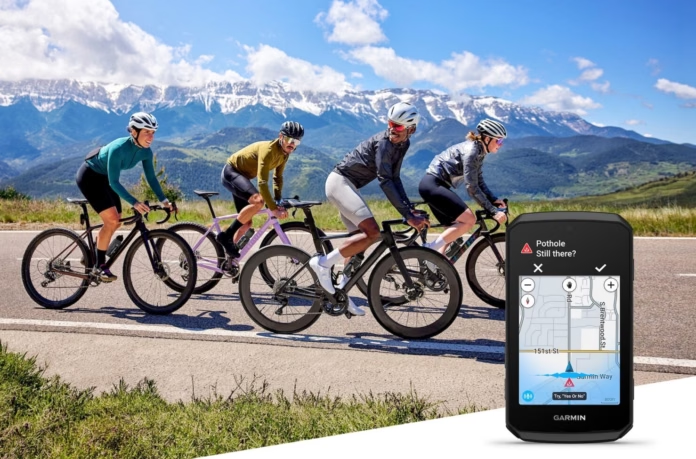
The Edge 1060 introduces a microphone and the ability to start commands with “Okay, Garmin”. Garmin says riders can ask for their heart rate or other training data, find a nearby point of interest, select a destination or report a pothole without opening a screen menu. A built-in speaker reads out responses. With a compatible smartphone and Garmin Messenger, the computer can also exchange voice messages.
That makes most sense on a long ride where the road surface is rough, the weather is poor or there is a reason to keep both hands in position. It could also be useful when somebody is pacing a hard interval and wants a quick data update without changing screens. The limitation is familiar from other voice systems: wind noise, traffic and different accents can affect recognition, and Garmin notes that language support varies. The launch specification is not proof that every instruction will work equally well on a wet road at 35km/h.
The Edge 1050 has a speaker and can provide audio prompts and a virtual bike bell. It does not have the 1060’s microphone, so software alone cannot add the same onboard voice-command feature. If hands-free interaction is the main attraction, this is a genuine hardware distinction rather than something the older computer could easily gain through an update.
 Photo Credit: Garmin
Extra buttons matter in a British winter
The original Edge 1050 is not buttonless. It combines its touchscreen with three physical controls, but many navigation and menu interactions depend on tapping the display. The Edge 1060 adds a seven-button arrangement. In thick gloves, on a wet descent or while the screen is dotted with rain, tactile inputs can be more dependable than trying to hit a small icon.
This is arguably a better reason for a winter rider to prefer the 1060 than the microphone. Physical controls offer direct feedback, do not need to interpret a spoken command and work when riding beside noisy traffic. The caveat is personal preference: a rider already comfortable with Garmin’s touchscreen interface may not find the extra buttons worth another £150.
Navigation adds options rather than reinventing mapping
Garmin’s new Route Options function compares journeys according to riding time, elevation and bike type. Route Previews are designed to show distance, estimated duration, traffic and reported hazards before a ride begins. Free Flow Routing looks for routes with fewer stops, junctions and interruptions, a potentially useful refinement for steady training rides where repeated traffic lights are a nuisance.
There are also road-closure warnings, enhancements to the Up Ahead points-of-interest display and easier access to hazards reported by other riders. Some functions need a compatible smartphone and Garmin Connect connection, and their usefulness depends on the local data available. A rural lane with no recent reports cannot be assumed to have perfect hazard coverage.
The Edge 1050 is hardly short of mapping tools. It already supports route creation on-device, cycling-specific maps, ClimbPro, surface information and GroupRide functions. It is also important not to treat every 1060 launch feature as permanently exclusive. Garmin has a history of expanding features through firmware releases, although the exact availability and timing of individual routing functions on the 1050 should be checked rather than promised.
Training features are more similar than different
The performance foundation is familiar across Garmin’s top-end Edge units. Power Guide, real-time stamina, course demands, ClimbPro, training status and compatibility with sensors are already part of the 1050’s appeal. Riders using a heart-rate strap, power meter and smart trainer are not starting again by choosing the older computer.
The Edge 1060 adds a more interactive workout screen, further GroupRide detection and a customisable home screen. Garmin also advertises TrainingPeaks workout synchronisation and recovery-linked coaching features with compatible watches or its CIRQA band. Those may streamline a structured training week, but are not, by themselves, evidence of more accurate power measurements or a better GPS track.
For somebody who uses a computer mainly to record club rides, follow a preloaded GPX file and glance at power, cadence and average speed, the 1050 remains comprehensively equipped. A rider juggling complicated workouts, multiple group rides and route changes will have more opportunities to benefit from the new interface.
Reverse charging is useful, with a significant limitation
The Edge 1060 can provide power through USB-C to another compatible device, including a phone or Varia light. That could rescue a depleted rear light before heading home or offer a modest emergency top-up to a phone. Garmin specifically states that reverse charging is not intended for use while riding. It should not be described as a rolling dynamo replacement or a way to charge a rear light continuously on the road.
Neither model becomes an endurance specialist merely because it can share power. Giving charge to another device draws down the computer’s own battery, so this feature is best treated as a contingency rather than a normal part of an all-day ride setup.
Is it worth upgrading from the 1050?
For an existing Edge 1050 owner, the answer is generally no unless hands-free control or the more extensive physical controls solve a specific problem. The bright screen, core navigation, training metrics and claimed endurance are already there. Selling a working 1050 at a discount just to buy an equally sized display and unchanged battery estimate is a costly way to gain a lighter casing.
There are exceptions. A rider who navigates unfamiliar routes several times a week, frequently changes destinations or finds the touchscreen awkward in winter gloves could value the extra interface options. Garmin’s new routing tools may also suit regular fast training rides, although the scope for firmware updates on the older model is a reason to confirm the current feature list before spending.
Which Garmin Edge should a new buyer choose?
At the checked UK price gap of roughly £150, the Edge 1050 is the more rational purchase for cyclists who want an excellent colour screen and Garmin’s advanced metrics but can manage without talking to their bike computer. It has already undergone independent road testing, and its strengths and limitations are well understood. The 1060 is a better fit for someone prioritising a new interface, a smaller body and voice-led navigation over the lowest purchase price.
For a new purchase, use the actual delivered price rather than Garmin’s launch pricing. Sigma Sports advertised the 1050 at £549.99 and Tredz listed the 1060 at £699.99 when checked. That is a meaningful premium for microphone, interface and routing refinements without a battery-life gain. If the price gap narrows, or you intend to use the voice features regularly, the newer device becomes easier to justify.
Our published Garmin Edge 1050 vs Wahoo ELEMNT ACE comparison covers a different decision: whether to stay in Garmin’s ecosystem at all. The Garmin Edge 550 review is also useful for riders who do not need a flagship-sized device. Garmin’s Edge 1060 announcement and Edge 1050 launch details provide manufacturer feature information. These are direct, non-affiliate links.